> the feeling is that there is a massive potential for chaos and that the iron grip of the government prevents that chaos from emerging
This is similar to how Russian government presents the situation in Russia, and lots of people getting the information from government channels tend to agree with that.
The difference is that China is moving ahead economically much faster than Russia today. As soon as advancement stops, subsequent talks about maintaining stability are met with slowly growing scepticism. Stability is only good when it a stable advancement or if the state of affairs is perceived as good (i.e., after recent raising out of abject poverty). As soon as stability is preserving the undeserving status quo, it's not as good.
This change of view may not necessarily happen soon after slowdown though.
>"[..] the situation in Russia, and lots of people getting the information from government channels [..]"
It's not only people getting the information from government.
I have spoken to Russians living in the European Union, that don't support the current Russian government, and there is an agreement that the current situation is better that the 90's , that they frequently describe like the "wild west".
This is, I think, one of the reasons of the popularity of Putin in Russia.
>>"[..] the situation in Russia, and lots of people getting the information from government channels [..]"
> It's not only people getting the information from government.
Getting the majority of information through government media is widely known as not necessary to having the populace think exactly how the government wants it to. In fact, an independent/private media can be more pro government than a government stated media, extremely well known paradox.
Look no further than the united states and make a very simple exercice: pick a random media of just any political stance, pick a random foreign policy or national security topic and count the number of times you dont see gospel of the state department.
>Look no further than the united states and make a very simple exercice: pick a random media of just any political stance, pick a random foreign policy or national security topic and count the number of times you dont see gospel of the state department.
That's simply not true. Take any international issue and look at the mainstream media and you will find lots of debate. To take just one example, in the run-up to the Iraq War, there were many well-known voices both for and against it.
I may be wrong, but I am guessing you know this perfectly well, and are trying to mislead people for some political or ideological motive.
> in the run-up to the Iraq War, there were many well-known voices both for and against it.
I'm certain you realize a 'media' and a 'well known voice' aren't exactly the same thing. The Iraq war is an excellent example and you are absolutely right that 'medias' were certainly proposing oped columns to those voices here and there. Those voices were sometimes occasions for a little bit of intelligence and sanity, other times unfortunately, in a way, just a way to make the idea of not being 100% pro war kind of dumb and unpatriotic. Sometimes debates were simply being made on alex jones level kind of conspiracy theories, such as the idea that Saddam Hussein has links to Al Qaeda (lol).
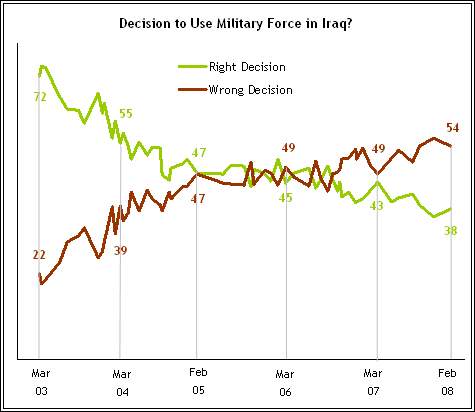
Anyhow, digressing a bit .. I'm talking about the media here, and my claim is that it is overwhelmingly unanimous on those category of issues, at large, and generally speaking aligned on the positions of the state department. US media coverage of Iraq war before the runup is actually a state of the art example of what I am claiming. If not, I would be curious to hear you explain the reason for this trend:
http://assets.pewresearch.org/wp-content/uploads/sites/12/ol...
> I may be wrong, but I am guessing you know this perfectly well, and are trying to mislead people for some political or ideological motive.
The second part of your sentence is not right or wrong, it's just inelegant, given you just allowed yourself to speculate on negative intentions of mine, to mislead people for political or ideological motives. I dont know if the idea here is to corner me into disproving a negative such as being a supporter of a particular president of the US? :)


This is similar to how Russian government presents the situation in Russia, and lots of people getting the information from government channels tend to agree with that.
The difference is that China is moving ahead economically much faster than Russia today. As soon as advancement stops, subsequent talks about maintaining stability are met with slowly growing scepticism. Stability is only good when it a stable advancement or if the state of affairs is perceived as good (i.e., after recent raising out of abject poverty). As soon as stability is preserving the undeserving status quo, it's not as good.
This change of view may not necessarily happen soon after slowdown though.