I bought it in paperback as well, and read and loved it immediately. I then gave it to a young programmer I met in Sapporo, who was (at the time) working with BeOS.
I have the text version (the proper one, I suppose!) on my laptop as I type.
I was with Simple from the start and generally liked the app and the customer support (based in Portland IIRC) was very helpful and friendly.
My problem was that I had a large check to deposit and before they cleared it they insist I not only specify the source of the funds but also what I was going to use the monies for! I understand they need to ask the former (per IRS regulations and "Suspicious Activity Reporting") but the latter is frankly NOTFB and no other bank has asked me that question. I told them as such and closed the account.
My iPhone 5s (still my favourite iPhone design) died a couple of years ago (well, the battery did) and since then I use an iPod touch for apps and a cheap (£30 IIRC) dual-SIM little Nokia for telephony. The latter keeps its charge for days and I don't worry about losing it.
I confess as a news junkie I enjoy twitter, youtube, podcasts and reddit etc on my iPod but as it is wifi-only of course there are built in constraints in its use. I also have taken to going out without iPod or phone after work hours... very liberating and almost revolutionary! Nice to have an untracked-feeling if nothing else.
Note that apart from privacy issues and technical problems (Puerto Rico blackout, anybody?) numerous studies indicate that people spend less money when using cash instead of credit cards. That's one reason for the big push by the banks, shops, restaurants, and media to "go cashless".
>Note that apart from privacy issues and technical problems (Puerto Rico blackout, anybody?) numerous studies indicate that people spend less money when using cash instead of credit cards.
This is one of the reasons why casinos use chips rather than actual currency.
>It's one of the reasons they use digital vouchers (scannable paper or loaded onto cards) instead of either, increasingly.
Only at slot machines. Table games are all chips.
When playing roulette, sometimes I'll see some drunk person throw a bunch of cash on the table and yell something like "Put it all on black!" It gets thrown right back at him until he gets chips from the cashier or has his money changed at the table at the appropriate time and in the customary fashion.
I'd argue that this is good for the economy. Economies are strong when money is changing hands a lot. If people hoard all their pennies, then money isn't changing hands, business isn't growing, and the economy stagnates.
Pointlessly spending more money than necessary probably isn't good for your health as an individual though, and arguably the push to get more people to spend more money more often isn't good for a society. It might be good for their economy, but economy ≠ society.
If you really just want to inflate the amount of money being spent, there's always room for more rent-seekers and debt collectors.
Also, it may be "good for the economy" if "good" is "more money being spent". But that's too valueless for my taste. A stupid utility function. If you by "economy" mean as a metric for other utility in the society, then, spending money on stupid stuff, is just akin to digging holes and then filling them again.
Only that, the holes are very elaborate. (Like perfumes or stupid shit like a metric crap ton of TVs nobody uses anyway because we are busy staring at a much smaller screen in our palm.)
The problem here, as with any economic ideas, is properly defining "stupid stuff". Value has to be defined on an individual basis. If someone gets more entertainment from digging holes and filling them with dirt than using their phone, then hole digging doesn't seem like such pointless endeavor. The hole digger will probably end up in better health than the phone user, too, so it's not like there endeavor is altogether pointless.
Taking options away (like cash) is a bad idea if you're optimizing society around individual autonomy. We should want as many options as possible.
I agree, though I think we have plenty of real problems left to solve still. We are not quite at Star Trek level economy, where hole digging might make even more sense.
On the other hand, back to talking about real people, the less you feel like you have a sufficient buffer to last until your next paycheck, the more stressed you are. If we psychologically manipulate people into spending more than they’re naturally comfortable with, we’re creating a society that’s worse off for the people in it.
> If we psychologically manipulate people into spending more than they’re naturally comfortable with, we’re creating a society that’s worse off for the people in it.
If the average person didn't spend too much money on things they don't need, we'd have very high unemployment. The people with jobs might feel better and less stressed but a huge number of people would be extremely stressed and despondent.
If psychological manipulation to the point of causing harm to people is necessary to make our system work, maybe it's a system that doesn't work. Anyway - advertising isn't along the same lines as literally making it more difficult for people to make the connection between spending money and, well, spending money.
I see your point, but I don't think we should be aiming at a solution of continuing to promote overconsumption. I think we should aim for a world where people are less manipulated into overconsumption, but everyone still has the means for a comfortable and happy life.
It may sound obvious when I put it that way, but it seems to me that many times the political or economic proposals I hear fundamentally disagree with this goal.
> Resources that are wasted on stuff that we don't need is directly taken from other better places that those resources could have been spent on.
The vast majority of people have skills and are employed in areas other than housing, food, transportation, healthcare, clothing, and education. What would they all do in a world where nobody bought massages or luxury vehicles or hair dye or designer clothes or airplanes or tasting menus?
Would you have all the artists and marketers retrain as farmers and green energy researchers? Would people really be happier in this hypothetical ultra-efficient future of such limited career choices?
I disagree. There's certainly short term benefit to this Keynesian view, but long term it leads to wild volatility, partly because people are only one pay check away from ruin. When only the wealthy have a store of money to draw on in harder times (job or income source loss, broken appliances/vehicles/etc), it further harms the poor. It's a regressive policy because it disproportionately harms the poor. It forces people into leveraging credit each time a moderate to large expense comes up. That's not a fun way to live.
People misinterprete it to this basterdized version a lot though.
The real Keynsian model is that we should spend more in bad times and LESS in good times to even out business cycles.
People always forget that second part...
It was NEVER about spending for the sake of spending or wasting money on things that we don't need to help the "economy".
People misinterpret it to the point where they believe the economy is some infinite motion machine, where you ad more motion and even more motion comes out.
I agree with everything you said. Have you considered that the Keynesian model might be a failure since it does not account for human nature? I don't believe a government will ever reliably cut spending in good times and spend more in bad times. I am starting to sound like socialists saying "it's never been properly implemented!" Well, maybe the core idea works on paper but ignores human nature, maybe it simply can't be implemented properly.
Interesting, I'll definitely look into this further. If you have any links I'd appreciate it, but no worries if you don't have them handy (I can google).
>I'd argue that this is good for the economy. Economies are strong when money is changing hands a lot.
That's an axiom, not a fact.
Or rather, it only becomes a fact when people want X and Y and Z out of the economy (e.g. constant growth) over other values (e.g. avoiding environmental externalities, non-shopping-related quality of life, stability, equality).
And I'd argue there that, to some degree, it's a matter of breadth of spending and not just depth. Money may or may not trickle down, but it certainly gushes upward. So as an obvious example a thousand people selling something for $10 a piece instead of 1 person selling something for $10,000 is obviously much more desirable. I'd speculate that tactics like this won't really increase the breadth of spend, but only the depth - so you simply accelerate the upward flow of income.
That could hypothetically be a good thing, invoking my inner Milton Friedman, if those on top then use that groundswell of 'free' money to then reinvest in their business and everybody moves upward. However in this case, as opposed to general supply side economics at large, you need to show that that subsequent trickle down is more beneficial than what was removed from those at the bottom. I think that's going to be improbable, especially as the merit of supply side economics itself becomes ever more debatable.
My last smartphone was an iPhone 5S (which IMO is the nicest of all iPhone designs). The battery eventually died... I still think about reviving it. In any case I then got a cheap (30 quid IIRC) dual-sim little Nokia which takes a French and a UK sim card (pay as you go) and quite cheap for regular calls. Works like a charm, the battery lasts for days, and I don't worry if I lose it.
Separately I have an iPod touch which gives me some control over smartphone addictive behaviour as it only has wifi. And it has the headphone jack :) I absolutely refuse to buy a device without one.
I used to joke with friends about "smartphone zombies" in the streets but now it is no longer a joke. It's genuinely scary to be on a train or subway and see everyone glued to their phone without looking up. Mothers and kids each staring at screens instead of interacting.
I was a big Steve Jobs fan when he was alive, but now wonder if the iPhone (and its competition) are destroying society the way automobiles destroyed much of the physical world.
The article mentioned how Brown rented out the Kip's Bay cinema in NY to try to get distribution. That is where I in fact saw it as a small boy with my sister and parents. I never surfed myself but relatives in California did and I always remembered the line about "the dirty Wedge" somewhere near LA. Fond memories... I'll have to see it again.
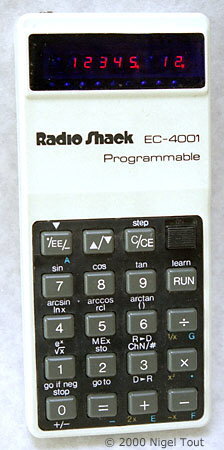
Strangely (I think) this doesn't mention the Sinclair calculators, one of which I purchased in the mid-Seventies and still have in a box somewhere. It was minimalist but gorgeous. I'd like to dig it out now and carry it around... would be v hipster.
If you like old calculator hacks, you might be interested to know that some early calculators (such as those from Wang[1]) could natively perform only addition, subtraction, e^x, and the natural log. So to multiply numbers, they took e^(ln(a) + ln(b)). See also: factor combining [2]
Ditto that. I listen to a variety of podcasts (politics, comedy, tech) and it is the same four or five adverts. Harry's probably most of all.
As for Blue Apron itself, I recently discovered the pleasures of cooking and for me it is almost a therapy (and I listen to podcasts while I cook, in fact :) but I have a bit more free time than many people. I could appreciate the convenience of the delivery and the recipes but as others have noted the amount of packaging waste is absurd. And once people start cooking they'll quickly realise how easy (and tasty) it can be.


I have the text version (the proper one, I suppose!) on my laptop as I type.