I love the Dell Ultrasharp series, interesting they went with Thunderbolt though I had issues with it not working when trying to use another dock with my Thinkpad.
I'd rather buy the USB-C one so I know it will work with the Steam Deck, etc.
Malaysia. It's not going to be cheap for long here though, they're really positioning themselves as a tech hub and I think they'll do well.
Utilities are particularly cheap here, I pay around £10 per month for water and electricity. Many working people live on around RM3000 or about £550 a month here.
I couldn't disagree more. Throughout history, higher productivity leads to a higher quality of life for everyone.
Yes, the transition can be painful and some people will lose out and face hard career changes.
But overall, the multiplicative power of investment only increases, helping to make everything cheaper, and everyone richer.
People focus too much on their own small part of experience - like Claude Code replacing CRUD developers. Without appreciating that the LLM revolution (and broader AI like AlphaFold) also includes PhD students that don't need to lose time programming tooling, interns that might have spent their time on tooling that can now use LLMs to learn faster and actually contribute to their fields, disadvantaged students that can learn more directly and in a personal way, without it being dependent on their physical location.
All of this means you get more experimentation, more ideas, and more successes.
You're wrong. Sharing the fruits of labor and greater social cohesion are what lead to greater quality of life. Greater productivity leads to increased wealth among the owning class, but historically that wealth only reached the masses after hard, usually physically violent, conflict between the haves and havenots.
IMO the issue is not propaganda at all, but real physical problems that are not being addressed.
Western governments have been mostly incapable of building housing and infrastructure. We have a severe housing shortage, barely improved public transport since the 80s, a lack of energy production (in Europe), lack of reservoirs, an aging population and increased international competition, etc.
And this all creates a huge pressure for ordinary people, just housing alone has a huge impact now - stunting the formation of families, and effectively taxing productive people to fund those who were lucky enough to buy the assets in the past.
This is one thing that I don't understand, take for example Germany, the population barely grew over the last 20 years [1], at the same time there has been a building boom that building costs have risen dramatically (more than doubled between 2010 and 2024). Compare that to the 60s and 70s where population was rising much faster in combination with the rebuilding effort. So is the growth of housing stock lower than the population growth? If yes how come that this was not the case when population growth was significantly faster (even 30 years ago). I don't recall there being more building going on when I was young than now, in fact if anything my impression is it's the other way around.
This apparent conundrum breaks away if you consider who holds the wealth now vs. in the 60s. In the 60s-70s, there was a wealth tax in Germany. Shortly after WW2, a law was drafted to redistribute wealth: All individuals and companies whose assets remained largely intact were required to pay 50% of their net wealth (as assessed on the day of the 1948 currency reform).
This means that the working class had immense wealth and so simple jobs could support a family on a single income, buy a house, etc.
Compare that to today — the two richest families in Germany hold more wealth than the bottom 50% COMBINED.
It is no wonder that normal families cannot afford to buy property anymore; and are forced to rent. This further exacerbates the wealth gap.
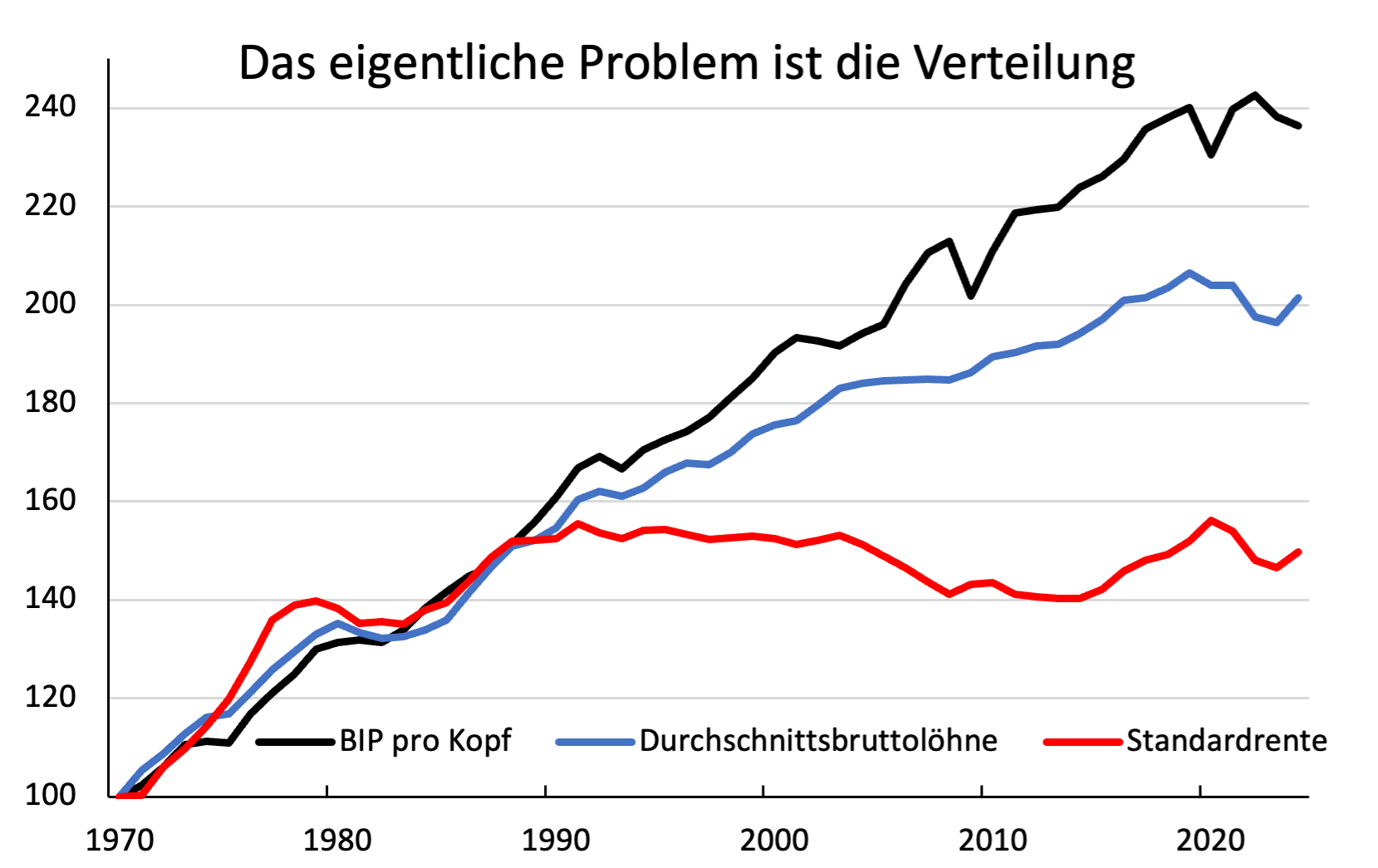
(Black line - GDP, blue line - avg comp; red line - avg pension)
In short - the productivity increased; but ordinary people are being squeezed out of the gains regardless. No wonder that everyone turns sour at some point.
1) the 50% net wealth tax vis-a-vis 1948 currency reform?
2) which 2 richest families in Germany hold more wealth than the bottom 50% combined?
3) most wealth distribution plots I have seen show a significant negative start (people in debt) then a large number of people with effectively 0 net wealth (what is earned is spent) and then a rise towards the haves. From such plots for different nations I am not surprised that the lower 2 digit percentages effectively have net 0 (with those in debt balancing those having a mediocre surplus), so it would seem trivial for this factoid to be true in many nations (with a slight change of the 50% number or a slight change of the exact number of richest families)
The perspective you give is certainly remarkable in the sense that the Nazi rise was basically a counterreaction to the rising popularity of communist ideas, with the end result... a redistribution of wealth after all, not even a holocaust could stop the wealth redistribution.
> So is the growth of housing stock lower than the population growth?
National averages can hide a lot of local issues. I'm in Berlin right now, I'm told by locals that it's lost the reputation it used to have for "cheap" housing. (It's not cheap, but I'll have to take their word for it that it ever was, I've not found historical purchase prices vs. income graphs like I've seen in the UK).
New places are more expensive for various reasons. The land in Berlin can easily be as expensive as the cost of building a home on that land, because fixed supply and a lot of demand. Even if the land was free, the cheapest new build cost I've seen is more than twice the price of the more expensive of those two, but will almost certainly also make up for the full price difference (including land at Berlin prices) just in reduced energy bills before the mortgage is paid off.
I suspect part of it is that the housing being built now is both bigger and better than that built in the 60s and 70s. Think of what cars were like then versus now. The other might be the availability of land. Another factor is how housing has changed from being more of a commodity item back then (its a place to live) to an investment vehicle (its a thing you own and make return from). These trends are not specific to Germany, but would apply to many developed countries worldwide.
Excellent question, what happened is there are less people in a household than there used to be and households consume more m2 per household member. In reply to your second point, percentagewise there has been less building, in absolute terms there is more because of population growth since the 60s. This translates to ‘seeing more building projects’.
IMHO the key problems is new building is not targeted to the affordable market and easier to build areas with access to jobs of good economic income are not really open any longer. The established land markets are more expensive because literal "green field" expansion of new cities is not very common, and no longer available in quantity. The cost to build are further increased because the higher end market demands more amenities and developers almost always target the highest market available.
Note: I have a personal theory that one way China was able to perform at this it's current stage of growth, was because it was expanding a lot of first generation real estate development to new areas. It will be very interesting to see if they are able to maintain low housing costs going forward into the next couple decades.
There are dubious claims that the lower end market will be served by aged-out high end market housing and that's simply not the case. It ignores that housing stock ages out of usability - and remodeling is often more expensive to work on than the initial builds. Once you remodel them, they occupied at the high end, then they never free up or go down in rent for other portions of the market.
Not German so I can only talk about how it is going in another country:
- Massive change in the average household size: way fewer people live together now (delayed couple & family formation, divorce, etc.). If you go from 4 people per household to 2 people per household, now you need twice as many homes.
- Massive internal migration: declining population in a lot of rural areas and increasing in cities & their suburbs. So lot of empty houses and super cheap houses in Dumbfuck, Nowhere but scarce & expensive homes where people want to live.
There is also the problem of housing "lost" to the lifestyles of the well-to-do - whether that's 1%'ers who own multiple houses, or regular housing which becomes short-term rentals (Airbnb or whatever). In places, those are major problems. Overall - the biggest problem those cause might be that they're socially divisive distractions from bigger issues.
I will agree but rephrase, they were not incapable limiting supply of housing or chinese imports or international information channels is the model. Artificial barriers, ethical redefinitions, rag pulling, tollboothing have been the way to divide and conquer to channel the decaying international and domestic market share to political affiliates. Most political , maga, lgbt, policing, race etc issues are highlighted and disproportionately promoted to noise out discourse about money. If money and safety is considered as a key factor of historical actions and current events, then countries grievances are eastbti explain. When I hear for the other side the media to claim “they went crazy”, “they are barbarian subhumans” I know I am being manipulated.
Propaganda always builds on real greviences that the electorate has.
It's good that you bring up housing. There are, to my knowledge no political parties that have made housing their top agenda item. They only use housing as a talking point to serve their message. For example the extreme right will just say, immigrants are occupying all the housing supply. The extreme left will say it's just capitalism that is to blame.
The problem with the housing issue is that real solutions to it are extremely unpopular, even amount people who agree with the scale and intensity of the problem.
The regular voting public doesn't even agree that there's a connection between increasing the supply of housing and housing becoming more affordable.
Their position is, roughly, "there's plenty of housing already - it just needs to be more affordable for regular people". Sometimes this even manifests in support for self-defeating demand subsidies like help-to-buy schemes for new homeowners
This is a position that can never be satisfied because it is fundamentally disconnected from reality. It is equivalent to the meme of the dog with the stick in its mouth who wants you to throw the stick for them, but not take the stick from them.
So many people have much of their capital in housing which makes it extremely unpopular to try to lower the prices, so neither side is going to make this their top priority.
> IMO the issue is not propaganda at all, but real physical problems that are not being addressed.
I can't speak for other countries, but in the US, a big reason the real problems aren't being addressed is because of propaganda.
To my mind, the biggest problem is ultimately wealth/power consolidation in the hands of a shrinking group, resulting from massive consolidation of markets, repeatedly eliminating taxes on the most wealthy, and legalized bribery finally cemented in the Citizens United ruling.
As a regular worker, you have limited job mobility because there are fewer businesses within any market you may specialize in, those remaining players in the market often act as cartels, and emboldened shareholders demand layoffs on the regular. It feels like you're drowning in costs because housing has long outpaced inflation while your typical yearly raise rarely meets or exceeds it.
You can turn to your representatives for some relief, but voting Republican is guaranteed to make the problem worse (and they aren't shy about telling you they'll screw you over for the benefit of the wealthy), while voting Democrat doesn't actually make things better because they're controlled by the same special interests and merely present the illusion of an alternative.
The consolidated media, owned almost entirely by wealthy individuals with explicit mandates to support right-wing messages (e.g., Fox News, Newsmax, OAN, Sinclair Broadcasting group, and now Paramount Skydance) and constantly tell you that all your problems are really the fault of immigrants and other minorities - hence how we ended up with ICE-occupied cities, while simultaneously only making the problem worse with tariffs, which both increased prices and led to a slump in job creation.
In much of the west we don't really have markets in any useful sense. Overregulation and financialization ruin markets, and we've allowed both to creep into effectively every market that matters.
I didn't realize there was a cut and dry "correct" answer. Has it occurred to you that perhaps you are subject to similar biases as other people without being aware of it?
> I didn't realize there was a cut and dry "correct" answer.
There is cut and dry response to this economic one tho. If you look at the economic performance of past presidents, there is very clear pattern of who simultaneously makes debt higher and economy worst. There is also nothing in Trumps past performance that would suggest he would make economy better. And in fact, he is making it worst.
Sometimes things are cut and dry. Economic anxiety is just an excuse we use, so that we can idealize conservative people. If you read what they write and say, it is very clear it is not the economy that makes them vote how they vote.
Business owners turn fascist over economic anxiety. Hitler's funders were afraid they would be irrelevant in an international context.
The people have real grievances but tend to follow any *hole who has been the visible problem all along but can say the problem is that they were blocked from creating the ultimate vision of a perfect **hole.
I don't know the answer to representational democracy but I think there is something in systems like the Scandinavian judiciary where the jury is professional and competent.
A place like the US is a failure because there is a fear of setting any professional requirements on political positions. This is not irrational because the US has not dealt with its history of Jim Crow laws such that it will never happen again. The US is actually organized to make sure it happens again.
Business owners turn fascist over economic anxiety.
The grandparent said billionaires though. Some of them may have economic anxiety (not being in the government's graces might damage your company), but it seems most see a possibility of operating in an environment where they are not constrained by 'pesky' rules. E.g. leveraging Trump's wrath to pressure the EU into dropping laws like the DMA/DSA that protects citizens against the power of large tech companies.
The more extreme billionaire types see the world as a zero sum game. If they lose a third of their paper wealth, they are still billionaires. The more extreme ones want to gut the middle class, because political power is the only threat to their existence. They see a path where they become merchant princes, and another where they are stood up against the wall and meet their fate.
German and Italian fascism took a similar path. In Italy the state even took over some industry, but the big industrialists with power did great. It didn’t end well for them, but their pal Franco was smarter and hung in there for decades.
That doesn't really make sense. The population in most of the west is vaguely around replacement. A given individual can only make use of so much housing at once. Sure if you're rolling in cash throw in a vacation home or two. There's a pretty quick falloff in terms of utility, status, desire, any metric that's coming to mind as I type this.
It seems to me that at least in the US the issue is location. There's cheap stock in places without jobs and ridiculously expensive stock where the good jobs are located. It doesn't have to be this way.
Millennia before Adam Smith was born, pretty much every human societies which built "houses" (be they crude tents, igloos, lean-tos, thatched huts, or whatever) made a point of building enough of those to house all their members.
Capitalism has financialized housing, and that seems to be a major cause of the "can't actually build housing" problem.
In general, in pre-industrial societies families built their own houses rather than "society" building them for them. Of course this was because 1) many tribal societies had no concept of land ownership so you could just build wherever someone else wasn't using, and often these were temporary for a season or two anyway 2) later feudal societies where there was land ownership had land mostly owned by a nobleman who allowed his serfs to build their cottages on his land.
This is happening in Barcelona now due to the rent controls - where they strip everything out to provide the absolute bare minimum since demand far exceeds supply but the prices are capped.
Well of course. As rent control continues the failure is more obvious every year, so they try to socialism harder and mandate more things. As an owner you either convert to condo (if you can) and sell it, find some loophole, or just hold on as long as you can until they remove the rent control
Using government monopoly to solve private monopoly has to be the goofiest idea we continually try. It's right up there with unions. You can't negotiate successfully against corruption. If the system has no competition than corruption almost always creeps in.
Granted, it quickly solves some of the problem, but to act as if it is a sustainable solution is maddening.
Lawsuits. Civil remedies include breakup of the company.
I was never sure why the ownership class preferred one large investment over many smaller or even medium sized ones. Apparently diversification is only good for /my/ portfolio.
The reality is, the current government security state prefers this arrangement, as it vastly simplifies their strategies for mass data collection and abuse. There used to be 30 cellular companies. There were so many they felt entitled to tell the government off when they overreached. Widely seen as a problem by law enforcement the message was received and enforcement of anti trust laws in certain sectors ceased.
This is a nice effort at gatekeeping, but which would you prefer, historical examples such as Union Pacific, ADM, or AT&T, or more modern examples such as Apple and Visa?
Is there any reason you want to isolate it to one thing? Does that benefit the discussion in any way? Were you trying to project that you don't believe anything such as a modern monopoly can be said to exist?
Monopoly comes in many forms, and only the most limited version of the argument puts it at "100% market control," whereas, if you read the many good laws that were passed in the wake of consumer and market harms, you'll see there are four specific elements, any of which, are not only a criminal act but are widely considered "monopolistic behavior."


reply