Having lost a job suddenly, any employment is better than none. A perfect job that provides everything you need is pretty far detached from "this is sufficient", or even "this will slow my fall while I work something else out", and this kind of bitter resentment towards anything less than a job that pays out an idyllic American existence is what causes them to be priced out by legislative fiat like the minimum wage.
More to the point, not every skill level or job is _worth_ that kind of compensation (as uncomfortable as it might be to entertain), and attempts to circumvent market forces by making lower wages illegal at some arbitrary point have substantially more damaging externalities than 'low wages' -- which are as much a system of slavery as gravity or magnetism, and just as resilient to ideation.
> More to the point, not every skill level or job is _worth_ that kind of compensation ...
This is a fair stance to take, but you need to accept the consequences of the stance when people get desperate.
> attempts to circumvent market forces by making lower wages illegal at some arbitrary point have substantially more damaging externalities than 'low wages'
A population of people who can not feed themselves are going to kill you on the street for the canned tuna you might have in your bag.
> Having lost a job suddenly, any employment is better than none.
While this is true for you it is not true for the society as a whole.
This entire comment seems be written with a complete disrespect for macro dynamics and taken right out of a hunter gather society.
It completely ignores everything modern governance - and it is quite frightening.
In catastrophic circumstances perhaps, but the metric for actual starvation in the US is so low that finding a solid figure is difficult. Malnutrition, while higher, seems strongly correlated to child/elder abuse/neglect, and not homelessness. Street muggings for nourishment by a starving underclass is a fantastical and disingenuous narrative. And, surely, you see the dissonance in suggesting that poverty leads to crime, while also suggesting criminalizing low-wage labor?
> While this is true for you it is not true for the society as a whole...
Why isn't it? What about using the legal, practical market means at your disposal is exclusive to some privileged section of society, and why does it include me and nobody else in hard times?
Your 'rebuttal' is just a broad, dismissive gesture to theory and platitudinous insults.
I agree everything people might want done isn't worth the cost of having a human do it. But I don't see why such jobs should exist. I also don't think the base level of welfare needs to "idyllic," but enough for everyone to act as good citizens without being trapped in cursed doom cycles of impoverishment.
In general, though, it wouldn't matter what the minimum wage is if everyone had a sufficient level of general welfare without working...
Which goes to show that rather than minimum wage we ought to have a welbeing floor, perhaps with UBI, perhaps based on keeping key costs, like food, housing, healthcare, and education minimal.
Are chemical irritants preferable, then? Or just LEOs in riot gear with rubber batons? There's no amount of pushback or repercussion that a rioter will feel is fair or humane, and the mindset of "I'll turn violent and/or destructive if my participation in civil unrest is punished" is a perfect justification for these systems to exist.
Absolutely. You can heal from those. LRADs are maiming weapons designed to cause permanent damage. Under any reasonable legal system their use would be considered a war crime.
LRADs are not designed to cause permanent damage. They are explicitly designed under the intention of being a way to disperse a crowd without long term harm.
There hasn’t been much research on long term health impacts, but it’s not a tool to maim people.
I don’t think you need to be a rocket scientist to realize loud noise = hearing loss.
Just intuitively, I know many people with degraded hearing from concerts. And that hearing is gone, that’s how hearing loss works.
I think the people who designed these weapons aren’t anywhere close to stupid enough to think these won’t cause long term damage. Which means that the only explanation is they INTEND for them to cause long term damage.
Check out the link I posted. It’s from a physicians group focused on human rights.
> I don’t think you need to be a rocket scientist to realize loud noise = hearing loss.
Being a doctor and understanding that the levels people are exposed are not maiming if the thing is used “by design” should carry some significant weight in how you think about this.
They are designed to produce sound pressure levels that cause permanent hearing damage from short exposure, which makes them maiming weapons. There is no safe way to use an LRAD. Anybody who uses an LRAD is evil. Stop making excuses for despicable behavior. Deliberately causing hearing damage is no better than smashing people's fingers with hammers.
Risk of instantaneous noise-induced hearing loss: 120dB(SPL)
A sonic weapon must cause pain to be effective. Any sound that reliably causes pain is capable of causing instant hearing damage. Therefore any sonic weapon is necessarily a maiming weapon and is designed as such. There is no hyperbole.
As LRADs are less ethical than CS gas, the true design intent is likely to produce something that looks insignificant on video recordings so it can be used as extrajudicial punishment of undesirables with less risk of public outcry.
this. and let's not forget that these....officers always receive the best, most top notch training to use these things safely. (/s)
yet another reason to ensure footage looks like 'nothing terrible happened to these people' as expertly trained cop uses a weapon of war against civilians.
> There's no amount of pushback or repercussion that a rioter will feel is fair or humane
I mean you're talking about using violence against people to stop or prevent property damage. Most options are off the table in the moment, in the same way you can't execute someone if you catch them vandalizing your car. Smashing their fingers with a hammer wouldn't probably kill them but you can't do that either.
After-the-fact repercussions like criminal charges or civil liabilities, well, it doesn't matter how they feel about it? That's not how court works.
This reads like you suppose the only thing to do is let rioters vent their outrage against whatever objects happen to be in their way at the time, and hope that there exists some legal comeuppance after the fact.
Why can't some reasonable degree of force be used to prevent property damage? What moral dilemma exists that makes protecting property deserve a comparison to executing someone?
> Why can't some reasonable degree of force be used to prevent property damage?
It can, of course. If a police officer sees an individual engaging in property damage, that officer may walk over to that person and arrest them. If that person resists arrest, the officer can use appropriate force.
If you're talking about using force against innocent individuals who happen to be nearby, of course that is both outrageous and out of the question.
> Why can't some reasonable degree of force be used
No one said that. It was suggested that physically injuring someone in direct retaliation for property damage wasn't appropriate. Add to that the fact that riot control measures are hardly targeted.
There are many non-violent options available. Sometimes rioters will escalate violently against the officers carrying those out. It's far less likely anyone objects to proportionate and necessary use of force in such cases.
If threat of injury is what stops someone from destroying your car, then it's appropriately leveraged.
I'm also curious, what kind of effective, 'non-violent' means are there to control the initial mob-martyrs, and ensure level-handed justice is served? Those looking to escalate will use any police activity against them or their group as justification to do so.
Your disagreement essentially amounts to "it's appropriate because it accomplishes my goal", or do I misunderstand? In a discussion of ethics that seems specious to me.
> Those looking to escalate will use any police activity against them or their group as justification to do so.
As I previously pointed out, once rioters escalate against the officers themselves most people are unlikely to raise objections to targeted use of force. That's quite different than a paramilitary force lashing out violently at anyone perceived to be up to no good.
Also important to note, most of the riots I have seen don’t start with the protesters escalating. It depends on the country, but based off of what I have seen, it is almost always the authority who escalates. Often, there is preemptive and disproportionate riot control.
> Your disagreement essentially amounts to "it's appropriate because it accomplishes my goal", or do I misunderstand? In a discussion of ethics that seems specious to me.
My disagreement is that the ongoing or imminent unlawful destruction of property should be allowed to be met with _appropriate_ deterring force, whether by law enforcement or by the property owners. I argue that because in a system of individual rights that include property ownership, the position that an impassioned crowd has more right to that property than the owner (by damaging or destroying it in this case) is morally indefensible.
> once rioters escalate against the officers themselves most people are unlikely to raise objections to targeted use of force.
That is untrue for at least the last decade or so. After the 2015 Baltimore riots, President Obama couldn't even popularly get away with referring to rioters as "thugs"[1] after ~300 businesses were damaged, 60 buildings set on fire, 113 police officers injured and 27 drugstores looted. Since then, there have been plentiful riots and mass demonstrations that either turned violent or otherwise sheltered violent activity, including the moment in 2020 that spawned the "mostly peaceful protests" meme of the reporter with a building burning down behind him because of the rose-tinted glasses public analysts used in their coverage. Mayors and governors gave lip service to violent demonstrations like CHAZ/CHOP [2] while violence was taking place, and only tepidly supported law enforcement's presence to curtail it after the fact.
_To this day_ those actions are routinely and popularly dismissed as racial outrage, justified, etc. largely along political boundaries, all to the detriment of the thousands of individuals whose livelihoods were damaged or destroyed as result. The idea that good consciences will win the day and protestors will distance themselves from n'er-do-wells among them is, as a standard, irreconcilable with the countless recorded hours of protest footage that exist.
Rights aren't trumped by implicit public vote to destroy your property, any more than two thieves can vote that they need their victim's wallet more than them, or a gang of rapists can hold a 5-1 vote for consent. QED, immediate and active threats against property should, morally and legally, warrant an appropriate amount of force to defend it.
> the position that an impassioned crowd has more right to that property than the owner
That is a blatant straw man. The original position is more or less that nonviolent enforcement action must precede use of force. You are arguing to start off with violence, and even to apply that to perceived precrime ("ongoing or imminent" in your words).
To be fair regarding your wording, depending on your definition of "imminent" and the crime in question I might be able to agree. But that doesn't appear to be the case here.
To the rest of your comment, you seem very politicized. Most of what you wrote is non sequitur to the point that it doesn't seem feasible or worthwhile to respond. An outraged minority on social media is not the "most people" I was referring to (indeed they are a clear minority). The mainstream media exhibiting an agenda about a particular event has approximately nothing to do with the general principles we were supposedly discussing here.
Why should your interest in asserting property rights be permitted to trump human rights and due process?
Tu quoque; Republicans harboring fringe beliefs in some cases isn't a response to Democrats' mainstream acceptance of beliefs that the scientific method doesn't accurately reflect reality.
I think it is fair to say that through the nomination process, whoever is voted to run as the Republican nominee for president is considered to be the best representative for the party. Looking at the president-elect and all of the leaders of the party, saying they have "fringe beliefs in some cases" is severely downplaying it.
> I think it is fair to say that through the nomination process, whoever is voted to run as the Republican nominee for president is considered to be the best representative for the party.
It is not fair to say that at all. The primary system is highly undemocratic, and what’s more, the people who participate in it aren’t statistically representative of Republican voters as a whole.
Even if you are voting against someone, the person who you voting for is the person you find the most palatable of the options presented. I also don't think you can look at the de-facto leader of the party and say "in some cases" as if the president isn't a big case.
That's a naive way to see it. People vote _against_ the other candidate, against what they fear is worse. And, if the theory that the frontrunner is the best representation of the party holds true, it speaks quite poorly for the Democrats appointing Harris despite Biden winning the vote of his party, no?
And, again, tu quoque; even if the GOP was exhaustively comprised of reality-evading lunatics, voters and all, it wouldn't excuse stooping to their level -- the DNC's _explicit_ support of racial identitarianism, benevolent racism, and biological denialism run in direct opposition to this supposed moral high ground they tacitly hold.
> it speaks quite poorly for the Democrats appointing Harris despite Biden winning the vote of his party, no?
Yes it does. I agree fully.
> the DNC's _explicit_ support of racial identitarianism, benevolent racism, and biological denialism run in direct opposition to this supposed moral high ground they tacitly hold.
I don't think benevolent racism means what you think it means and no one is denying biology. Trans people aren't even denying biology. I would suggest you actually speak to a few trans people in real life.
I am definitely not the person to write a dissertation in support of trans people but the logic being used as I understand it is that male and female are not the same as man and woman. Whether I or anyone else agree with that is up in the air.
Just sticking with actual science here; how do you define "adult human male", how do you define "adult human female" .. and what do you label humans that don't meet either of your definitions?
I'm assuming you have a checklist of physical characteristics and genetic attributes in mind, sticking purely with that which can be measured, tested and observed and steering clear of fuzzy concepts.
Males are females are biological sex labels. It's how our bodies develop so we can reproduce. Even if our bodies don't develop properly or if we have developmental sex disorders we are all either male or female.
If you lookup biological adult, it's just someone who has completeled their reproductive development.
> Even if our bodies don't develop properly or if we have developmental sex disorders we are all either male or female.
That's not what the actual developmental science says though.
The strong all humans are either male OR female by { unprovided definition } is simply incorrect.
> If you lookup biological adult, it's just someone who has completeled their reproductive development.
Sure. Some are born and develop into biological adult males. Others are born and develop into biological adult females. And others yet again are born and grow into adults who are neither one nor the other.
Look it up .. start with "intersex".
See your own first link, for example, it's really sloppy, and yet:
Although all cells have a sex, designated by the presence and dosage of X or Y chromosomes, which in most cases will be XX (female) or XY (male),
* all cells will have a sex (okay ...)
* most will be XX (female) OR XY (male) (... okay)
* ... crickets ...
Nothing said about those cells that are neither male nor female.
All that aside, you have dodged the question.
What definition do you have for male, for female, and what do you designate the remainder?
Are you even aware that people are born who are neither male nor female by any of the generally accepted physical and genetic attributes?
The comment this subthread branched from was discussing the differences in athletic ability.
From the intersection of developmental biology and sports science research we know how male physical advantage in competition arises, and which set of known "intersex" (DSD) conditions confer this. For example, 5-alpha reductase 2 deficiency does. Swyer syndrome does not.
I was curious about the self referential circular definitions and enquired of a specific person what their understanding of development biology was.
Thankyou for your response, it might be better directed toward the person who apparently hasn't yet realised that such a thing as intersex categories and conditions even exist.
I responded to your comment because it was the most recent in the thread, but I agree that it would have perhaps made more sense as a reply to the other commenter.
Anyhow the broader point I think is worth making is that there is often a more context-specific approach, of which eligibility criteria for competitive sporting events is one example.
> What definition do you have for male, for female, and what do you designate the remainder?
I didn't dodge the question, you just don't like my answer
Here are the English definitions.
Male: of or denoting the sex that produces small, typically motile gametes, especially spermatozoa, with which a female may be fertilized or inseminated to produce offspring.
Female:of or denoting the sex that can bear offspring or produce eggs, distinguished biologically by the production of gametes (ova) that can be fertilized by male gametes.
"a herd of female deer"
Now I know what you are going to say, what if they cannot create gametes? That doesn't change anything because even if your reproductive organs don't develop properly nor function properly it doesn't make you neither male nor female.
You still have many other characteristics that needed to be addressed. This is why we have Sex as a Biological Variable.
> Are you even aware that people are born who are neither male nor female by any of the generally accepted physical and genetic attributes?
That's not really true, people are either male or female but didn't develop properly. Doesn't mean that they are neither nor, people with DSDs are documented. I know there are groups trying to push away from the concept of DSDs but there is not a consensus. People have all sorts of development disorders, this is just one kind.
Now even if there were people who were of no sex, it doesn't mean we start changing sex labels for fully developed people because we now consider it a social construct. The people who follow Gender Theory like to use people with DSDs to push the idea that fully developed people can change their sex and they can't.
"if the term intersex is to retain any meaning, the term should be restricted to those conditions in which chromosomal sex is inconsistent with phenotypic sex, or in which the phenotype is not classifiable as either male or female"
Why “Intersex” Conditions Do Not Invalidate the Sex Binary
But what about “intersex” individuals? Unfortunately, confusion and misunderstanding reign when it comes to their existence. Humans are indeed born with a variety of “intersex” conditions at low frequency, but that does not mean that these conditions are part of normal healthy variation. Humans are also born with a great variety of devastating congenital deformities and diseases, and if alien exozoologists were to write a description of Homo sapiens based on extensive observations of the population, such a description would never feature, for example, anencephaly, and neither would it include anything else but binary sex.
Extremely deleterious phenotypes, especially when their fitness is invariant with respect to environmental conditions, cannot be part of that description, as they are by definition actively eliminated from the population. The mathematics of natural selection is remorseless. For the human population, even an allele with an initial frequency as low as 0.01 and selection coefficient s = 0.05 is nearly ensured fixation. On the other hand, that should not be taken to mean that natural selection is all powerful. First, even if an allele is strongly deleterious, its frequency will not be zero, as it is constantly reintroduced by mutations at some rate µ. Second, alleles with small selective (dis)advantages are not ensured fixation. Genetic drift can lead to fixation of alleles with small selective coefficients irrespective of their effects, as long as s < ~1/Ne (Ne is the effective population size).
Therefore we cannot expect “perfection” from biological processes. Imagine that a biochemical reaction runs with a given accuracy in a finite population. The selective advantage of mutations improving its accuracy will generally be at most the fractional improvement that they confer. Thus it is not possible for selection to push the system towards absolute perfection as further fractional improvements are “invisible” to it if smaller than the selection barrier ~1/Ne. Errors are thus expected to occur everywhere, and indeed they do. This is why important genes get mutated, developmental processes get disrupted, and the results are newborns with very low fitness.
These facts bear on how we are to think about “intersex”' people. The great diversity of such conditions cannot be explored here in detail. These include Androgen Insensitivity Syndrome (feminization of males due to androgen receptor mutations), Klinefelter's syndrome (47,XXY karyotype), XX male syndrome (46, XX “males” due to translocation of the master regulator SRY to the X), Turner's syndrome (45,X0) and many others.
These conditions present with a variety of phenotypes intermediate between typical male and female features, but they have one crucial commonality—individuals afflicted are almost invariably sterile;20 on the few occasions where fertility is possible, the phenotypes are mild and it is hard to even call them “intersex.” Their evolutionary fitness is therefore as negative as fitness could possibly be short of being stillborn (s = -1 for sterile individuals). Importantly, these fitness reductions are invariant to environmental variables. It is possible for a condition that is a debilitating disease under some circumstances to be beneficial under others (e.g. sickle-cell anemia and malaria). But this does not apply to the inability to produce viable gametes which makes one unable to reproduce under all circumstances.
All “intersex” conditions, when examined, clearly arise from single-gene mutations or chromosomal aberrations on a genetic background that would have indisputably been producing male or female gametes had these mutations not occurred, and, rarely, due to chimerism (i.e. individuals made up of both male and female cells). True hermaphrodites possessing both sets of functional gonads and genitalia have never been observed in Homo sapiens.
Therefore the “intersex” argument against the sex binary is simply not valid. Intersex individuals exist only because of continuous de novo reintroduction of the relevant mutations in the population, recessive genes becoming unmasked, or disruptions of normal embryonic development.
Sex in mammals is on a fundamental level binary and immutable, and claims that “intersex'” individuals disprove that can only be made in the absence of any consideration of the biological nature of humans and how our evolutionary history has shaped our biology. Which brings us to the most worrying aspect of the widespread adoption of such denial
I know there is a ongoing social debate about this, and there are people withing the field who disagrees. So it's not like you are showing me anything I haven't already seen.
The idea that there is a consensus is not accurate. There are people who disagree and they have been writing about it.
404. But have you heard the term "bimodal distribution"?
I'm sorry but the text you quoted is nonsense. Alien exozoologists could very well write about Homo sapiens "rarely they are born without brains, and die quickly." They would be correct to do so. However, this is quite a minute and usually irrelevant feature of the species. If they go into enough detail, they would write it.
There are more transgender people born than anencephalic people (... if they can even be called that).
And sterile people aren't non-people. They are people, so a very detailed description of the species would say that some people are sterile, sometimes because they are intersex.
> All “intersex” conditions, when examined, clearly arise from single-gene mutations or chromosomal aberrations on a genetic background that would have indisputably been producing male or female gametes had these mutations not occurred
so what? this is meaningless. This is searching for plausible sounding arguments to justify a desired conclusion.
> Therefore the “intersex” argument against the sex binary is simply not valid. Intersex individuals exist
therefore sex is not completely binary. It doesn't matter why. You are reaching for plausible sounding arguments, that on closer inspection still make no sense. Some people are male, some are female, and some are neither, therefore, it is not true that all people are male or female. QED. This is very basic logic. Defying very basic logic is nonsense. You might as well argue that 1+1=3, we just haven't seen it yet.
> Sex in mammals is on a fundamental level binary and immutable
What would it take to disprove this for you? I have a feeling that if someone designed a gender change ray that could convert a human male into a human female, in all aspects including cellular genetics, genitals, and brain structure, you'd still say sex was immutable and the ray didn't really do that.
> claims that “intersex'” individuals disprove that can only be made in the absence of any consideration of the biological nature of humans
Claims that sex is strictly binary, rather than bimodal, can only be made while looking the emperor in the eye and saying his clothes are gorgeous. Intersex people exist, and they are not male or female - that's the definition. But you don't want to hear it, and would rather pretend they somehow don't count. That's the denial here.
Alternatively, perhaps you believe that sex is a property that is not shared by all people. That is, perhaps you believe that some people do not have a sex. Is this the case?
Keep in mind: just because something is on pubmed, doesn't make it true. "Trust the science" is bullshit, right?
It's a thoughtful piece that discusses sex in a much broader and more fundamental biological context than just our human species.
It would be worth reading the whole thing rather than just the quoted section.
> Claims that sex is strictly binary, rather than bimodal, can only be made while looking the emperor in the eye and saying his clothes are gorgeous.
I think you may be confusing sex with sex-linked traits.
For example: testosterone levels. If you sample a randomly selected population of humans and plot this variable, it will show a bimodal distribution.
But this is because the sample contains two discrete populations that have an average difference between them in that variable: males with higher testosterone and females with lower testosterone.
So you will invent a property called sex that is not always based on facts and observations, but sometimes based on your own opinion just for the sake of making it always binary even when the facts aren't?
This is not "some cases." This is core policy of the party. You can see major leaders within state and federal legislative and executive bodies actively denying climate change research on a daily basis.
So biological denialism is a morally superior position to hold, then? Democratic leaders can't ever seem to acknowledge biological differences between the sexes, certainly not with regards to competitive advantages.
As for it being "core policy", I'd need to a see a citation, otherwise it's conjecture. The 2024 GOP platform [1] doesn't mention climate change, global warming, IPCC, et al. once, whereas the DNC's platform [2] discusses it at length.
What is this? I would have thought that the idea that some people who are outwardly one sex have brain wiring for the other sex is quite plausible. Development is very messy.
The significant increase in non-binary gender identity and rapid onset gender dysphoria suggests there's a cultural factor at work. A 2021 systematic review found mixed results for transgender brain structures mirroring their self-identified sex, with most neuroanatomical measures mapping to their birth sex.
Though I agree with you that development is messy. We should be much more concerned about exposing children to endocrine disruptors, micro-plastics, and bizarre social dogmas.
"The American Psychological Association and 61 other health care providers’ organizations signed a letter in 2021 denouncing the validity of rapid-onset gender dysphoria (ROGD) as a clinical diagnosis" -> https://www.caaps.co/rogd-statement
For example, recognition of the existence of the syndrome and reduction in social stigma. Kind of like how the rate of homosexuality increases when you stop subjecting them to vivisection.
So a 3x increase over 50 years for left-handedness.
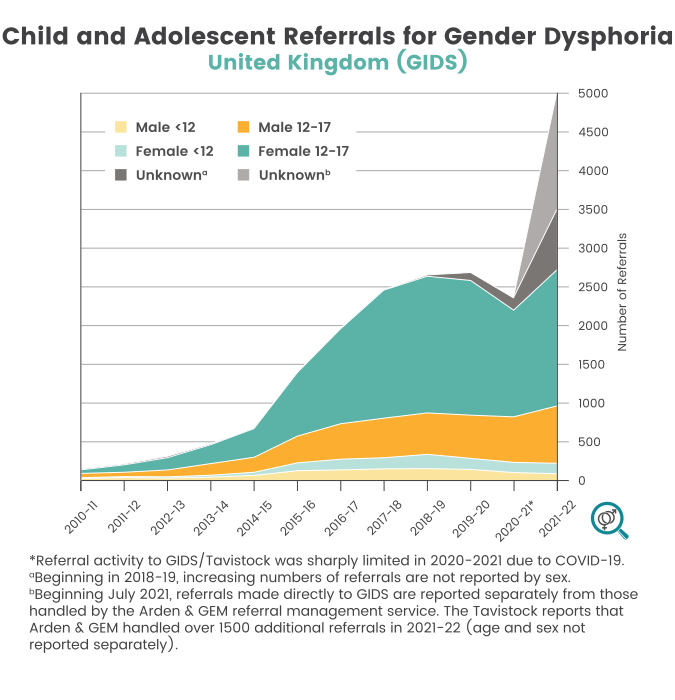
By comparison there's been a 40-50x increase in gender clinic patients in just 11 years from ~100 patients in 2011 to 5000 patients in 2022: https://segm.org/images/280UK_22.svg
I'm arguing that there's a qualitative analogy of an increase in rates eventually leading to a plateau, and you're turning it into a quantitative argument?
The point here is that if there's discrimination against certain characteristics, there will be individuals that will deny part of their identity to the outside world.
But discrimination against trans individuals has by most measures increased. Bathroom bills, many states categorized gender medicine in minors as child abuse, etc. Polls asking people of they agree that gender can be changed has decreased over time: https://www.pewresearch.org/social-trends/2022/06/28/america...
So whatever is causing trans identification to increase ~250x faster than left-handedness is happening despite increasing discrimination against trans individuals.
These aren't intended to unfairly discriminate against the trans-identified. The purpose is to protect female spaces (which males really have no right to enter), and prevent medical harm to children by doctors with gender identity ideological beliefs.
Actual discrimination would be things like, repealing laws that protect individuals with a trans identity from being refused housing or employment because of that identity (or expression thereof). As far as I know, no-one is pushing any bills that would do this.
I do not believe a being could tell if it has a male or female wired brain without relying on some fictitious tropes (or call it stereotypes) about manliness or femininity. This is a constructivistic/social phenomenon.
Well there's two questions. One is whether it's possible for "inner" sex and "outer" sex to be in conflict. There's no reason to think this is impossible.
The other is whether a person suffering from this could tell something was wrong. They couldn't diagnose the problem in detail, but shouldn't they be able to tell, at some level, that something isn't right? Denying the latter just sounds like gaslighting to me.
You misunderstood. I said "without relying on some fictitious tropes". If you have these tropes internalized (which is a common thing apparently) the conflict between the idealized gender roles and physical reality is bound to happen.
I don't think I've ever seen anyone deny the plausibility of the brain being wired differently than the body. What I believe the poster is referring to, and which I've seen in the media many times, is denial that physiological sex-linked characteristics are fully expressed even if doesn't match the one the brain is wired for. If brain wiring can mismatch physiology, it demonstrably is not determinative of the biology the brain is attached to in any meaningful way.
I understand the motivation for this denialism: most social institutions that segregate by sex are motivated by the practical effects of physiological sex-linked characteristics, brain wiring isn't a relevant criterion for determining "sex" for these purposes. It is currently impossible for the physiology to match the brain wiring in such case as a matter of science. Since the social institutions around sex segregation are widely viewed to exist for good reason, it motivates denial that physiological sex-linked characteristics actually exist for people that want to be segregated according to their brain-wiring sex.
It is very common for left-leaning figures in the US to deny that trans women and girls possess any advantage over cis females in sports. In reality trans women still possess greater bone density, higher average height, higher red blood cell concentrations, higher VO2 max, more fast-twitch muscle fiber and more.
Democrats' mainstream acceptance of beliefs that the scientific method doesn't accurately reflect reality
No such belief exists. Recognizing the existence of bias in a science (with biased input data having detrimental effects on the reliability of the results) or observing the existence of methodological shortcomings is not the same as repudiating the method.
Journalists always overlap their coverage. Even 'exclusive' stories will get articles describing the exclusive coverage. A story/theme being covered from multiple sources is hardly evidence of conspiracy in a vacuum.
"Antisemitism" could be replaced with "racism", "transphobia", "homophobia", etc. and your point would hold true. At some point popular discourse became such that escalating disagreements to accusations of tangible transgressions was fashionable.
They make the cynical case that automation is coming for us all, and it will eventually replace every ounce of fun or meaning in gainful employment, but that it's okay because of some nebulous societal good. It's not a convincing argument.
While I do question their point that AGI is coming for all jobs, I think you're shoehorning your own narrative onto their point. At no point did they mention "fun" or "meaning". Even the idea that those are synonymous with employment is suspect.
It's not a narrative so much as a leftover from what I was originally going to post, in that the creative/expressive/stimulating work is what's being touted as the first thing to be eliminated by AI.
That aside, what exactly is suspect about finding meaning or joy in work? Is the quintessential experience meant to be soulless and grating?
> Is the quintessential experience meant to be soulless and grating?
Of course not. Few things in life are more fulfilling than a job you absolutely love and are excited to whack at every single day.
But your question raises another one of equal stature: Is the quintessential experience meant to be a job? If we are creative enough to make rocks that can learn to do our jobs for us, surely we are creative enough to craft an economic model which allows us who no longer need to work to paint or write poetry or rebuild antique engines without needing to starve?
I don't think a _job_ is the quintessential experience so much as _productive value,_ doing something that brings you joy from the act of creating, whether it's making music or art, assembling Lego kits, antique engine restoration, etc. Getting that satisfaction from your job is totally possible, so perhaps to some people it is!
As far as crafting a post-scarcity economic model goes, it's not the problem of dreaming one up, it's the pervasiveness of scarcity. Even if all of humanity's basic necessities are one day a given, scarcity won't disappear, just shift around (maybe as transportation for the otherwise-infinite supply of consumer goods? Or living space away from dense urban centers? Maybe even the kind of heuristic analysis abilities humans are unmatched in to keep the matter replicators functioning?)
More to the point, saying that this kind of luxury will exist in a thousand years doesn't nullify the concerns of the present, and probably wouldn't convince most people to forfeit their employment to machines likely owned by the uppermost classes.
I would argue there is a danger of conflating "productive value" with creative effort. The general view is that productive value is measured by how much a market is willing to pay for a product or service. I would venture to guess that most creative efforts aren't very marketable, unless your view is that society should go back to artisan craftsmen. Nobody particularly wants to consume the music that I create, so they have little to no procutive value, other than the joy I get from doing them. On the contrary, a lot of non-creative work has immense productive value. Re-shingling my roof isn't a particularly creative job, but I'm still willing to pay for it.
I think there's a distinction in that I was referring to "knowledge work" which isn't explicitly creative/expressive/stimulating. Many would classify much of research or law as "boring" even though they are knowledge work.
>what exactly is suspect about finding meaning or joy in work?
I did not mean it as wrong to find joy in your work. On the contrary, I think that's a worthwhile goal. But the distinction I make is that any work can be found to be fulfilling. It's the distinction between "finding your passion" and "cultivating your passion." I've worked with people who found meaning in their job cleaning offices and others who treated the design of rockets as soul-crushing. I think it has more to do with the person than the job. So I push back a bit on the false dichotomy created by classifying "knowledge" jobs as inherently worth saving from automation while manual work should be fodder for it. I also think the focus on a job for fulfillment is a bit of a red-herring. I think what people really need are to be valued members of society and, for many, a job is a means to that end (and maybe not even a good one).
That's such a yellow-press non-answer. Annoyed interpretations of the name of something doesn't offer any insight into, or affect the reality of, the thing.
It's hard to interpret "We basically put a big flashing sign right out front saying whose interests are the top priority" as anything but distaste, just as it's hard to parse "the name “capitalism” states whose interests are favored in our system" as anything but a favorable verisimilitude. Whose capital? Construction contractors? Service industry bosses? How exactly are they favored? Clearly wage theft is a well-understood phenomenon, so wouldn't it be a greater indictment of the legal system backing the law than the system that rests on top of it? How is any of this unique to a capitalist system and prevented in, say, command economies?
> How is any of this unique to a capitalist system and prevented in, say, command economies?
Social-capitalist economies (the “social democracies” and adjacent) tend to do better job at this particular thing. Unions are pretty damn effective at cutting down on employers failing to follow through on their obligations, for one thing, and other states do a better job of supporting and incubating those organizations, besides whatever else they do in statute and enforcement to curb the power of capital to behave poorly.
The US tends to center its capitalist nature more than other states, is why I suggested we wear it rather “on our sleeve”.
“Why does this liquid taste like apples?”
“My brother in Christ: the label reads ‘Apple Juice’”
> Social-capitalist economies (the “social democracies” and adjacent) tend to do better job at this particular thing.
Can you point to a social capitalist country that does a demonstrably better job as a direct result of being a social-capitalist/social democratic/democratic socialist policies? From a cursory search, the US shares in wage theft being a problem with the UK, Australia, Germany and Sweden (granted to a lesser extent for the last two), and I have no doubt a slew of others as well.
(Not GP) I think this is fair enough of an answer, I agree with you.
Though, when complaining about capitalism to try to improve it, it is probably best to mention social-capitalism as what you are advocating for.
Due to the recent political climate (e.g. the Russian invasion) communists are also complaining about capitalism on online forums as a way to advocate for it, which I believe is why GP thought you were talking about command economies. I thought so, too.
Ah, fair point. The most extreme ideology I even kind of identify with is left-libertarianism, for the record, and mostly I’d just like a better social safety net, better social services, better consumer protection (this, overall, helps the market! Markets are pretty awesome and we definitely should work to keep them healthy and helpful) and stronger unions. I reckon that’s about as good as a large state can get, in the current environment.
I get the communism association given the origin of the term “capitalism”, though it’s been pretty thoroughly adopted and embraced by, well, capitalists. But no, I’m not a fan of communism and didn’t mean to give that impression.
In a world where political labelling can be so very misleading (“people’s democratic republic”) I just find it a bit amusing, and maybe even refreshing, that we tend to self-label our system as capitalist (among other things, to be fair) and that’s pretty damn honest. Take the term fairly literally and it’s a good guide to what you see actually happening, and what you ought to try to do to attain greater privileges and protections. We announce exactly what our deal is.
[edit] more to the point, I wasn’t even trying to get into a what’s-better discussion, just pointing out that thing from the last paragraph, really.


More to the point, not every skill level or job is _worth_ that kind of compensation (as uncomfortable as it might be to entertain), and attempts to circumvent market forces by making lower wages illegal at some arbitrary point have substantially more damaging externalities than 'low wages' -- which are as much a system of slavery as gravity or magnetism, and just as resilient to ideation.