I've been looking into how to survive low bandwidth/high latency/frequent disconnecting internet, because we may need to save money at home and temporarily switch to an unlimited 2G speed (64kbit) cell data plan as our primary internet for a few months. (Red Pocket's $7/mo. 1GB GSMA plan paid annually.) Not only is Red Pocket notoriously bad at limiting both bandwidth and are horrible with latency, we also live far from the closest cell tower, so our reception is also poor and frequently disconnects. A one-two-three punch for a bad internet experience.
This is probably about as close to experiencing an Antarctic data satellite connection within the continental US as is possible, and would be even worse than a 56k modem; While the bandwidth is roughly the same, Red Pocket users often report latencies in excess of 1000+ms, whereas 56k modem latency was typically under 200ms. The frequent disconnects (because we're far from the tower) would simulate Antarctic conditions, as well.
So how do internet-connected people living in 2024 survive such an atrocity?
First, we would leverage SSH and CLI tools as much as possible. Brow.sh and Carbonyl browser for web and Mutt for email. Mosh.sh to keep the SSH connection alive and reconnect automatically on reconnect--even if your IP changes. (Mosh is incredible.) Some terminals have a zoom feature (ctrl++ or - in kitty) which may help if some web browser item is just too difficult to see in its blocky resolution. See also the Carbonyl --bitmap and --zoom flags:
https://github.com/fathyb/carbonyl/releases/tag/v0.0.3
The youtube-dl command can fetch tiny versions of a video on a server (even audio-only if we don't care about the video portion such as with long-form interviews), then transcode them on the server to the smallest-tolerable bitrate. rsync them home overnight and watch them the next day. rsync can retry on failure: rsync --partial --progress --compress-choice=STR, --zc=zlib --compress-level=9 --rsh=ssh user@host:remote_file local_file
Needs a remote Linux server, but ServerHunter has servers adequate for the task for less than $3/mo. Focus on RAM; Most any plan has sufficient hard drive space and speed, sufficient bandwidth and CPU for what you're doing. You're not serving large content to many demanding customers, and in my personal testing I have found that even 1GB RAM should be enough--but obviously more is better. And many companies only charge for data egress--which should be smaller than ingress. Data ingress to the server is usually free, and when you're downloading large amounts of data to the server, then compressing them, egress is much smaller. Choose companies that have a domain age of at least 1 year old; I've had a fly-by-night company take my money and run. (PayPal reimbursed me.)
To download large files, try first compressing them; Although, depending on the original file, compression can either give you no advantage or even _increase_ the file size. Try different compression methods; bzip2, zpaq, xz, lzma, etc. ls -l the before and after to see if it helped any.
Also, we'd rely on phones apps for things like Gmail/Facebook/Messenger/WhatsApp/Telegram/Twitter/Discord/etc. This saves always redownloading JavaScript for each visit. While there are Windows/Linux desktop clients for these, they usually are only thin layer over a browser, which means they still download JavaScript and large images on every use. But a phone app has everything it needs all the time--until the next app update, of course. Can temporarily disable app updates, but I wouldn't do that for long. The good part about app updates is they can tolerate slow links and frequent disconnects. And we often take our phones with us to high-bandwidth locations, so we can do app updates there and disable them over cell data. The article said on some days Antarctica has better bandwidth availability, so you could halt updates until conditions improve.
Same with Windows or Linux OS auto-updates; Disable them until bandwidth conditions improve. (But you're probably already doing that.) Edit: After reading the article again, yes they definitely are doing that, and are still having problems. Bummer.
Installing Bluestacks is an option, for the above reason. Using phone apps on the desktop that don't need to download JavaScript on every use could bridge the gap somewhat. Disable its auto-updates as well.
Gmail can be set up for IMAP or POP3. Try both; POP should give a better experience, but by default it removes messages on the server, so look for that setting to disable it if you want to keep them there. I believe you can disable downloading attachments and images automatically, which probably works better for IMAP? Not sure if POP can handle this. Doing it this way means you don't need to load the web interface any time you check mail, and you'll only be reading the text content of emails. It should therefore work through Mutt as well.
Then there's browser tricks for local rendering: Disable graphic images and disable media autoplay. uBlock Origin to reduce overall download size. Turn off JavaScript until truly needed. Pain in the butt, but it works.
In Windows, set your network connection to metered. This should help. (And back in the US, we can set our phones to low bandwidth mode--but that would only help users on cell networks; I'm sure the south pole lacks cell reception.)
You're not going to be gaming with large downloads and patches, nor will you be competing with low-latency gamers around the globe. But not all games need these. Play against the computer instead of other people. Play only pre-downloaded or DVD-based games. Or go back to the 90s and set up a LAN party and play against one another in the same room. We love Unreal Tournament 1999 GOTY; Plays blisteringly fast on any computer, is cheap to buy on DVD or Steam, has no in-game paid-for upgrades, has oodles and oodles of maps for download, and gameplay still feels fresh even 25 years later. Card games and offline phone games are king in low bandwidth environments.
You're probably not going to make many audio or video calls, so learn to send mp4s or mp3s to others back and forth by email. Use the lowest-tolerable bitrate. A 6Kbps OPUS/32Kbps AV1 video is about 5KB/sec and is clear enough to follow along, and would certainly be acceptable for a video message. A 0.5Kbps OPUS-encrypted audio file is surprisingly understandable, if not very enjoyable. But to get the message across, it works. A 6Kbps OPUS audio sounds like telephone quality to my ears.
https://heavydeck.net/post/64k-is-enough-for-video/
I don't know if podcast apps have a low-bandwidth option, but it's worth investigating. Apparently the Player FM Pro app compresses pods on their servers before sending.
Finally, there's the possibility of running a remote desktop session: Something like RDP over SSH, VNC over SSH, NoMachine's NX, TeamViewer, etc. Can give clearer detail than brow.sh and can sometimes be faster than browsing locally. I tested it by intentionally limiting my desktop's speed to 5KB/sec and while it wasn't fun, it got the job done. Took about ten seconds to paint a page on a 1GB VM, but that can often be faster than rendering a JavaScript-heavy page locally. Seems to be a good compromise for certain situations when the rest of the options fail you.
Typing is too laggy (5 seconds before characters appeared) but one way around that is to type into a file via SSH then cat the file on the server, paste that into the web form. Or write your notes to a file on your local system and copy+paste that directly in. I've found that even a server with 1GB RAM is sufficient for even this task, as long as you're only looking at one web page at a time. No multiple tabs. I ran XFCE4 on Ubuntu 22.04 and Google's official Chrome package. Resized the connection to 1024x768, which I consider to be the minimum for useful browsing. Changed the quality settings to lowest, color depth to lowest, etc. Disabled audio and printing.
To read large pages offline, print to PDF on the server inside RDP/VNC and download that with rsync.
The combination of all of these should help us get through a season of needing to save money, and it may very well save the day in Antarctica, as well.
I was reminded that Google Cloud offers a free forever 1GB RAM server with 1GB of network egress. In the US, additional egress costs $0.02/GB. A server sending 5KB/data every hour of every day for 30 days will cost you about 25 cents a month :-)
Back in 2002 I built an LFS on a 400 MHz HP desktop with 256MB of RAM. Took about eight hours. It was quite a learning experience, to see Linux's guts all put together. I highly recommend it to everyone :-) Don't use a 400 MHz machine tho...
Taxing the rich seems to be one of the hardest things in the world to do. They can afford the best lobbyists to influence politicians to write loopholes in whatever laws you can think of to tax them; they can hire the best accountants to shelter assets from those laws; they can hire the best lawyers to help them get off the hook if they breech those laws; and if they become too unpopular here, they can afford the high price of gaining citizenship in other nations.
> Taxing the rich seems to be one of the hardest things in the world to do. They can afford the best lobbyists to influence politicians to write loopholes in whatever laws you can think of to tax them
More to the point, they can hire the best propagandists to spread the idea that it's too hard to tax them and you should do something else.
Oh that’s right, the PR firm mails me my check today ;-)
No seriously, am I wrong? Has taxing the rich ever been successful in the long term?
Take for example the much-lauded United States marginal tax rates of the 1950s. Do your research and you’ll find that the wealthy evaded those taxes quite handily.
I don’t see how it’s possible to get any more blood from that turnip. Better solutions are needed.
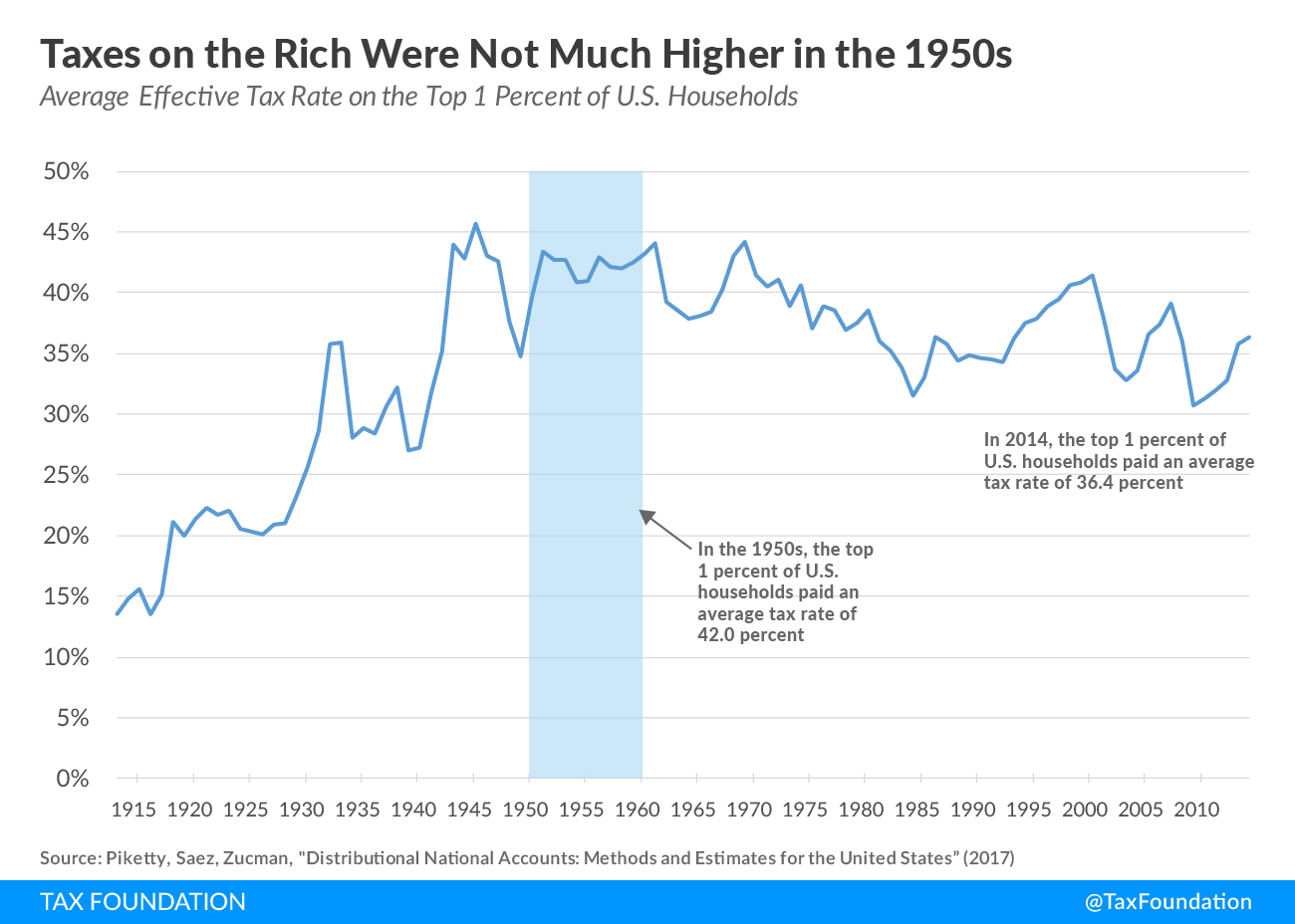
The effective tax rate in the 1950s wasn't actually substantially higher than it is today. [0] A high top-marginal rate is only a small part of the story.
It may be hard to get effective tax rates for high earners above 40%, but it would be eminently feasible to get them back up to 40%, where they stood before Bush and now Trump went off and reduced effective tax rates for high earners so much.
I just mailed the feds my owed taxes for 2017; my high earner effective federal tax rate is ridiculously low (lower, because of the cut off for social security at ~120k, than significantly less well paid people).
I didn’t ask for these tax cuts, and they’re certainly not enhancing my propensity to work, they’re just going to allow me to retire earlier.
But if your point is that income taxes aren’t an awesome way to raise revenue, I’m with you. Land-value-taxes would be almost impossible to avoid, and would have the salutory effect of improving efficiency in dense urban areas.
Would a land value tax be priced on farms as well? I wouldn’t think so, else you risk pricing farmers out of business. Have you noticed how many wealthy people own vineyards? Put some greenhouses on it and call it a farm.
The wealthy are clever, or they can hire some downright clever people to help them. Better solutions are needed.
It depends what you mean by successful. The Soviet Union and China were both very successful at taxing the rich. The consequences of doing so were disastrous, however.
I don't know how successful they were at confiscating existing fortunes, but the point is that they were extremely successful at preventing new fortunes from being accumulated.
Or, even easier and more effective, abolish estate and gift and capital gains taxes, and tax inheritances, gifts, and capital gains as normal income to the people recieving them.
Because for some recipients, especially for the non-rich, these are non-repeatable, you do need to add some handling to the regular income tax system to address inconsistent incomes with multi-year smoothing mechanisms to make taxation of those kinds of income fair, but that also makes taxation of variable regular income more fair, too.
I'm familiar but none of them are very good. The only really good way to avoid capital gains taxes is to die and use your estate tax exemption on the securities you hold. Which is why increasing the estate tax rate and decreasing it's exemption in tandem with an increase in capital gains is the best way to tax the wealthy.
Who would pass these capital gains taxes? Politicians, right? The same ones who can be influenced by lobbyists?
When these laws are passed, will assets be sheltered by accountants?
I know a Bitcoin millionaire. He avoided capital gains taxes this year by upgrading his Jeep. The money that would have gone to taxes, he used instead for upgrades, because of a loophole that permits upgrades to be taxed at a much lower rate.
And it’s an overstated solution. I don't think people have a sense as to how incredibly large the U.S. budget is - for 2016, the expenditures were nearly $4,000,000,000,000 (trillion). Even if you seized the assets of the top 10 richest (which took them a lifetime to accumulate), you're not even close to covering the U.S. budget for a single year.
The military budget is the elephant in the room that no one will address for fear of appearing as soft or anti-American.
True, but 8 people hold 50% of the world's wealth, and pay less in taxes on a percentage basis than us normal slobs. There's no reason we shouldn't tax them and everyone who has more than they need for 1000 lifetimes at 90%, no matter how long it took them to acquire their wealth. It's obscene.
Wealth inequality is extremely easy to solve - raise taxes on the rich (as well as rent-seeking). The problem is that our politicians, especially conservatives (though liberals are in on it too), have no integrity in this regard. We just need to stop voting in people who won't raise taxes on the rich.
* By the rich, I'm not referring to the doctors, engineers, and lawyers in the upper middle class, I'm referring to billionaires
Yeah and global warming is easy to solve, all you need to do is get everyone on board...
Capital, like water, takes the path of least resistance. There's ample academic literature which shows and explains international tax competition exists, we can't pretend it doesn't. Any country that increases taxes just signals to the increasingly mobile tax base that they ought to go somewhere else. And tax coordination, i.e. countries agreeing on minimum tax levels, is an incredibly difficult political problem. You're literally putting the heart of a country's budget on the negotiation table, it doesn't get more political.
As such, it's not at all extremely easy to solve. It's not just an issue of integrity, it's also an issue of international politics.
It's not an issue of international politics for a country like the U.S. to raise their own taxes. It's literally a matter of tweaking numbers. Of course there would be side effects if U.S. raised them too much or in the wrong way (eg. targeting small business owners instead of billionaires), but we're not even close to that point. Overcomplicating this is just rationalizing the status quo.
Did you notice that those conservatives and liberals are wealthy, or have wealthy backers? Have they been aggressive in raising taxes on the wealthy? Why do you suppose that is?
Perhaps the better question is "what has changed that could make it workable now?". For example, in an interconnected world like today's, some countries actually do have massive power. Take the anti-corruption laws that say a multinational corporation can face stiff penalties at home for corruption that happens abroad - AFAIK, while not perfect, they're not ineffective either.
If, say, US would pass laws that allow them to tax everything that touches/ does business with a wealthy individual - that would make it very hard for said individual to avoid taxes (relocation to other countries doesn't help, and avoiding any business with US is impractical). I mean - what I present here is certainly not a "workable idea", but the gist of it should be that "because it was impossible in the past, it's not necessarily impossible in the future".
> If, say, US would pass laws that allow them to tax everything that touches/ does business with a wealthy individual - that would make it very hard for said individual to avoid taxes
Who would pass these laws; politicians, right? The same politicians who are influenced by lobbyists, right?
You might then outlaw lobbying but the wealthy would just find another way to bring influence, wouldn’t they?
Not sure how you'd define "sustained", but the introduction of inheritance tax in the UK very effectively clobbered most of the surviving minor feudal landowners. Although that was also the period of massive social change and the world wars.
Of course it wouldn't be unfair for one person earning 100% of all income to pay 100% of all taxes!
So let's see if that's happening...
Top 1% pay 40% of all taxes. How much of total income do they earn? Interesting, only 21%. Looks like they already take on a much higher burden than their income alone would suggest.
What we need to look at is their net income after taxes, and there the 1% is still doing much better than the median taxpayer. If you look at the top 0.1% earners, it's obscene, let alone the 0.01%.
The only tax analyzed here is the federal individual income tax, which is responsible for more than 25 percent of the nation’s taxes paid (at all levels of government). Federal income taxes are much more progressive than federal payroll taxes, which are responsible for about 20 percent of all taxes paid (at all levels of government), and are more progressive than most state and local taxes.
Does anyone here believe the top 1% and 10% are being taxed enough? The most oft-expressed opinion I’ve seen, even expressed below, is that the rich don’t pay enough as a percentage of their income.
100 years ago there wasn't any income tax at all? I think the opposite is actually true, Tax is very easy to apply now and with the crackdown on offshore havens its harder to evade. Top rates are lower than they were in the 70s, but the total tax take isn't low.
Taxing the rich is fine, we just need politicians to show a bit of spine and do it. Most rich folks aren't going to pick up and move because they make their money tied to the place they are now. There's a handful of high-profile exceptions, but that's all those folks are; exceptions. Most rich people will stay put and complain and pay the tax.
In America, half the problem is one political party persistently working to lower taxes. The public is divided and distracted by social issues, and media hyperbole.
There is a presupposition in this article: The automated jobs will leave a vacuum. That is, routine jobs will be taken away with no other jobs to replace them.
What if reducing routine jobs frees up minds for higher pursuits? In the same way that high level programming languages such as Python have increased the amount of programming jobs, as contrasted with writing in assembly. A quick search on Dice shows Python jobs outnumber assembly 8 to 1.
You only have to go back a little over 100 years to a time when agriculture accounted for over 50% of human labor. Now it's under 2%. Yet unemployment is still under 5%.
While agriculture likely represents the largest shift in labor during the 1900s, there were a huge number of jobs automated away during that time. Assembly lines, factories, and automation have been displacing workers since the dawn of the industrial age.
75 years ago there were basically no information technology jobs, and now it represents nearly 10% of the workforce, or four times the level of agricultural employment.
In summary, I agree with you; freeing people from mundane labor will lead to an explosion of jobs for which people are better suited; jobs which are more engaging and fulfilling as well.
There are always people who fail to adapt and get left behind, but the rest of the world moves on. People like to work.
Up until now, the people displaced from the jobs automated away have always been intelligent enough to offer utility beyond what automation can provide. But there's a tipping point when automation/machine intelligence exceeds humans at which point they offer no utility to employers of any kind. We haven't hit that point for the vast majority of workers, but the early indications are that we very well might.
But looking at the past as a predictor of the future is a very dangerous proposition. We saw that in 2008 when it came to the housing market. Sometimes now really is different from the past. And if we hit that tipping point, it will be much like the posited AI singularity. Vast swaths of humans will become surplus to the most efficient means of completing work. It's important to realize that the people who are talking about this issue as one we need to confront are envisioning a future that is fundamentally different from today or anything that has come before now and they're predicting that for a very specific reason. You can disagree with that reason, but you can't use previous examples of automation-displacing-jobs as a way to dismiss that thinking. Because what's being predicted is fundamentally different from what has already happened.
There's not much to learn from agriculture. People left farms for better jobs in factories. That's not a story of unemployment and displacement.
If a new source of jobs pops up that can employ 50% of the population at higher wages than they are currently earning, no one will complain about it (except maybe for the employers at their current jobs, but they will probably just buy the proverbial tractor).
Factory jobs started out being awful, and workers had to physically fight and die to get basic protections. Eventually we got a 40-hour work week, less child labor, etc.
Well it's still better than watching your family starve, sure. Reshaping our society to accommodate a lot of people who don't have to work (because machines are doing the work) is going to be a long and painful process.
Interesting :). Though, this sort of presupposes that the people whose jobs are automated away have the financial security in order to take the time necessary to create a new job/career.
I think a lot of people, in the U.S. at least, don’t have that level of financial security (plus the healthcare snafu).
What is financial security but the ability to afford to pay for one’s needs? Automation in farming has cut the price of calories, and perhaps too automation in other sectors will reduce the cost of living. Automation in medicine could be a big help for costs.
Unfortunately though, housing cannot be automated and that is very expensive. Though much of housing costs, at least for new builds, is from regulations and labor. Reduce regulations with better governance, and reduce labor with automation (3D printed houses?), and you’re on your way to part of a solution.
The true cost of housing is relatively flat across the developed world and especially the US. The actual cost is almost entirely a function of local politics.
We could have a flood of nice, brand new homes for $300k in Silicon Valley and nice older homes for $200k, in the same way a city like Tokyo or Houston does, if the people of California had not made the deliberate choice to pull up the ladder behind them.
You won't have brand new homes in $300k in SV because the land itself is worth more than that due to the heavy demand for housing in what is a comparatively small area, though you might get $300k condos in multi-story buildings if the zoning issues in the Bay Area are addressed.
Houston isn't a good example either. Houston has almost no zoning or building regulations, which was on ample display when entire neighborhoods flooded because developers weren't prevented from building houses in flood basins. (CA allows the construction of residential properties in floodplains, which are flat areas that might get flooded if flood control mechanisms fail. In Houston, houses were built in the flood control mechanism.)
There are also plenty of places in California where houses and residential units are being built. In LA, for example, several ten thousands of new residential units were built in the downtown/downtown-adjacent units in the past few years. In San Bernardino/Riverside counties, they still have housing stock available from the last building boom. It's not that the people of California pulled that ladder up; it's simply basic market forces: too many people want to live in the nice parts of California.
This idea that automation will free up others to perform "higher pursuits" (especially programming) seems completely wrong. The reason is that we have a tremendous shortage of programmers, at least in the largest cities but in a lot of smaller towns too. These jobs pay much more than truck driving or burger flipping. If people could do these jobs, they'd be paid tremendously more with better job prospects right now.
There's nothing stopping people from training to be programmers today and working as a spoiled or fortunate software engineer, just as I am today - nothing other than the challenges of training, the time required, their own interests and capabilities, and possibly unawareness of the opportunity. Maybe a few people would try programming if they suddenly had money and no need for a daily job, but they could also do it today.
YouTube and free SDKs, IDEs, and cheap servers are quite a democratizer.
But is it true to say that automation would fail to free up higher pursuits because there is a shortage of programmers? What would you be doing right now if there were no electricity?
The point I was trying to make is they could already be doing programming bc there are so many jobs and improving their lot in life but they aren't. Freeing up more people to do programming won't change the job equation. There are already openings to dev.
But the question is whether automation across all sectors would free up all kinds of pursuits, not just programming. Maybe that wasn't clear in my question, but that's what I was proposing.
It doesn't matter how cheap calories are if you do not have the income to purchase them.
If you like, change food to housing in my original comment. The point still stands: Higher minded pursuits require a level of safety and security to pursue. That level of safety and security does not exist if you do not have food security and housing security, and those things don't exist if you do not have an income.
This is why when economists blame lost aggregate jobs on automation they are being disingenuous. If the government thinks that there aren't enough jobs they can just raise the minimum wage and increase fiscal spending, creating jobs until there are.
There were similar claims made during the depression. It wasn't about automation then either - it was about wealth inequality and a lack of aggregate demand.
Roosevelt then spent and invested in infrastructure - building stuff like LAX - until the country returned to full employment.
> Ok so tell me more about how building LAX was "make work".
No, I'm asking if that's what you're proposing for the 21st century. What projects would you have be initiated that would fill the gap of some roughly 60% of unemployment, in the case of most cities on that map?
* Green energy infrastructure - wind/solar farms and the smart grids to support them
* Fixing roads, bridges and dams (all currently neglected).
* Building community centers and schools
* Caring for the elderly and infirm
There's a curiously high number of people who declare the jobs program that built LAX an obvious example of make work yet defend silicon vallley's silly startups and bitcoin mining (the purest example of make work) as "socially" useful merely because they were funded with private dollars.
I used to be pretty big on the UBI bandwagon but I've come back to Earth recently and the reason is pretty simple - while we certainly do not take advantage of the total sum of intellectual talent available today - we squander a huge amount of it to poverty and cultural isolation - even with global UBI and universal access to education there will never be a population where even the majority of people can do those jobs.
Tech is a bubble, and we dig ourselves in deep. But you don't need to go to the third world to find illiteracy and ignorance. You often don't need to go more than a few miles in any given direction to find entire populations of doomed people - they have no ambition, education, and most importantly no desire to ever have them. The smart ones leave, go to the big city, succeed in school and go to university and end up successful, but for every capable intellect there is often someone who just can't. Its no different than introversion vs extroversion - some people crave the new and different and some people crave consistency and pattern.
And we might like to think otherwise, but automation replaces the routine, not necessarily the physical. But a lot of people don't have the capacity for boundless creativity, in my experience it actually hurts some people to have to think outside the box that much. Like headache causing stress and frustration. They don't become scientists not because the opportunity is not available to them fiscally, but because they cannot think like that. At least not in a professional capacity with forty hours a week consistency.
I don't think we can eliminate that factor. And I think it is much larger than anyone who promotes UBI as leading to an era of scholars and scientists aplenty gives it credence for. Or for not recognizing that as a species we are barely evolved beyond animals that could only, at most, do simple tool manipulation and use. Who couldn't understand the concept of self. Asking for human brains to on average be innovative, imaginative, and capable of running in the highest states of consciousness we can reach on a near constant basis is asking too much of a lot of people.
It asks too much of me many days where I try to find something rote to do rather than face new problems that can get overwhelming, so from someone not on top of the brain potential spectrum, there is a reason why predatory repetitious skinner boxes work, why addiction is such a big problem, why people get stuck in their ways and why change is hard, and these aren't things we will ever eliminate from the species entirely without a serious investment in transhumanist innovation. These people will not become scholars, creatives, or thinkers.
That being said, I'm not convinced its even a problem. A lot of why people crave "meaning" in their lives is the fear of loss. Having a purpose gives you an anchor to always ensure you never go completely adrift from your life as it is. You can lose your job, home, etc but if you have a purpose and feel like you can do something it gives you the strength to keep fighting to survive.
With a UBI, the fight to survival pushed on pretty much everyone by capitalist economics as a means to spur growth changes fundamentally. I would be interested how societies pressure to have purpose and how we build our self worth would change with it.
Also, from my (very much outsider) observation of the legal profession there seems to be a lot of boring work that probably could be automated. So maybe not lawyers themselves, but legal helper workers, will increasingly be replaced.
It seems to me that knowledge worker support staff (paralegals, PACs, etc) are the current low hanging fruit in terms of automation. Firms without them will be able to turn higher profit on less revenue.
This seems more of a theoretical attack than a practical one; have there been known to be any attacks on old encrypted data with known vulnerabilities? If this is not a problem today would it be a problem in the future?
As in, phone or email and you’re dead. Most email is backed by another email or phone. Targeting a phone like this is probably the sturdiest foothold if you get it right.


This is probably about as close to experiencing an Antarctic data satellite connection within the continental US as is possible, and would be even worse than a 56k modem; While the bandwidth is roughly the same, Red Pocket users often report latencies in excess of 1000+ms, whereas 56k modem latency was typically under 200ms. The frequent disconnects (because we're far from the tower) would simulate Antarctic conditions, as well.
So how do internet-connected people living in 2024 survive such an atrocity?
First, we would leverage SSH and CLI tools as much as possible. Brow.sh and Carbonyl browser for web and Mutt for email. Mosh.sh to keep the SSH connection alive and reconnect automatically on reconnect--even if your IP changes. (Mosh is incredible.) Some terminals have a zoom feature (ctrl++ or - in kitty) which may help if some web browser item is just too difficult to see in its blocky resolution. See also the Carbonyl --bitmap and --zoom flags: https://github.com/fathyb/carbonyl/releases/tag/v0.0.3
The youtube-dl command can fetch tiny versions of a video on a server (even audio-only if we don't care about the video portion such as with long-form interviews), then transcode them on the server to the smallest-tolerable bitrate. rsync them home overnight and watch them the next day. rsync can retry on failure: rsync --partial --progress --compress-choice=STR, --zc=zlib --compress-level=9 --rsh=ssh user@host:remote_file local_file
Edit: On second thought, rsync doesn't perform well in high-latency environments due to TCP acks, but something like uftp which uses UDP should do better, and offers resume. https://stackoverflow.com/questions/38014501/what-is-the-fas... https://uftp-multicast.sourceforge.net/ https://sourceforge.net/p/uftp-multicast/discussion/general/...
Needs a remote Linux server, but ServerHunter has servers adequate for the task for less than $3/mo. Focus on RAM; Most any plan has sufficient hard drive space and speed, sufficient bandwidth and CPU for what you're doing. You're not serving large content to many demanding customers, and in my personal testing I have found that even 1GB RAM should be enough--but obviously more is better. And many companies only charge for data egress--which should be smaller than ingress. Data ingress to the server is usually free, and when you're downloading large amounts of data to the server, then compressing them, egress is much smaller. Choose companies that have a domain age of at least 1 year old; I've had a fly-by-night company take my money and run. (PayPal reimbursed me.)
To download large files, try first compressing them; Although, depending on the original file, compression can either give you no advantage or even _increase_ the file size. Try different compression methods; bzip2, zpaq, xz, lzma, etc. ls -l the before and after to see if it helped any.
Also, we'd rely on phones apps for things like Gmail/Facebook/Messenger/WhatsApp/Telegram/Twitter/Discord/etc. This saves always redownloading JavaScript for each visit. While there are Windows/Linux desktop clients for these, they usually are only thin layer over a browser, which means they still download JavaScript and large images on every use. But a phone app has everything it needs all the time--until the next app update, of course. Can temporarily disable app updates, but I wouldn't do that for long. The good part about app updates is they can tolerate slow links and frequent disconnects. And we often take our phones with us to high-bandwidth locations, so we can do app updates there and disable them over cell data. The article said on some days Antarctica has better bandwidth availability, so you could halt updates until conditions improve.
Same with Windows or Linux OS auto-updates; Disable them until bandwidth conditions improve. (But you're probably already doing that.) Edit: After reading the article again, yes they definitely are doing that, and are still having problems. Bummer.
Installing Bluestacks is an option, for the above reason. Using phone apps on the desktop that don't need to download JavaScript on every use could bridge the gap somewhat. Disable its auto-updates as well.
Gmail can be set up for IMAP or POP3. Try both; POP should give a better experience, but by default it removes messages on the server, so look for that setting to disable it if you want to keep them there. I believe you can disable downloading attachments and images automatically, which probably works better for IMAP? Not sure if POP can handle this. Doing it this way means you don't need to load the web interface any time you check mail, and you'll only be reading the text content of emails. It should therefore work through Mutt as well.
Then there's browser tricks for local rendering: Disable graphic images and disable media autoplay. uBlock Origin to reduce overall download size. Turn off JavaScript until truly needed. Pain in the butt, but it works.
In Windows, set your network connection to metered. This should help. (And back in the US, we can set our phones to low bandwidth mode--but that would only help users on cell networks; I'm sure the south pole lacks cell reception.)
You're not going to be gaming with large downloads and patches, nor will you be competing with low-latency gamers around the globe. But not all games need these. Play against the computer instead of other people. Play only pre-downloaded or DVD-based games. Or go back to the 90s and set up a LAN party and play against one another in the same room. We love Unreal Tournament 1999 GOTY; Plays blisteringly fast on any computer, is cheap to buy on DVD or Steam, has no in-game paid-for upgrades, has oodles and oodles of maps for download, and gameplay still feels fresh even 25 years later. Card games and offline phone games are king in low bandwidth environments.
You're probably not going to make many audio or video calls, so learn to send mp4s or mp3s to others back and forth by email. Use the lowest-tolerable bitrate. A 6Kbps OPUS/32Kbps AV1 video is about 5KB/sec and is clear enough to follow along, and would certainly be acceptable for a video message. A 0.5Kbps OPUS-encrypted audio file is surprisingly understandable, if not very enjoyable. But to get the message across, it works. A 6Kbps OPUS audio sounds like telephone quality to my ears. https://heavydeck.net/post/64k-is-enough-for-video/
Remember that 24-64kbit audio streams are still a thing. Search low bandwidth streaming radio. Sort by bitrate: https://directory.shoutcast.com/ https://directory.shoutcast.com/?q=299_Talk_297
I don't know if podcast apps have a low-bandwidth option, but it's worth investigating. Apparently the Player FM Pro app compresses pods on their servers before sending.
There are a few text-only news sites: https://blog.wturrell.co.uk/text-only-news-websites/
RSS feeds can fetch news over a slow link, and they're still a thing: https://rss.feedspot.com/world_news_rss_feeds/
Finally, there's the possibility of running a remote desktop session: Something like RDP over SSH, VNC over SSH, NoMachine's NX, TeamViewer, etc. Can give clearer detail than brow.sh and can sometimes be faster than browsing locally. I tested it by intentionally limiting my desktop's speed to 5KB/sec and while it wasn't fun, it got the job done. Took about ten seconds to paint a page on a 1GB VM, but that can often be faster than rendering a JavaScript-heavy page locally. Seems to be a good compromise for certain situations when the rest of the options fail you.
Typing is too laggy (5 seconds before characters appeared) but one way around that is to type into a file via SSH then cat the file on the server, paste that into the web form. Or write your notes to a file on your local system and copy+paste that directly in. I've found that even a server with 1GB RAM is sufficient for even this task, as long as you're only looking at one web page at a time. No multiple tabs. I ran XFCE4 on Ubuntu 22.04 and Google's official Chrome package. Resized the connection to 1024x768, which I consider to be the minimum for useful browsing. Changed the quality settings to lowest, color depth to lowest, etc. Disabled audio and printing.
To read large pages offline, print to PDF on the server inside RDP/VNC and download that with rsync.
The combination of all of these should help us get through a season of needing to save money, and it may very well save the day in Antarctica, as well.