Breaking accessibility for looks is the cardinal sin of web development. The two are not exclusive and often it's actually less work to make things accessible — simply don't break the built in functionality. It's a widespread issue and mostly I'd put the onus on bad education: to this day, many big libraries have very poor accessibility both in their code examples and their components. The true measure of a website's user interface is not whether it's pretty, it's whether it's usable, by everyone.
Same here in germany.
When we hear the word master, most people think of the master in karate kid or the master degree of a university.
I think only in the usa people are so full of hate that they directly think of bad stuff.
The funny thing is, I don't think very many people thought of "bad stuff" before this idiotic culture war planted it in everyone's mind, even if in a negative light.
I would bet that most people didn't have any idea that words like "grandfather" or "blacklist" had (or didn't have) any racist history.
Wouldn't it have been better to just let the words outgrow their history? These words were already dead or dying as racist terms. Not any more.
I don't know, but it seems plausible that awareness of the term's origin might well be considerably higher among those whose own father or grandfather was disenfranchised by one of the original grandfather clauses.
I at least was intellectually gratified to learn about it.
> In 2011, just 35% of white liberals thought racism in the United States was “a big problem,” according to national polling. By 2015, this figure had ballooned to 61% and further still to 77% in 2017.
In the Netherlands, which unlike Germany was significantly involved in the transatlantic slave trade, AFAIK the word meester never had any connotations of slavery, only of expertise and teaching ability (as in a guild master).
It's still used to refer to a male teacher, particularly in elementary schools, as well as being the title used by lawyers.
Or slavendrijver, which is still a very derogatory way to point out exploitative behavior.
I think an important difference between ex-colonial European powers and the US is that the (ethnic) slavery did not take place on European soil. Most colonies were operated with very few Europeans to oversee, and as such people were not as exposed to it as people in the US, where masters and slaves would perhaps not live in the same part of town, but also not a continent away. So this may explain why those terms seem inoffensive/only have their meaning outside of the slavery context in Europe.
I wouldn't say they are full of hate. Slavery has defined the country and has repercussions still.
But I'm really worried about how we import everything American to Germany without thinking twice.
Left newspapers have started to write BIPoC everywhere when it comes to domestic issues. What exactly are the indigenous people of Germany? Even blacks are relatively rare. It would make much more sense to coin an acronym that includes Jews, Sinti and Roma, given our sordid history. But we simply take what American culture has thought up.
We have problems to integrate Turkish or Russian immigrants and their children as Germans, not as people from elsewhere. As well as the refugees from Syria.
Having lived in a mostly Turkish neighborhood for five years (as a German, Turkish landlord, Turkish "housemates" (?)) I think some just don't want to be integrated...
Landlord was pretty chill and I kind of miss being able to just ask anything and he would try to make it happen (including things like repairing car motors).
Housemates were of the mildly radicalized religious kind, with daughters that did not attend the normal school system and are now being married of early.
I don't know if the German "integration system" has failed for the later ... they have the freedom to chose and they chose a path that is different from what is considered "normal" in the "West".
I think "integration" is a sham. Integration implies a give and take, a compromise. It seems actually assimilation or submission is what many Euro countries want.
As a Canadian (Vancouver), I can tell you true integration happens over generations of people working together and respecting each other. In those conditions, it is unavoidable.
If either group lacks respect, the outcome is always conflict.
You put their kids into school together young and they won't know not to be friends until you tell them. That was my experience, anyway.
>It seems actually assimilation or submission is what many Euro countries want.
No we think that forced marriage has no place in Europe, or the oppression of woman's. And yes, that's our culture..so is the freedom to choose your religion and to have free speech. If someone from another culture comes we are happy to integrate it into ours, but NOT when it clashes with our Laws.
>You put their kids into school together young and they won't know not to be friends until you tell them.
And what when they go into different schools (Jewish or Muslim etc), live in different parts of the City (look at Paris or Berlin), and never met someone outside of their bubble until 20 or later?
I said it in another post ... it's not about being forced into something, it's about freedom of choice. And that is something universal, it's just codified in our laws.
It's completely fine if a women decides to become married and have children early ... it's probably not a good choice ... but morally there is no way to reject that.
The problem arises when people never learn that they have a choice ... I have (female) friends from rural Germany that think it's perfectly reasonable to go study and once finished move in with their husband and be the perfect stay-at-home mom.
edit: heck ... I even have friends from larger cities who would just prefer to be stay-at-home moms because that gives an excuse to sloth on the couch for half of the day :-)
The point is, "BIPoC" means specifically "Black, Indigenous, People of Color". It does not mean "immigrants" or "refugees" or "all marginalized groups" or whoever else needs social justice in Germany.
Borrowing that specific term for other purposes is stupid.
As an immigrant, I didn't want to leave my country, let alone integrate where I did.
I was forced to because the government in my country steals and wastes so much money that the economy breaks and you can't make money there.
Still the quality of life is much better at home and I'd rather stay there.
All my friends are immigrants, I couldn care less to integrate here. Ideally I'd just rather live in a town with just immigrants from my country. As long as you keep them out of politics they'll probably won't rob you.
Interesting.
I also left my country but mostly because there wasn’t really anything left for me there and I met my girlfriend and she was from somewhere else... So I moved to her country.
Her country is clearly superior in almost everything except for weather and food. I like living here and I've made good friends and enjoy my life here.
Now the curious part comes...
I have zero attachment to both countries, their culture and their national identities.
I couldn’t care less about their language or customs. I just see myself has some kind of post-nationalistic person that would much rather speak English with everyone, hang out on the internet and live wherever.
As far as I'm concerned national identities and culture are useless and holding us down as a species. I really wish people could outgrow this nonsense.
I partly feel the same. I agree with you that identification with a country (patriotism/nationalism) is holding us back. However I do recognize that my upbringing has shaped me culturally and similar in my behaviour. Similarly the 3 other countries I have lived in for significant time, which have also formed my personality. I also do feel attachment to those places, but this is much more due do people and the location, not the nation.
I agree with you that the culture I was raised in has had a huge effect on me.
You can take the man of the country but you can’t take the country out of the man.
In hindsight I don’t think I was raised in a particularly enlightened culture. Do those even exist?
I would much rather have us move past dumb social biases and constructs and work together to build a better future and a more universal and cooperative world.
"I would much rather have us move past dumb social biases "
On person's unbiased Baysian predictions based on a lifetime of experience and evidence, looks a lot like biases and prejudice to the delicate of mind.
And they get nasty about it.
So no, there will be no building of a better world.
Generalizations like "chinese people are ..." or "muslims tend to..." are garbage. There is no possible objective truth to any of these since we are talking about billions of people.
You brain might think it’s very smart and clever and has the world all figured out but most likely it doesn’t.
The world is a chaotic system beyond any one's comprehension. All generalizations that are not purely mathematical and 100% abstract in nature are wrong.
Just like any other immigrants, westeners in Asia integrate do different degrees. Some only hang out with people from their own country and refuse to go to anything but restaurants that serve their own food. While others practically become locals.
Some nationalities integrate more than others. This goes for different European countries even, so it has very little to do with "race".
I understand and I think that is acceptable. I'd welcome you and yours in Canada. When both groups respect each other, true integration comes over generations of working together.
Obviously we did not respect the Indigenous people and I hope that can me mended through generations of mutual respect.
I think Vancouver is better because of the rich mix of cultures. It's not perfect here but I think it is pretty good. I have seen a Muslim man give his shoes to a homeless man on the bus and walk home barefoot in the rain. I believe anything is possible.
> What exactly are the indigenous people of Germany?
Ha! I remember a drunken night with a north-american colleague; he asked why didn't we have indigenous people here in Europe. Then he suddenly realized the answer: oh, but it is you, you all are!
I'm in no way a native speaker - but even I recognize that in English 'master' has - and always had - many different meanings. One of them completely equal to the German 'Meister'.
It is all about context. Question is, why certain groups emphasize - or better: impose deceivingly by altering him - the wrong context to a crystal-clear situation.
It is the only right association because it's the same word coming from "magister" in Latin and which traveled to become maestro in Italian, meister in German, maestre and then maitre in French and finally master in English.
"I'm in the USA. I think only in Germany are people so full of themselves that they over-generalize entire nations with their own ignorant assumptions."
That would be a rather rude, dare I say hateful thing for me to say, wouldn't it? In reality, I really enjoyed all the places in Germany I've visited, and most of my interactions with German folk that I've interacted with socially and professionally over the years. I especially enjoyed taking a technical and engineering German language course, so I can appreciate words like "Kaftfahrzeug-Haftpflichtversicherung" and "benzinbetriebenes Motorsystem". I wouldn't think to make such a comment about the German people, like you did about people in the USA.
The point I'm attempting to make is that stating blanket negative over-generalizations about any group of people isn't productive, and in this case it's seemingly ironic to me. If you think I'm a hateful person because of pointing that out, then by your definition I am hateful and I'm okay with you thinking that. I obviously disagree, though, and I'm happy to attempt to civilly discuss that with you if you'd like.
Germany is a really bad example though. The German way is to pretend racism just doesn't exist - today is the aniversary of a racist, arson attack that happened in 1994 killing 7 people (one of them pregnant) where the official line is still "the guy was just crazy what can you do ?!".
If you want to transplant the "master"-example, look at all the discussions of how they name certain sauces,schnitzels and deserts as well as a weird insistance that offensively named streets, underground-stations and (for some reason) pharmacies "must not need to be renamed, why would you even be offended".
Germany is not the example to go with concerning offensive language.
You just showed the problem: Mixing completely different things and pretending it's the same. The parent comment and the parent-parent and the submitted text all talked about something, you come up with something else.
> look at all the discussions of how they name certain sauces,schnitzels and deserts
Okay I do - and that is exactly the useless actions that the submitted text and this discussion is about. For some reason you just ignore all that was said and just repeat those exact criticized points as if nothing happened.
Well, they parent tried to transplant the word "master" into a german context and noted it doesn't translate. I then gave examples of words that work analogous to the word "master" in English. These things are connected by the concept that "I'm not offended by them, why should anyone else?"
Where these discussions about how Germans call their pharmacies connect to the article is that in both cases the arbiters who decide how things are called are the white - once you start to involve the people that these offensive words are about, you suddenly get a different sense of how important or offensive these words are. There's a recent example of a talkshow where a couple of white more-or-less-celebrities decided that these words are just german heritage, and really what is all the fuzz about ? To appease the ensuing mini-scandal the station organized a roundpanel of people who might be affected by these slurs - and surprise, they really weren't so fond of them.
You are obviously right, changing words by itself doesn't change a thing - but if I can't even count on someone not using slurs about me, I can't expect to respected at all.
I don't buy the assertion that the German way is to pretend racism just doesn't exist.
There are racists, and fascists, neo-nazis and old-nazis. They do exist, it's just that they don't pose that widespread of a problem in every day life, like it does in other western countries.
I'd say gender (in)equality is something you will encounter much more often in every day life over there.
It's about choice ... there are women (also in Germany) that gladly _chose_ to stay at home, _chose_ to prepare meals for their husband and _chose_ to care for the kids.
On the other hand there are women that _chose_ to give their children into daycare weeks after birth to go back to work.
It's not about condemning any lifestyle as wrong, it's about given everybody (males included) the ability to life their live as they want.
Sadly this is far from the reality with median wages being barely high enough to sustain one person, forcing women (and men) to work and robbing them of their agency.
We've got a far right party that gets around 13% in national elections, in some states around 25%.
We've got a minister of interior that does not want to start a study on racism in the police forces.
That's two of the big issues, that's not even every-day racism where it's hard to get an apartment or a job with a "foreign name", underrepresentation in leading positions or that in some parts you'll get at least hassled for walking with brown skin.
Germany is and always has been extremely conservative and integration/racism is an issue precisely because the largest party always saw imported skilled labor as people that should be forced back "home" again, even with a second and third generation growing up in Germany.
See the thing about that is, that it let's you neatly compartmentalize racism to the nazis, and since the nazis don't exist anymore (well, the ones being talked about in history class) there is not racism or antisemitism anymore.
That is of course simplifying it a lot, but Germany as a whole has a problem with right-wing extremism who almost regularely murder people, and a police force who regularly have scandals involving members being present day Nazis, and these Problems not being adressed properly.
So I am not sure learning about The Nazis of the olden days is very helpful withouth showing the reach that these ideologies have into present day Germany.
And I say that as someone who has gone through these years that you reference as well.
> but having went to school there entire years of our history class were dedicated to the Nazis.
To be precise it is about the atrocities committed by the Nazis and how they managed to subvert the society to be able do their crimes. By the way they started early on to change the everyday language.
"Ministry of Propaganda and Public Enlightenment" - it was candidly named, if nothing else.
> Indeed, Goebbels initially opposed the term propaganda, recognizing that in popular usage, both in Germany and abroad, it was associated with lies. Even after the ministry had been in existence for a year, he proposed changing its name to Ministry of Culture and Public Enlightenment, but Hitler vetoed this proposal.
Of course everyone would have a different feeling towards those words. Every country has their own history. I think it is a positive step in the US going through all these hurdles to address their past. US has the power and the economic leverage to really step to next level, it can afford it.
Every country is different. Developing world wouldn't care about rights, because they have to make cakes as fast as possible, and developed world can spend much time on being fair. It is something we should do.
Is a name change really that difficult for everyone? I remember when I first saw 'main' branch on Azure, yes, I have to slow down a bit, is it the end of world? It means something important for the US, and would be good for the future generation, I think I can afford the personal inconvenience. We, developers, are having the best job in this world, do we really need to get pissed off for this?
> Is a name change really that difficult for everyone?
It's just a complete misunderstanding of the topic. Changing "master" branches simply confuses signified and signifier, and the fact that multiple signified can have the same signifier (like the signifier stool and the signified faeces and a thing to sit on. Removing the word doesn't remove the concept.
If these companies actually wanted to work for diversity, they could just do exactly that: employ more people from other backgrounds, or have extra internships for early orientiation in high school, or fund computer labs schools in poor neighbourhoods and so on.
Edit: As an illustration of how this doesn't affect the underlying meaning: In Germany there's a similar discourse going on, and the result is that the German radical right also started to talk about migrants instead of aliens or foreigners. But they didn't change their attitudes at all! They just adapted to the new word and kept their old concept.
>Is a name change really that difficult for everyone?
So whole world has to change because US has its core problems?
>We, developers, are having the best job in this world, do we really need to get pissed off for this?
do we?
spend thousands of hours of your free time in front of computer just to learn stuff,
then spend 3.5/5 or even more years for degree
then stay competitive / in touch with tech as a part of life style
just to have office/remote job with good pay?
is this "best job"? seems decent, but I wouldn't call it "the best", especially in countries where programmers do not have really outstanding pay like in SF.
No, but the way we measure value is so flawed that it can seem that way.
Consider how we define poverty.
Suppose we discover an as-yet unknown group of people who have been using traditional farming methods to sustain themselves in the same area for thousands of years.
How would you classify them economically? Are they in "abject poverty", the same as a group whose traditional means of sustenance have been destroyed and who rely on international aid? What distinction do we make?
As a very low but presumably stable level of income of course. Almost certainly would be abject poverty if they still had a small population after thousands of years along with presumambly genetic issues from isolation and a population size small enough to not be detected. That classification would be vwey correct despite having first world romanticized "sustainable farming" and "traditional means of sustance". They would still certainly lack things like modern medicine let alone other tools like "iron farm implements" that they would have very poor ability to purchase.
I suppose the value judgment is between "very low but presumably stable income with small positive net worth" versus "very high but extremely unstable with massively negative net worth."
Its mostly about having secure transactions between state transitions. If you do not need them, you have often better performance when you run multiple instances with a load balancer.
From the docs it does not look like that every http tx is stored onchain. It is more like an ssl-alternative where you sign stuff with bitcoin crypto and therefore not need to trust the sender.
That use case would seem to be better served by creating a new standard that references the other standard for its IDL and serialization format, and general semantics, while having a separate standard for any websocket-specific details.
That avoids having to amend the original standard for each new variation. If you get enough variants (probably in the neighborhood of 2-4), then it makes sense to go back and supersede the original standard by breaking out the high-level layers each into their own standard that's designed for inclusion in other standards. That way, for instance, your async-Bluetooth standard doesn't have to refer to any document that gets bogged down in HTTP/1.1-specific messaging semantics. It's not worth re-factoring your standards stack the first time you reuse a standard, but you don't want some big spaghetti tangle of standards, either.
Hi, author here! Thanks for the feedback. I'm not in charge of Try It Online, so I can't do anything about filling it with code by default, but as someone else noted, there is a Hello World button, which fills in a (very trivial) snippet.
There also a bunch of examples with tutorial-like explanation in the Examples folder.
I'll think about adding one example to the main README though, just to really put people off of looking further into the language. ;)
While I'm here, in case anyone does actually use the language and find it to be useful, I also wrote a VS Code extension that lets you use it as a powerful search-and-replace alternative: https://github.com/m-ender/vscode-retinate
I think that's a little overblown. It's true in the strict sense that general purpose manufacturing capacity was more common and the production of many goods was more distributed, but on the other hand that manufacturing capacity would have been very limited in capacity and scalability. I'm not convinced it would actually make a big difference in practice.
Actually I was thinking more about scale than about absolute impossibility: simple things like emergency hospital beds and the like, a modern city could still make them at artisanal scale, but not in volume like they could back then. All those amazing efficiency gains we have from flatpacks, automation and specialisation come at the cost of reduced flexibility.
There is still plenty of ability though. I have a table saw in my garage, If I'm needed to stop my computer job I can make a couple jigs and turn out bed rails, someone else in my town can turn out legs, (repeat for a lot of other parts), then the whole kit gets sent to other people with just a screwdriver.
Not for long. You could probably sustain that for a 3-5 weeks. I live in an area of upstate NY where this would be possible in 1918.
Today, no sawmills, no regional tool and supply manufacturers, no regional raw materials. Iron ore from the lake Champlain area could be smelted in the Albany area and made into nails in many places.
Today, you’re 100% dependent on diesel and open roads to Newark, the I-81 corridor and rail traffic from the west for food. 75% of the regional produce producers of gone. Most (50-70%) of whatever is left of dairy production will be driven into bankruptcy this year.
There is plenty of transport, and plenty of diesel fuel. Thus my city doesn't need to be self sufficient. I'd expect my beds to be exported to other nearby cities, while they work on making ventilator parts.
I'm not sure if it is needed though: there is probably more than enough lumber in the local lumber yards currently intended for local construction projects but when nobody is building/remodeling...
Actually I live in a manufacturing city so I'd expect we would be making ventilator parts, since I don't have machining experience I'd be repurposed to packing the parts into boxes. Any city has enough tablesaws to build beds, not every city has as many people who know how to run a lathe as mine.
There is implied failure of services in Spookies response. Already here in vegas, my step dad works at a bread factory as supervisor, they are seeing an increase of demand. He's had to go in several times late at night to relieve someone who was on a longer shift. He says if they lose one person they will start falling behind.
The short term consumables or raw resources are the ones that matter the most. If people stop going to work to make bread or toilet paper or refine oil it's going to put a strain on a lot of things. The oil and chemical industries are really going to be important for producing medical items like gloves, sanitizer, cleaning agents, plastic ventilators, sanitary plastic containers for equipment and needles, etc. Not to mention the effects of lower oil production and the strain and cost on shipping those things back and forth to their respective factories.
But it will have to be pretty bad before we have to worry about that I think.
A lot of that can be attributed to the bullwhip effect. It is the effect that even small demand fluctuations down stream, e.g. consumers, in a supply chain can have on parties, and availability, up stream, e.g. manufacturers, suppliers, whole sellers and so on.
One of the reasons why panic, and the resulting changes in consumer demand for certain products, is so dangerous. Not because stores are running out of toilet paper, but because of the mid term effects this has on availability of all kinds of things. This effect is impossible to predict upfront.
So, yet another reason to stay calm and avoid this kind of stress on supply chains providing goods of daily need.
This is, in my opinion, a common misconception about modern day supply chains. JIT is mostly used for the last delivery step, component deliveries for automotive final assembly lines are the best example for this. And even there is a certain buffer, a well planned and monitored one.
All other steps involve buffer stocks and inventories. This inventory is sitting local warehouses for example. Or just dead weight in the various locations. More often than not, this is due to inefficiencies.
That beingsaid, JIT is simply to hard to implement to use it for anything else then the most important parts. and even there only for the very last step, everything else smply has to many variables for JIT to work.
The best example are automotive supply chains that kept running all the time through February.
And stuff like groceries are not run JIT, with the exception of the replenishment of shelves and local stores from a regional warehouse. And that is not true JIT.
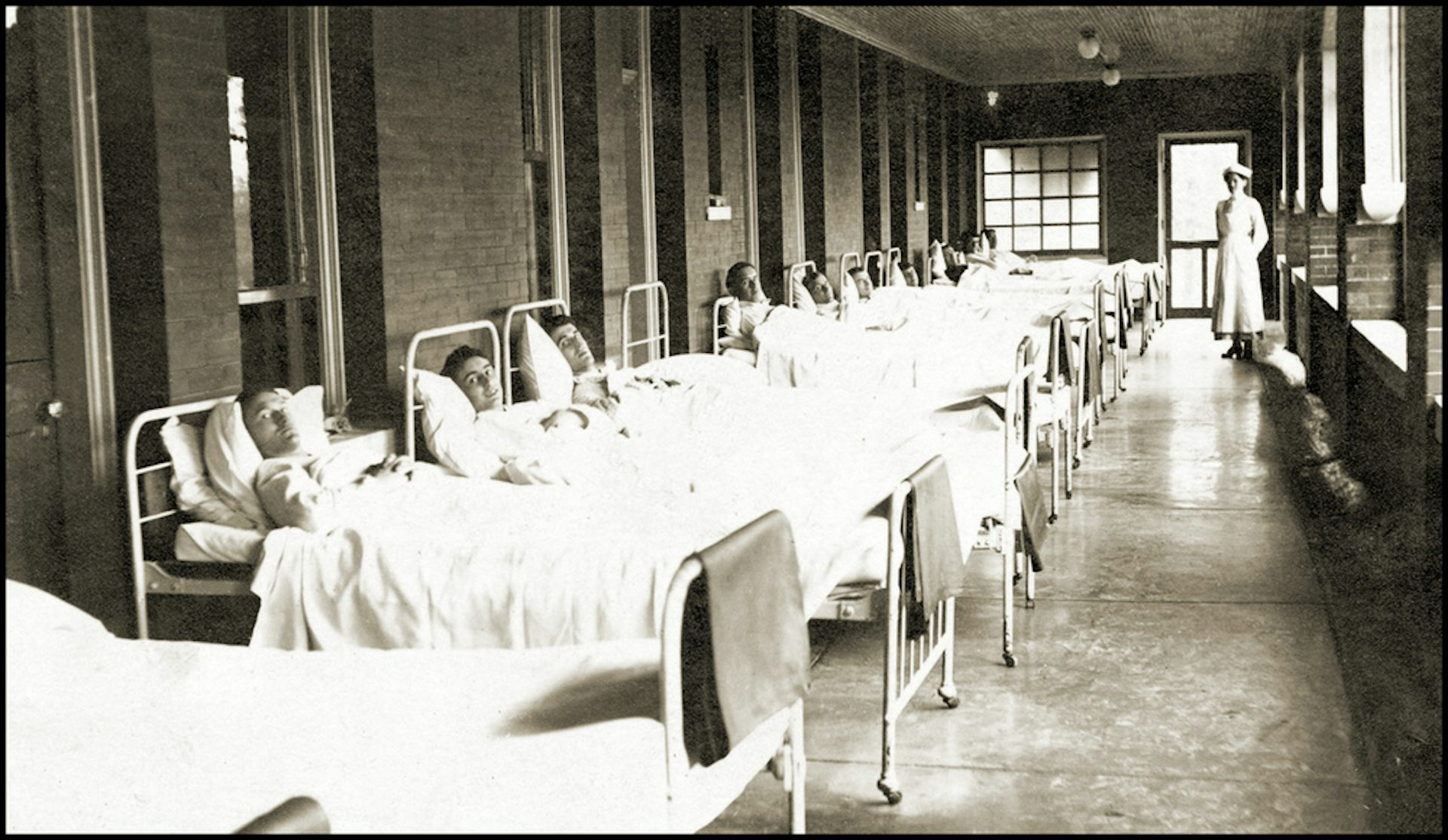
How were hospital beds made in 1918? Basically by hand ("artisanal"), but with lots and lots of very cheap labour. Those conditions still exist, since training someone to cut and bend metal tubes, drill holes and screw them together is not hard.
This effeciency doesn't simply go away, so. In the worst case scenarios we are discussing here, the relevant products are only asmall portion of global trade and supply chains. You could, for example, completely ignore Apple's operations under this scenario.
These critical porducts, and the coresponding manufacturing base, will be part of the critical infrastructure to be kept running. Automation is a huge benefit for this, as these operations can be run with a very limited number of people. Distribution and transportation is the same, it can be kept up for the essentials with a very limited amount of people. Even internationally, container ships continued to sail from Chinese ports. Granted, sometimes they sailed empty, but that was due to the shut-down of Chinese manufacturing.
In a true worst case scenario, dedicated ports will be kept running. again wth close to no people involved.
Administration for all this can be done to a huge part from home. Feet on the ground are by no means as important anyore as they used to be.
a situation like this should be avoided at all cost so. Hence the measures currently being taken.
Could it? We often no longer have random factories waiting around, ready to be repurposed. Neither do we have well functioning internal supply chains for the needed raw materials. I don't think people truly understand just how dependent any given country is on global trade (and especially Chinese manufacturing).
yeah, but even in 1918 not every city had a refinery or blast furnace. And even back then, a lot of the basic stuff was imported (think opium, cocain (probably the top medicines back then...), rare metals...). On top of that, in 1918, a lot of the things you (and I) take for granted were not even found (for example antibiotica). And instead of random factories, each city (heck each small town) has like 10-15 CNC-machines ready to produce anything which was done in 1918 - a problem might be all things chemistry/mining related, but the real important stuff (which was known in 1918) also back then has been produced centrally (and still is)...
The hard part is the basics - things that get commoditised tend to get manufactured more efficiently, and at massive scale this tends towards centralisation.
As a concrete example, in the entire country of New Zealand, no one manufactures window glass. Every window, everywhere in every building, ultimately gets shipped into that country in a container.
We'd also miss shoes as there are no "real" factories locally anymore. I think we make nails but I can't tell if we can really make bolts. So I'm not talking about cars, computers or aircraft. No way. Windows. Shoes. Bolts.
So OK, we're missing commodities, most industrial chemical processes, feedstocks, experienced manufacturing labour and plant expertise, all of which went south when NZ was one of the first countries to drop its pants and remove import tariffs. OK. I don't have a dog in that fight, there are reasonable arguments to stop subsidising things you'll never be internationally competitive at.
That said if all imports stopped tomorrow for, let's say, 2 years, it's surprising what you can do without or improvise. The main thing I think we'd really miss is life sustaining medicine. A loss of exports would actually be more catastrophic since our farmers would a) have no reason to exist and b) not be able to keep the finance wheels turning.
We're unbelievably wealthy compared to people in 1918 and we have a lot more slack and fat in our systems than we really know.
> The main thing I think we'd really miss is life sustaining medicine.
Yes, we need flexible chemistry machines on the style of CNC mills. The good news is that they aren't that far away, at the next pandemics we will probably have them.
you didn't have those meds at all in 1918 either (and this was OPs point). and for the NZ case: did NZ ever have a real industry? With a 4.5 Mio. population today I somehow doubt that... As for basic industries (and meds): in western europe at least, we still have those things, small-scale and specialized, but we have it, including all the supporting industries (what we don't have is electronics, which 1918 wasn't a thing yet ;)). We needed to import the raw materials for 200 years. So?
I have nostalgia for local production but also recognise it can be harmful to subsidise inefficient industries. Hard to draw the right line between cronyism (obviously tariffs are actually a tax on locals) and resilience. Strategically, NZ unilaterally dropped a lot of tariffs on the advice of economists without considering, game theoretically, how to extract corresponding concessions with trading partners. This started in NZ in the late 80's. They then negotiated largely empty-handed (What will you give me? Wait you already did that.. nothing else?) and had a lot of trouble getting other people to drop their tariffs. Which are still there, in many cases! So there's my dog I guess?
Uranium glass. Radium-dial watches. Gas-lantern mantles of urania and thoria. Lindane. In California, denatured alcohol. The meat of the heath hen or the baiji dolphin. Opium. Caribbean monk seal oil. Spermaceti. Ivory billiard balls. Low-radioactivity steel. Most patent medicines. Old-growth wood of some kinds of tree. Chemistry kits. The Revigator. Large sheets of monocrystalline mica.
It's probably going to be more difficult to find something that is still widely used and is manufactured, but cannot be manufactured in a particular city in 1918 but not 2020. It would require deep knowledge of the industries of a particular city or of a particular industry. For example, right now I think all three of the ruling engines in the US capable of cutting a research-grade diffraction grating into glass are in the single Richardson Gratings lab in Rochester, New York, but one of them was built at MIT before 1918. So perhaps Boston (or Cambridge at any rate) was capable of producing such artifacts in 1918, but not today; but, if that is true, rigorously establishing the truth of that claim would require considerable investigation.
Similarly, many US cities have many fewer watchmakers, compounding pharmacists, and piano tuners than they had in 1918; in some cases the number is indeed zero.
You can make soap at home, a factory anywhere can trivially make it. And face masks are paper plus string, again hardly difficult to manufacture in any city in 2020. (In the UK most paper was made centrally in 1918, I happen to know this because I live near the site of the former paper mills - https://www.thepapertrail.org.uk/).
Look, I have a lathe at home and can make an engine if I want to, thing is other people can't because they never were interested in that. And I used the simplest things possible as examples.
Realistically, where would you start with these in a typical deindustrialized town today? "A factory" is a poor answer, some towns have none really, and factories are not interchangeable anyway.
There are small factories - everything from workshops to industrial estates - all over the place. If anything it's much better now because CNC machines and lathes are cheap, widely available and very versatile.
Yes, they're cheap and widely available. That's because we import them from China.
If your plan for resilience against a long-term disruption of global trade has a critical dependency on global trade, you may need to rethink it somewhat.
face mask: some variation of paper cloth. Go to the local cellulose factory (I doubt every city had one back then, they were and still are near cheap energy/wood), specify the quality of the paper you want and get it (you have to pay for it, because today they are probably producing paper for $$$ bills). Some yarn: cotton/wool has always been imported in some locations, a local workshop will build a spinning machine @1918s quality in no time. The same for sewing machines (those things haven't changed a lot if you don't factor in automation (which even today noone bothers to pay for the existence of cheap slave labor in Bangladesh)).
Soap bar: we have a lot of animals around here and butcher them locally
giving you everything you need (https://www.essentialchemicalindustry.org/materials-and-appl...). You just have to find someone who is willing to do the necessary stuff 1918-style :)
I don't think that's true, case in point being the (eventual) Chinese response in Wuhan, which appears to be extremely effective (if you trust their figures). It's all about government determination, which is mostly missing now, just as it was then, based on the article.
> Or it is harder to force people into quarantine.
From the article:
> Harris believes that the rapid spread of Spanish flu in the fall of 1918 was at least partially to blame on public health officials unwilling to impose quarantines during wartime.
I think there's a quantity/quality difference between the cities of 1918 and today. Even if we have more people in cities today cities in 1918 had much, much worse health and cleanliness practices and allowed much more opportunity for disease to spread.