No one can enlighten anyone; you have to enlighten yourself.
Where did you get this picture of the pre-1968 world? For instance, your picture of classical Europe as "hardcore unrestricted capitalism" is frankly bizarre; you seem to be projecting 19th-century classical liberalism, a left-wing ideology in its day, back two or three centuries:
My turn: feel free to undarkly enlighten me. Watch this movie, or even skim it, then tell me that all is for the best in this the best of all possible worlds:
When this film was made, most women didn't have to work; now they do. When this film was made, African-Americans had a 25% illegitimacy rate, which Moynihan thought terrifying; now they have an 75% illegitimacy rate (with whites at 25%). When this film was made, women in college were treated like ladies; today they're treated like Casanova's whores. When this film was made, Detroit was America's third-largest city; today it's a ruin.
Tell me again what your abstractions have done for women and African-Americans? For Detroit? For anyone, for anywhere? Can you find me a population that was struggling in 1966 and is thriving now? Can you find me a place that was a shithole in 1966 and is gleaming now? I can sure as heck find a lot of examples in the other direction...
Oh I wasn't trying to describe classical Europe, I was describing what it looks like DE people want from the little I've skimmed. I won't pretend to know much about either topic.
Your "ideas" are abstractions. These abstractions are new (they are a product of 19th and 20th-century ideology). The realities behind them (charity, social mobility) are anything but new. For instance, Cardinal Wolsey was born into a poor family:
In general, the answer to your question is "the Catholic Church." This was not a perfect institution. Ours are not perfect, either. The present has had many opportunities to give you its view of the past; the past has had no opportunity to give you its view of the present.
The Ryen account is a little far down that page. Since we heard one story in anatomical detail, how about another?
"The first time I met Kevin Cooper I was 8 years old and he slit my throat. He hit me with a hatchet and put a hole in my skull. He stabbed me twice, which broke my ribs and collapsed one lung. I lived only because I stuck four fingers in my neck to slow the bleeding, but I was too weak to move. I laid there 11 hours looking at my mother who was right beside me.
I know now he came through the sliding glass door and attacked my dad first. He was lying on the bed and was struck in the dark without warning with the hatchet and knife. He was hit many times because there is a lot of blood on the wall on his side of the bed.
My mother screamed and Cooper came around the bed and started hitting her. Somehow my dad was able to struggle between the bed and the closet but Cooper bludgeoned my father to death with the knife and hatchet, stabbing him 26 times and axing him 11. One of the blows severed his finger and it landed in the closet. My mother tried to get away but he caught her at the bottom of the bed and he stabbed her 25 times and axed her 7.
All of us kids were drawn to the room by mom's screams. Jessica was killed in the doorway with 5 ax blows and 46 stabs. I won't say how many times my best friend Chris was stabbed and axed, not because it isn't important, but because I don't want to hurt his family in any way, and they are here.
After Cooper killed everyone, and thought he had killed me, he went over to my sister and lifted her shirt and drew things on her stomach with the knife. Then he walked down the hallway, opened the refrigerator, and had a beer. I guess killing so many people can make a man thirsty."
The sole survivor, Josh Ryen, had told a social worker in the emergency room that the murders were committed by 3 or 4 white men. Josh spelled his message by pointing at letters on a clipboard as he was unable to speak, but the social worker and medical staff observed that he was lucid and could spell his name and address correctly. Judge Fletcher wrote, "Deputies misrepresented his recollections and gradually shaped his testimony so that it was consistent with the prosecution's theory that there was only one killer." Jurors, however, said they disregarded Ryen's testimony because they believed he was confused and traumatized.
On June 9, a woman named Diana Roper called the Sheriff’s Department to tell them that her boyfriend, Lee Furrow, had come home in the early hours on the night of June 4. He arrived in an unfamiliar station wagon with some people who stayed in the car. He changed out of his overalls, which he left on the floor of a closet. He was not wearing a t-shirt that he had been wearing earlier in the day. He left the house after about five minutes and did not return. [Roper and her father] both concluded that the overalls were spattered with blood. Roper turned the overalls over to the Sheriff’s Department and told the deputy that she thought Furrow was involved in the murders. Roper later provided an affidavit stating that a bloody t-shirt found beside the road leading from the murder house had been Furrow’s. It was a Fruit-of-the-Loom t-shirt with a breast pocket. Roper stated that she recognized it because she had bought it for him. She also stated that a bloody hatchet found beside the road matched a hatchet that was now missing from her garage. [...] The Sheriff’s Department never tested the overalls for blood, never turned them over to Cooper or his lawyers, and threw them away in a dumpster on the day of Cooper’s arraignment."
Furrow had been released from state prison a year earlier. He had been part of a murderous gang, but had been given a short sentence in return for turning state’s evidence against the leader of the gang. The leader was sentenced to death. Furrow told friends that while he was part of the gang he killed a girl, cut up her body, and thrown her body parts into the Kern River."
We know you can implant false memories, especially in kids. If the cops decided Cooper was guilty it would have been easy to coach him into giving the testimony above.
I'm not saying he is innocent or guilty, just that there appears to be some doubt, much of it due to police sloppiness and misconduct.
This is why it's a great idea to try these cases on Hacker News. (I'm only half kidding.) Always and everywhere, if you sit on a jury and listen only to the prosecutor or defense attorney, you will come to the conclusion they want. This is for the same reason you can't tell what a magician is doing with his hands: he's an pro, you're an amateur.
3. Josh Ryen told the police he thought three men committed the attack. He later changed his story.
"When Josh was rescued the day after the murders, he could not talk because his throat had been slashed. He could only squeeze the police officer's hand in response to questions. The story that Josh was finally able to tell police was that he was awakened in the middle of the night by his mother's screams. When he and his friend Chris went to investigate, he saw the bodies of his parents and Jessica and the backside of one unfamiliar person, so he ran and hid. Then he heard Chris screaming, so Josh ran back towards his friend. At that point, something struck him in the head, knocking him unconscious. He awoke later in a pool of blood.
When later queried by investigators, Josh spoke of three Mexicans who had come to the house earlier and thought they could have done it because they had been there once before. However, Josh never said he saw three people commit the murders. He consistently told different investigators that he saw only one attacker. The triple murderer theory is merely speculation based on the visit of the three Mexicans and twisting of a little boy's words.
Additionally, Josh was an eight-year-old boy who was startled awake by a horrific murder and was brutally attacked. It is unsurprising that probing questions by adults and the power of suggestion later tried to confuse his story. Most important however, Cooper was not convicted on the limited testimony of an eight-year-old. He was convicted by the mountain of other evidence incriminating him."
1. The girlfriend of a former inmate friend of Cooper's, thought her boyfriend might have been involved in the murder. She turned his bloody coveralls over to the local Yucaipa sheriff's substation, but they threw out the coveralls without testing them.
"This girlfriend, Diane Roper, was dismissed by law enforcement as completely lacking credibility. She was a professed witch who claimed she had a vision during a trance that the murder had been committed after she heard about the Ryen case. However, she had no substantive reason to believe her boyfriend was involved with Cooper the night of the murder. In fact, she told sheriff's investigators that she did not even know to whom the coveralls belonged. She said she "just knew" from the vision that the coveralls were connected to the case. By the time the San Bernardino County Sheriff's Department heard about her fantastic story, they had Cooper in custody with mountains of evidence (see above) against him. Based on their limited resources and already having the likely killer in custody, the San Bernardino County police chose not to expend precious time and money chasing Roper's crazy story."
As for the other evidence:
"The victims died from numerous chopping wounds later determined to have been inflicted by a hatchet or axe and stabbing wounds inflicted by both a knife and an ice pick. Later that day, bloodstained items were found in the vacant house where Cooper had stayed, including a button from a prison jacket identical to the one he was wearing when he escaped. A police criminologist also found evidence of blood on the carpet, in the bathroom sink and in the shower along with Cooper's footprint. Hairs from the shower drain and the bathroom sink were consistent with those from two of the victims.
A bloodstained hatchet from the vacant house was later found near the Ryen home. The sheath from the hatchet was found on the floor of the bedroom where Cooper had slept. Some hunting knives and at least one ice pick were also missing from the vacant house. A strap fitting one of the missing knives was found in the same bedroom. Shoe prints were found in the Ryen home and the vacant house next door matching the unique pattern of shoes issued exclusively to prison inmates. The prints indicated shoes of Cooper's size and brand that he had recently received in prison.
While most of the blood samples taken at the murder scene were determined to have come from the victims, one sample was conclusively determined to have come from a black person with the same blood group as Cooper. The sample was too small to determine if it was Cooper's rare blood type.
The Ryen station wagon was found several days after the killings in a church parking lot in Long Beach. Hairs found in the car matched those of Cooper. Tobacco issued exclusively to prison inmates, which Cooper smoked, was found in the vacant house and in the Ryen's station wagon.
Two days after the murders, Cooper befriended a couple in Mexico and joined them on a boat trip up the California Coast. Weeks later, Cooper was arrested on a boat off of Santa Barbara after the woman reported that he had raped her at knife point, threatening to kill her if she woke her husband. Following his arrest, several items taken from the vacant house in Chino were discovered on the boat.
At his trial, Cooper admitted staying in the Chino house but denied any involvement in the Ryen murders. Josh Ryen, who miraculously survived his injuries, testified that he awoke on the night of the murders after hearing his mother's screams. He remembered being hit from behind when trying to investigate but was unable to identify his attacker.
For the 19 years following his 1985 conviction, Cooper's claims of trial and sentencing errors have been reviewed by California and federal courts. In 2000 he won a delay of his execution so that new DNA testing could be performed on various blood and saliva samples found at the murder scene, in the stolen station wagon, and on a bloody t-shirt found near the Ryen home. The DNA from all of these samples was found to have come from the same person. This DNA was then compared to DNA from Cooper's blood. It matched. The odds of the match being by chance were 1 in 310 billion."
When you hear one side of the story, always look for the other -- whether or not it's a criminal trial. Adversarial justice works.
There's one fact that is never mentioned in this story.
Methane is lighter than air (about 0.7th the density of air). The methane leak is above Porter Ranch (about 1200 feet, a fact that is mentioned).
You know that and I know that. But do most NYT readers know that? If not, why doesn't the writer mention it? He does mention elliptically that the town residents are smelling mercaptans, not methane. He doesn't mention that the methane can't possibly be reaching them. It seems like this simple science fact would bring a lot of clarity to the picture.
(In related news, the greenhouse effect is O(log n), as a function from greenhouse gas concentration to thermal forcing. I'm sure everyone here knew this as well.)
Whenever I see smart geeks talking about tons of CO2, I always wonder what percentage of them know whether the Arrhenius effect (temperature forcing as a function of CO2 concentration) is exponential, linear, or logarithmic.
Yep; the other irony was that his prosecutor was O. John Rogge, one of the great liberal crusading attorneys of the day, who insisted on bringin charges in order to drag militant racism into the light of day. So Dennis, spurred by his hatred for American racism, made common cause with thuggish men who would have happily hanged him from a tree, and as a result was prosecuted by a man who otherwise would have been his natural political and moral ally. A complex man, Lawrence Dennis. (There is one biography available, The Color of Fascism, which is a little too clunky to be authoritative, but which is well worth reading. An equally unusual journey is that of Bayard Rustin, an openly gay African American civil rights activist who studied under Gandhi, introduced MLK to the theory of nonviolent activism, and ended up part of the neoconservative movement in the Reagan administration.)
I'm not sure any intellectual who collaborated with Hitler should get points for warning the world about Stalin. Or vice versa.
If Harper's had written an article called "Who Goes Bolshevik" in 1941, it could have been much shorter: "pretty much everyone." Or at least, everyone who mattered. If you wanted the truth about Stalin in 1941, you'd do much better with the Voelkischer Beobachter than the New York Times.
It doesn't seem like it at all. Things she apparently wrote in 1946:
The West experienced moments of doubt, Thompson wrote, in which the outcome of communist belief and behavior was questioned: "Can communist cultism, organized like a medieval secret order, with a priesthood, a police and an inquisition, reform itself into a modem, liberal, democratic movement?" Why, during the war, did communist propagandists throughout the world demand an immediate "second front", an attack on heavily fortified Western Europe by the United States and Great Britain? "Did these obedient claques care nothing for the lives of American boys? Were they listening to any voices but the voice of Stalin?"
"Yet, we said: No", Thompson continued. "We shall prove our confidence, trust and trustworthiness. We shall hold faith that it will not be betrayed. Loyalty, we said, begets loyalty." But as Germany collapsed, the Soviet Union began "reversing every wartime pledge and policy. And not only was the quarter of a century of communist despotism to be fastened again upon the necks of the long suffering, heroically,enduring, eternally,hoping, eternally,serving Russian people -but naked and unashamed it was seeking new people to subject. "
"Dorothy Thompson, the well-known columnist, writes: 'Russia does not want to make an isolationist policy. Russia wants a friendly Europe in a friendly world, with a system of collective security. There are signs of such hostility in both Europe and America to Russia that it gives Russian leadership some reason for suspicion. As things look at present, it is by no means certain that defeat of Germany will assure a non-Fascist Europe or one prepared to adopt a good-neighbor policy toward Russia."
Her views in 1946 are standard 1946 post-FDR New Dealism (after the Anglo-Soviet split); her views in 1943 are standard 1943 New Dealism. You're just hearing the party line; God only knows what she actually thought, and when.
It would be much easier to fight the memory hole if we didn't have these ridiculous copyright laws, but a lot of original WWII propaganda (not cherry-picked by modern hagiographers) remains on line. It's often pretty appalling reading.
That's extremely thin gruel. You seem to want to paint any whiff of Russia/Soviet sympathy as the equivalent of 'Stalin apologist' and reaching even further, an equivalent to being a Nazi sympathizer. I don't think that's a view that can easily be factually rather than ideologically supported.
I recommend Malcolm Muggeridge's autobiography for a compelling look at the circle of Western journalists in Moscow in the '20s and '30s, of which Muggeridge was a part. Scott Alexander has a good review:
You either stayed in that circle or dropped out; there was no in-between. Of the reporters listed in the link, W.H. Chamberlin is the only other one who defected. Duranty (whose Pulitzer the NYT still refuses to return) was the norm, not the exception.
Also note that Thompson was part of the most bloodthirsty wing of New Dealists (eg, Rex Stout, also seen in the link) who supported prewar and postwar anti-German atrocities. It was certainly Nazi policy from 1941-45 to kill as many Jews as physically possible, but it was also Allied policy from 1941-45 to kill as many Germans as physically possible -- and that policy by no means stopped on a dime in May 1945:
I think a very small amount of stylometric analysis would cast a lot of doubt on this theory.
Satoshi's grammar is always perfect. His sentences are tight. He's clear and to the point. Wright rambles; his grammar is terrible; he seems to have no idea what a comma is for. Scanning his blog for a minute, he comes across as the kind of slightly dotty kook who would try to convince people he's Satoshi with this kind of "leak."
I'll stick with the current mainstream theory, thanks...
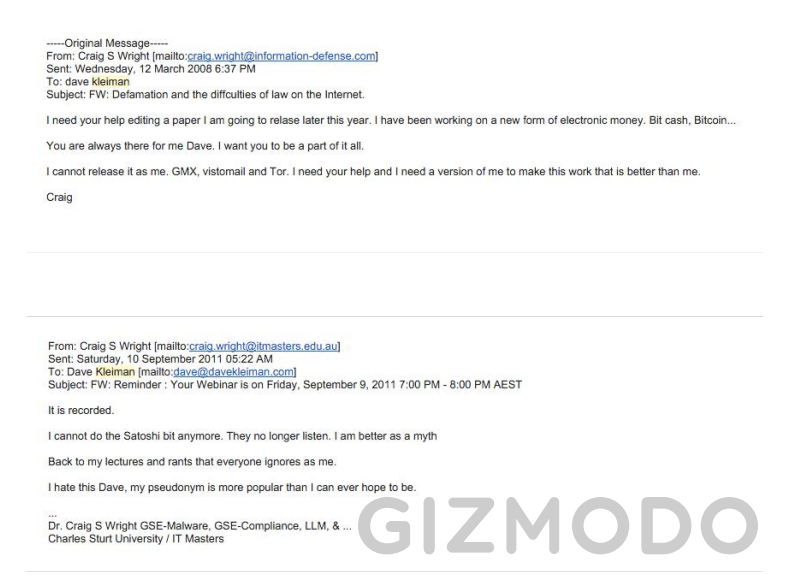
Satoshi is two people - Wright and Kleiman. Kleiman was responsible for the public Satoshi writing, and he doesn't have any of his own writing samples online that aren't co-authored to make a stylometric comparison against.
I think there are a lot of engineers on here who only express a single language style.
In the business world I see writing style changing depending on who one is talking to - a trait I don't generally see in engineers. Who knows the mind of the originator of bitcoin.
Also, Wright can have a few drinks and click to send a sloppy message without much thought. However any time he purportedly posts as Satoshi he probably re-reads it 100 times with his heart pumping at 150bpm and takes as much care over his writing as the potentially fictional Satoshi. The author of bitcoin would surely be clever enough even if his natural language skills were poor.
You'll need to get on archive.org then as he is currently going through and deleting all his blog posts.
Edit: well worth mentioning, on this note, that he asks for his associates to edit his public messages, seemingly aware of his terrible writing. Or a knowing attempt to obfuscate these matters. Or alternatively, yknow, not this guy.
Not only grammar, but Wright's writings are full of typos and spelling errors, which occur at a remarkable rate, to the extent that he can't spell Silicon Valley! (he spelled it as "silicone valley"). I never once saw Satoshi make a spelling error.
That said, the rest of the evidence is pretty compelling, isn't it?
Satoshi did once say he wasn't all that good with words, despite evidence to the contrary. Perhaps this mysterious collaboration with his dead friend involved the other guy writing the messages.
I think that's plausible particularly because he emailed someone asking them to leak his message about not being Dorian, and that person heavily edited / redacted it; it's quite possible that is a recurring theme.
Also in the Gawker article we are told Wright emailed Kleiman asking for "help editing a paper", "I need your help and I need a version of me to make this work that is better than me."
Notice that most of Wright's retroactive editing to make himself look like Satoshi took place in 2013-2014, shortly after Kleiman died.
Perhaps Kleiman was the one who really wanted to keep Satoshi's identity a secret, but Wright had different ambitions and now he doesn't have his friend to rein him in anymore.
Or Kleiman & Wright formed the Satoshi identity as a collaboration, and after Kleiman died, Wright decided to edit the historical record to take more of the credit for himself.
I'm glad you wrote because I was wondering about that. The stuff I've seen on Satoshi seemed to indicate a precise, engineer's mind. He should also have a certain programming and writing style with quirks that would be hard to entirely eliminate in revision. My method would be to compare the code/writing of the "maybe Satoshi" to Satoshi's.
Your comparison indicates they're highly unlikely to be the same person. Come to think of it, Wrights words are one of the only things we can attribute to him and evaluate in this. The rest can be made up crap and probably is.
the spelling of "silicone" looks intentional to me. the review is titled "Like the US is the only country to produce tech."
'Craig Wright of Australia wrote, a bit petulantly, “Always the assumption that [Satoshi Nakamoto] must be a bloody yank. The analysis of who Satoshi is is always so limited.”'
> So let’s recap: in September 2015, Wright was annoyed that people didn’t know who the real Nakamoto was.
Is Kashmir unable to read? Wright never said that. He was clearly angry about the national stereotyping and the 'assumption' and how thinking is 'limited'. This is exactly like those cases where women authors publish books under names like 'J.K. Rowling' and readers assume they are men; of course they are going to be upset.
> Satoshi's grammar is always perfect. His sentences are tight.
That makes me think it's more than one person, e.g. Wright, Kleiman, Szabo and possibly more. The more people that edit a work, the less errors there will be.
This has to be the nicest, most reasonable-sounding ad hominem argument I've ever seen.
But it's still an ad hominem argument. Is there any way you actually disagree with the post? What would you say to Dr. Hsu if he were in the room?
Also, what is your evidence that he's not in touch with experts in psychometrics and human genomics? I don't know him, but I have very much the contrary impression.
Also, what is your evidence that he's not in touch with experts in psychometrics and human genomics? I don't know him, but I have very much the contrary impression.
I don't know him in person but I have emailed him. He is in touch with a lot of eminent experts (I know some of the same eminent experts and see some of the regularly in person), but he hasn't imbued their worldview about human genetics, forged after years of pursuing other worldviews that don't hold up to experimental test. But your comment is fair, so I'll recommend here for you and for onlookers some writings by people who are experts in psychometrics and human behavior genetics.
The review article
Johnson, Wendy; Turkheimer, Eric; Gottesman, Irving I.; Bouchard Jr., Thomas (2009). Beyond Heritability: Twin Studies in Behavioral Research. Current Directions in Psychological Science, 18, 4, 217-220
includes the statement "Moreover, even highly heritable traits can be strongly manipulated by the environment, so heritability has little if anything to do with controllability. For example, height is on the order of 90% heritable, yet North and South Koreans, who come from the same genetic background, presently differ in average height by a full 6 inches (Pak, 2004; Schwekendiek, 2008)."
The review article
Johnson, W. (2010). Understanding the Genetics of Intelligence: Can Height Help? Can Corn Oil?. Current Directions in Psychological Science, 19(3), 177-182
looks at some famous genetic experiments to show how little is explained by gene frequencies even in thoroughly studied populations defined by artificial selection.
"Together, however, the developmental natures of GCA [general cognitive ability] and height, the likely influences of gene-environment correlations and interactions on their developmental processes, and the potential for genetic background and environmental circumstances to release previously unexpressed genetic variation suggest that very different combinations of genes may produce identical IQs or heights or levels of any other psychological trait. And the same genes may produce very different IQs and heights against different genetic backgrounds and in different environmental circumstances. This would be especially the case if height and GCA and other psychological traits are only single facets of multifaceted traits actually under more systematic genetic regulation, such as overall body size and balance between processing capacity and stimulus reactivity. Genetic influences on individual differences in psychological characteristics are real and important but are unlikely to be straightforward and deterministic. We will understand them best through investigation of their manifestation in biological and social developmental processes."
(The review by Johnson, by the way, is rather like Tao's understanding of how mathematical talent develops in individuals, which prompted the blog post kindly submitted here.)
A comprehensive review article for social scientists on genetic research on IQ emphasizes what is still unknown.
Chabris, C. F., Hebert, B. M., Benjamin, D. J., Beauchamp, J., Cesarini, D., van der Loos, M., ... & Laibson, D. (2012). Most reported genetic associations with general intelligence are probably false positives. Psychological science, 23(11), 1314-1323. DOI: 10.1177/0956797611435528 http://www.ncbi.nlm.nih.gov/pmc/articles/PMC3498585/
"At the time most of the results we attempted to replicate were obtained, candidate-gene studies of complex traits were commonplace in medical genetics research. Such studies are now rarely published in leading journals. Our results add IQ to the list of phenotypes that must be approached with great caution when considering published molecular genetic associations. In our view, excitement over the value of behavioral and molecular genetic studies in the social sciences should be tempered—as it has been in the medical sciences—by an appreciation that, for complex phenotypes, individual common genetic variants of the sort assayed by SNP microarrays are likely to have very small effects. Associations of candidate genes with psychological traits and other traits studied in the social sciences should be viewed as tentative until they have been replicated in multiple large samples. Doing otherwise may hamper scientific progress by proliferating potentially false results, which may then influence the research agendas of scientists who do not appreciate that the associations they take as a starting point for their efforts may not be real. And the dissemination of false results to the public risks creating an incorrect perception about the state of knowledge in the field, especially the existence of genes described as being 'for' traits on the basis of unintentionally inflated estimates of effect size and statistical significance."
The newer publications on the topic are not changing the picture significantly. If one desires to develop a child's mathematical ability, for example (a problem I have pondered four times over as a parent), then the thing to do, after gaining whatever favorable shuffle of genes one can through thoughtful choice of a marriage partner, is to ensure that the child receives a sound primary education in mathematics. That is rarely done in the United States,[1] but it's something parents can do if they know mathematics well through some other channel, for example having lived in another country.
> The review article...includes the statement "Moreover, even highly heritable traits can be strongly manipulated by the environment, so heritability has little if anything to do with controllability. For example, height is on the order of 90% heritable, yet North and South Koreans, who come from the same genetic background, presently differ in average height by a full 6 inches (Pak, 2004; Schwekendiek, 2008)."
If you think this is contrary to Hsu's position, you don't understand his position.
TLDR: the researchers you admire are part of a school that disagrees with Dr. Hsu's school.
Or at least, sort of disagree. It's not that they have any results showing a method for increasing either IQ or mathematical capacity. They just don't feel that it's entirely, completely, totally and utterly proven that such a method (which the entire education industry has spent the last century searching for) doesn't exist. Well, sure. Obviously, in an empirical science, negatives are pretty hard to prove.
But let that be. Suppose your guys are totally right. It used to be, in days gone by, when perhaps the spirit of science was better understood, that everyone interested in science understood that a hundred flowers bloomed, contending schools are a great and normal thing, and scholars can disagree -- without attacking each other personally as failed physicists, college administrators, etc.
Let alone elitists, racists, and Trotskyist wreckers. Speaking of the spirit of science, and schools thereof, I wonder what your position on Professors Boas, Gould and Mead might be? Do you regard them as conclusively guilty of scientific fraud? Or do you feel that in some way the jury remains out? What do you feel Professor Turkheimer's views on the question might be?
The N. vs S. Korean example you mention is explicitly discussed in one of Hsu's articles. (Secular change in height due to improved environmental conditions.)
"Let me reiterate that within a range of favorable environments (i.e., providing good nutrition, hygiene, and access to education), evidence strongly supports the claim that individual differences in cognitive ability are largely associated with genetic differences.
Figure 8. Increase in stature in European countries over time, almost +2 SD. Nutrition, hygiene, and average number of years of schooling all improved dramatically over the last 100 years, leading to improvements in both physical and mental development."
You should probably read his paper carefully before making ad hominem attacks. Save your SJW signaling.


Where did you get this picture of the pre-1968 world? For instance, your picture of classical Europe as "hardcore unrestricted capitalism" is frankly bizarre; you seem to be projecting 19th-century classical liberalism, a left-wing ideology in its day, back two or three centuries:
https://en.wikipedia.org/wiki/Mercantilism https://en.wikipedia.org/wiki/Jean-Baptiste_Colbert
My turn: feel free to undarkly enlighten me. Watch this movie, or even skim it, then tell me that all is for the best in this the best of all possible worlds:
https://www.youtube.com/watch?v=aBZ6hgA-Cc4
When this film was made, most women didn't have to work; now they do. When this film was made, African-Americans had a 25% illegitimacy rate, which Moynihan thought terrifying; now they have an 75% illegitimacy rate (with whites at 25%). When this film was made, women in college were treated like ladies; today they're treated like Casanova's whores. When this film was made, Detroit was America's third-largest city; today it's a ruin.
Tell me again what your abstractions have done for women and African-Americans? For Detroit? For anyone, for anywhere? Can you find me a population that was struggling in 1966 and is thriving now? Can you find me a place that was a shithole in 1966 and is gleaming now? I can sure as heck find a lot of examples in the other direction...