Can't answer for aluminium, but I can answer for window glass: One of our plants was threatened by massive flooding 2021, threatening the float glass oven (which doesn't float itself despite the name). It was closed off with insulation, turned off, and everyone hoped for the best and no steam explosion. In the end, only the cellars with the control equipment flooded and it could be gradually (as the control cabinets were checked and restarted) brought up again without loosing too much heat a day later.
In short: Heat Inertia of large molten bodies is massive with good insulation. If the time is too long tho, only dynamite will dismantle a solid chunk of material again.
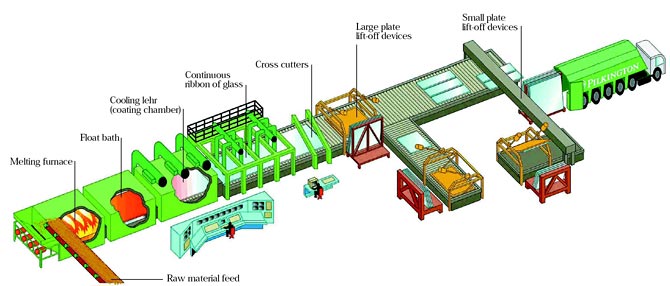
Its not an oven alone, its a kiln that smelts up the components for glass of the desired recipe, then purs the glass on a long (~half a km) basin of molten tin where it stretches and cools slowly, pushing the solidifying mass down the basin until the end. Re-Melting it is as far as i know not possible, as the melting is done before the pouring. You can melt the tin again, but not the glass.
Interesting! Does this mean that you could use intermittent energy sources, like solar power, to heat up the float glass oven during the day and it woul keep enough heat during the night so that it could keep running in the morning?
Float glass is a continuous process, so it runs 24/7 and too much product is recycled into the smelter at the start again (Funnily, glass waste is actually a scarce resource). Getting the process dialed in to emit the desired quality is a long winded thing as far as i know (not involved in the process myself). Also, the heating is done with gas (LNG/CNG/H2) and electric in combination.
The Insulation is in place all the time because the process is very energy intensive and the glass over the whole basin is supposed to cool evenly. Just the end is not closed off as the glass is ejected in a continuous endless stream[1].
At least where I live, the Steam is either reused from thermal power plant waste heat which would be evaporated off anyways, or its the heat directly produced from specialised combined electric/thermal gas plants (Blockheizkraftwerk).
Also, general industrial waste heat is sometimes used (glass plants e.g).
I always wanted to build a controller for Canon Telephoto lenses to use them with c-mount cameras and control the focus from a PC. Might be helpful for that.
A couple of universities built a telescope called Dragonfly, that utilizes 48 Canon 400mm lenses to photograph the skies of New Mexico. The kicker is they don't use camera bodies. Instead, they designed and built mounts that directly connect the lens to a sensor. A PC controls each lens through some custom electronics using commands they reverse-engineered from the Canon control software. These commands control focus, aperture, and triggering a photograph. Images from the 48 lenses are then combined in the computer into a highly detailed final image. This was done back in 2013 so its possible Canon has released an API by now but I suspect they still keep it proprietary.
I visited some similar telescope in Australia at https://www.sidingspringobservatory.com.au/ run by Macquarie University ... the students explained the lens system could not be too new and could not be too old. Basically it sounded like someone had partly reverse engineered one generation of the lens interface only.
I guess the camera and lens manufacturer wants their lenses to be used with their cameras and to have better results than other manufacturers, whereas random companies want to clone the interface and sell cheaper lenses that also work with the cameras. Realising how awesome the lenses are, the students want an array of them, however they don't have the budget to buy a similar array of top end manufacturers' cameras.
A number of machine vision camera vendors have higher-end variants that support active EF-mount lenses. They tend to be quite expensive models with larger sensor, since you tend to lose a lot adapting full-frame lenses to tiny C-mount sensors.
If you want a computer-controlled lens, one of the cheapest options is to use Blackmagic cameras that support SDI and/or USB control. You can then control either native M4/3 active lenses (focus, aperture, zoom) or supported EF-mount lenses if you use one of the EF->M4/3 active adapters.
Working at a large Tier 1 Automotive supplier for most European OEMs but Tesla as well, it was a not-complete-joke to make show prototypes that massively hinted at Tesla or had some misleading branding and leave them accidentally lying around, when you wanted to increase your chances of selling it to any other OEM.
Also, when you sold something to Tesla, you could already prepare RFQs for all others basically the day it would be released.
Stopped since Musk went Bananas, now noone wants to be associated with them. At all.
I did something similar with a friend for some time for another game.
As it went, our data was used to prove things to the developer they would have loved to hush-hush, which led to a cat and mouse game with the data and their open and... not so open apis. In the End, we stopped playing the game and stopped our efforts at it.
Fun times.
I am in the vehicle glazing/ automotive electronics industry.
Sometimes I wonder if I shouldn't switch to making child-sized sewing machines, toy-shaped landmines or fentanyl-laced sweets. It would be morally less damning than what is made in that industry.
Another amazing feat of age is Noriaki Kasai, 51 Years old, still active in competitive ski jumping. Oldest Person to ever win a world cup competition. In 2014. And still (sometimes more, sometimes less) capable of performing.
In all honesty, and considering that everything you build with a SBC is not that powerful and a cabling mess, I would recommend to go for a refurbished ThinkCenter Tiny or similar + an external HDD Rack.
Atleast thats the route I went, and I am vastly less annoyed about it.
I got a small thinkcenter a while back that I currently run some docker stuff on (homeassistant, pihole, some custom stuff), and I am pretty happy with it. Do they have a spare pcie or something to attach all the drives to, though? I don't remember seeing anything like that when I was inside mine, though that was a while back, so my memory may be wrong
In theory you can use the WiFi-One, though I don't know if that one is BIOS-locked. I just use it with USB3 and a 4 Bay Enclosure, which probably someone is gonna explain to me is the worst idea since leaded gasoline, but I have absolutely no Issues with my ZFS NAS for 5 years that way.
Over on reddit I once floated a similar idea but everyone exclaimed that USB enclosures sucks and you should not use them at all. Now technically you could - with some PCIe expansion cards - connect SAS/SATA HDDs to the ports on your mini/SFF PC, but then you need an enclosure for holding, powering and cooling the disks. Holding and cooling is simple enough and there's enclosures on AliExpress that cost like 10 bucks that do it for you, but you'd still need a PSU outside of the PC to power the disks. At that point the USB enclosure starts looking even more enticing.
Which one are you using right now? There's some brands out there that are considered really bad by the community.
Ah, good point, I hadn't considered a USB solution. I might look into that, though I'll have to see if there's a good way to keep all the cables looking tidy and not have a cable coming out the front and then disappearing back inside again haha
Some of the models do - I have the M720q and it has a small form factor PCIe 8x slot on the motherboard, but you need a proprietary riser board (cheap on aliexpress) to convert it to a real PCIe slot, and it takes the place of the internal SATA drive cage and rear port adapters (VGA or serial or what have you) so you can't use those.
I'm using mine as an OpenWRT router with a dual 10 Gbe ethernet card in the PCIe slot ever since I got 10 Gbit internet at home and consumer 10 Gbit routers are expensive and leave a bit to be desired
I would love to buy one of the Maruti Suzuki Jimnys. It's been sold in Europe, but you can't get one in Europe anymore because its not complying with arbitrary eco-guidelines (Which somehow a G-Wagon, a Defender or a Land Cruiser are).
Prices for 50K KM Used Cars are nearly double the price of new ones.
Since also LADA isn't on the European market anymore, you can't get a small off-road capable vehicle anymore.
Okay, there are no dedicated off-road vehicles anymore, only luxury SUVs that no one can afford and no one would take off road.
I guess it is because of EU fleet-wide CO2 averages. From next year on fleets must be below 93 g of CO2 per kilometer or the manufacturer is fined.
Suzuki has a very small fleet without any real low-emission cars, thus struggles to get below this new average. Combine this with the EU Jimny's four-cyclinder 1.5 l engine terrible gas mileage and it is easy to see why Suzuki is pulling this car (and many others) from the EU market.
That's why critics say that the fleet-wide CO2 average regulation favors manufacturer with large fleets. Since actual sales number do not factor into the equation low or no emission vehicles average out the wasteful SUVs and other big cars on a fleet average on paper only.
I'm not completely against fleet-wide averages, but I would like to see a competition. The fleet with the lowest average CO2 emission per kg sets the lower bound for a given year and all others are fined. This would cause a very fast scramble (just to catch up with Tesla, Jaguar, and Honda) and level the playing field for smaller manufacturers.
It was emissions [0]. In fact, it's still being sold as a "Light Commercial Vehicle", having less strict emissions needs, under the names Jimny Pro (at least on Spain), Jimny Mata (Italy, starting to sell in the end of this month IIRC) or Jimny Horizon (Germany).
The electric model seems to be confirmed for the future, and there are rumors of a hybrid model.
Join us in the chorus to get rid of fleet-averages ;)
The crux, however, is that nobody is allowing or disallowing anything. Suzuki has made the choice to withdraw the Jimny in light of the fines, while Mercedes-Benz made the choice to keep the G600 available despite the fines.
Consider, Mercedes-Benz has many cars, esp. Smarts and EVs, in their fleet that significantly lower the fleet average to around 110 g CO2/km. Suzuki, with a small portfolio of ICE cars, in comparison, hovers somewhere 115 g CO2/km (all from the link above). MB is a higher-margin shop, its cars, esp. the G600, are much more expensive then Suzuki's, so MB opts to shoulder the (lower) fine, while Suzuki does not.
I can't really blame Suzuki on this and I'm looking forward to the Toyota-Suzuki co-op on EVs.
But only in the sense that manufacturers are pooled together to reach a certain volume and very small manufacturers are basically excluded from the regulation.
> I'm not completely against fleet-wide averages, but I would like to see a competition.
They seem absurdly silly. Just put a tax for each car of $$$ per g of CO2 per km. Then you're properly targetting the thing you care about rather than a lossy proxy. Or even better, increase tax on fossil fuels!
I think the idea is that car manufacturers are motivated to internally subsidize low emission car development and sales, so that they can sell high margin high emission cars, making the latter even more expensive. Double win?
I just want to interject that "50K KM" was fun to parse out. I like the way two conventions collided here. 50Mm would have been correct, but confusing.50MM more so.
I sometimes see kk on the interwebs when writing the full numbers doesn't make sense ie too many zeroes or to avoid the accidental confusion between k and M.
Eco guidelines apply to manufacturer's fleet sales as a whole, meaning a larger manufacturer which makes EVs and eco friendly ICE variants has the "budget" to offer models that are not eco friendly, such as your examples. Suzuki doesn't have offers on the market that would offset the Jimny's pollution so they can't sell it anymore.
Jimny is in a completely different league than Panda 4x4, not even remotely close. Ladder-frame chassis, no center differential, beam axles, double-range gearbox — none of that typically applies to SUVs (especially cheap ones)
With modern horsepower levels, modern transmissions and modern stiff body/chassis that stuff doesn't matter nearly as much these days as it did 30yr ago.
A modern crossover with ~200-300hp and whatever stupid low first gear they gave it in it's 8-10spd transmission typically has the same 0mph torque as whatever 90s meme-mobile the fanboys are all drooling over at any given minute. Modern unibody chassis are rigid enough ladder frame doesn't really matter. Suspensions mostly get mounted to thicker subframes anyway. Modern clutched center diffs are typically capable of transmitting more power and torque than you have traction to make use of (even with real tires and sometimes chains, trust me I've tried).
The biggest hurdle is that any given model may or may not be neutered in software. Unless the particular vehicle in question has some mode you can put it in to tell it that a little tire spin is fine all the electronic nannies are gonna flip the F out because what works well in sloppy off road conditions is pretty much the exact opposite of what's ideal for preventing some Karen who's got her Gingerbread (gotta pick a winter seasonal flavor for this comparison) latte in one hand and the steering wheel in another from getting ever so slightly sideways in the snow dusted parking lot. This has the hilarious side effect of resulting in "off road" and "sporty rally car" trim AWD subcompact SUVs and small cars running circles around the "soccer mom trim" versions of "proper" SUVs (in real situations, not sand on the beach or parking in a muddy field stuff) because while the latter has a more impressive hardware stack it's software stack won't let it actually use it.
Since we're on safety ratings; the Duster gets a 3/5 from Euro NCAP.
Many of Dacia's newer models get 1/5, some 2/5, and only the Sandero gets 4/5, their highest score (in this market).
In the UK, a Duster starts at £20k for the base model , while something equivalent with a 5 star rating like a Nissan Qashqai or Kia Sportage starts at £30k.
Only Lada Largus which is based on Dacia Logan MCV. There was also Lada Xray based on Dacia Sandero, but it's not produced anymore.
Lada Niva is essentially ancient car from 1977 which changed very little since then. It's awesome cheap car with extreme offroad capabilities, -1 star safety and poor reliability. Interesting and unique combination of properties in modern world.
There's also Lada Niva Travel which was developed in 1998 with a bit different market orientation.
Lada Vesta is most modern Lada development and it's not directly based on Renault tech. Lada Granta is a bit older Lada which is in-house development as well. Those are not 4x4, though.
I have no idea whether those cars are sold in Europe. Probably not.
Nivas (both classic/4x4/Legend niva and travel/chevrolet niva) are not based on Renault tech, they've been developed inhouse (with GM help on Travel one)
Yes, but if you look at the euroncap the low score is not for essential safety stuff, it's more because it doesn't have lane assist and other highly optional whistles and bells (in my opinion).
I mean it's not terrible if the price is a concern, even something I'd consider "simple", like a Ford Focus is £30k these days. 70% for the driver is pretty bad though, you'd want much higher safety for the seat that's going to be occupied for 100% of the car's use, and if like myself you have young children you'll want that 5* rating for their safety (even if that includes bells and whistles like lane-exit alerts etc; they can matter when they need to).
For the sake of £10k I'd take a 5* safety rated car, likely with a better finish and quality overall, over a 3*, and as much as I'd like to be understanding about budgets, there's plenty of reliable, high-quality, safe cars on the used market for much less than their new-price.
Is there any _good_ reason to buy a mediocre car new for £20k, over a £40k+ car with a few years on it for £20k? I'm asking genuinely because I don't know, I'd buy the used car every time.
> there are no dedicated off-road vehicles anymore, only luxury SUVs that no one can afford and no one would take off road.
I saw a classic Willys MB -- an original Jeep -- the other day, and it really brought home to me how far modern "SUV"s have strayed from their roots. It was shockingly small, and open, and, yes, dangerous for modern roads, but also fun-looking. It would be at home next to a tuk-tuk.
They sold for a while the "commercial vehicle version" (Jimny Pro) that removed the two seats in the back. There is a "Jimny Horizon" on a limited edition only sold in Germany and quite expensive.
Until the arrival of the rumored hybrid or electric versions, there isn't anything like that :(
I believe that the Jimny is only sold as a "commercial" vehicle now, which in most EU countries precludes you from actually buying one unless you are a company (probably being sold to farmers and etc). At least, this is the case in Spain. I think it's to dodge some sort of emissions regulations, I guess commercial vehicles are at a lower standard.
It's not arbitrary and it's not just CO2. The Euro 6 and upcoming 7 standards also test for carbon monoxide, unburnt hydrocarbons, nitrogen oxide, and particulates from the tailpipe, brakes, and tires. The Jimny couldn't pass on those and Suzuki decided it wasn't worth the price of compliance to add things like gas particulate filters and change the brake pad material.
Mercedes does not make a G600. If you're not talking about Mercedes then you should specify a manufacturer because I can't figure out what car you mean.