The J.C.R. Licklider book was difficult for me just because the font is small. I ended up finding an epub version and read that instead and loved it. The physical book is beautiful though and I'm glad I have it.
I was fortunate to read a preprint of Brand's latest. It's magnificent.
How and why do things fail? What are the cultures that lead to long-lasting products?
The undercurrent here is that Brand is behind the 10,000 year clock and has a vested interest in making things last a long time.
This book is an exploration of the world of things, how they break, and how people fix them. It's a huge effort, and Part One is right. He's been posting further work on Twitter from Part Two.
He included some sword fighting manuals that I sent that we think are the earliest written instruction guide.
> The undercurrent here is that Brand is behind the 10,000 year clock and has a vested interest in making things last a long time.
What do you mean by this? I have no idea who Stewart Brand is, and I am wary of authors who advertise themselves by saying how many books they have written, because it makes me think they are fiction writers rather than people with real knowledge on the subject.
He's not in this to sell books. Stewart is investigating a way of life, and a means of keeping things working a long time. And he's documenting it thoroughly.
We loved writing them, too! Traffic to the photo teardowns dropped and has been replaced by video. If you can help us figure out how to get people to pay attention to long-form articles again, we're all ears!
Thanks for your work. The photo ones are much more practical as a reference though! I would imagine for long term traffic that still counts. You can browse through them quickly and zoom in easily. I’ve been using photo teardowns often as a volunteer in a local repair café and I hope you don’t give up on them.
Thanks for the feedback! Fellow Tennessean here so I'm a bit embarrassed. I fixed the Make your voice heard embed (we removed a CallPower integration).
I'm working on fixing the letter now.
We built this tech when having five or six states with bills was exciting. Now, 50 states times two chambers times sometimes two or three bills has become a whole thing to keep track of it all.
Keeping all of these bills up to date across 50 states that change every year is quite the project. It's a pretty manual process right now, alas. I'd love to automate it.
Everyone else: please thread any bill year mismatch / other issues you find here, and I'll fix them!
I don't know how your site's infrastructure works, but would it be possible to have some way we could submit something like a pull request to contribute easier? It would be no trouble for me if it made it easier for you.
The Toyota Sienna is the only minivan with all-wheel drive, which matters in cold climates or for the more adventerous families. It's built on the same chassis as the Highlander.
> Hot tweezers is a fun idea we've been talking about. How would you like to see it implemented?
I suppose probably as a separate USB-C soldering iron. I was initially thinking of them as an attachment to the existing iron that would add an extra grip section, but now that I'm thinking about it a bit more that might be a bit too unwieldy. (And it would be helpful for hot tweezers to also have swappable tips for working with different components.)
> We'll post more documentation on the serial interface, it's pretty straightforward. A temperature control program would be no problem.
Thank you! I wish more companies would be this open about their products' interfaces.
Thanks for the feedback! The storage cap indeed makes a huge difference when you have to do something quickly and then put the iron away.
In our testing, we rarely need to change temperatures. I think our algorithm does a better job of responding to the power load and flowing heat into the material than other irons. Of course, if you're changing solder then you'll need to change the temperature setting.
We built the web interface with mobile in mind. We just need a mobile browser that supports web serial. Someone else posted a WebUSB polyfill, and I'm going to check that out tomorrow.
The cap has a magnet on it that auto-homes so that really isn't a risk.
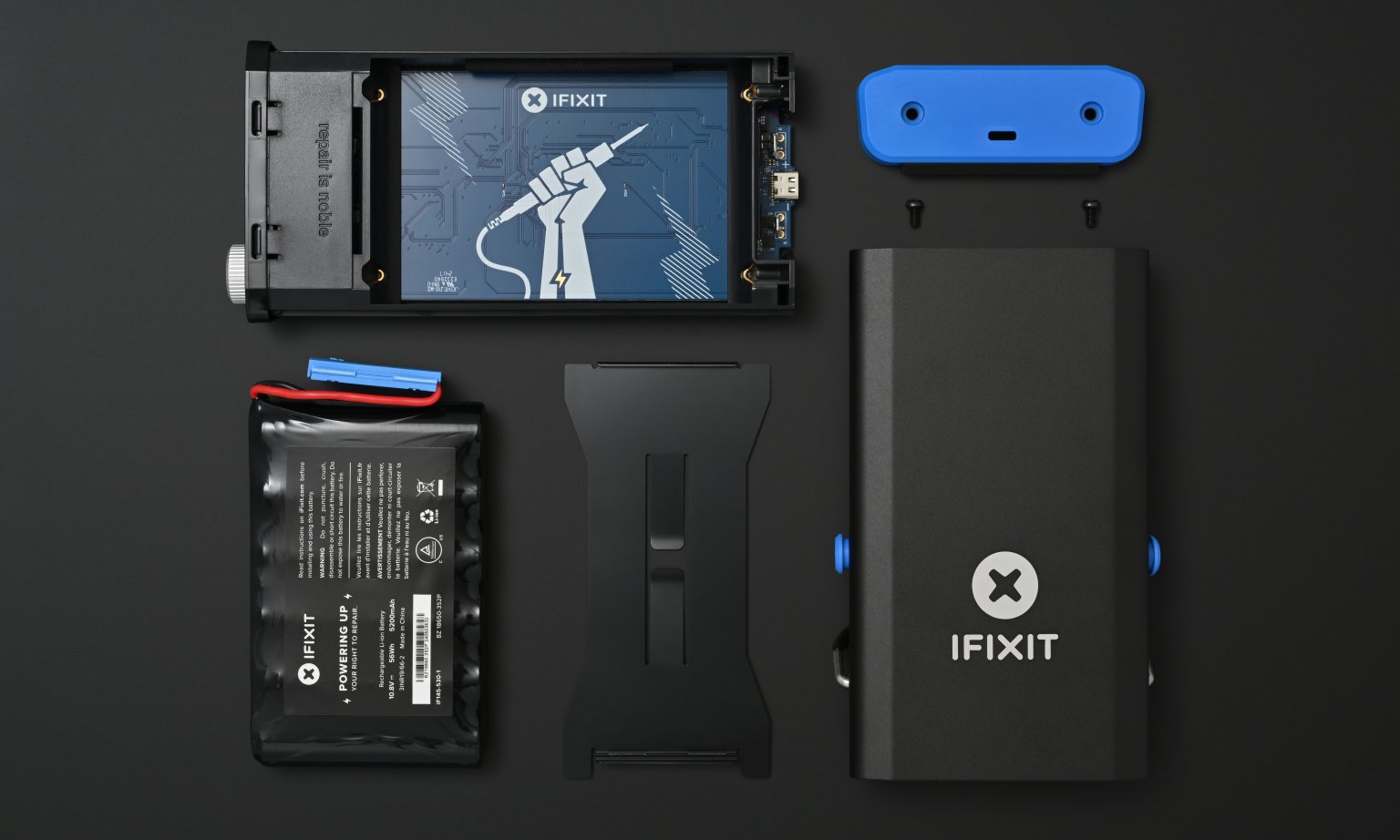
The Power Station has a 55 Watt Hour battery, which is where most of the cost comes from. It doubles as a battery bank for your phone or laptop, or any other USB-C devices in your life.
I agree with you. We wanted to use individual 18650 cells so badly! We designed the whole thing that way. We did exactly what you proposed, and built cell balancing circuitry and code. It worked great! Then we went to the safety certification bodies and they said, absolutely not, there is no way you can sell that.
We tried so many avenues to persuade them, from proposing 18650s with built-in safety circuitry to showing the safety system that we designed into the pack. No dice.
There are a variety of safety standards to blame, but the primary one is UL 1642. It needs to change. I'm planning to join the standards body to see if I can shift things.
After my initial consternation about the temperature control costing $170, I think I have an idea that may placate my concerns.
A compact temperature control widget without batteries at all.
It accepts the appropriate USB PD power input in a standards-compliant way. It has a knob, and also a screen for status. It talks to the soldering iron and provides power to it. It does not have batteries or any special facilities for batteries *though if a user chooses to use it with an appropriate USB PD battery then they certainly can). This all seems possible, and adherence to USB PD specifications should tend to make it safe by default.
The rub, and this may not be possible at all, is that it must be substantially cheaper than soldering iron itself.
But because you've done the right thing and documented the protocol, then maybe someone else will implement this (as DIY or otherwise) and it won't be your problem at all. :)
Out of curiosity - why not offer tool battery adapters, e.g. DeWalt/Makita/Milwaukee/Bosch (depending which color you bleed). Those are ubiquitous 18v - have fast charging, and drawing 100W is fine even for the 1P types, e.g 2Ah. As a bonus they have excellent mechanical properties (usually PA6 or PC/ABC bodies - so even dropping the soldering iron on them would be okay)
Of course, a pack of 6x MJ1 is relatively trial to built (except it'd require some decent plastic body)- esp for 2s/3p, still not very useful aside running that particular iron/tool (and most likely end up charging it w/ the power supply...)
Sorry to hear that, and good luck. Additionally I apologize for the undue cynicism, but as a flashlight enthusiast I've been frustrated with this problem for years and years. The form factor of a battery charger and USB powerbrick/supply would be so nice! It's massively annoying to me that I own many 18650s and still need to buy and replace power banks.
Worse, it seems like the manufacturers best suited to make the product I desire(anker and nitecore) are directly incentivized by obsolescence to not ever make it. The best thing I've found so far is the Nitecore LC10, but it was discontinued. :(
I sort of suspected that it might be the case of safety bodies getting in the way. I really hope you make progress with UL. I'm rooting for you. There should be a way of overcoming this problem.


reply