I definitely agree in principle. But - without doxxing myself - I input my zip and the city is not correct. It’s a very close neighboring suburb (where the boundaries are definitely blurry) but it’s not the city on all the legal documents for my current house.
Yeah city is not fully a function of zip. ~I think state is though.~* I believe when multiple cities share a zip code USPS uses the larger one. Usually the wrong city will get delivered though, probably not guaranteed.
* correcting myself, some zip codes do cross state lines
Can't say anything about the US, but in Germany when more than one cities have the same zip code it's just not important because there is only one sorting center for all cities with the same zip and they just sort per street address.
Legal address doesn't matter for mail, and all of this stuff is about mail/shipping. This includes billing addresses.
I would have assumed that you knew that. I know people whose ZIP code belongs to a neighboring town (because mail works that way) and it basically becomes their de-facto address.
But if you get mail to an address with a ZIP code listed to another city then surely you're aware of this as it comes up constantly for anyone who ever receives mail or packages.
Some areas have duplicate, or very similar street names (ie, 'ave' vs. 'street') I don't think its that much of an ask that a website lets you enter your address correctly
FWIW I have received mail from the USPS in places that had no canonical full address as well. It's not the case in reality that the USPS only delivers mail to mailboxes that have an associated entry in their canonical database here in "messy" reality.
But isn’t the second half of the article the author pointing out a bunch of menu examples from macOS Tahoe where some items have icons and others don’t and still coming to the conclusion that it’s confusing? How is that not a contradiction of the prior declaration?
Yeah, that's a bit inconsistent. I think they are criticizing that it appears to be random which menu items have icons assigned, instead of (for example) giving all important or frequently used items an icon, or in some way that creates visual structure in the menu. Personally, what I find the most disconcerting in those examples is that the menu items aren't consistently inset.
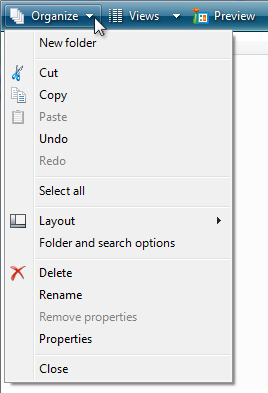
Here is what I would think is a fairly good use of icons: https://learn.microsoft.com/en-us/windows/win32/uxguide/imag...
The icons are positioned such that they introduce groups of menu items, and they create a visual structure that one learns to recognize with repeated use.
> no point in trusting people who are disconnect from reality
My brother in christ, we are all just names without bodies or even faces on this digital ocean of the internet. Letting people know how they should address you isn't "disconnected from reality", it's grounded in the very real reality that we, as people, like talking to each other. We should all be so thankful for their foresight in allowing us the opportunity of avoiding an otherwise unavoidable faux pas of calling everyone in the world "hey you".
Got me curious. The Wikipedia page for the term basically says that the word means the different things depending on being used in an American legal or British legal context.


reply