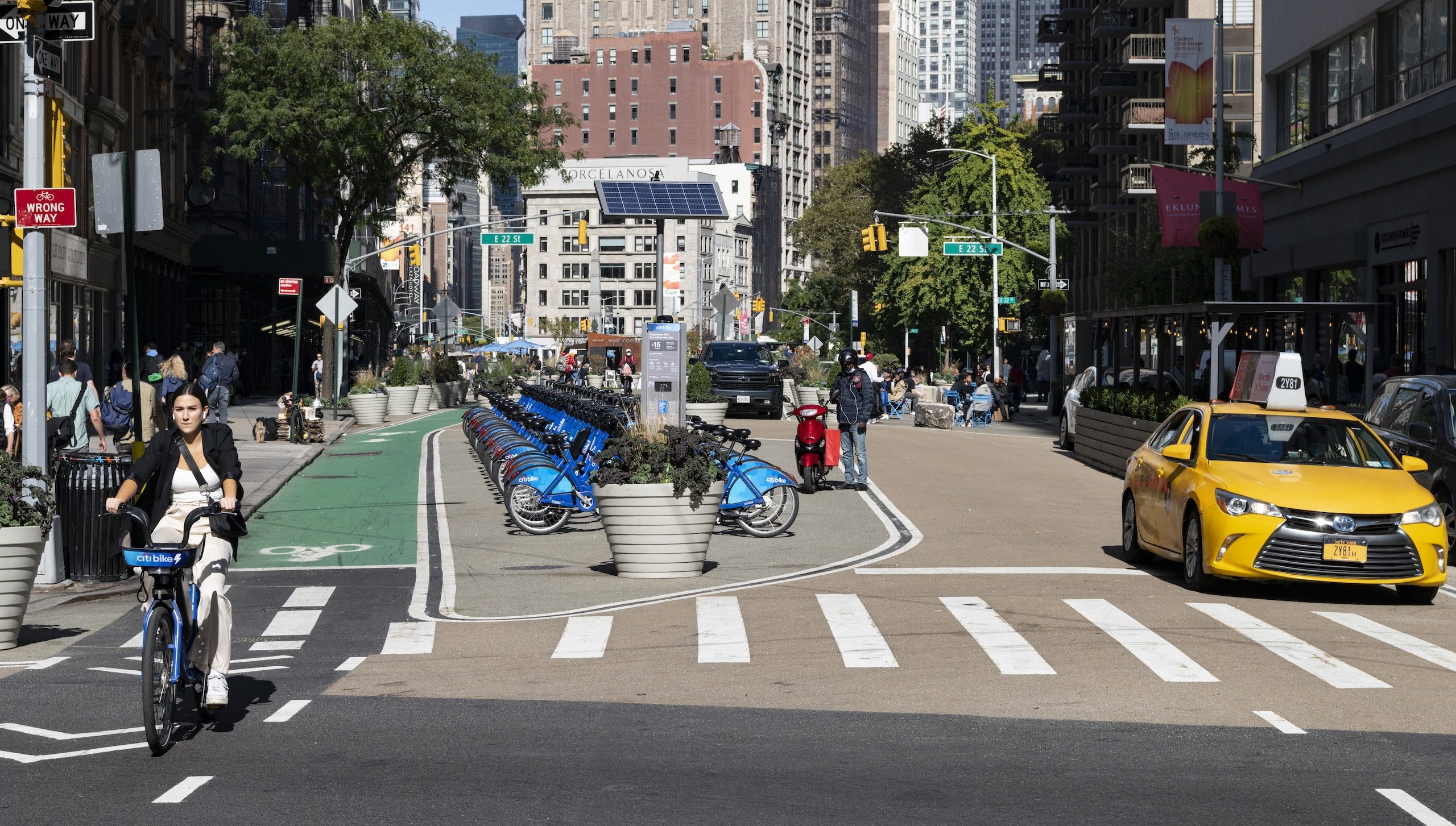
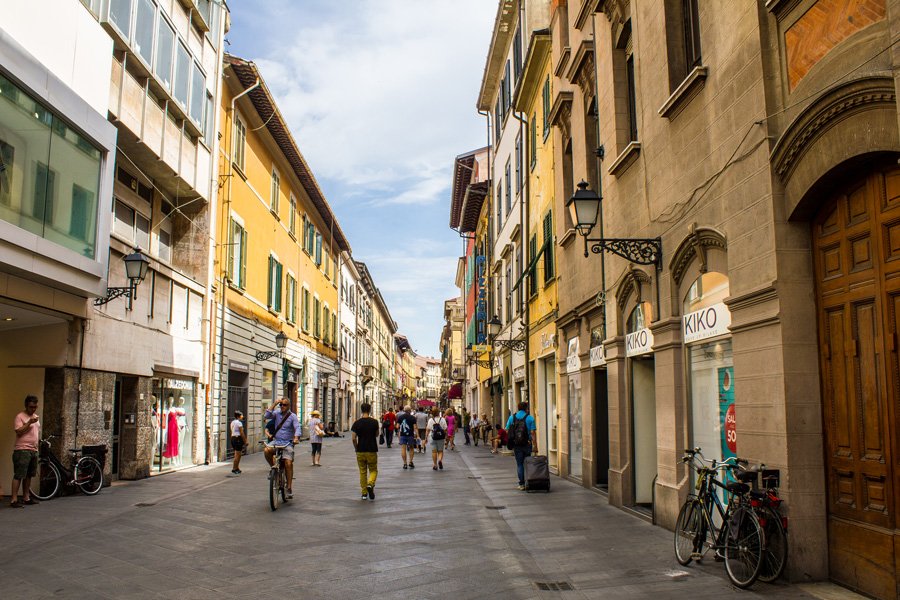
You’re either exaggerating or don’t spend much time in NYC. Half of Broadway is closed to cars now, same with Wall Street. We have summer streets where they close many on weekends. Lots of dedicated bike lanes and a few isolated paths throughout the city. Could there be more? Sure. Are they completely absent? No.
Those photos say it all. The NYC reduced street still manages to park a Chevy Silverado smack in the middle of it all, and all those planters aren't there for the sake of having plants, but rather as crash barriers protecting the patios from traffic.
New York City has more people in it than the 4 most populated metro areas in Italy. Italy has ~3x the population of the state of New York, half the population of the state lives in NYC area.
The obvious answer is more public transport infrastructure & bike lanes.
If you think population density is an excuse for public transport infrastructure not coping or need for more people owning cars I suggest taking a long hard look at e.g. Japan to have that hypothesis reality-checked.
I'm btw. not saying you did, just reading between the lines.
As I wrote in an earlier reply to parent, NYC hasn't managed to even build ring Metro lines around its city center – since a century!
And that is for one reason and one reason only: not nearly enough (political) pressure from the public to improve public transport infrastructure.
And that in term gets us to the root cause again: the US can't imagine itself without cars.
This is not a critique. It's just an observation that is very plain to see if you grew up in Europe (and possibly many other places, too).
When/if that changes, ever, the above things will just happen naturally.
What would a ring metro look like in NYC? Manhattan is an island. Directly west of it is a body of water, then land that is not NYC, in fact is not NY.
It doesn't have to be a closed ring. Or resemble a ring.
Many metro systems in other big cities with comparable topological constraints have metro lines that are orthogonal to those going out in roughly a star pattern from the center.
But NYC almost only has the latter.
Underwater sections are not an issue, really. There are many cities that have metro lines going under bodies of water.
And even the length or depth required is not an issue if you want to build it.
That's why you can go from England to France, by train, in roughly half an hour, under the English Channel.
in context, i am specifically talking to “the US can't imagine itself without cars” point here and in my other reply upthread. I live ~36 hours from Los Angeles, driving at legal highway speeds, assuming no stops or delays. It's all about perspective. California is larger than germany. New York isn't a small state by any stretch of the imagination, unless you're comparing it to texas, alaska, or california. The car/public transportation stuff in the US is partly because of the ruralness of the country in general, plus culture. A lot of people have the idea that public transit is for the poors.
I live in Canada, a bigger country with less people and better public transport. A bunch of provinces are bigger than Texas, doesn't stop the public transport from being decent inside the cities.
Man, there are street that are closed to traffic, and you just are either lying or being dumb.
They just don't look like streets anymore, as they are turned into plazzas or parks.
EG:
E25st at Lex, Baruch College is truned into a plazza/walkaway. No cars.
8th/st Saint Marks, by A Ave, is off cars, (It is part of the Tompkins park).
Irvin Avenue is part of a park (gets interrupted by Grammercy Park)
etc...
There are plenty of places like that, but over time they turn into plazzas or parks, and you think they were not streets at some point.
For things I prepare in bulk myself (eg perhaps sauce in your case), I usually just get stats on the whole batch. Then just approximate per serving or average it over the whole batch.
Anyone know if there’s a a good solution to manage multiple OpenWRT devices on the same network, akin to Ubiquiti Unifi or TP Link Omada? Feel like that would be amazing.
Taking out 95%+ of ledging edge semi that adds trillions to western hi tech and supports strategic industries seems worthwhile. Doesn't have to be invasion, but I'd expect grayscale shenanigans on island power grids etc now that there's less reason to hold back.
Sure, there’s no free lunch, but there is the beat-you-up-and-take-your-lunch-money of not investing.
Bonds may have gone down, but they still paid out. Unless people sold at a loss for liquidity or could’ve timed the market and bought low, they were better off than people stashing money in a mattress or most bank accounts.
That's not really my point. I think one thing that gets lost in the "everything has different levels of risk" discussion is that many risk/reward profiles are bad. Calling everything a tradeoff is misleading. Banks are more than happy to capitalize on laziness and lack of knowledge (an American is more likely to change their spouse than their bank), so the balance between risk and reward gets thrown out of whack.
If you want to get really deep into investment theory, Beta implies basically everything is a good investment in small enough amounts https://en.wikipedia.org/wiki/Beta_(finance)
> I think one thing that gets lost in the "everything has different levels of risk" discussion is that many risk/reward profiles are bad.
Yes, not everything is on the efficiency frontier for risk/reward. Eg cash is convenient to spend, so it can 'get away with' offering a worse risk/reward profile.
Yes, the Sharpe ratio is one of many ways to measure risk adjusted returns.
> If you want to get really deep into investment theory, Beta implies basically everything is a good investment in small enough amounts https://en.wikipedia.org/wiki/Beta_(finance)
Well, that assumes no fees, transaction costs and taxes, I think. And even without transaction costs etc, the theoretically optimal amount can be so low that it's not worth bothering with.
Your last four points are good, but in practice the first two have not netted significant advantages for NYC's bus operations: many of NYC's buses run on narrow one-lane streets, where any amount of double parking makes the road completely un-navigable. Similarly, it's more common to see a bus route taken out of operation entirely for a week than to have it re-routed on the fly (the latter does happen, but the network also dense enough where most riders can take the next avenue's route).
I think a significant understated advantage to streetcars is their effect on local neighborhood development: like a subway line, a streetcar line is a semi-permanent installation that can't be easily taken away by a short-term replanning of the network. Bus lines, even when dense and well-developed (like NYC's are!), simply feel impermanent in a way that rail transport doesn't.
(Or as another framing: if you build a rail connection to a neighborhood, there's a good chance there will still be a thriving neighborhood there in a century. It's not as easy to guarantee that with a bus route that can be taken away overnight.)
Rail-based transit also provides major side-benefits to its routes: development and improvement.
The principle is that bus routes can change, bus stops can move. Rail right-of-way and train stations are quite permanent and immobile.
Therefore, if a city invests in rail, the developers will follow, and redevelop, revitalize, or gentrify neighborhoods along that route. Conversely, folks in the neighborhood may fight the rail expansion, because "there goes the neighborhood" usually in a more upscale fashion.
It was smart for cities to build out streetcar lines in their early expansions, enticing developers into areas that promised long-term access. Of course, rail lines don't last forever, but the point is being more permanent and staying put, more reliably, than rubber-tire-based transit.
And getting people to buy into this Ponzi scheme is getting more and more expensive. Hence the ballooning interest payments. As debt reaches maturity, more and more of it will have to be refinanced at a higher “apr”, since nobody is even contemplating drawing down the principal. This could further drive up the rates.
I watched some of the videos on their YouTube playlist about blockchain and crypto, and while there was some good information, there was not a lot of interaction. The hosts just seemed to read from a list of questions, and they did not seem to have any follow-up questions.
> I watched some of the videos on their YouTube playlist about blockchain and crypto […]
That was a special series on the topic.
Quite often they do have a list of prepared questions, and send them to guests ahead of time so they are somewhat prepared: depending on the answers they may delve more deeply into some answers.
The hosts (Ben and Cameron) also do prep ahead of time: they read the books—and more often research papers—of the guests, and so already know to a certain extent what they're going to say before they ask. The guests' answers are more for the viewers/listeners, and give the guest an opportunity to perhaps comment more 'free-style' than what can be written down.
1//2 always resulted in an integer, even in Python 2, with or without "from __future__ import division". To get floating point division in Python 2, you had to convert at least on of the operands to float (much like in C or C++).
You can try it online at tio.run, they still have Python 2 among their available languages, as well as Python 3.