So what is happening right now with rare earths used for military purposes? My reading says it will take 5-10 years to build processing facilities without which the raw ore is useless. Has the US stopped building missiles and fighter jets? They seem to still be selling them to other countries, but it is unclear if they can actually deliver anything until many years from now, or even restock their own supplies. Maybe the military has a small stockpile of some of the REE's? It's also not clear how the UK, EU, and Australia are going to stockpile REE's if they don't have the capability to process the ore. Is the West's supply of weapons going to run out soon as they use up what they have and can't build more? This seems pertinent both to attacking Iran and the war in Ukraine.
Stockpiles have existed for years, and Japan+SK began building an ExChina REE supply chain in the 2011-17 era that most other countries are piggybacking on.
> UK, EU, and Australia are going to stockpile REE's if they don't have the capability to process the ore
They do. The issue has been price. They only began working on building an ExChina supply chain 2019 onwards, and this current G7+ announcement is part of that larger strategy that officially began under Biden but has been cooking for years.
While I do hoard notes I've realized over the years that the main reason I write notes is as a memory aid. If I write it down I remember it better, and I'm more likely to do it. Notes also act as a filter because I write stuff down, sometimes review the notes later, and decide what I wrote down isn't worth doing, so making a note of an idea essentially gives me a delay to review the idea and decide if it is worth doing. I do also record links, keeping them in wiki pages (along with wiki pages for notes about various projects); I started doing that because browser histories today seem to autodelete old links. Putting them into a wiki makes them searchable. I keep journals as well, which are also searchable. I don't necessarily want to be reminded of my notes and wiki/journal entries, I know they are there, I mainly want to call them up when I decide I need them. That's the main drawback of paper notes, I can't search them. I've tried scanning them, but it's tedious and they don't translate to ASCII text well, and drawings are not searchable. I've considered using one of the e-paper notepads instead of paper notes, but I'd need a notepad handy in every room of the house and that would cost too much, and the procedures to automatically sync them to a central location don't seem very reliable (and I don't want to sync personal notes to some public cloud).
So for me, an AI that suggests stuff would be annoying. An AI that could take some vague search terms and my history and could pull old information out of notes that don't necessarily have the keywords I enter, using the context provided by my history might be useful. So for example, I may remember I happened across a design for the DSP algorithms in guitar pedals, but the URL or note may not even mention DSP, so something that could turn a search for "guitar pedal DSP" into finding a link for an audio processing web page I visited would be useful. The AI would probably have to scan all the web pages I visit to be able to store enough context to be useful for a search like that. Doing this for 20 years or more might run into some scalability/cost issues.
Thank you for your feedback.
That makes sense — for many people notes are primarily a memory/idea-filter, not a task generator.
Context, long-term memory, and storage issues are indeed challenges currently facing AI and large language models (LLMs), and they're not unique to the scenarios we're discussing. However, with technological advancements, I believe these issues will eventually be resolved.
Based on your requirements, it seems you need to grant the AI sufficiently broad access and privacy permissions. That said, leveraging what you've already stored, achieving the fuzzy retrieval functionality you mentioned should be feasible.
It's impressive that you can recall exactly where to find your notes! That said, active retrieval still requires you to remember what you're looking for. I think your fuzzy retrieval concept shares some similarities with what I'm aiming for—where the AI offers suggestions based on your intended actions, even when you haven't consciously decided what to search for. Wouldn't you welcome that kind of assistance?
There may be a more subtle issue here. When the specification is interpreted by an LLM that is different than it being interpreted by a person. From the LLM you get a kind of average of how a lot of people wrote that "kind" of code. From the person you get a specific interpretation of the spec into code that fits the task. Different people can have different interpretations, but that is not the same as the random variations LLM's produce. To get the same kind of fine tuning a person can do while coding (for example realizing the spec needs to change) from an LLM you need a very precise spec to start with, one that includes a lot of assumptions that are not included in current specs, but which are expected from people. I see further complications with getting an LLM to generate code where the spec changes, like say now you want to port the same spec to generate code on new computer architectures. So now specs need architecture dependent specifications? Some backwards compatibility needs to be maintained also, if the LLM regenerates ALL of the code each time, then the testing requirements balloon.
“We have found this really important, never-before-understood difference in autism that is meaningful, has implications for intervention, and can help us understand autism in a more concrete way than we ever have before,”
So we might be able to make all the non-autistic people autistic? What would the world be like if everyone was mildly autistic?
How does many worlds justify the doubling of energy with each quantum split? Probability can double all the energy in existence for every quantum fluctuation? Is energy conserved between realities? If not, that makes reality a very strange place. We could potentially use that to create infinite energy, infinite people, planets we could grab, if we could move stuff between worlds.
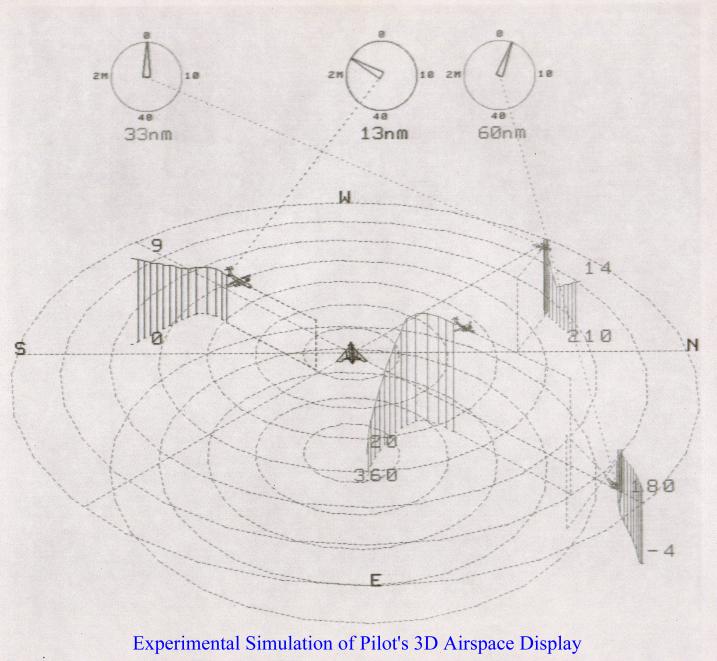
I was asked to come up with a 3D display of the airspace around an aircraft for the pilot to use and which could replace the 2D displays used then. People were impressed, but decided it was impractical for a variety of reasons. You can't really tell where the aircraft are relative to each other and the ground without rotating the display (which means the pilot loses their orientation), and there are no altitude indicators and it's difficult to tell where each aircraft is relative to the others. (Which is why I added the vertical lines and ground tracks.) Also things get visually messy when several aircraft are close together, even if you use different colors (which doesn't work for the colorblind). For example, could you use this display to tell if a collision is imminent near ground level in proximity to an airport? The display does give you a high level sense of what is going on in the airspace; it may not have enough details to be of practical use to pilots and air traffic controllers. I'd suggest consulting with them to get feedback. Maybe this would be practical as a VR display? How did they solve this in the F-35 helmet display?
You might find interesting how space games have tackled this issue. Most share the same design for a radar display that shows targets around you in all dimensions using vertical lines to offset the markers above or below. Check out a video of Elite Dangerous combat to see it in action. It seems conceptually very similar to what you came up with.
You faced all of the same usability problems. Until there is a true 3D display I don’t think this will be super useful for true traffic awareness. The cockpit is just too chaotic.
It’s very interesting to see your graphic. Was this supposed to be displayed on a cockpit TV?
Yes, it was supposed to be an alternative graphic for a cockpit radar display in a jet fighter. The goal for any such display is to convey maximum information at a glance. I got feedback from a fighter pilot who said he wouldn't use it. Most people don't think in 3D, they think in 2D. Pilots have to think in 3D to some extent, but in a battle a fighter pilot wants to know what they immediately need to pay attention to, which is usually something heading directly at them (another jet or missile) and they mostly want to know the direction it is coming from, not so much what its altitude is. I made the path histories fade out so they didn't get too long and clutter the screen. The vertical bars were calibrated to indicate a specific distance so they also gave an idea of velocity. It would be possible to add/remove things from the display based on some automatic assessments of priority (i.e., remove everything not headed at the pilot, though having things appear and disappear can be confusing also). The aircraft icons were actual wireframe models representing the type of the aircraft, but had to be oversize to see them, which added some confusion also. The pilot found a fixed size icon with a few numbers next to it and highlighting for approaching/receding much more useful. Took me a long time to digitize them with just a ruler. While such a display may not have a technical use, it might be useful in advertising, showing travelers at an airport what is going on around the airport at the moment for example.
Not everyone sees color exactly the same way, for example some people can see a little into the IR and UV. While the pilots may not be colorblind, the people who repair the displays might be. Situations can also make pilots colorblind, like strong glare coming through a window. It's better to have an unambiguous display that is easy to interpret rather than to rely on something that can be subjective like color. People can only reliably identify a few distinct colors, so if you have 300 kinds of planes and missiles to identify using shades of red and purple doesn't work so well. An ID number next to an icon can handle thousands of kinds of entities. People can tell color #F0479E is different then #F04750 when comparing them side by side, but they probably can't tell you what the exact name of each shade is, and at a glance they might think they are both the same color. So it's not so much colorblindness as it is the limits of human perception. What I call Hunter Green and English Racing Green might look like the same color to you.
What is perhaps more important is how this transition will be managed. Are the old methods just being halted and all projects halted and the new methods will take over whenever they start producing products? Switching horses midstream could end up destroying both old and new acquisitions without a good plan. This seems like something the Trump administration has continually failed at, they break things first, then try to figure out what to replace it with while chaos ensues. Possibly they will have to fund much of the existing plans while simultaneously funding the ramp up of the new plan, perhaps doubling the cost of acquisition for a while. Even if the new plan is faster overall, there may still be a five year delay before products start to appear from factories.
What neither Big Tech nor Big Media will say is that stronger antitrust rules and enforcement would be a much better solution.
What’s more, looking beyond copyright future-proofs the protections. Stronger environmental protections, comprehensive privacy laws, worker protections, and media literacy will create an ecosystem where we will have defenses against any new technology that might cause harm in those areas, not just generative AI.
None of their alternatives will work or solve the problems that creatives face or the problem that people cannot think for themselves any longer (as seen by the downvoting in this submission).
I read that as the problem that people are relying on LLMs to do things for them rather than actually learning the thing themselves. Which is real but it's unclear what it has to do with copyright.


reply