Extremely well written title, content so-so though.
It's simple: Make the funnel full that you don't feel any pressure, anxiety or whatever because you have options. No need for some voodoo advice from OP.
That's the general route that I took. As an applicant or hiring manager, I view the interview as a meeting between two equal sides looking for a mutually beneficial fit. If there isn't a fit, it's ok. Onto the next interview. It makes interviews a lot less stressful and more engaging to me. But to go down that route as an applicant, it helps a lot to think about what's needed to have those options.
Fabien is trying to share the 4K display between the silent PC and the Macbook, but it is not possible through a single USB 3 hub due to bandwidth limitations. The second image suggests that a separate display cable from each device fixes the issue, and the rest of the peripherals can still be shared through the hub.
...I should probably also read through the entire article, it does not end here :)
I found this write up confusing also. At the end when he said, "Apple announced a fanless M1 which would have solved my problems", I was like, Wut? You problem was sharing peripherals between a pc and a laptop, right?
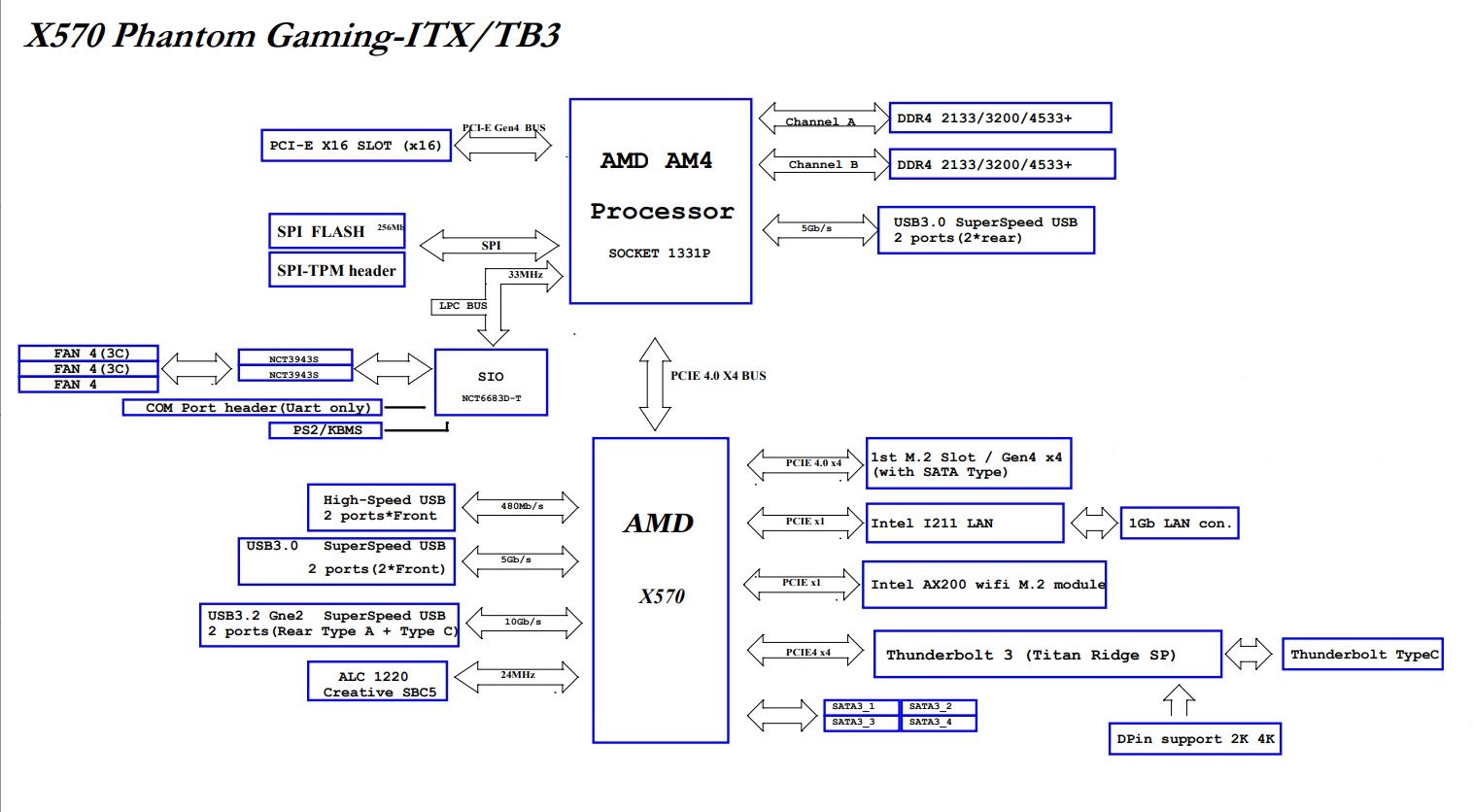
The Thunderbolt in this case is coming from the chipset on the motherboard, not the CPU. He lists the motherboard as an X570 Phantom Gaming-ITX/TB3 which supports 2nd gen Ryzen, and which has that support built in.
This is incorrect, no AMD chip (CPU or chipset) comes with thunderbolt built in. The x570 Phantom Gaming board uses an Intel Titan Ridge (see the obligatory AnandTech block diagram) controller hanging off of the chipset's PCIe lanes to provide thunderbolt 3. This is functionally equivalent to just buying a thunderbolt add-in card, other than the space requirements.
Ah my bad, you are right, I didn't meant to imply that it was actually provided by the x570 chipset, just through it as a part of the motherboard. I just worded it poorly.
Does this explain the author’s surprise that apple’s fanless MacBooks can handle thunderbolt 3 without getting hot? If they’re doing it on cpu then I suppose that could bring about a lot of cpu i/o efficiency.
The X570 chipset is strange. It's just a Zen 2 IO die backported to GlobalFoundries 14nm. Presumably they were able to remove the unnecessary parts (memory controller) while backporting, but maybe they're reusing excess chips if they chose late in the process to move the IO die to 12nm. I'd guess there's some inefficiency from being a clever hack and not exactly designed for purpose.
Additionally, the X570 chipset supports a lot of peripherals:
- 16x PCIe 4.0 lanes + 4x lanes to the CPU
- 12 SATA 3 ports (some PHYs are shared with PCIe lanes so you can't have all of both)
- 8 USB 3.0 10Gbps (I'm not going to google the "official" nomenclature, ugh)
- 4 USB 2.0
- Other things like SuperIO and SMBus which don't use much power
Far more peripherals than M1. (Probably, it seems there's still no detailed specs about the thing anywhere).
Then there's the process advantage, 14nm GF to 5nm TSMC is a huge difference for all the logic involved. The advantage is dampened somewhat for IO because a significant portion of the power is used to drive the signals out of the chip, which is not affected by process changes. Apple's PCIe 4.0 PHYs may be more efficient considering X570 is a first generation PCIe 4.0 design.
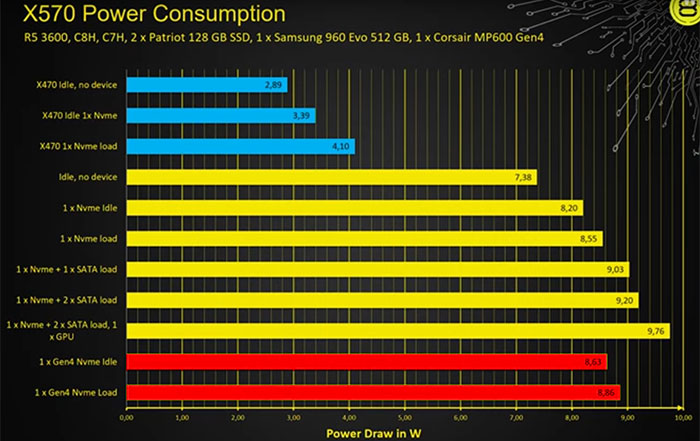
Also, the power consumption of X570 is not that bad for what it is, 7-10W [0]. AMD must be a stickler about the 15W TDP because the fan seems unnecessary. This article is basically the worst case scenario: small heatsink on a cramped ITX motherboard in a passive case with no airflow. Maybe BCLK overclocking would run the fan? Or a dust clogged no-airflow case in a hot climate running all the peripherals at full bore?
The lack of airflow is probably to limit coil whine.
I think the main fault with X570 is that it doesn't save power at idle (PCIe supports downclocking links to save power, actually hot-swappable), but it appears to run all the lanes at full speed. Going from a Intel 6700K to AMD 3950X double the power draw at idle (50 watts to 90+) and that's with the same components.
On my system the chipset will quickly heat to 57c (when the fan starts) within two minutes regardless of usage. I swear Asus have the cooler upside down (semi-passive heatsink blows air downwards), worse still it ingests warm are from the heatsink. I have been meaning to modify it, right now I have a 140mm fan pointing at it to stop it hitting 1500rpm (where it irritates me).
Chasing silence does have diminishing returns. Manually setting the 3950X to 3.6ghz 0.95 volts does make a massive difference. I could run the PC semi passive (no case fans, just CPU <500rpm) if it wasn't for the damn PCH fan!
AMD also sets the voltage too high for their GPUs, making them actually run slower (the one-click downvolt works well), I think AMD dislikes the planet...
With the exception of Intel's ice lake CPUs (10th gen Core), everyone does thunderbolt on a discrete controller (in the case of this ASRock board it's a Titan Ridge controller). The x570 chipset runs very hot and is actively cooled regardless of the presence of an off-die thunderbolt controller hooked up to some of it's PCI-express lanes.
Unpopular opinion & OT: Synchronous communication (eg. calls, video calls, real meetings) with more than two people rarely add value.
Edit: Dear Downvoters, it's ok that you downvoted as it was expected but please share why you think different and give examples what value a 2+ meeting adds
My team hosts a weekly call where we sum up our progress for the last week and loosely plan the activities for the next week.
It's very useful. It adds value, since during this kind of conversation one can offer useful suggestion or another point of view on an issue that they hadn't addressed before (because they were working on something else, for example).
Different use case: incident handling with tight time constraints. In other words: prod offline and has to be brought up asap, but coordination is needed in touching the various systems. A 2+ people voice call is a godsend because now everything is "in sync" and usually updated in real time with what other people are doing.
Your opinion is not unpopular, is just the product of an HN-like echo chamber. People advocating of async-only communications are a small minority that makes a lot of noise, it's a common situation.
Yes. You need both sync and async capabilities in a communication tool. It is hard to choose two different tools for that purpose. Both have a place when it comes to Team communication.
Clubhouse user here, it can add value if people are intentional, empathetic to others in the room, and have differing perspectives. There is something magical about co-creating a conversation like Jazz musicians improving a piece. When it works you feel a tangible energy that is it's own 'person', when it doesn't work it degrades into a mob. So the key here is curating people and making sure they have some common base of values.
I had to talk to two others yesterday, all separated by thousands of kilometres. The video chat gave us the ability to catch up without having to repeat the same stories twice. And it was a chance to hear two voices on the same topic from their experience in their specific country/place. And I got to see their smiling faces.
It's basically a comparison of two functions. On the one hand is the overhead of needing to schedule and maybe travel in order to meet, and amount of time wasted by people in the meeting who don't actively need to participate. On the other is the cost of context switching, risk of misunderstanding inherent in lower-bandwidth communication and delay in understanding one another that comes from asynchronicity. Whichever is more costly in a given situation loses out. In my experience, if the conversation would require a lot of back and forth (e.g. complex or delicate topic) synchronous wins, otherwise asynchronous wins out. As async tools become better, the cost of async goes down, and it comes out ahead more often. It's not always the best solution, but it often is.
I guess its ok for non-business purposes, e.g. catching up with friends. It was a bummer having to bounce off to Messenger for that, especially when tg's user interface is smoother.
Get a lawyer or at least someone who deals (talks) with them, asap, you are in a war.
Important question: If they gave notice today would the notice period "help" with staying longer than 1 year and hence, not falling into the 1 year cliff?
All further advice depends on above question, so once we know the answer we can give proper advice.
I think the OP should investigate how much time and effort it will take them to get the first vest (or an equivalent agreement). Then they can make an informed choice.
I agree that the partnership is wrecked and that he should walk away after determining if they can get the 10% ownership (heck, maybe the right number is 3% or 7% or something else, only the OP knows what feels least wrong).
But it's not clear to me that the company is doomed (from the little we know). In fact, it sounds like it might do great.


It's simple: Make the funnel full that you don't feel any pressure, anxiety or whatever because you have options. No need for some voodoo advice from OP.