I just bought a PTS, to replace an LG G Android Wear watch which I can no longer stand.
It's slightly terrifying how much better the PTS is that the G, in every possible aspect, despite technically being worse. It's got less RAM, it's got a slower processor, it's got a smaller screen, it doesn't have a touchscreen... but somehow it ends up being a vastly nicer and more useful thing than the G.
I think that partly it's to do with different expectations. The PTS feels like a watch with lots of cool features. The Wear feels like a lobotomised smartphone which would frustrate me every time I use it.
But there's a lot of really careful design in the Pebble which is missing from the G. The UI is amazingly fast --- you never have to wait for it, ever (unlike the G). It's well designed and I can find things, unlike the G with it's weird U-shaped settings menu. I control it by pressing buttons, which is fast and reliable and, critically, means that the screen's not covered by my fingers; the G was controlled by sloppy touchscreen swipes that it wasn't very good at recognising.
Also, the PTS has a 10-day battery life and a screen that I can see in direct sunlight.
(The PTS screen is a thing of beauty. It's a reflective Sharp Memory LCD, and you can see it in direct sunlight. Like, it looks really good in direct sunlight. The colours have this metallic tint to them which the UI design shows off nicely. It's small, but so, so much nicer than the G's screen.)
I agree, my pts feels like a nice watch, a good watch with well visible screen in any conditions. What you get extra is:
Notification, alarms, bike computer, ski-tracker, music controller (includes Sonos), step counter, sleep tracker. Mine consistently gets a 12 day battery life. It can even be stretched to 14 probably because at the end it goes into watch only mode. I love it much more than I could have imagined in advance. Just expect a nice watch, not a small smartphone. I even got it becuase I wanted a watch, my alternative was a Casio with some features.
I use my phone in a very different way now, I hardly turn on the screen anymore. I see if something is important right away (usually it is not) and I can leave it until I'm on the train for example.
I never understood the appeal of smart watches. Aren't they like tiny screens for the phone in your pocket? Why can't you just use the phone? I don't own a smart phone either, but I understand why you would want one. But with smart watches I'm at a complete loss.
Can some smart watch owner please explain what they like about having the watch?
My wife and I would be very sad if Pebble went away. Even "crippled" with iOS it is a huge improvement.
* my phone is permanently on silent. Only my watch vibrates. I've found this to be much more professional.
* good step tracker
* I have an app that wakes me up between REM cycles. It's glorious!
* I always know the time, you know, like watch people do
* battery life and water proof -- I never take it off... One reason I am not interested in Apple Watch
* inability to interact/reply from watch is a PLUS. Watches make terrible input devices and there's less of a distraction
* I don't get distracted by my phone. If I have to grab my phone to check a notification I'm going to start opening apps out of habit and get lost in my phone.
Morse Code has always been timed and spaced. There have to be consistent pauses between dits, dahs, chars and words or it all runs together and makes no sense.
didahdah is the letter W and didah dah are the letters AT. Having the wrong timing or no pauses between dits and dahs totally changes the code.
And, it's never been very efficient for sending large messages. 40 WPM is the fastest humans can copy. Most normal people top out at about 20 WPM. To put that in perspective, we speak at about 300 WPM. Basically, that's why Morse Code has so many abbreviations called Q codes.
https://en.wikipedia.org/wiki/Q_code
"The duration of a dash is three times the duration of a dot. Each dot or dash is followed by a short silence, equal to the dot duration. The letters of a word are separated by a space equal to three dots (one dash), and the words are separated by a space equal to seven dots. The dot duration is the basic unit of time measurement in code transmission."
It is extremely efficient and effective when you only have a few watts, a switch and would like to communicate around the world. Nothing really compares.
It is indeed a tiny screen for the phone in my pocket, which allows me to interact with my phone without necessarily having to take it out. Here's a few ways in which I use it:
* In the kitchen to time cooking, to save getting half cooked food on my phone.
* To have a quick glance at incoming notifications while walking.
* To send quick replies to some of those notifications.
* To check the time (its not only a smart watch, but also just a watch).
* To track how much sleep I'm getting, and the quality of that sleep.
* To track my exercise, both while running with real time information from my phone, and passively tracking how much walking I do.
* To control music I'm listening to in the shower.
* To give me at a glance directions when Google Maps is navigating for me, rather than walking around staring at my phone.
> allows me to interact with my phone without necessarily having to take it out
No offence, I'm sure you love this device, but to me this sounds like a wafer-thin marginal improvement that does not seem worth the effort required to keep yet ANOTHER device charged. Seriously, we're talking 2 seconds saved per look? If the argument is "it adds up", you're looking at you smart device (phone or watch) too much! With the watch you then you have to decide whether or not to take your phone and fiddle with it. IMHO everything on this list works as I want with a phone, except checking the time, so I have a Swatch from 2004 for that (which has a replaceable batteries that lasts years each).
Smart watches as they currently exist fulfill a manufactured desire (again, IMHO!)
I saw someone with a Pebble while we were catching up over drinks. An incoming call came in, and in just a glance he'd looked down at the watch & back up again, determining that it wasn't a call he needed to answer. With a smartphone, he would've had to reach into his pocket or backpack, press the hangup/voicemail button, put it back in his pocket or bag and apologize for the interruption to the conversation.
Of course, the ideal would be turn off the phone entirely, but I thought the Pebble was an elegant & respectful way to remain on-call with work, but also remain present with others. I can see how it would be useful to some people.
If your life is significantly "digital", if you're interacting with people constantly via email, twitter, messaging apps, etc. then you're going to have a lot of notifications every day. And cutting out the "few seconds" of hassle to pull out your phone and check those notifications is a significant savings when multiplied over all those interactions throughout the day.
As for battery life, my pebble time steel lasts about a week between complaining about needing charging, which is at about the 35% range, where it could survive probably several days of use if you forgot to charge it. And if you have a smartphone it's probably not a significant inconvenience to add another cable to your charger one day a week overnight.
I don't know how much time it really saves me, but in addition to the convenience I find it much less intrusive (e.g. in meetings or other social situations, or when walking) to quickly glance at my watch to read an incoming notification rather than pulling my phone out.
It wasn't until college when I discovered this, but a lot of people (not necessarily a majority) listen to music in the shower. I thought it was pretty weird until I saw this multiple times.
> * To give me at a glance directions when Google Maps is navigating for me, rather than walking around staring at my phone.
This one is actually the killer app for me. I use it while on my bicycle where pulling out my phone and unlocking it to monitor my progress is quite unwieldy. I used to use a bluetooth headset for this, but not having anything covering my ears is both safer and more convenient.
To your second point, I have grown up with smartphones around me for close to half my life and in my peer group it isn't considered rude to occasionally check your phone and maybe peck out a quick response. By contrast, I've found that people with smartwatches are often looking at their watch, which is a gesture that is hardwired in my brain to mean "what time is it"/"I'm in a hurry"/"you're wasting my time". It's a very subtle thing, to the point where it has made me mildly anxious about interactions without consciously understanding why. If smartwatches really catch on, it will take time for me to mentally re-bind that gesture to mean something less rude.
I bought an LG Urbana a while back, mostly because I wanted to get a watch after going most of my life. The fact that I could get a tech toy at the same time was good enough (+I wanted to eventually play around with Android Wear). The Urbana was the first watch that appealed to me aesthetically which is why I decided to buy it. Here's how I use it:
- Tell the time [often]
- Quickly browse mail and instant messages to see if it's worth getting the smartphone from the pocket. Side benefit: I use my cell in public a lot less and communicate more like a human being. Mostly just quick glance at the watch instead of being distracted into doing a bunch of stuff with the cell while sitting at a table with other peopel [often]
- Navigate via Google Maps while on foot in a city I'm not familiar with [occasionally]
- Maybe strange: Call notification via watch vibration = no missed calls (I missed some on standard cell vibration which is bad since I have my phone on vibrate 100% of the time)
It's only very simple stuff really but well worth it for me. Battery time is bad compared to Pebbles but I don't care because I take off the watch when I sleep and put it on the charger and it gets roughly two days without charging.
$60 when I bought it, now $30. Charge lasts a week. Customizable vibration patterns and text for different kinds of notifications from my phone. It works fine as a watch even when the rechargeable battery is dead. It has a normal clock face so it's always on and visible from all angles. It doesn't look weird or bulky on my small wrist. I'm less likely to miss or ignore calls/texts/email etc when the phone is in my pocket.
I don't know why this watch is not more popular or why there aren't more manufacturers making similar devices.
Man, this thing is so cool! Never ever heard of this watch before. This is exactly the kind of 'smart' watch I want: deliver some additional infos, without being obnoxious about it. I think I might just pick up one of these.
Edit: you happen to know if it has GPS or a step counter?
I've got an Android Wear device that sits in a drawer because it is pretty useless. Charging it every night is more hassle than it's worth. I don't like wearing watches though. However now I wear a fitness tracker (Garmin Forerunner 235) because it is useful to me.
It lasts 5 days on battery, it has GPS built in so I don't take my phone when I run anymore, it tracks my sleep and has all day HR monitoring and best of all it connects to my cycling sensors so it replaces my cycling computer.
It also has basic notification support but that is the least useful part. Getting notifications on a watch saves me about 2 seconds and is not worth wearing a watch and charging it every night.
If you're not using your Android Wear, then I'd recommend that you sell it on swappa (or wherever, but I like swappa). You'll get a few bucks, and (hopefully) someone else will be happy to use it.
Big fan of the Forerunner series! I only wish there was some type of app ecosystem for it. I'm a heavy countdown timer user and carry a normal digital watch just for this feature alone.
Interactions with smartphones generally are of two types. Type one is full interactivity, you're using the phone to "do something" that takes at least a minute, maybe many minutes. Type two is reading a notification, which often takes a few seconds and often isn't immediately actionable. For reading notifications smart watches are perfect, because they reduce the friction of reading notifications significantly. You don't have to take your phone out of your pocket, you don't have to unlock it, you don't have to pull up the notification, you don't have to put your phone back. In situations where you are likely to receive a lot of notifications, which is increasingly common for many people these days, it makes it trivial to keep caught up on notifications even if you're busy doing other things. Granted, that's not always what you want (though it's also trivial to put a smart watch away or on mute) but when it is it can be anywhere from highly useful to a lifesaver.
For me, I started using a smart watch exclusively while working events where me and my team would coordinate using group chat. It wouldn't be uncommon to receive hundreds of messages per day, and sometimes dozens over a few minutes. The vast majority of which wouldn't require a response, but being caught up on what was going on would be critical. And often everyone would have their hands busy doing something else, so being able to just look at your watch to read a message is an amazing improvement.
I started wearing my pebble every day maybe two months ago just as an experiment (after spending something like 2 decades not wearing a watch). So far it's been a success. Being able to stay caught up on my messages with little friction is helpful, and surprisingly having a watch is actually useful fairly often as well.
> Can some smart watch owner please explain what they like about having the watch?
* When a call comes in, I can see at a glance who's calling and dismiss the call without taking my phone out of my pocket and carefully do the right swipe gesture to dismiss the call without accidentally picking it up.
You can use it in situations where pulling a smartphone out of your pocket is impractical. For example:
1. While driving. You can easily take a quick glance at your wrist while your hands are on the wheel and your eyes are on the road. Rummaging around for a smartphone in your pocket is significantly more unsafe. I've saved myself 20 minutes on a couple occasions because my wife IMed me to tell me the place we were meeting up has changed, or that she'd already gone to the grocery store and I didn't need to stop there.
2. While exercising. A lot of people don't like to wear things with pockets while out for a run or cycle.
3. In a meeting. It's less rude and less obvious to glance at your watch than to pull your phone out and start fiddling with it.
4. While cooking. This is a pretty big one: oftentimes your hands are very messy and a call comes in, and you'd miss it if you washed your hands. This is also why half of Apple Watch owners have used their nose as an input device.
5. While carrying things. This is great at the grocery store; I always found having to juggle my bags to grab my phone out of my pocket to be a huge hassle. I can flick through my shopping list without dropping what I'm doing now.
6. When your phone is charging. I'm much more inclined to leave my phone in the charger when I'm home now, because I'll get notifications on my wrist if an important call or message comes in. This in turn frees me up to wear pants that don't have pockets at home, which are often more comfortable.
It's also great in general for screening your notifications so you don't have to take your phone out of your pocket.
I think that the best uses for it will actually come about later, when devs realize they aren't like tiny screens for the phone in your pocket. Rather, they're tiny computers that can deliver information to you in bursts of 1-5 seconds (and from you continuously). How many moments are there where the right information could've led you to make a very different decision? I've encountered several - knowing not to go to the grocery store because your wife has already been, or that the person you're meeting will be 15 minutes late, or that your meetup has changed locations, or that it's about to rain in 10 minutes and so it's time to cut my walk short. I can brainstorm several others: remembering that it's your client's daughter's birthday just as you're about to sell to them, or that the item you're looking at at the store is on sale on Amazon right now, or that your employees think that this presentation you're giving is full of bullshit. What else can devs think of? There are a lot of 1-5 second moments in the day, and historically, whenever computation has reached new situations new $100B businesses get founded.
They're shifting their focus to health, which really concerns me. I've been a Pebble user since day 1 and mostly love the idea of smart watches because they can be a very easy way to get information. Unfortunately, Apple is keeping their API's closed off, because of which Pebble is crippled on iOS. I have the feeling that this lack of good integration is forcing them to focus on health.
Smartwatches always seemed like a fad to me. Part of the point with smartphones, at least to me, is to get rid of the watch. Smart or not. I used a watch throughout my youth and still remember when I got watch free. My wrists: free at last!
It's also puzzling me a bit because the appeal of watches among people where e.g Apple is aiming their watches for given the price range, tend not to be about supporting the latest WiFi standards or whatnot, but the value of classic, mechanical, precise, designs.
It's very subjective. I have a Pebble that I never use, a Microsoft Band that I occasionally use, and a very, very expensive watch with an automatic movement that keeps bad time and I never look at - but I wear all the time. Which makes it a fashion accessory first, and a status symbol second. I imagine you can ask 5 people about their opinions and get 5 different answers.
It's interesting how a large majority of people, even those most technologically-inclined and most likely to be early adopters, just don't warm to the idea of a smartwatch.
Maybe it's the fact the hardware and software experience just isn't up to scratch, or in my personal case, maybe people just don't want that experience. It's not the awkward stigma of talking to or interacting with your watch in public, but it's the unnerving feeling of connectedness and intrusion.
I can't say I'm surprised. They hired a lot of people for a niche product that isn't a huge seller. Sure it sells pretty well for what it is but, at least from the outside, it never looked like it could support the huge influx of people that they hired.
Also the number one complaint about the Pebble that constantly comes up with every single release is the huge bezel and then their latest watch, the round, almost appears as if it has more bezel. Sorry but I just don't think it looks attractive that way and I honestly really want one.
If they could get rid of that horrible bezel design, more people would probably buy their product. I still can't understand how they shipped the round with that HUGE bezel. WHAT WERE THEY THINKING?! Did no one want to tell Eric that that was a bad idea or was he just stubborn in wanting to ship it like that? Also, what was up with their terrible website design? SEE THIS FOR CONTEXT --> https://web.archive.org/web/20141230224643/https://getpebble... I mean, I know they wanted it to look friendly but it made Pebble look like it was marketing a toy (or something specifically for nerds), and not a well designed consumer product.
Honestly, there's a lot of talented people at Pebble, but their vision IMHO has just been the wrong one. I still think they should partner with someone like Timex, Casio or Garmin and ship something like an F-91W or a G-Shock with PebbleOS. That would be really interesting. Hell, if they partnered with Garmin they could probably build an awesome developer community around solid HW.
All this said, I really admire Eric and the rest of the staff at Pebble. They've put in a lot of hard work to ship something functional, BUT they really need to rethink how they're marketing themselves, who they're marketing to and what the vision of the company/product should be if they intend to survive.
Lots of the smartwatch manufacturers appear to have engineers and designers who've never actually used watches all that much. The Fitbit is another great example of hardware fail: both of my parents and one of my brothers bought a Fitbit Surge about a year ago. In the last month, the strap broke on all three. Well, that's typical for a plastic strap watch, just buy a new strap. Oh no, the strap actually contains antennas and stuff, so you can't! So all three were returned to the shop as warranty claims. Thanks to good consumer protection laws, my parents got Samsung Gear, and my brother a Garmin, instead of defectively designed hardware. The man at the shop said they were getting Fitbit returns at a rate of about five a week.
You're comparing it to the wrong product. I think their vision is spot on compared to other manufactures, I can't understand why Apple/Google don't pursue a watch with this type of screen and battery life.
(1) The usable screen on those watches WORKS FOR THOSE WATCHES. Form follows function sir. (2) I don't want them to literally transplant PebbleOS onto those watches. No. That would be stupid. What I am saying is that Pebble is a watch company first and a tech company second and that it would benefit from having solid watch designs complement their amazing app ecosystem and OS. (3) Apple/Google won't pursue this because they are NOT in the business of making watches first. Apple Watch for example COMPLEMENTS an iPhone and is useless without it. Same for Android Wear.
As for the form follows function: The bezel/screen ratio enables longer battery times (smaller bezel in the same casing means a more power consuming screen and less space for the battery) so that applies to Pebble as well.
It's a bit unfair to link to a version of their page which is two years old --- the current one is completely different.
As for the bezel... it's not actually a big deal in real life. It looks way worse in photos. I was concerned until I had a chance to hold one in my hands. I think it's because that watch interactions tend to involve very focused attention for very close up. If you get a chance to try one in real life, I'd recommend it (actually put it on).
I imagine the reason for it is simply that Sharp Memory LCDs don't come in very many sizes and they need somewhere to put the works; i.e., a technical compromise.
(I would much rather have the small Sharp screen that a bigger OLED. You have no idea how much nicer the Sharp screen is.)
To exaggerate your statement you're basically saying that Pebble is making a crap product that doesn't appeal to anybody, though that's provably incorrect by their market penetration. You could say that they could make a better product, but that's a very different argument.
I DO NOT think they make a crap product that doesn't appeal to anybody. YES I am arguing that they could make a better product. IMO they have solid SW but ugly functional HW.
And that's the gist of it. Pebble is supposed to be a watch first. It's just not a very pretty one. Everyone I know who buys watches for how they look and not for what features they offer is turned off by Pebble's design and bezel.
You can side-load apps, but the watch is very tightly dependent on the phone apps - without them it's essentially just a regular watch. If Pebble were to go bust, I'd hope they'd at least open-source the api. Unless they do this, the minute an Android/iOS update breaks the Pebble app the watches become useless.
I don't really have a lot to say about this article, but I do really love my Pebble watch. 99% of the time, it's just a watch -- who needs all the other fancy crap? But it has the nice features that make it worth it, the best of which is just the vibration when I get a text or call.
I dunno. I think Apple Watch is overkill. But Pebble is just right. I hope they don't go out of business.
I love my pebble but I wouldn't have bought one (it was a gift). The silent alarm (doesn't wake partner in the morning) and receiving messages while riding my bike to/from work with canned replies (mine are ETA 5,10 and 20) are the two things I've found valuable.
But neither is life-changing, and I'm not sure if I'll replace this one should it fail.
A large part of the problem is that companies are focussing more on the watch aspect and less on the smart-wrist-mounted-device aspect of such things - for me, at least.
I have the feeling that there's a breakthrough "why didn't I think of that?" moment not too far in the distant future from now.
A large part of the problem is that companies are focussing more on the watch aspect and less on the smart-wrist-mounted-device aspect of such things - for me, at least.
Funny you should say that. I find a large part of the problem is that companies seem to be focusing more on the smart-wrist-mounted-device aspect and less on the watch aspect. I want a device that is a beautiful, high quality watch first and some smart-wrist-mounted-device aspects tastefully added to that.
I am so addicted to everything smart. My notebook, my smartphone, the Internet, all my apps, my PS4. From time to time I am such an heavy ADD, I can't focus for 10 minutes. To all smartwatch makers: I don't need another crackdevice on my wrist.


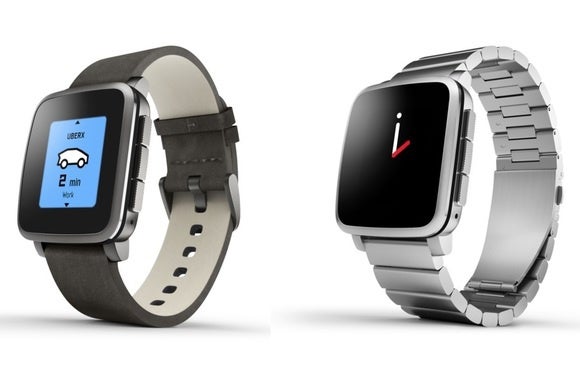
It's slightly terrifying how much better the PTS is that the G, in every possible aspect, despite technically being worse. It's got less RAM, it's got a slower processor, it's got a smaller screen, it doesn't have a touchscreen... but somehow it ends up being a vastly nicer and more useful thing than the G.
I think that partly it's to do with different expectations. The PTS feels like a watch with lots of cool features. The Wear feels like a lobotomised smartphone which would frustrate me every time I use it.
But there's a lot of really careful design in the Pebble which is missing from the G. The UI is amazingly fast --- you never have to wait for it, ever (unlike the G). It's well designed and I can find things, unlike the G with it's weird U-shaped settings menu. I control it by pressing buttons, which is fast and reliable and, critically, means that the screen's not covered by my fingers; the G was controlled by sloppy touchscreen swipes that it wasn't very good at recognising.
Also, the PTS has a 10-day battery life and a screen that I can see in direct sunlight.
(The PTS screen is a thing of beauty. It's a reflective Sharp Memory LCD, and you can see it in direct sunlight. Like, it looks really good in direct sunlight. The colours have this metallic tint to them which the UI design shows off nicely. It's small, but so, so much nicer than the G's screen.)