We've all pretty much given up on the idea that social media will 'democratize' the media. That slippery slope was passed long ago.
I was just reading a book by William F Buckley from 1959 about early American conservatism. Many of the points sound straight out of modern day partisan media:
- Liberal Bias in newspapers and universities: Buckley specifically cites NYTimes, NYPost, WaPo, and other prominent papers at the time all exhibit a noticeable liberal leaning. He also included a number of examples in higher education, especially at elite universities.
- Liberal Mania: Buckley noted that the hardcore liberals have a habit of grouping up on anyone who dares to become a prominent public proponent for Conservatism. They try to get them fired or formally reprimanded by authorities (such as by congress leaders). He also notes a level of smug/elitism. A view point that the left believe they have discovered the correct ideology and anything else is heresies.
- Opponents = Hitler: This was the left's favouritve label for right leaning opponents. He shared a story about how Eleanor Roosevelt famously labeled McCarthy-ism as Hitler-ism. When challenged by a reporter on this label she was asked if she would make the same comparison for this Soviet diplomat she had a known positive relationship with. But she refused - despite the fact he played a leading role in Stalin's purges. It was something reserved for the right.
This was written 58 years ago.
Whether these generalizations are true or not, it's funny how history repeats itself.
William F. Buckley was pretty much the father of the modern American Right, and they've largely been following his propaganda script since. So, no, the fact that his attacks on the left mirror what's seen today isn't an example of "history repeats itself", it's an example of a movement that's been using the same propaganda nonstop the whole time between then and now.
And of all the examples of "history repeats itself" to use right now why would you go with "liberals are mean!" and not the whole rising fascism thing that, yes, is actually happening again.
Intolerance from our contemporary left and right are roughly equivalent. Moderates of both camps have more in common with each other than with the provocative fringe groups spouting this nonsense. The fact that they have strong voices at all only demonstrates the hyperpartisan state our government is in.
It's doesn't have too much that is as pointedly specific as the SIXHIRB meme. If I had to pick what Americans conservatives tend to use that's kind of equivalent to SIXHIRB, it would be either allusion to country ("real American" type memes / unpatriotic / traitor) or allusions to certain stereotypes (such as "elites" or "hippies").
It's interesting in the Oxford link though that "bigot" and "racist" are hurled from both sides of the fence roughly equally.
Special snowflake, 'triggered!', elitist, pussy, pinko, queer, and so on. The difference is that the labels you point to as 'ad hominem' when used by liberals aren't really ad hominem. They are about ideas and behaviours. Calling someone 'nasty', or saying that they are a 'special snowflake' is much closer to the idea of an ad hominem attack as I understand it.
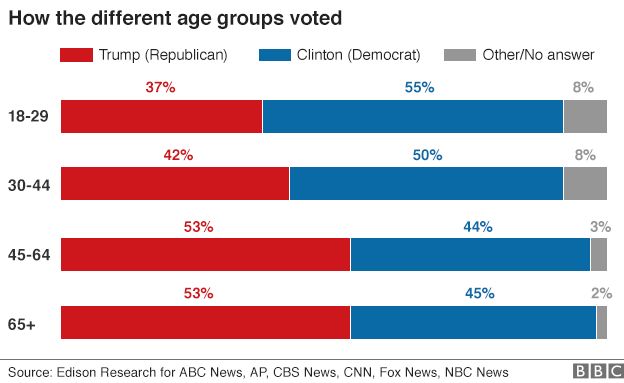
The distribution for Bernie is probably even more young.
Additionally, there are ~3x major 24/7 news networks leaning left and only 1x that is right. Online newspapers have a similar distribution.
So it's easy to believe that hyper partisan nastiness is more popular on the left. But I'm not sure that's the case. Otherwise I'd be much more inclined to agree with you.
I'm neither mainstream left/right but regardless I've noticed a definite trend on the internet towards left wing slander and villianization of anyone on the right. But I associate that with the media distribution bell curve pushed far to the left.
Especially on places on Twitter and Reddit which largely regurgitate media to validate peoples views and the subsequent hive-mind that generates.
A ripe, and quite fair ground, might be the 2 recent Women's Marches.
- The (leftist) Women's March (for abortion, LGBT rights, etc.)
- The conservative Women's March for Life (against abortion)
Do we see equal amounts of slurs and vitriol at each march? One might examine the signs held by protesters, the videos taken, the violence that occurred.
You'll likely hear about more vitriolic protests on the left. Again this is mostly influenced by media coverage - protests don't necessarily translate to being representative of whole populations. Protests are largely something young people do (which means more liberal) and the kind of extreme protest tactics that get in the press push more people away than helps - so it's not necessarily drawing wide support, even from within the party.
The media also loves a good protest, regardless if only 100 people show up. Which is again further tilted by media biases.
There's also the generalization that the left is better at organizing while the right quietly shows up in strength at the voting booth. The exception to this rule recently was the Tea Party, which largely took a page out of the left's political handbook and created a visible protest 'movement'. But again that's the exception.
Some people on the right like to joke that people at protests are all unemployed or students, while the conservatives are all adults too busy working or taking care of a family.
So I'm not sure how much you could gather from looking at protests or issue movements. It's possible that young people are just less mature and don't know better than to use slurs and vitriol, which is reflected in group dynamics. Not to mention education and social class.
You would need to account for differences in group size. An equivalent number of slurs out of both would amount to a larger proportion for the smaller group.
Off the top of my head: libtard, cuck, shill, godless, communist, hippy, thug, welfare queen, other assumptions that their opponent has no job or no work ethic or smokes a lot of weed. "Intolerant" is a bipartisan insult now as well.
I don't deny those have been used against the left. (Although some terms, like shill, aren't left or right wing, and godless could describe an atheist whether conservative or liberal.)
The difference is cadence. Do conservatives label virtually all our opponents with slurs? No. But the inverse is true: the left almost invariably labels its opponents with SIXHIRB.
For example, go to FoxNews.com and find articles about leftists. Is there name calling? How often?
Now do the same on HuffingtonPost.com and find articles about conservatives. Is there name calling? How often?
> Do conservatives label virtually all our opponents with slurs?
Yes. That is, for any opponent of the right, you'll find someone on the right that has labelled them with a slur for their politics.
Of course, many on the Right see themselves as individuals and the Left as a single faceless collective, so while they will take it as "the Left" using a slur if anyone on the Left does so, they will dismiss it as an isolated subgroup if someone on the Right, but not the whole Right, does so for a particular target on the Left. (The same is true in reverse, of course.)
There's a lot of overreaction on the left but the right does have some real issues with race, religion, and gender. If you create policy that oppresses people on any of those bases without some damn good reasons you should expect to be labeled accordingly.
How would you suggest the left approach minority voter suppression? Racially biased criminal justice systems? The rise of religion and race-based hate speech and hate crimes? Perpetual Republican attempts to control what women can do with their bodies? Republican attempts to teach Christian creationism and abstinence-only sex ed in public schools?
Hell, how about painfully irrepresentative gerrymandering? Disproven and destructive economic policy? The predominantly conservative military-industrial complex? The financialization of power? Global climate change? Environmental catastrophes? The dismantling of government institutions that serve millions of Americans?
How should the left expose people to their subconscious biases in a way that causes change? I agree calling everyone "racist" doesn't help but at least it gets the message across.
"[Universities in particular have] a kind of intellectual blindness that will, in the long run, be more damaging to universities than cuts in federal funding or ill-conceived constraints on immigration. It will be more damaging because we won’t even see it: We will write off those with opposing views as evil or ignorant or stupid, rather than as interlocutors worthy of consideration. We succumb to the all-purpose ad hominem because it is easier and more comforting than rational argument. But when we do, we abandon what is great about this institution we serve."
Maybe I should clarify. The left does need to stop calling their opponents names and ignoring hard truths. I love talking with people who can expose me to hard truths, even if I reflexively reject them. But the right also needs to open their perspective and understand how their goals affect people who are different from themselves. The GOP has seemingly lost all compassion for their fellow humans and that's what the left is rebelling against.
>> "I agree calling everyone "racist" doesn't help but at least it gets the message across."
By that measure, the best way to expose people to their subconscious bias about abortion is to call them murderers of innocent children.
Sure, it gets the message across. It just doesn't help public discourse, and it furthers the divide between Americans of different political viewpoints.
As for your political points, you asked "how should the left address [list of perceived wrongs]." Answer: that's for you to figure out. But if you simply resort to name-calling and personal attacks, we in middle America will keep voting for people who oppose you. Speaking for myself, if the left persists in personal attacks and identity politics, I'd be glad to vote for Donald Trump for a 2nd term.
What I'm saying is when the left attempts to engage in rational debate they're called names or ignored just the same. The problem you're talking about doesn't only exist on the left. Case in point: lots of pro-lifers do call liberals murderers of innocent children. I'd argue that a clump of embryonic cells is no more important than the pounds of dead skin we shed in our lifetimes and that there are important benefits to allowing abortion... But I do at least try to understand where they're coming from, see things from their point of view.
Another instance: I listed out several plainly-worded, well-known, evidence-supported societal issues based in race, religion, and gender and your response is to simply call them "perceived wrongs". You're clearly an intelligent person and I'm sure you can understand how many on the left make the logical leap from ignorance of systemic bias to racism. If you're a white person living in middle America you most likely aren't exposed to even half of the day-to-day issues that come up when we don't acknowledge and account for tribal ideologies. Ignoring these problems increases volatility for everyone. Vote for Trump again if you want but don't be surprised if we elect a literal communist after him...
>> "I listed out several plainly-worded, well-known, evidence-supported societal issues based in race, religion, and gender and your response is to simply call them "perceived wrongs."
Yes, because you perceive them to be real wrongs, and we do not. I find most of them to be very good and progress for our society towards an upright, life-honoring and wise civilization.
>> How would you suggest the left approach minority voter suppression?
Voter suppression? You mean like requiring identification for voters like many western nations already do? We find it insulting to minorities to say they're being supressed by asking for identification.
In a fair system, each person gets 1 vote. Identification helps ensure that. It's not suppression, it's ensuring fairness.
Most of your other issues are likewise based on false assumptions.
> Moderates of both camps have more in common with each other than with the provocative fringe groups spouting this nonsense.
Moderates have more in common with each other in rhetorical style, but more in common with their own sides extremes in substantive policy positions. The idea of a strong policy center is a persistent myth that is popular specifically because both sides find it useful to pretend that their moderates are that center, rather than because it is actually true in any substantive way.
Sure, there is no "center". But I think most of both sides are generally inclined toward fiscal conservatism and free market solutions while ensuring people in poverty are taken care of. It's just that vocal Republican voters think all liberals want to take all their tax money to spend on abortion and welfare recipients while vocal Democratic voters think all conservatives are power-hungry and severely intolerant of variable social perspectives. Both sides have some truth but moderates of all stripes mostly just want a safe, stable, healthy economy in which to grow their businesses and families. They're willing to work with each other to achieve that. There are other reasons that our democracy is not functioning properly.
(I don't personally believe the two parties produce solutions of equivalent quality at this point. Democrats have demonstrated much greater awareness of the deep problems in our governance. But I spend a lot of time trying to understand the Republican perspective and I can generally understand where they are coming from, even if I disagree.)
> But I think most of both sides are generally inclined toward fiscal conservatism
Only in the trivial definition where "fiscal conservatism" means government should spend money only on those things that are important for government to do, and tax no more than is needed to do that.
OTOH, the left and right (even the moderate left and right) have fairly divergent views of what government should do.
> and free market solutions
Even moderates on both the left and right tend to favor wide areas of government-run programs for "good" things, and of absolute prohibition of "bad" things (with overlapping, but conflicting, definitions of what is "good" vs. "bad"), rather than market-based solutions. ("Free market based solutions" is somewhat incoherent: "free market" is a single, universal state; were it achievable by policy at all, it would be exactly one solution, you can't have multiple of them.)
> while ensuring people in poverty are taken care of.
Even moreso than "fiscal conservatism", this is only a point of disagreement if it has no coherent definition, so that it is equivocation. Sure, the and the right would agree with the phrase, but mean radically different things by it.
No one wants to spend money that doesn't have to be spent. The argument is over what has to be spent. I agree that there are differing definitions at play.
The free market can be contained and guided. Governments set the platforms on which the free market operates, and it can be manipulated much like water can be poured into different shape cups. Water doesn't stop being water when it's poured into a different container... The free market can absolutely be leveraged into efficient solutions for societal problems. We do it all the time. If you want to think of the free market as a singleton then you'll have to include all interconnections and energy exchange throughout the entirety of the universe, which happens to include the human forces which are capable of regulating small parts of itself the way any other sustainable system does.
If someone on the right (or even right-center) would say something along the lines of "I agree gender equity in the US is a problem, and we need to think hard about how to solve it, but I don't think allowing abortions would help and here's the data that convinces me," I would listen. Instead, they say things like (1) gender imbalance is not a problem or (2) the effects that you're attributing to gender imbalance are actually because of innate biological differences that make men better than women (with nothing to back that claim up except the status quo) or (3) an appeal to family values which is a quaint way to say the man should be in charge.
With that being the standard, how can I _not_ think they are being sexist? Seriously, tell me what signals I should use to counteract these official policies, and conclude that in fact the people speaking them are not sexist? (the case is much the same for other injustices I see all around me)
The problem is that you're defining terms wrong. To you, "If someone disagrees with my ideas on gender equality, they are sexist."
It's like me saying, "If anyone disagrees with me about abortion, they're child murderers."
See the problem?
Not everyone who disagrees with you needs an ugly label. I'd be glad to talk to you about why we conservatives rationally oppose radical theocratic Islam. But not if you're just going to demonize me with an "islamophobe" label, I'll just avoid you and vote for people who institute conservative policies.
Actually, you misread my comment: if someone disagrees with my ideas on gender inequality, I will only take them seriously if their reasons include evidence and logical reasoning. It doesn't take much, either.
I've heard people tell me they oppose radical Islam and want to kick all muslims out of their city. Their reasoning: Sharia law has already taken over many cities in the US, and if Muslims are allowed in their city, they will take over their government. Is this your reasoning?
>If someone on the right (or even right-center) would say something along the lines of "I agree gender equity in the US is a problem, and we need to think hard about how to solve it, but I don't think allowing abortions would help and here's the data that convinces me," I would listen.
Maybe you should try doing the work to convince them, rather than assuming your position is "correct" and everyone who disagrees is wrong. Or, you can choose to "not listen".
>With that being the standard, how can I _not_ think they are being sexist?
William F. Buckley's idea of what constitutes liberal leaning is hardly any kind of gold standard. Bear in mind that no real left wing policies or media platforms exist in the US, it's right vs. far right. The Economist is considered a left-wing organ here.
>> "Bear in mind that no real left wing policies or media platforms exist in the US"
Newspapers in the US are overwhelmingly and verifiably leftist[0].
Out of the 46 major newspapers in the US, 41 of them endorsed Hillary Clinton for President, several endorsed Gary Johnson, and only 1 endorsed Donald Trump. [1]
"Leftist" by American standards in 2017 is, again, not leftist by world standards or even US standards in 1970-1990, except on a few social issues (e.g. Gay rights) or things that aren't even political in other countries (basic science). Bear in mind that Nixon tried to pass Obamacare and set up the EPA. Teddy Roosevelt set up the national park system.
>> "Leftist" by American standards in 2017 is, again, not leftist by world standards"
Yes, if your standard for leftism is Joseph Stalin's Soviet Russia.
But that's like saying, "The right by American standards isn't actually on the right according to world standards, where the right wing == Benito Mussolini's Fascist Italy."
At most you should be comparing MSNBC, CNN, NBC, ABC vs Fox News, or Mother Jones/The Nation vs National Review.
> the Democratic Party received a total donation of $1,020,816, given by 1,160 employees of the three major broadcast television networks (NBC, CBS, ABC), while the Republican Party received only $142,863 via 193 donations
This pretty much sums up while a silent majority kicked left's butts this election.
Peter Thiel supported Trump and these people wanted Zuck to fire him. That is absolutely ridiculous. Now, it is a democratic/free speech right to make a demand public but then there will be consequences. The consequence here was the mass consolidation of votes against the left.
Even Sam Altman's recent piece suggests that people overwhelmingly voted "against left" rather than "for trump".
I know bunch of Profs who got fired or cornered for nothing other then their support of one opinion v/s the popular leftist opinion.
You need an actual majority in order for there to be a silent majority. The correct phrase would be "vocal minority, concentrated in a few specific geographic areas engineered to have more power over the electoral process" which is nearly the opposite of a silent majority.
> vocal minority, concentrated in a few specific geographic areas engineered to have more power over the electoral process
Speaking as someone who identifies as radical leftist: I disagree with this. That the "center of America" (same as for rural areas in Germany, which also heavily tend to vote conservative/right) has been vastly ignored by the left is a fact. While gerrymandering is certainly a problem on state-level elections, it is not so much a problem on US-wide elections and certainly the state borders have not been "gerrymandered" to result in the voting power differences that in turn resulted in Trump becoming president.
The left parties, not just in the US, but also especially in Germany have for long left their roots as parties of the workers and instead shifted their focus to what one may call "the urban elite". While in Germany with Mr. Schulz there is a hope that he may win back the votes of former core SPD or Left party voters, I am not sure if the Democrats will be able to do the same in the US.
Actually in fact the entire election scheme was developed in a compromise with the explicit idea being to give more rural, less populous states more power than their actual population would warrant, an agreed-upon gerrymandering by design. The power between urban/populous and rural/slave-owning states was carefully constructed, they compromised at counting slave votes 3/5ths of a citizen vote, which could be cast by the slave owner for example. The US was created as a confederation of distinct states, all of them as equal partners, not a collection of people, and concessions had to be made to get all of them to sign on and present a united front against the British if there was any hope at a successful rebellion.
That was all well and reasonable when state power was large and federal power was relatively small, but now that the opposite is true and states barely matter with the federal government superseding and deciding nearly everything the premises for that compromise no longer hold.
But this will likely never change; the power given to the smaller states is enough that they can prevent any modification to the rules, and the rules radically favor keeping them in power, so there is no incentive for them to ever give it up besides some sense of doing the right thing even if it isn't politically advantageous which is a sentiment that sadly doesn't really exist anymore in American politics.
The reason for that is cities are becoming the core centers of production over time. As distributed production centers like factories become more and more automated, the social reactors of cities need to operate well for states to be successful.
That's no excuse for ignoring smaller towns but to be fair voters outside of cities have tilted hard toward Republican representation since the 80's. Should Democrats try to win them back? Yes, of course. Should they abandon their metropolitan base to do so? Depends on the party's goals. Should liberal policies be blamed for every shitty economic situation outside of cities? No, not when the representatives they vote for generally make life harder for them.
I also disagree when it comes to gerrymandering affecting state elections. Gerrymandered states are "brainwashed" by their representatives into voting for similar politicians. They assume everyone around them thinks a certain way because why else would Republicans (or Democrats) keep being elected? Obviously that party is better! They also implement voting restrictions, education policies, economic systems, etc. that benefit their parties. Lobbyists from industries that their parties support them in elections. The entire power infrastructure of that state is organized to promote the continued dominance of that party. It's a gross abuse of democracy.
> The reason for that is cities are becoming the core centers of production over time. As distributed production centers like factories become more and more automated, the social reactors of cities need to operate well for states to be successful.
While true, that does not help the hundreds of thousands of people left to rot in deteriorating cities like Detroit, Flint, or to stay in Germany, the Ruhrpott cities. They are the voting base of the right-wingers, and unless we left-oriented people don't offer anything except "oh, it is the way it is, move to the cities or be damned", that won't change. Not to mention that "move to the cities" is often impossible because rents are at an all-time high.
> Should Democrats try to win them back? Yes, of course. Should they abandon their metropolitan base to do so? Depends on the party's goals.
There's nothing contradicting between supporting the left-leaning metropolitan bases and the rural areas. Many people in the rural areas don't give a flying f..k about gay marriage, LGBT equality or whatever, they just want to be heard and have a perspective on life that's beyond social security - and the Democrats as well as German left parties have made the potentially fatal mistake to ignore this.
When entire campaigns revolve around said topics and have NOTHING to offer for those not in metropolitan areas, there is no surprise that people in rural areas tend to think "the damn lefties only care about gays and pot, but what do they offer to me personally?!". It would imho not require much to win back their votes - a couple visits to show "we did not forget you", support from the state-level party leadership for the local politicians and their worries (this is lacking so hard, it's painful - and it leads to people not engaging in parties at the local level, because a typical local politician has nothing to decide/change as a result), and that's enough to prevent that "we're abandoned" feeling.
The solution for rural areas is to decentralize production again. That means renewable energy all across the country, faster internet speeds, small farms, local commerce, etc. These all happen to be strongly opposed by the current iteration of the Republican party, and the Republican party dominates so these solutions aren't even considered.
Gay rights were a difficult fight over the last few decades. You can look at it now and say people don't give a flying fuck but the same was not true 20 years ago. 30-40 years ago it was womens' rights. 60 years ago it was black rights. Look at abortion today - probably one of the most significant drivers of Republican voters right now. That's not something Democrats will budge on (for many scientifically validated reasons) and it's not something Republicans will budge on (for primarily religious reasons). That becomes a sticking point that blocks other issues from moving forward. Another example is business regulation. Various small businesses feel constrained beyond what they think is necessary, but Democrats require consumer and environmental safety. It's very well possible that businesses are overburdened by unimportant regulations but Democrats think they're just complaining about not being able to poison the environment or rip people off, so they shut down.
Headliner Democrats visiting rural areas would help but I don't think that's the only requirement. We need to plow through the roadblocks before rural areas will see any improvement.
> That the "center of America" (same as for rural areas in Germany, which also heavily tend to vote conservative/right) has been vastly ignored by the left is a fact.
I disagree with this premise. Many of the signature policies of the "left" were specifically intended to address the issues facing "middle America" - the ACA/Obamacare was intended to address rising health care costs, Clinton was pushing a retraining program for workers in areas where jobs have migrated from, and both Sanders and Clinton were arguing for increasing access to tertiary education via free/discounted programs.
I also think it's interesting that these areas complain they are "abandoned" by the left while continuing to elect Republicans. Blaming the Federal government (ostensibly "left" despite the Republican controlled House and Senate for the last 6 years) for the failings of State politicians and Governors, who have at least as much impact in your daily life, is another example of how absurd politics has become. We need to break the partisan nature of politics and start electing people who are interested in building a city/county/State/country for ALL of their constituents via compromise.
> I also think it's interesting that these areas complain they are "abandoned" by the left while continuing to elect Republicans.
(disclaimer: the following may be inaccurate due to the fact that I'm a German and don't get reports on every activity of Clinton)
From what I've seen in news reports, Trump has made a habit during his campaign to appear not only in contested swing states but also in areas where many jobs have been lost - be it due to the closure of coal mines, huge factories or whatever - and promised people to "make them great again" and "make their voices being heard". Clinton however focused on swing states and the DNC shot down the Sanders campaign.
In Germany, it's the same - old miner towns or rural areas rarely get visits from campaigning politicians, except when there's a beer fest or a really huge factory opening. This is where that "we're abandoned" complaint comes from - it's not that local politicians abandon the population in these areas, it's that state/country politicians rarely turn up, and as a result the "abandoned" areas rarely get any media attention outside local newspapers (we don't really have the ultra-local TV stations like in the US). And if they do get mass media attention, it's mostly in the form of some TV team turning up and filming stuff like that abandoned houses get squatted by homeless people and the entire area gets dragged down by filth; not exactly what makes one proud of living in such areas. While Democrats and left-wings don't do anything, the right-wingers at least promise "we will help you", and that is - even if they don't have the slightest thought of keeping good on their promises - enough for the population to vote for them.
On a sidenote, that is what really scares me about Trump. As bad as it is, but he is the first politician in long times to publically show "I am doing, to the letter, exactly that what I promised in my campaign", and people will vote for him and his party AGAIN because of this, while ignoring that what he promises is backwards, false loads of dung.
Clinton did plenty of campaigning in impoverished areas - the difference is that she wasn't making some wild claim so it did not generate the same coverage. "Clinton gives speech in Detroit" doesn't have the same media impact as "Trump says he will knock the shit out of ISIS".
There are many reasons why Trump won and Clinton lost - the perception that the left has abandoned Trump supporters likely had some impact but the bigger story there is why there is that perception not that the DNC has abandoned Red states (Clinton loss has even been attributed to her campaign efforts in traditionally red states - http://www.npr.org/2016/10/18/498376750/is-hillary-clinton-r...).
The mistake of Clinton was to persist running for office. She knew that the Republicans would dominate the entire election with that stupid email server debate.
It didn't need any wild claims from Trump to dominate the media coverage, the email stuff was way more than enough that could be exploited to drown out her media presence. Any candidate with a bit more sensible advocates would have cancelled the run early, but Clinton decided to stick and hope for the best, instead of letting Sanders take the run and ride the waves of support among young people.
In American presidential elections the only majority that matters if of electoral college. The majority of heads does not matter, majority of head adjusted for privilege points does not matter, votes of global citizens do no matter. In that sense my use of the word "majority" is perfectly correct.
Why are you talking about privilege points? Who said anything about that? Why are you introducing things like privilege into this conversation? Perhaps you want to dodge the rest of the argument because you know you aren't correct and talk about your feelings about privilege instead, because feelings can't be wrong? I've seen the tactic before and nobody really falls for it outside of /r/the_donald. Certainly not on HN.
You don't have a majority of American citizens. You don't have a majority of people living in America. You don't have a majority of American voters. You don't have a majority of people who voted in the 2016 presidential election. You have a majority of electors in the electoral college, but they are the opposite of silent. Their votes are published online for the world to see. They make public protest votes. Their lack of silence is how we know who won the election. 'Silent majority' could not be more wrong as a description of what is going on here.
The Dems won a clear majority of votes for the Presidency and enough votes to take the House as well. The GOP holds both because of unrepresentative electoral systems (the electoral college and gerrymandering) rendered a decisive number of votes irrelevant.
The left is the majority. It lost because it didn't play as dirty as the right.
Congress and Senate combined has far more power than executive as well.
In fact the executive branch has grown significantly in power largely because of the ever growing pageantry of the elections. Everyone puts responsibility for all economic and social issues on the president. This eventually becomes a self fulfilling reality as we saw with Obama who signed more executive orders than anyone. The pressure is significant.
When in practice the executive branch is in fact quite limited outside of offering an ideological leadership and his cabinet/court picks.
I hope this is the ultimate result of the Trump Presidency. That executive power is further reduced rather than emboldened.
This is how the founding fathers envisioned the political system. They didn't want an unlimited amount of power left to the whims of one man.
But it seems everyone continually sees the problem as merely the wrong person rather than improving the system itself. The never ending belief that it will be better next time!
Either way I've learned to be less pessimistic - despite the mounting hysteria these days - largely because the system still somewhat reflects it's intention. As we saw when the only really bad policy (Muslim ban) was shut down from within party ranks by a Republican in the judicial branch.


I was just reading a book by William F Buckley from 1959 about early American conservatism. Many of the points sound straight out of modern day partisan media:
- Liberal Bias in newspapers and universities: Buckley specifically cites NYTimes, NYPost, WaPo, and other prominent papers at the time all exhibit a noticeable liberal leaning. He also included a number of examples in higher education, especially at elite universities.
- Liberal Mania: Buckley noted that the hardcore liberals have a habit of grouping up on anyone who dares to become a prominent public proponent for Conservatism. They try to get them fired or formally reprimanded by authorities (such as by congress leaders). He also notes a level of smug/elitism. A view point that the left believe they have discovered the correct ideology and anything else is heresies.
- Opponents = Hitler: This was the left's favouritve label for right leaning opponents. He shared a story about how Eleanor Roosevelt famously labeled McCarthy-ism as Hitler-ism. When challenged by a reporter on this label she was asked if she would make the same comparison for this Soviet diplomat she had a known positive relationship with. But she refused - despite the fact he played a leading role in Stalin's purges. It was something reserved for the right.
This was written 58 years ago.
Whether these generalizations are true or not, it's funny how history repeats itself.