I dearly hope that they restore advanced search options and access to all search-matches. It's currently a nightmarish Playskool version of yesterday's Google News, suitable for ages 6-12. I like to search for specific topics in time buckets, e.g. "wind power" in the past day or "spectroscopy" in the past week. Maybe even search between specific user-specified dates if I'm diving into the history of a complex topic. Now I can't specify the time range and can't see all matching results even for the search terms I turn into a dedicated section. It's as limited and frustrating as Google News on Android.
They've also hidden the snippet text that let me quickly judge whether or not I wanted to click through to a full article. Presumably that's to protect themselves against European copyright disputes, but it's a big step backward for users.
I'm trying Bing News for the first time today. It still has snippets and time ranges, but also lets me see only a small fraction of the stories that match my search criteria. Yahoo News apparently doesn't permit time based searches at all. What other products best fill this Google News-shaped void for news power-searchers?
EDIT: for now I can get the old, powerful Google News by initiating a regular Google search and then clicking over to the News tab. But I wouldn't count on this escape hatch remaining much longer :-(
If you don't like it, you can get back to the classic version of Google News by installing the User-Agent Switcher for Chrome (https://chrome.google.com/webstore/detail/user-agent-switche...) and switching the user agent string on Google News to Windows Phone 8.
guess this is a reason to learn python and try scraping google news and headlines to look more like a hackernews page with article descriptions. my python-fu is low so if anyone thinks this is 'easy' or already done please let me know.
It's not designed for readability, it's designed for less density of information. It's easy to do that by putting space everywhere, but the real challenge is keeping the same kind of information density while making it more readable. Really disappointed by their redesign.
It's not even less density of information. It's less information period.
The previous design showed headlines and the first sentence or two of each article's lede. The current design just shows the headline. That's just broken, especially in the era of deceptive headlines.
It seems like the wrong success metrics are used here if this isn't an experiment. If they used something like "more clicks on articles" this change could appear positive from their end since people now have to click the articles to actually see if they want to read it.
Techmeme remains the best tech-focused news aggregator. Their sister sites Memeorandum (political news) and Mediagazer (media news) also deserve a spot in your bookmarks.
One of their best features, which Google has moved away from, is linking to multiple news sources for each story.
If you view the new Google "News" from a desktop browser with a narrow width (well, narrow for these days--1024 pixels, so I can actually have other windows on my screen), the "content" takes up about a third of the page. The other two thirds is wasted.
Even within the "content," tremendous amounts of space is wasted, and less information is present than before.
- Everyone runs their browsers maximised don't-cha-know...
I really don't, yet I've been noticing over the past few years my browser window width has been steadily getting wider to accommodate modern website design.
I blame touchscreen PCs. Less dense UI is better when you need to navigate with a fat finger. As Windows becomes more focused on touch, people using it will demand that the web becomes so too.
I agree, they went too far on the whitespace / card thing. A subtle change in layout could have make the thing a little easier on the eyes while retaining enough density.
I came up with some CSS to remove the fixed header at the top and increase the information density on the page, permanently applied using the Stylish browser add-on:
One issue is that it looks like the density was partly adjusted in order to allow for larger images alongside the story, and then some level of cruft was added to fill the area alongside.
Personally, I think using "Snopes" as a fact checking source gives it much more credibility than it deserves.
And the whole idea of publishing "Fact Checks" like this sounds and feels Orwellian.
I don't mean to say that I don't trust those media fact checkers who dig into claims made by competing media sources, but I don't trust them 100% and I've seen blatant spin in too many "Fact Check" claims to not have to fact check them too.
Hell, I don't even trust Google search results anymore.
> And the whole idea of publishing "Fact Checks" like this sounds and feels Orwellian.
You think it’s Orwellian for there to be an objective truth separable from political spin? Because I’m pretty sure it’s the other way around: a big part of /1984/ was how the government ignored truth altogether in favor of whatever ‘facts’ best fit the political agenda of the moment. “We’ve always been at war with Eastasia,” etc.
I know, I know, you’re claiming that Snopes is acting like the government in that analogy… you’d say they’re establishing what purports to be objective truth, and what Google and others are now promoting as such, but in fact may be tainted by political bias…
But I don’t buy it. You say yourself that you consider fact checkers valuable: then it shouldn’t be seen as Orwellian to promote them, even if they’re not 100% infallible. If anything, what’s Orwellian is the actual government, as currently headed by a president who has (as president) made assertions as blatantly false and disprovable as anything about Eurasia and Eastasia.
Snopes doesn't know the objective truth. All they do is check other sources: other media, press releases, and such, and decide whether they trust those sources.
How well do they choose sources to trust? When "fact checking" claims that Obama paid for the release of hostages from Iran, they used Vox as a primary source.[1] Surely we all agree Vox is biased.
The story originated in claims by Iranian officials, and lacking direct evidence to support either claim, any objective observer would admit there was no way to know whether Iran or Obama was telling the truth. Snopes, not being objective, confidently rated the story "FALSE".
Snopes is most useful when they're able to trace a story back to an admitted satirical source. When they attempt to judge the truth of disputed claims, they don't know more than anyone else. They shouldn't attempt to rate those disputes at all, but the temptation to use the platform to promote opinions is the Shakespearean flaw in fact checking.
That does pretty bad for Snopes. Though I suspect you’re cherry picking… To be honest, I don’t usually read Snopes. However, I do read PolitiFact from time to time, largely for amusement, so I have a pretty good idea of what their output looks like. They do fake news checks too (more since the Facebook partnership thing), but most of their fact checks are for actual claims from politicians or pundits. The articles provide value with a few different elements:
- They do the research, things like finding the relevant statistics buried in some government website, as well as supplementary/background information to provide context for the claim. You or I might know how to use Google well enough to find the same information after spending enough time on it, but I’m not going to do that for every claim I feel like questioning; that’s their job.
- Most of the time there’s at least one interview with a relevant expert - indeed, even when that would seem semi-unnecessary, like when they’ve already found statistics proving something false, but still get an expert confirmation of “yeah, that‘s bogus”. I don’t know how often Snopes does this, but it definitely bolsters credibility.
- And they reason through the claim, consider different angles, and ultimately decide on a rating. This is the most subjective element, of course, and the easiest to challenge with claims of bias. Certainly I’ve ended up disagreeing with a decent fraction of their ratings, even as a sort of moderate liberal, pretty close politically to where you’d imagine PolitiFact to be. (Usually in a minor way, though, e.g. thinking something rated False should be Mostly False.) Nevertheless, I find their perspective valuable: more analytical and details-oriented than traditional publications tend to be, even the ones I like. Your mileage may vary.
Again, I don’t know how well Snopes holds up by comparison - if nothing else, PolitiFact seems to make it much more clear what exact statement is being checked. And certainly no outlet is perfect, as demonstrated by your link. But at least what I’ve read I believe to be far, far better than nothing, if you care about finding the truth rather than throwing around political slogans.
I agree fact checkers are valuable, but it's important to consider them critically because I've yet to find one truly "separate from political spin." Politifact specifically I find is usually right as a general barometer, but sometimes they reaaally stretch what makes a statement a lie/truth. Ultimately they're still a media news site and that includes some bias. I first knew Snopes as an urban legend verifier, and at least in my experience their political fact checks retain a more objective voice and tend to be less editorialized. Politifact seems to abuse their "scale of truth" to regard some politicians more critically than others. "Politician X lied, but it's only a SORT OF lie, but politician Y from the other side is ON FIRE with lies." Regardless, Snopes still uses completely biased sources at times and requires canny evaluation itself.
There's no getting around it - to have an informed opinion, you need to really understand what's happening in the news, educate yourself, and be able to critically evaluate the advice you get from sources like fact checkers. Unfortunately, it seems like that's becoming an impossible task in 2017. I think that's an opportunity for something better, maybe.
I've found that people who dislike fact checkers often have viewpoints that conflict with objective reality. Thankfully they're usually pretty explicit about it, "this campaign won't be dictated by fact checkers", and thus easy to discard.
I don't like the fact checking feature at all. Moreover, why can't I control which fact checkers I want or, better yet, why can't I turn off the fact checking panel completely? I'm a big boy and I'll do my own fact checking if that's what I choose to do.
If you're a HackerNews reader you can probably figure out a technical solution to hide it fairly easily. Being able to choose who checks facts is pretty much the same as being able to decide your own (alternative?) facts, which is the problem they're trying to solve.
- If you're a HackerNews reader you can probably figure out a technical solution to hide it fairly easily.
For sure. Hiding the panel was done within minutes of realizing that Google didn't provide a way to either redefine/block who fact-checks or remove the panel altogether. That doesn't change the point that Google should have provided a way to hide the panel for those who don't want it.
- Being able to choose who checks facts is pretty much the same as being able to decide your own (alternative?) facts, which is the problem they're trying to solve.
They're trying to solve a problem I didn't ask them to solve. I'll do my own fact-checking.
They rarely lie about straight facts, but the WashPo checker obviously slants their "half lie", "pants on fire" "mostly true" measures as politically convenient. Most people are too lazy to read the full details.
I read the full details. There were several situations in which I thought they were being too diplomatic regarding the Clinton email scandal (meaning they were being unnecessarily harsh on Clinton).
I think what you're saying is that it should flatly be "False" and not just "Mostly False".
Per their stated rating system [1], 'Mostly False' is defined as "This rating indicates that the primary elements of a claim are demonstrably false."
The slim kernel of truth in it is that the fake letter references a real court case involving the Supreme Court and Gorsuch - which seems like why it was only Mostly.
How so? They explain their reasoning, and it's independently verifiable.
I was especially impressed by the note at the bottom:
> "NOTE: This story has been updated based on discussions with a number of scientists in the field. It was originally listed as a MIXTURE, but we have now reclassified it as FALSE in response to concerns that our original narrative might have led viewers into taking the results of an activist group’s lab analyses as a scientifically rigorous addition to the debate."
It is bias because it ignores and dismisses information that is relevant. I'm not a fan of "Food Babe" but I have read up on what scientists who are not paid or influenced by Monsanto have said in their studies and how much Monsanto has done to discredit them as well.
Here is "Food Babes" response to their "Fact Check". Look into it and follow up on what she says:
But most of that hinges on IARC, which is (literally) a joke[1] in the scientific world, and that there are conflicts of interest among some (not all) researchers.
The argument is just that glyphosate isn't dangerous at the doses found in food, and that seems to be true based on Wikipedia's summary of the existing research[2].
That's distinct from the argument that glyophosate is safe for the environment or that it's safe for workers handling it in large quantities.
The distinction you point out is part of the problem I have with Snopes because those statements are not fully qualified.
We really do not know the long term effects of exposure and to dismiss that aspect ignores the cautionary principal which has been ignored far too much in this debate.
We can look at DDT as an example of what can happen when ignore and dismiss long term results. It is true DDT didn't affect those who wallowed in it and that was used to "prove" it was safe, but it is also true it affected their children, especially females, and not until they were adults did those effects become apparent.
It is also true that eating food is not the only source of exposure for everyone. And it's also true that homeowners and farmers don't always follow the instructions and laws for using these products.
So, if we read Snopes "Fact Check" on this issue it's very easy to come away thinking all those who've done independent research are wackos and glyphosate is "Safe" and may even lead some of them to say they believe it's "Safe to drink a quart of it" and therein lies the problem.
I hate to go back to the recent elections, but that's probably when Snopes lost a significant amount of reputation in my book. It's not that they're mis-reporting, but there's a complete mismatch between what they claim to be fact, and what the "rating" is. For example: http://www.snopes.com/hillary-clinton-freed-child-rapist-lau...
The claim: Hillary Clinton successfully defended an accused child rapist and later laughed about the case.
What's true: In 1975, young lawyer Hillary Rodham was appointed to represent a defendant charged with raping a 12-year-old girl. Clinton reluctantly took on the case, which ended with a plea bargain for the defendant, and later chuckled about some aspects of the case when discussing it years later.
What's false: Hillary Clinton did not volunteer to be the defendant's lawyer, she did not laugh about the case's outcome, she did not assert that the complainant "made up the rape story," she did not claim she knew the defendant to be guilty, and she did not "free" the defendant.
The language used is already terribly biased. Young Hillary reluctantly defended this child rapist and she merely chuckled - not laughed - chuckled!
Snopes verdict: Mostly False. What?
What worries me is that when Google and others use Snopes they're not looking at what Snopes reports, just the "verdict". If I read that "Hillary Clinton successfully defended an accused child rapist and later laughed about the case." is "mostly false", I'm not going to assume that it's mostly false because she chuckled instead of laughed, I'm going to assume it's mostly false because she did not defend an accused child rapist.
I don't mean to say that I don't trust those media fact checkers
I would say that. In fact, I trust them even less than the outlets they cover. Most "fact checking" is opinion disguised as analysis making it just a boring op-ed.
Most of my exposure to Snopes is pointing relatives worried about things like celebrity deaths, The Onion articles, and that Harry Potter is a satanist to it in an attempt to counteract whatever they were exposed to on Facebook.
At the very least, they seem on the side of sanity against bullshit like that.
As to their politics, they seem to get criticized by both sides [1] - which while not an automatic pass of trustworthiness at least seems to be on the right path.
I'm getting older and I have poor eyesight. The information density of the old design was a huge distraction for me, making it very difficult to actually read the news.
Whitespace can be incredibly helpful for readability.
What Project Kennedy tried to do and wasn't allowed to once the pitchforks came out, Material Design has successfully accomplished. I spent ten minutes trying to find the setting for a compact layout (like the Kennedy versions of Gmail and News eventually supported). Ugh.
I really do dislike it when tools start "simplifying" at the expense of their most invested users. While that cohort isn't always the most vocal, they're generally the most stable userbase. It really doesn't feel like that additional risk of abandonment is accounted for in the multi-armed bandit testing.
It practice it tends to be the exact opposite. Your most invested users tend to be the most vocal and least likely to represent the majority of your user base. The additional risk of abandonment of the entrenched super-users is usually 1. accepted in favor of appealing to a new, larger group of people 2. usually far less than those users will tell you.
To be fair, there's something that is actually more advanced.
In the settings, you can now block sources you don't ever want to see, by entering names. Before, you had to play the lottery of "wait until this stupid source with auto-generated news items based on stock tickers and press releases shows up in the right bar". That's the only place where you had the option to block them. You couldn't do it in the main section in the middle, which is where they tended to appear most often.
I just added a bunch.
Now, if I could follow Entertainment news about rock bands, without getting junk about the Kardashians and WWE...
Horrible!!!! I have been using this product for years, suddenly they make this change without the option to rollback. I can't search, I can't filter. If these options are there I can't find them. These usability experts... how can they fail so miserably at times.
Material design, in my opinion, is a disaster. Especially for desktop, where screens are huge and existing UI feedback loops are in place and well known.
A grey background was dingy when Material Design was introduced and it's still dingy today. The previous News design was much cleaner. With some tweaking it would be much preferred to all of the superfluous cards.
Ugh. This means the two-column view is disappearing (it was an option in labs). Infuriating that phone-driven design is destroying the desktop experience.
I will try it for a day, but it looks like this is the end of me using google news, a site that I have visited daily for the last 8 years. I was still clinging to 2-column view despite their efforts to change it.
* Too little information on the page
* WAY too much blank space on desktop
* It seems optimized for the brand new user experience, rather being than a powerful tool. Stop getting rid of options
* Fact check section is useless - it should be in-line related to the story if you're going to have it.
* "More about" seems like a less useful google search. Where's the value here? Picking "NASDAQ:SPLS" doesn't even show the stock price, while if I enter it into google I get links to company stats and the stock price
Imagine if the NYTimes did a design like this - they would be out of business.
Yeah and I get that you'd do mobile first as a startup, but Google news probably has > 100mm daily views, you'd think they could afford the extra .5 engineers it takes to maintain the old UI.
I thought the whole idea with html5 and responsive this and that was the ability to very easily serve one layout for mobile and another for traditional desktop.
This redesign is god awful for desktop use. The Bing alternative is only marginally better. I honestly have no idea who they test these on before release to think they are a) good and b) an improvement.
I find two column news presentation distracting. Scrolling vertically on one single column seems more efficient than scanning two columns, jumping around between them.
I would like this, if only to eliminate the fluff and click bait that dominates unfiltered Google News. For the service you are developing, is there a way to control the topics shown, or eliminate certain subjects or keywords from the display?
One comment about using wire services from other countries: Many of them are government-sponsored or otherwise controlled by the government/ruling political parties, and therefore can be quite biased in their presentation of local or regional news. Xinhua, Taiwan's Central News Agency, and Voice of America are examples.
Thank you for your thoughtful comment. Filters are on the ROADMAP.md - I am interested in allowing users to create different "views" of the firehose (e.g via presence / absence of keywords) that function in a similar way to Google Alerts.
I am aware of the bias that exists in many wire services & I appreciate the reminder. Some would say that there is a significant (western) bias in the services already that I have made available! I am still struggling to find a way to present a global perspective while still making people aware of these prejudices.
One of my favorite wire services I have encountered is the Non-Aligned Movement News Network (http://namnewsnetwork.org/v3/index.php), which was established to publish news that is not controlled by the interests of major world powers.
It comes from Twitter! It is v expensive to directly subscribe to each wire service - also difficult to maintain scrapers for each. Many services already post links to Twitter - for the ones that don't it is easy to create an account driven by a scraper & maintain the common interface.
I left feedback that the sidebars should be collapsable. I also miss seeing the lede under each headline. Even the "Full Coverage" view is missing a preview of article content. Perhaps an issue with fair use?
Regular users will not need that left sidebar to be reminded of what sections they have configured for the page, and it takes up a large amount of screen space. The right sidebar might be useful to more people, but the "In the News" block is just words and phrases pulled from the main content. It seems redundant.
Overall I like the fresh look. Google News is one of the few sites I have been visiting almost every day for well over a decade now!
It seems like they've also changed the algorithm. I'm getting completely irrelevant articles to what I search for. For example if you search for "Chobani" the top articles are about Yoplait(??)...then there is a bunch of results about Alex Jones interview with Megyn Kelly(???)...I know there was a whole debacle between Alex Jones and Chobani but these articles are not even about that. They're about Alex Jone's interview with Megyn Kelly. Maybe they'll have a sentence or two in the article about the incident with Chobani but these articles have nothing to do with Chobani! I'm just using one example, it's like this for everything I search for. https://news.google.com/news/search/section/q/chobani/choban...
Yep yep - they either changed the Algorithm or did something stupid with the UI. For example, searching for "H4 EAD" on news.google.com returns nothing now -
The biggest improvement they could make to Google news is to do better selection of sources. With some regularity I get 'breitbartnews' as one of the things that I should supposedly be interested in.
I hope scrolling on an ipad now works (not a small feature for a website, but html is fun to break).
I wonder if they also fixed the picture problem. They seemed to collect a random picture on the website of the article and associate it with the story on the front page of google news. This leads to terrible associations, like you would have a headline about the Queen of England illustrated with a mugshot of a thug, or an article about some rapist being arrested illustrated by a movie star that happened to promote a movie the same day.
iPad scrolling is really jerky, and no tap to return to the top. Sometimes it flickers between 2 scroll positions, vibrating at 60 fps. Hope it's not deliberate. How is it on Android?
Google Now suggests interesting news on my Android phone. After a bit of training it I now find 40-50% of suggested articles worth reading (which is a rather high ratio). Google News had a different selection algorithm that is not so "trainable" and therefore less efficient (despite being linked to the same account). It would be great if besides the new UI for the News they also started using the selection algorithm from Google Now.
Google News has been the first page of any news media for me for last several years. I have relied on the the summery of the news under the headlines to consider whether to go to the news details or skip to the next news. And this latest redesign removes that summery. I can't think of any reason to using it as the first source of news any longer, unless Google decides to revert to last design.
Way to take something mediocre and make it truly awful. I'm not trying to be witty here, this is one of the worst user interfaces I've ever seen. Every single aspect of it is worse and I have no idea what benefit it's supposed to be offering. It's like something that was designed by someone who hates reading and has little or no interest in news.
I wish it could be a great opportunity for someone else but it would probably be quite difficult for a small vendor to effectively aggregate so many different news sources. Suggestions welcome, but I've already been looking for a while :-/
Cards, cards everywhere. Not using the full width of large screens. Not a fan yet, but maybe I'll warm to it. Or it'll be like when they changed the effect of "+" in search and I'll hate it but it'll work perfectly for Grandma (since I assume they've tested this a lot). We are after all a set of people who like the HN amount of news density.
News is such an alluring area for change. It kinda sucks. I see the same stories for many days on Google News, can't mark it as "read"/"hide"/"don't care about this topic". Would prefer that over a new look.
This redesign has the look and feel of the Facebook feed plus Trending section on the upper-right hand side. With so many people consuming news from Facebook[1], this is not surprising at all. Maybe Google News is where the Google Plus feed will ultimately show up.
A new design can't hide the fact that news aggregated through google seems to have a strong ideological bent. I've spent a lot of time setting up the weighting of various news sites and still can't seem to get certain agendas filtered out of the news. Perhaps this is a problem with news in general and only reflected through Google News, but I don't think so - things have gotten worse over time and certain sites seem to be over-represented.
I've been concerned about my need intake being too biased and started using a app called "read across the aisle". It has news sources categorized by political position and tracks how balanced your news diet is. Maybe that can help you not being negatively impacted by certain agendas since you are more likely to get a balanced view?
The concept of "sides" and where the lines are drawn between them are part of the agenda: you're not escaping it. If every morning you're reading Fox News and The Huffington Post, you're getting "both sides" but not much insight.
Which sites are over represented for you? I think google uses people's browsing habits to show them "personalized" news. Google seems to have miscategorized me. It exposed me to some crazy fringe news outlets (Breitbart) at first, but now it is just annoying.
The problem that has plagued Google News at least here in Australia for some time is the regular inclusion of headlines that redirect to paywalls. These links need to be flagged as paywall only, otherwise it's no different to the kind of behaviour Google claims to be against - links not accurately representing their destination.
It's about link integrity. Nobody wants to play "roll the dice" every time they click a news article, with some asking for a credit card, others not. No doubt the paywall services pay Google to include those links, but Google should be honest and correctly label paywall links on the Google News page, or stop including those news outlets that use these redirect tactics.
Apart from that, the redesign seems to be re-inventing link hover style. Mouse over a section and every link in that section turns blue, not just the link you're hovering over. I'd prefer if the main headlines stood out more for easier scanning, keep them always blue for example, and the other text black. Or just keep links blue and non-links black. Right now it all seems to blend in, without enough visual separation. I'll be visiting less, and might jump over to Feedly or similar.
As a fellow Australian, I used to browse to news.google.com.au and see predominantly Australian news. Now, I get redirected to news.google.com and see no Australian content! (no, I'm not signed into Google)
I had already pretty much stopped using GN because it was so overburdened with Javascript that pages refused to scroll. (And that was on Android, which you'd think Google would optimize for.) Now it seems to scroll well enough, but you have to scroll a lot more because the information density is so low. Yet another website designed to impress rather than inform. Not interested.
I am a regular user of google news and the color combination hurts my eyes and the main reason why I used google news till now was that I would read the gist.
now, the hover function hurts my eyes too blue color (perhaps the people at Google have very high end monitors) and there is no two-three lines, just the title. Sigh. Google news is now successfully destroyed like Quora was few years ago.
Here is a redesign that does not increase efficiency, my opinion of course. Now more of my page has less information and in my opinion my goal is to consume more information in less space. this is terrible.
I stopped using Google news because too often the same news piece appeared several times in the RSS feed.
If these features address that, particularly labels, maybe I can get back to getting news from there, but the comments here aren't encouraging. I'll check it out myself anyway.
And yet, ditching Google's much-maligned AMP project is not discussed at all. If this were a wholistic attempt at a redesign by an no outside party, AMP and its detractors reasons would at least merit a mention.
Can Google stop making these backwards layout changes? The old version is key logical headlines and related articles from multiple sources which was actually pretty nice as an aggregator. Now there is only one related article instead of 3.
The plaintext version of the page because of the horizontal bar is now even harder to use. It feels like I need to make a site just to undo google changes and just give me a list of links again.
It's more readable but I hate the horizontal menu bar. I use a MacBook Pro and the screen is already short and wide. Taking valuable vertical space is bad, when there is so much more horizontal space.
Another: why cut titles at 10 words short? There is so much empty space around, but I can't read the last 2 words of the title without opening the article.
What I love the most: having the entities extracted from text and entity-centric news navigation.
Gotta say, I'm not a fan of this redesign. Others have touched on the biggest issues - lack of information density and missing article snippets, but here's the one I really can't figure out: Why is the left sidebar so crazily wide? There's at least an inch of wasted space and none of the bar's items even come close to using the full width.
I have mixed feelings about the ability to block certain sources. On the one hand it's nice to be able to block random blogs or poorly written sources (in the grammatical sense) that somehow make their way into the google news docket. On the other hand, I worry that this will only increase the polarization we're seeing in todays political arena.
anything branded google for content consumption I avoid or mitigate with other sources.
I use gmail because I almost entirely control that (unsubscribe, spam filters, user filters and auto forwarding) Unless they are actively deleting email sent to me and changing the content of email I am getting exactly what I want to get in my inbox
I use Google search in conjunction with duck duck go, bing, content aggregators, offline sources and for things i don't care about the source or that doesn't really have a possibility of bias (weather forecast, traffic) or when i know that the google search is really just a quick way to search something else (stack overflow, wikipedia)
the google new tab interface on mobile has such abominable suggestions that I quit using chrome on mobile (helps that I don't have a phone, just a tablet for e-reading, music and causal games)
Maybe it would have better suggestions if I turned on google tracking (app and website) or if I turned off the VPN and anonymizing proxy on my router - yeah right.
Even from their example, you can see the political bias clearly in the first pic. I believe that they believe themselves have an unbiased algorithm which creates this result, which they believe is unbiased.
However, it is clear to me, their result is definitely biased. I do not believe an unbiased algorithm will generate a top list of covering on the supreme court decision on the travel ban only includes reports from NYT, WP, The Atlantic, Chicago Tribune (the only right), CNN. I also do not believe an unbiased algorithm will generate a list of other top stories from only Politico, NPR, WP. So In a list of nine titles, only one right media (Chicago Tribune) got a shot, but not Fox News or WSJ. Not even CBS, ABC which are kind of centrist.
Of course, an argument would be that most of the media is left. But don't forget, the left / right split among the American voters is not that extreme. If you generate a list of new reports, which one is more unbiased: A) represent the perspective of journalists (90% left), B) represent the perspective of voters (60% left)?
My experience with Google News is that, if you do not manually customize new feed, you will get mostly from NYT and WP, almost never FN or WSJ. You will also get a lot far / crazy left stuff from Huffington post, Daily Beast, Mother Jones, but you will never get national review, not to mention breitbart.
Fox News is hardly news these days. Today their front page headline was about the Obamas being on vacation. This, on a day when the Senate Republicans fell flat on their face on healthcare. Wonder why that only got a small mention way at the bottom. Even now the main headline is about Palin suing the NYT.
Your basic problem is viewing this as a left/right divide, when it's really a reasonable journalism/explicitly partisan reporting divide. Conservatives have been trained by decades of talk radio to think this way, and now all they have left on their side is a bunch of charlatans. CNN or MSNBC aren't paragons of virtue, but at least they are not completely disingenuous hucksters like the ones Fox trots out all the time. Hell, MSNBC even features their own right-wing charlatan in Hugh Hewitt.
Your premise is that Google News only include news, which is totally wrong. Google News includes lots of comments. For example, Huffington post appears a lot in Google News.
I think you're letting your biases about Google color your vision. I've had plenty of recommendations from Fox News, NR and the WSJ on Google News, so I can easily counter your own anecdata with mine, but, unlike you, my conclusion wasn't that Google had a right wing bias.
EDIT: Oh, and I totally missed your remark about the Huffington Post. The reality is quite the contrary! Until the recent lay-offs post the Verizon acquisition, they had some of the best reportage on legislative activities in the House. Certainly, they have a liberal bent (which they do not hide), but the reporters they have (or had) are very good at their jobs.
Reality is not bipartisan. Fox has a recent history of peddling alarmingly dangerous and inaccurate conspiracy theories. I'm in favor of an algorithm that gives them less weight.
Also, I see lots of Fox and WSJ.
A study a few years ago found that WSJ's news is liberal, but their editorials are conservative. I think things look very different if you are able to forget about the editorials.
And, finally, the left/right split of people who read news is not the same as the US overall. Even if it were, it would still skew liberal, just as the US does.
No, I'm saying reality is party. For example, in the US, accepting that climate change is real is "liberal" (in the US usage of the word) and denying climate change is conservative. So if a newspaper reports factually and responsibly about climate change, the newspaper looks "liberal" and partisan.
Cherry picking one example (which happens to also be not "reality" but rather a best fit to evidence and which also does not fall as neatly along partisan lines as you appear to imagine) doesn't show anything about "reality" being politically partisan.
Partisan, by definition, is prejudice, the opposite of objectivity, and an enemy of "reality".
The natural human condition, (at least in culture or society) is to be biased (often unthinkingly, out of cultural training or personal interest). Overcoming this is the path towards understand reality.
What I mean is that, in the US, Democrats are not equally far from the truth as Republicans. Or, if you want to rephrase it without the parties, liberals are not equally far from the truth.
Objective facts will not be perfectly diplomatic. They will appear to be biased in one direction or another.
This is true of literally every issue in which one side is closer to reality/truth than the other side. I don't need to cherry pick because that's every single issue (as long as they disagree, anyway).
"in the US, Democrats are not equally far from the truth as Republicans"
Sure they are. Perhaps further on some things. It just depends on what aspect of the truth you are talking about. Economic reality or the age of the earth?
Mistaking bias, value judgement or personal preference for objective reality is a common mental trap. It's taken people, organizations and even whole cultures down many times.
I don't know what you want to say here. Are you trying to argue that NYT and WP is more trustworthy than Fox? How is this related to my post?
Are you suggesting because Google News developers believe NYT and WP is more trustworthy than Fox, like you do, so they always automatically pick NYT over WP? And this is considered as unbiased?
Or, do you mean they have a super AI to determine which news report is close to reality on each single case? So this is considered as unbiased?
> Are you trying to argue that NYT and WP is more trustworthy than Fox?
Yes, absolutely.
> How is this related to my post?
You said you don't believe an unbiased algorithm will generate so many articles from WP or NYT. I disagree, depending on whether the article is based 100% on pageviews (it's not) or also factors in trustworthiness.
> Or, do you mean they have a super AI to determine which news report is close to reality on each single case?
My understanding is that they have a mix of AI and an editorial staff. From what I've read, the goal is not to find the closest to reality, but rather the most "canonical" story (closest to being first-hand, earliest, and most thorough).
For example, most of the top stories about the Boston Marathon bombing a few years ago were from the Boston Globe, even though every newspaper was covering it. There were certain scoops/angles that were from other sources.
This may not be how the algorithm works exactly, but my point is just that "lacking Fox News and WSJ" != "biased".
I was disappointed by their redesign and I think I won't be using it much. There is too much wasted space, the banner at the top is useless (for how I use the site) and the selection of article for a story is too limited, only 3 compared to a dozen in the old design.
At least this afternoon I still had access to the old design by disconnecting.
The allegiance to an ideologically driven monopoly that is stripping basic news search features is undeserved. There are alternatives that provide full featured search and ideologically neutral alternatives such as https://Newslookup.com
It would be amazing to have this kind of service operate over reddit, HN, Twitter, other forums and blog comments and tag them with 1000s of categories. I want to select only specific posts from all these sources.
What Google has now is a collection of mainstream press classified in just a few subjects, almost the opposite of what I want.
I built https://statesreport.com because I found Google News lacking. The goal being a highly optimized news aggregator that doesn't use ML to create an echo chamber of news you agree with.
The Google News redesign makes reading the news difficult. My 24 inch vertical monitor- right have nav has 11 inches x 3 1/4 inches of blank grey space. Too much blank space to content ratio. You had one job...
Good lord this redesign is terribad. I can't even limit news stories to a time period as I can regular Google search results.
I guess it will make Google News appeal more to Joe Everyman, but holy cow it is a blow to being able to find news stories for a specific period of time (e.g. only show me stories on "am4 itx" within the last week, so I don't read blogs reposting news about a "new" motherboard 3 months after it was announced)
And yet Google continues to ignore Google Finance, which is by far the least updated Google operated site I've seen in ages. I mean, you still have to install Adobe Flash to get interactive charts, and the basic charts are simply an image. Seriously now?! Every other finance site has had fully HTML5 interactive charts since years.
And yet this is not sync with Play Newsstand. Is product management a thing at Google these days? Or they like many concurrent experiments by different teams don't talk to each other?


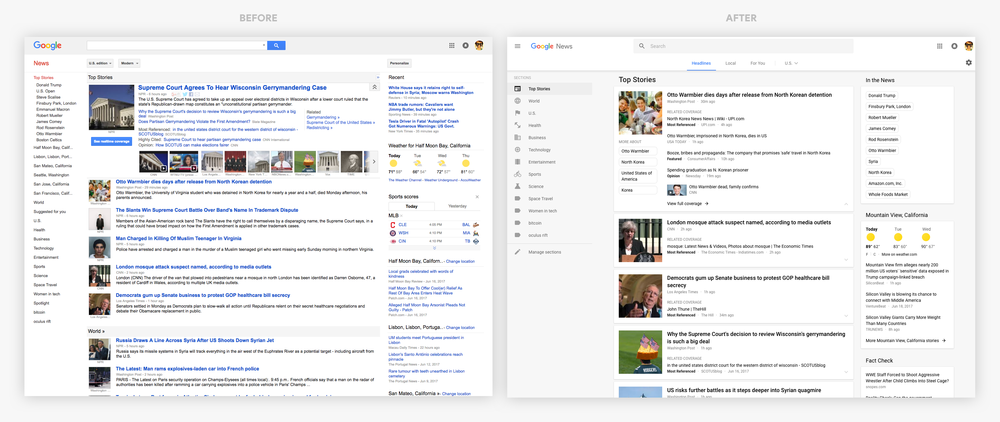

They've also hidden the snippet text that let me quickly judge whether or not I wanted to click through to a full article. Presumably that's to protect themselves against European copyright disputes, but it's a big step backward for users.
I'm trying Bing News for the first time today. It still has snippets and time ranges, but also lets me see only a small fraction of the stories that match my search criteria. Yahoo News apparently doesn't permit time based searches at all. What other products best fill this Google News-shaped void for news power-searchers?
EDIT: for now I can get the old, powerful Google News by initiating a regular Google search and then clicking over to the News tab. But I wouldn't count on this escape hatch remaining much longer :-(