For those confused by this: What they are making is less of a "submarine" in the mechanized sense, and more of an enclosed, air-tight & weighted chamber which two divers can tow between them (one diver in front, one behind) with a kid inside. So about the size of an adult body, hence being able to fit through the narrow caves.
1) Maintaining trim requires a significant degree of skill. A badly trimmed diver can't purposefully swim and is very difficult to tow. It's potentially safer and easier to bundle someone up as a package and manage their trim externally.
2) Scuba gear presents a considerable entanglement hazard in a confined space. There are a lot of hoses and protrusions that could get snagged on a rock feature, a guide line or another diver's gear. There's nothing stopping you from using a face mask and some kind of protective vessel to make the kids easier to drag through a cave. That vessel doesn't need to be pressurised to be useful.
3) A panicked diver can be absolutely terrifying. They do wild, irrational and often violent things. Many divers have died or killed a dive partner because of panic, even in quite benign open water conditions. A totally inexperienced diver in a difficult cave system poses a tremendous risk. Brutal as it might seem, a panicked diver doesn't pose a hazard if they're immobilised.
There are so many issues with either a pod or a solid tube. The biggest one is buoyancy. If it is full of air it will need to be weighted, and have air added/removed to adjust for pressure changes with depth. But imagine if the kid "turns turtle". Any brief head-down orientation will result in the fabric collapsing around the kid's head as the air rushes up to his feet. Correcting this requires forcefully turning the kid around to keep his head up. This is one (of many) reasons why commercial divers in dry suits use solid helmets. It isn't an issue for wetsuits. I'd rather slap a full helmet on the kid and tie him up into a bundle. It won't be pretty but does solve the buoyancy issues. I'm sure they are also considering drugging the kids to reduce the risk of panic attacks.
Here is the nasa device, the personal rescue enclosure:
Of the difficulties the pod solution poses, I don't think that neutral buoyancy us one of them, so long as the pod is rigid (e.g. steel) in construction.
The best succinct definition for neutral buoyancy I could find was this one, from Wikipedia:
> ...a condition in which a physical body's average density is equal to the density of the fluid in which it is immersed.[0]
This means that once the pod has been weighted to be neutrally buoyant it will be so at any depth of water, since neither it or water are compressible[1] and thus their average densities are unchanged by depth.
The challenges of maintaining neutral buoyancy arise when you submerge a compressible object, such as a scuba diver wearing an inflatable buoyancy control device (BCD). The water pressure (caused by the weight of the water above) will squeeze them and their equipment, compressing anything that is air filled.
To sink from the surface, the diver has to deflate their BCD, and then put sufficient air in it to achieve neutral buoyancy at their desired depth. If they swim downwards, the higher water pressure will squeeze them some more, the air in their BCD will compress some more, and their average density will increase. They will now be negatively buoyant and will sink.
The deeper they sink, the higher the water pressure will be, the more the air in their BCD will compress and the more negatively buoyant they will become. So they'll sink faster and faster. This happened to me once when I was first learning to scuba dive. It can be scary.
The opposite applies to ascending. This is why good buoyancy control is such an important (and difficult) thing for scuba divers to learn.[2]
From a buoyancy perspective, a metal pod is more like a camera in an underwater housing. These are rigid in construction (usually either plastic or metal) and their buoyancy characteristics don't change with depth.
None of this is relevant because the cave contains a restriction so tight that a rigid pod wouldn't fit through. The last thing they want is a solid object wedged into the restriction.
The SpaceX design is apparently flexible to fit through the cave, so some buoyancy adjustments would be necessary.
With a flexible pod, you'd partially deflate it to get it through awkward areas, which would make it negatively buoyant. Once re-inflated to the previous pressure it would be neutrally buoyant once again.
Re-inflation could be done via the same gas cylinder that's being used to replenish the air in the pod.
There's less oxygen available with a face mask. It should also be noted that NASA has an inflatable module that's being tested against space, but I don't know if there's any similarity here.
There is no less oxygen available with a face mask. The concern with full face masks is that they contain more dead space which can lead to dangerous CO2 accumulation. Divers who use full face masks or hard helmets often turn on at least a little free flow gas to supplement the demand valve regulator and keep their CO2 levels down.
Full face diving masks are designed to have an air flow that helps minimize CO2 buildup[0]. The greater concern is that they might leak due to not fitting properly, and/or the user might panic and pull the mask off while underwater.
Not SpaceX, a partner company. While helping is admirable, if he actually wanted to help in a more reasonable timeframe/more humble way then there are better channels he could have used, this all seems like a publicity stunt to me.
Yes. Thai TV is currently reporting that the extraction operation has begun. The stateless kid (forgot his name), the only English speaker, will be the first one to make the attempt. They expect/hope he will emerge around 9pm Thai time this evening, about four hours from now.
On your BBC link, they got 4 kids out, all in good health. Taking a break for the night:
> We will be able to continue the rescue operation when we are ready to do so.
We will be ready soon, because we will need to redo laying out all of the air tanks and all systems along the way again.
We have used everything [in the set up] that we had today. The set up team will do their work again once they are ready.
It'll be difficult to tell exactly when the next [evacuation] will start. But I guess it will be ready in the next 10-20 hours.''
8 kids and the coach are still inside. Looks like they may not need any outside help after all.
Wing Inflatables is a partner for SpaceX. This is pretty smart as they had expertise in flotation devices. The general assumption that SpaceX was designing and manufacturing these out of SpaceX spacecraft material was wrong. In fact, they were probably en route via Elon's private jet around the time he started tweeting about them.
> 14/ "What is interesting is, if you know #California at all, we are 350 miles north of #SanFrancisco in a little town, #Arcata. That is a little #riverrafting town. We manufacture inflatable recovery parts for #SpaceX".
> 15/ "So we have a relationship. When Elon had an idea he asked our engineering team to get a hold of us. It was wonderful to see it all come through", says Branagh, Wing Inflatables' president and CEO.
It wasn’t a general assumption: he said as much in a tweet.
“Got more great feedback from Thailand. Primary path is basically a tiny, kid-size submarine using the liquid oxygen transfer tube of Falcon rocket as hull. Light enough to be carried by 2 divers, small enough to get through narrow gaps. Extremely robust.
Hmm, it appears that SpaceX designed their own escape pod, separate from the Wing Inflatables which were flown to Thailand. While it is clear they didn't finish it in time for the very time sensitive Thai cave rescue operation, they are testing it out in a pool.
I'm hearing news that that the rescue is about to begin, they aren't going to wait for any new equipment.
"Rescue crews: the 12 boys + coach each have a dive mask connecting with an air line to their escort/diver. The diver has the oxygen tank/regulator. So, the boys are not SCUBAing, per se. Also, each boy will have physical contact with their rescuer throughout."
What is Musk thinking? First the bouncy castle tube and now a solid-walled submarine? He really has no appreciation for the cave environment.
Tight spots in caves aren't tubes. They are irregular twisty-turning CAVES. Some squeezes (the term of art for the narrow bits where you have to remove gear) are so tight that you cannot take a full breath. Any solid object more than a couple feet long will be stuck very quickly. Now imagine that in the dark, not seeing more than a few inches in front of your face. Then add a swift current constantly trying to separate you from your air supply. When a hardened cave diver calls something "gnarly" take it to mean a claustrophobic nightmare that would send 99% of us into a lethal panic attack.
Worse yet, imagine this sub becoming wedged in a squeeze. Setting aside the terrified kid dying inside, the only way to or from the twelve others is now blocked.
I'm a diver but no expert on caves. I've been in dry caves and have dove a couple lava tubes, but I would never tell proper cave divers how to do their thing. If I were the King I would airlift every possible drilling rig in Asia. I'd turn that mountain into a wiffle ball in the hopes that one breaks through, or at least add more places for pumps.
At least the pumps did work. Before I only saw two small 10cm waterhoses going out. Yesterday I saw a double size 30cm hose pumping water out in full speed. These 30cm made the difference I believe.
Because 1. It's great idea? and 2. May be a lifesaver in many other use cases? and 3. Is a good example of tech used to help, not just take? and 4. Beats watching TV?
Elon Musk seems to be a modern Howard Hughes.
Its interesting that wealth inequality has also surpassed 1900 levels.
I wonder, if wealth is concentrated enough, will a certain % of Billionaires be Howard Hughes types?
It's somewhat interesting how much attention these kids have received, meanwhile how many kids have died worldwide from hunger, disease, and warfare since June 23rd? Probably a bit more than 12. I guess that's not as exciting to read about though.
I don't think it's about excitement. It's just that what happened was so unusual that it captured everyone's imagination. It reminds me of an incident that happened in India probably a decade ago when a child fell into a open borewell. It was broadcast live for 2 full days until the child was rescued. But that wasn't the end of it. From then on, many children have fallen into open borewells but have never received the same amount of coverage. I guess it has more to do with viewers getting accustomed to such stories that it becomes "just another news headline".
But that doesn't mean mankind is insensitive to suffering. It just so happens that none of us can do anything about it even if we wished to.
> meanwhile how many kids have died worldwide from hunger, disease, and warfare since June 23rd? Probably a bit more than 12. I guess that's not as exciting to read about though.
Food for thought: there are probably a few million stars dying everyday wiping out possible civilizations and life we may never know about. I guess at some point we need to stop looking at statistics and instead focus on fixing what is possible.
more than 400,000 people die each year from malaria alone, a disease easily preventable by buying cheap mosquito nets. If you donated just 10% of your income each month, you'd be able to save many lives each year.
It's not giving that's the problem. The problem is in misuse of the donations. Your link does classify it as a myth but I live in a developing country and I can attest to the fact that most aid money donated by Western society either gets misused or swindled unless it's through proper channels. Finding proper channels is not as easy as you think. Even reputed organizations have been caught misusing funds:
If you truly are a "noble charitable cause" then there is no reason to hide your source of funding. Majority of these NGOs (Charities are classified as Non-Governmental Organizations in India) haven't filed their annual returns since their inception. So basically it's unaccounted dollars free-flowing into the country with no mention of source or the purpose for the donations. It could very well be money-laundering or for other ulterior motives. That can only be dispelled if the NGOs filed their annual returns just like every other organization. But the fact that they refused to do it, inspite of it being clearly laid down in law, shows ill-intent. You can't eat your cake and have it too.
I made a lot of family members really mad yesterday by saying exactly this. Then I looked up some stats. The numbers are a few years out of date, but UNICEF estimates that 29,000 children under the age of five die of preventable causes every day [1]. And those kids didn't do anything wrong to get themselves a death sentence. Now ask yourself how many of those kids could have been saved with the amount of money, manpower, and attention being devoted to the Thai soccer team.
Stuff like this gets pretty sad if you think about it in utilitarian terms.
I am not fishing for drama but I want to speak my mind. On that note, the most blatant form of hypocrisy in my opinion is pro-"life" supporters whose main argument is "think of the children" yet they also ignore the thousands of children that die every day.
If your moral worldview doesn't equate those effected by abortion as valueless clumps of cells,
The moral scale of legalized abortion dwarfs that of modern wars
--------
Between 1945 and 1992, there were 149 major wars, killing more than 23 million people.
...
Recent developments in warfare have significantly heightened the dangers for children. During the last decade, it is estimated (and these figures, while specific, are necessarily orders of magnitude) that child victims have included:
2 million killed;
4-5 million disabled;
12 million left homeless;
more than 1 million orphaned or separated from their parents;
some 10 million psychologically traumatized.4
I'm guessing that's not your moral world view, but for the sake of understanding the people you disagree with, you should realize that they view legalized abortion as one of the great humanitarian crises of our time, which easily outweighs most other issues that we squabble about. (And yeah, justifies teaming up with otherwise unsavory bedfellows)
Thank you for posting this. I'm pretty pro-choice for emotional reasons, but it's still extremely fascinating to me to learn the pro-life arguments (even if only to bolster my pro-choice views).
They don't ignore the thousands of children who die every day. You might not know about it, but Christians support all kinds of charities: food kitchens, medical missions overseas, operation christmas child which gives gifts to kids, the international justice mission which seeks to break kids and adults out of slavery... There are hundreds of examples.
One closely related to the topic at hand: crisis pregnancy centers often supply help to new mothers in addition to counseling them to no seek an abortion. That could mean short term housing, job training, community support (bible studies with other mothers), diapers and other baby supplies, etc...
Just because you can't help everyone doesn't mean you shouldn't
try to help someone.
You know it would be really great if Christians support all of the things you mentioned without resorting to conversions. There shouldn't be any ulterior motive attached to goodwill. Else it can no longer be called charity and should be labelled trade. What Christians really need to do (especially those in the West) is check if the money and clothes that they donate to Missionaries are actually being used honourably. The end goal should not be soul harvesting at the expense of someone's misery. Genuine goodwill will never go unappreciated; mix in religion and the Act loses it's benevolence. Sorry to put it so bluntly.
News is by definition something new, not common, unusual. It's weighted for novelty, not significance. That means that the usual misery either doesn't make the news at all, or only gets a mention in passing, and even if some news agency were to put the usual misery front and center, people would tune out because "I already know that".
It's also an interesting event, and media broadcast interesting things because people like to read about interesting things. Pretty straightforward, no?
From about 12.5 million, about 25 years ago, to 5.5 million. Or about 200 thousand children in the past two weeks, most of them due to preventable causes that require better infrastructure, logistics, institutional capacity and resources to solve. The solutions are not trivial, but are not complex either.
Of course there is massive institutional attention for these issues (which is in part why the number of deaths per year has dropped by about 7 million children, akin to preventing a deadly outcome equivalent to the holocaust every year), but the share of popular media attention is a tiny fraction, probably a rounding error.
This just feels like another Kony2012. That's not to say the efforts should not take place. But it is to say that it's once again confirmed that parts of journalism are a complete joke and part of its raison d'etre is providing for those with a fetish for digital disaster tourism, whether it's this or helicopter views of a police car chase. It like putting the real in reality tv. But it's not what journalists say they are, or how media companies describe themselves as.
It seems crazy, I can imagine the horror if the pod gets stuck between rocks while going through a narrow tunnel.
The simplest solution is to give the children swimming and scuba diving lessons from inside the cave and then once a safe route has been established, the children can get to the exit one by one (accompanied by a professional diver) by swimming along a rope which leads to the exit.
IIRC they've been talking about the potential of "packaging" up the individuals since they first found them. Packaging being giving them an air tank, face mask, and making them neutrally buoyant them so the experienced divers can push and pull them along the tunnels.
So long as the professional divers have full control over the "package", it shouldn't be a deal breaking issue. Detach the tank, move them through separately, just as the divers themselves do.
It's certainly not safe, as the loss of the recent diver has shown.
Little is known about why he died. I see many people go full tryhard when a child is in danger, doing dumb stuff.
I can see a scenario where he wanted to rush it, potentially cuttin corners, because of doom rainfall scenarios. This makes his death more a psych problem than a dive problem.
Another is age/shape. I used to be a fine skater, did a trick I could do in my sleep at 14 at 30 and fell hard. These kind of coordinations need to be maintained and he was explicitly retired.
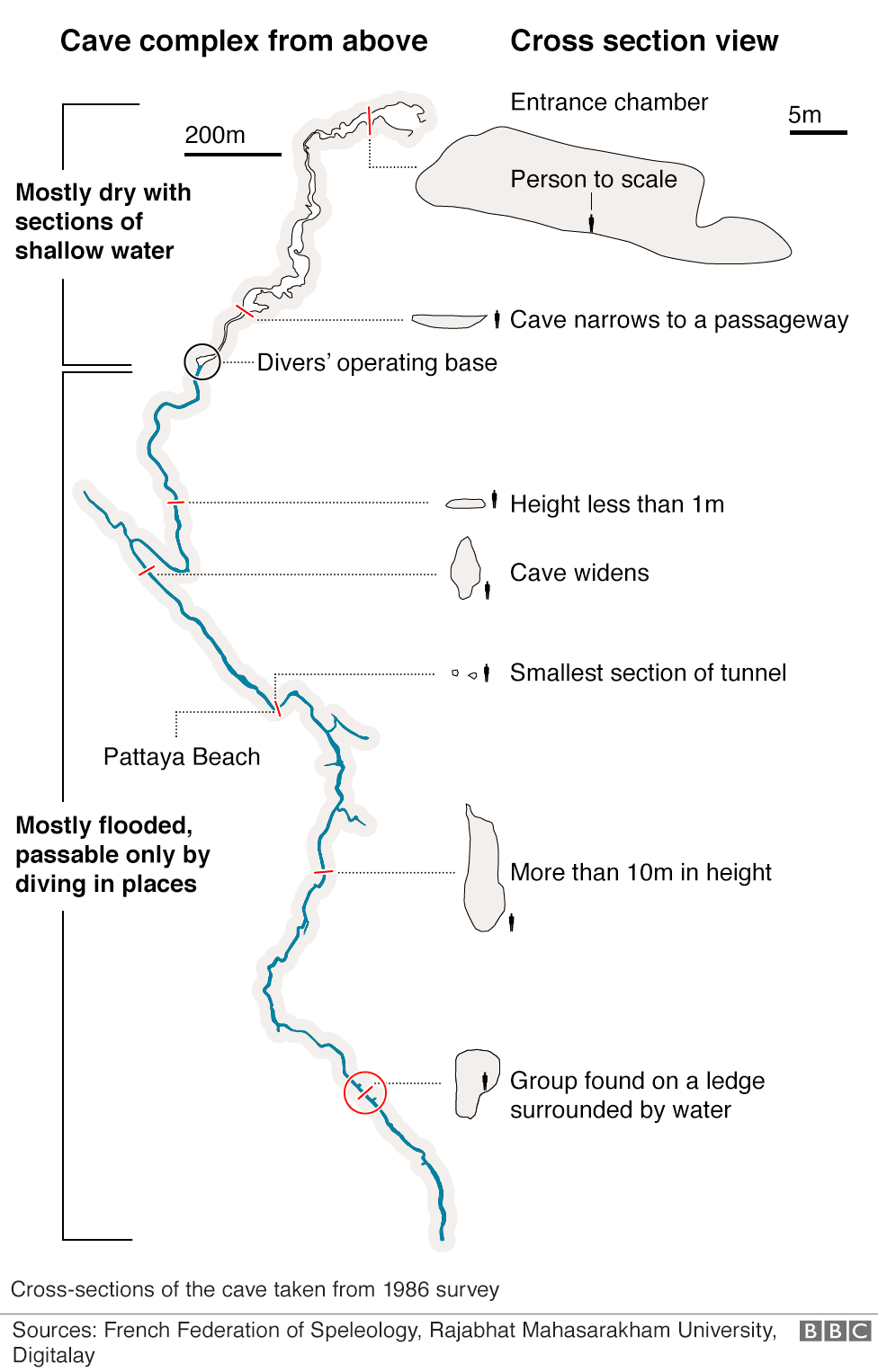
Whether this has a chance of working depends on the exact diameter of the narrow portions of the submerged route. My impression is that they were very narrow, perhaps too small for a rigid container containing a human?
I recall seeing one of a vertical cross section so you can see where the kids would need to go into the "submarine", but I can't find it again nor do I know how accurate that map is.
In any case, the above map has a few cutaways showing you the cross section size of the tunnel to human scale.
Indeed. The "submarine" is more like a duffel bag with air tanks and weights. It isn't rigid.
I think it might work. It helps that they are very young and small and athletic build (and now, unfortunately, really skinny due to not eating much food for the last couple weeks).
I am thinking of the obviously watertight and airtight flexible, yet very tough material used for collapsible diesel fuel bladders... Fitted out with an air tank supply and ballast weight mounting positions?
12 young soccer players and their coach who’ve been trapped in a cave in Thailand since entering it June 23rd, after which they became trapped by rising floodwaters.
That was a tweet and a pretty ridiculous one. These sorts of caves are famously full of razor sharp rock that would puncture such flimsy inflated underwater structures.
I don't like Elon much (I think he's an ass to his employees), but he still sent engineers for free to Thailand and is donating materials that are probably not very cheap (rocket parts for the mini-sub thing). At least he's trying to help!
He is of course getting a lot of attention and it might be one of the reasons he is doing it, but he is definitely helping and he isn't receiving money, is he? I think attention is fair price to pay to Elon for his help.
I mean it’s a slightly better idea than the alternative, which is force weak kids who can’t even eat solid food because of starvation, many who can’t even swim, to try and swim through it. If that’s what happens the odds that even one of them make it aren’t very good.
Whatever the solution is doesn’t have to be perfect. Since the alternative is almost certain death, anything that gets even a few of them through part of the cave is better than nothing.
And if kept under pressure and combined with constant pumping it might last just long enough to get them out. It doesn’t have to be perfect. It just has to be good enough to get them part way or to make sure they don’t all drown.
SpaceX isn't some magical company with a warehouse full of equipment that's better than anywhere else in the world.
It's hardly like the Thai's are using buckets to drain the cave, they'll already have the highest capacity pumps they can find.
A pump for pumping rocket fuel into a rocket is very different to the kind of pump you'd use to pump out a cave. For a start, rocket fuel isn't filled with grit and other bits.
I don’t have the citation, but recall reading that the water level is only going down about a centimetre per hour. With more heavy rains on the way, CO2 levels spiking, and uncertainties about the ledge they are on, it seems they have decided they don’t have the time.
I'd imagine two or even four divers taking each kid in between them. I assume there's a line, so no one is navigating and the route is fully supplied with any additional air needed. People go on intro dives all the time where an instructor does everything. Obviously the element of the long and narrow passages makes things a lot more difficult but it's doable. You just take your time. This completely unknown new technology seems riskier to me... Full face dive masks take most of the "tricky" don't breath in through the nose out of the equation. I'm a sport diver.
That said, there's always some people who "lose it" during a dive course or even newly certified divers. Though I've yet to hear of anyone who decides to stop breathing air and opt for water, usually they bolt to the top, which isn't an option here. That risk can be mitigated by doing "pool" dives right where the kid are and perhaps short stays in the adjacent cave areas. Maybe some relaxing music can be played as well... Another possibility is adding some "rest stop" by creating air pockets along the way.
They wouldn't need to swim. They would be pushed/towed and/or pulling on a rope. Diving isn't like swimming- the hardest part of swimming is staying on the surface and being able to breath. When you're diving you're just floating there and you have air. Divers typically use fins for propulsion which is quite different than swimming.
In many Asian cultures, swimming is discouraged, parents think it will increase chance of their kids drowning.
Drowning is the leading cause of death of young people in Thailand.
At a pool under a waterfall in Thailand last year I saw a bunch of young people trying to swim. No one wanted to be the first in. Some were plainly terrified. Water was waist deep only! Quite a sight.
In general swimming is not particularly popular in Thailand. Dark skin complexion is seen as something for the poor or uncultured (foreigners generally excluded), and that tends to go along with swimming. This is why you can find more than a few local hotels that will have pools built under natural shade. That way you can swim without being in the sun, even though it's something the vast majority of their target clientele would not want! It's also why you might see a Thai fully dressed while swimming at the beach or a pool. It's not about modesty - it's about avoiding the tan!
If you are poor living away from the beach, it's perfectly natural that you spend your entire childhood without even seeing the beach let alone learning how to swim. Thailand is not an island.
I live in a landlocked country and nearly everyone I know can swim. People usually swim in public pools, lakes or ponds. Swimming is also very often part of the PE middle school curriculum here.
Good of your country. Many cities in SE Asia have none of three. If you are in upper middle class, you can afford private swimming pool membership. Less then .1% schools have swimming pool. Rivers are polluted enough and have no infrastructure in place for swimmers.
Having them go directly relies on them keeping themselves calm while doing something that makes many adults panic. I'm not expert but I believe one key to successful diving is maintaining your heart rate at a certain pace.
Musk offered to send pumps too IIRC, but I'm not sure they took him up on it.
You'd consume your air much faster if your pulse was racing but other than that it shouldn't be a problem. If you're scared of closed spaces you might panic but other than that diving is a pretty calming experience for most adults. Sure, if you were diving by yourself in that cave and got lost you'd probably panic but if there's a solid plan/route in place with plenty of margin it shouldn't be that risky. Water temperature and depth seem favourable, there are plenty of open areas on the way. I was really surprised to hear about that diver death, someone must have been taking some unnecessary risks or not paying attention/following procedures. I think only a fraction of the route actually requires diving.
I doubt they would fall asleep, as the experience of being wrapped up likely would still produce plenty of adrenaline.
And would it be quiet? I would expect sounds of air bubbles, breathing apparatus, scratching along rock in the tightest passages, etc. Nothing high-volume, but it would certainly be audible.
I think the same but looking at all his very public "Tweeting" I can certainly understand if someone was to crticise. I'm not sure the tweeting has made his plans any more effective.
It all started when someone asked him for help via twitter. I am sure the back and forth he has done there is minimal compared to the unseen effort to get this far so fast.
It looks like they're going in to rescue the kids based on the current conditions. I'm guessing this submarine solution could potentially be a back-up in case something goes wrong. I doubt it's a PR stunt - Elon doesn't care about PR (remember his April fools tweet).
From recollection, that does not seem true at all. All of Musk's initiatives have benefited from his intuitive ability for hip and technophilic branding. See the naming of "Tesla" and "The Boring Company". He also likes to frame his companies' activities in the context of techno-utopian contributions to civil society, and this is nothing new. Outside of the obvious main electric-cars mission of Tesla, they have also built a battery power reservoir in Australia as well as dabbled in solar panels.
As SpaceX, sending a Tesla into space was great PR.
As the Boring company, they sold overpriced flamethrowers as great PR to the technophile crowd.
Whenever a safety incident regarding a Tesla car occurs, Tesla issues a heavy-handed, highly defensive piece spinning their cars to be among the safest, with a constant undertone of shifting all possible fault elsewhere. The April fools tweet sends a sort of "haters gonna be haters" message to his Tesla fans.
So Musk is indeed highly aware of marketing and branding, and this proposal is highly consistent with Musk's branding and strategy. It has the Musk elements of proposals that
1) seem prima facie simple
2) seem prima facie feasible
3) solve a longstanding big or deep problem, that
4) the layman does not think has been seriously considered before as a solution to the problems it tries to solve,
5) where the problem is currently being addressed by a very different solution that seems technologically uninteresting or costly.