My high school started at 7am. I also took the bus; which picked up around 6:15am; so I usually woke up around 5:45am during the week. I would often nod off during my first or second period; and routinely took 2-3 hour naps when I got home from school; which screwed up my ability to fall asleep early at night or get much homework done. I sometimes wonder what my academics would have been like if I was actually awake during those first two periods.
I've always been confused by TV shows showing kids leaving for school and it's bright outside with the whole family awake. Growing up, it was dark when we got up for school and just barely sun up (depending on the season still dark) by the time we left to get on the bus.
On the shortest days of the year in Los Angeles[1], there is civil twilight around 6:30am and full daylight before 7am. Maybe the writers, who even have children, live close to the schools they attend.
Los Angeles is far south, even in the context of California; that's not true for San Francisco.
Also the shortest day of the year isn't the day of the latest sunrise - that'd be the day before daylight savings time ends. On that day in San Francisco civil Twilight is at 7:08 and full daylight isn't until 7:35.
If we put aside daylight savings shenanigans, it's still not the same day (because of how the earth's orbit works); it's in fact early January and still 7:25 AM for full sunrise.
I definitely shared the experience (growing up in the mid Atlantic) of catching busses before true sunrise so I could get to a 7:40 AM start in the winter months. I don't remember it being fully dark, though that time in my life is a bit of a haze in no small part because I was completely exhausted all the time.
> I definitely shared the experience (growing up in the mid Atlantic) of catching buses before true sunrise so I could get to a 7:40 AM start in the winter months. I
That reminds me I have a vague memory that there was a lot of pissing when Nixon Admin moved up daylights savings time during the first oil crisis. Parents were complaining that their kids were having to walk to school in the dark. Back then city and suburban kids didn't get rides to school, they all walked.
The thing with evenly distributed sunlight is that, if you work in an office, you're not going to have a lot of free time to be outside and not commuting while the sun is out during the week.
With a big skew between winter and summer hours, it's dark in the winter but you don't actually lose that much in-the-sun free time while you gain a huge amount of light during the long summer evenings.
I do kind of enjoy the over 15 hours a day of sunlight Seattle gets in the summer, it peaks at around 16hrs on the longest day! I can get off work at 6, be home at 7, and still have 2 hours of sunlight left!
Less than 9 hours in the winter though... that part is harsh.
And mom is fixing bacon and eggs and no one is eating, dad is seated with the morning paper with his tie on. Mom in her robe or apron is the stove happily serving everyone.
Geographical latitude can make a big difference. Right now, there is a 30 minute difference between sunrise in Los Angeles (6:59am) and Seattle (7:29am).
Given that most US television programming has historically been produced in Los Angeles, it's not surprising that we should see daylight more commonly depicted during waking hours than what many Americans experience.
I have to say that is not productive, especially as a teenager, or old child, where sleep patterns shift to a "late-night-owl" more, and extra sleep beyond 7-8 hours is critical.
In the fall/winter when we were doing drama productions here (Indiana) in high school, I never saw the sun except via windows in classrooms that had windows. On the bus before the sun was up, at school before the sun was up, leave school after the sun had set. In junior high even in the spring we'd get to school (by walking) as the sun was coming up a couple times a week for FCA (Fellowship of Christian Athletes, at a public school in the cafeteria before school).
For that matter, that's basically work for me as an adult that time of year. Sun comes up after I get to work and sets within an hour or so of me leaving work late fall through early to mid winter.
Personally though I've never minded it. I've pretty much woken up between 5:45 and 6:45 my entire life, if I'm lucky I'll sleep in til 7-7:15 on the weekends. Getting up to get on the road for hunting or fishing as a kid meant getting up as early as 3:30 sometimes.
Suspension of disbelief. I live in Germany, and every movie and most shows take place during the summer when it's sunny and the characters are not wearing a jacket even in the evening.
That kind of weather is seen for a few days in July and August, current anomalous weather notwithstanding.
I had similar experiences. I and many other students would sleep in our winter coats on the morning bus ride, and it was hard to focus until about 10AM.
I strongly suspect that school hours are based around parents work hours, even if that is not what they say.
In high school, they're based around having time after school for sports practice and other extracurriculars, mostly, from what I understand (I know a lot of K-12 teachers). That's why so many districts still make elementary schools start like 2hrs after those kids are wide awake and already having some of their best hours of the day, while the high schools start before the damn sun's up for about half the school year—not enough buses to start everyone at once, so if you want the high school football players to have a nice long stretch to practice in the afternoon, you have to start high school very early and other schools very late.
Why don’t they just shorten the duration of school? Why does a senior in high school need 7 hours of classes 5 days a week, but one summer later only need 4-5 hours of classes 3 times a week as a freshman in college?
Our district solved that probably entirely by discontinuing bus service for all except special needs students. Kids can walk, or be driven by their parents. The district has partnered with the metro transit to provide dedicated buses on some routes, but only up til 8th grade. After that, you're on your own. Yet our property taxes are just as high as most districts...
As someone who lives in a country where schools all uniformly started at 9:00 am (i'm probably wrong on that, but lets just go with it), what's the social-background/theoretical reason for starting the school day at 7:00am?
From the outside that just seems absolutely bonkers?
As noted, bus scheduling. Because the US doesn't have a robust public transit system in most regions, it relies on dedicated school buses.
The really goofy thing is the schools are traditionally backwards. High school starts earliest (call it 7:30am), then middle school (call it 8:15am), and then elementary school (9am).
Physiologically, that should be reversed, as teenagers have a harder time getting enough sleep and functioning in the morning.
Timing-wise, starting ES earlier works out better for many parents, as a 9am school drop-off is too late for them to start their commute. So, one parent ends up time-shifting their work day in one direction (to drop off or walk to bus stop), and the other parent time shifts the other direction (to be home at the end of the school day). Failing that, the kid gets sent to in-school day-care before and/or after school.
If ES started at 7:30am, both parents could start their day at the same time, and only worry about child care after school (if neither can be home mid-afternoon).
Or, we could just stop sprawling all over the darn place, build some transit, and start all the school at whatever time makes sense for those students.
Remember that 7am in one place is not the same as 7am in another place. Time zones, latitude, seasons combine to cause big differences in what a time "means".
For instance on the equator sunrise and sunset is very consistent and so people tend to wake up earlier so that they can maximise daylight. Closer to the poles, it makes
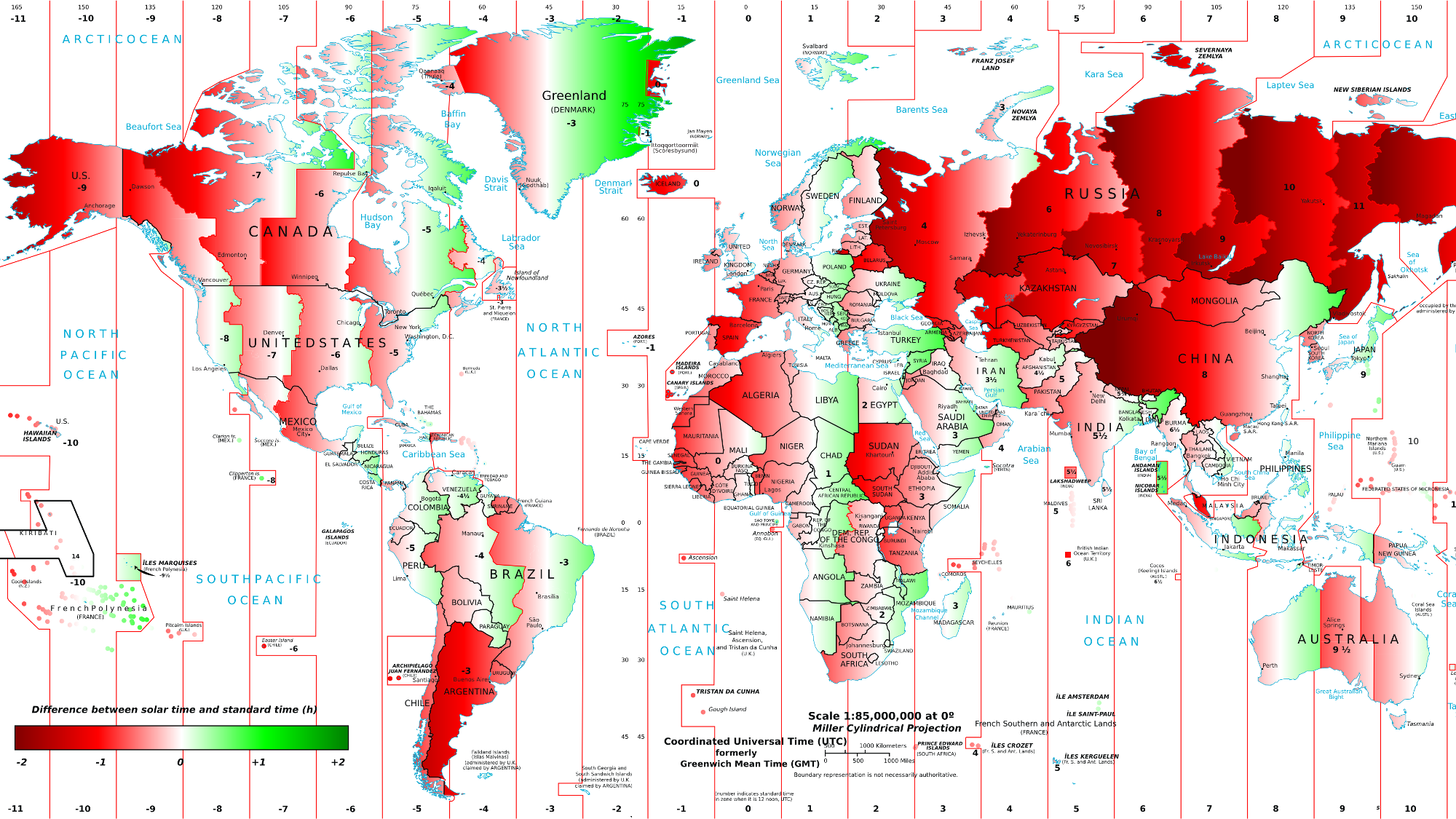
sense for school days (which tend to be shorter than work days) to start around the time that the sun rises in the winter so that they are in daylight all year. This is all relative what error your time zone has, as shown in this famous map:
There are two distinct equators which are not equal: celestial (perpendicular towards the axis of planet's spin) and ecliptic (a circle from planet's sphere on a same plane with orbit from a celestial body). On Earth they differ for 23°44' now (it's changing over time) which is why we have distinct seasons. As default we talk about celestial poles and equator which isn't right for theme of sunlight.
Also the "famous" map is outdated at least by 5 years, Russia has switched from permanent summer time to permanent standard time in 2014. Wikimedia has an version[0] which is somewhat maintained.
Not knowing the real reason, I suspect it's so that parents can drive their children to school before starting their commutes to work. What proportion of kids do you reckon walk/bike/transit to school in your country?
Honestly (Aus), relatively few. Drop-offs would traditionally be from about 8:00 am onwards (so kids had up to an hour before hand waiting for classes to start). Not everyone arrived from 8:00, but getting there well before that was exceptional.
We don't generally have "dedicated" buses for school, though there are some schools that have dedicated routes at certain times of the days usually contracted out to bus companies, otherwise its on the parents or the public transport system to get children to and from schools.
When I was younger (sub-12 years old, both parents working), parents dropped me off on the way to work, then we had a kind of neighbourhood arrangement with other parents at the school where we'd be picked up by them (car-pooling i guess) and go and spend the afternoon at their place before my parents picked us up from their place on the way home.
For high-schoolers, its a bit "well, they're capable of getting themselves to and from school by now...", with obvious exceptions if you live out in the sticks or miles away from the school (then the question would be, why are you going to that school without a way to get there?) and no real stigma to it if you can sync up with parents or after-school activities.
You know, i'm much older now, so its possible I'm out of touch, but I doubt I'm THAT out of touch to make a 7:00 starting time seem vaguely sane...
Edit: I've looked into it and I'm not that out of touch. State recommendations where I live are from 8:30 onwards, with most starting at 9:00.
The part about this logic that confuses me is starting early enough to early morning commutes (7ish) puts kids out of school long before parents are home (2-3ish). I remember briefly running with a crowd's whose daily ritual was, after being dismissed at I think 2:40, was to go home and smoke pot for a few hours before everyone's parents were home. Unless kids are in school for 9+ hours, I don't see how parental commute is a reasonable argument. Similarly, there's no reason there couldn't be early classes for kids who absolutely couldn't get to school otherwise.
Another perspective from Australia. When I was in high school virtually everyone took the bus to school except a few of the yr 12s who could drive themselves. The only problem was the nearest bus stop was an hours walk away from my house so I still had to get driven to the bus stop.
My solution is I would come home at around 3-4pm (after hanging out with friends for an hour) and then sleep for about 8 hours. I'd wake up around midnight and have a good ~5 hours to myself. With my parents asleep I'd cook for myself and do my homework and watch tv. When I had zero period having a rotated sleep schedule only helped. It was like living alone. I preferred the responsibility and the sleep schedule. There is nothing quite like that 3-4am calm in the morning.
I had a similar experience. I went to a magnet school, so it actually started one hour later than other schools (8am instead of 7am). However, since I rode the school bus, I still needed to be up early enough to catch the bus at 6am. The bus would first stop at the local school to drop kids off before driving to my school. I'd get home around 4pm, so all in all I was at school or going to and from school for 10 hours.
But the 10 hours wasn't my biggest complaint -- it was how little time we had to eat lunch. Lunch period was only 30 minutes, and the line to get food was 15-20 minutes long. So I only had like ~10 minutes to eat my lunch once I got it and use the remaining ~5 to be back in class in my seat or be tardy. We weren't allowed to eat in class or we'd get into trouble and get written up, so that ~10 minutes to eat once you actually account for all the logistics was it.
I don't think people realize how important it is for kids to get their nutrition when they're in school for so long trying to learn. Nutrition has a direct impact to learning. I think lunch period should have been longer. It felt like an afterthought in the schedule.
Grew up in Ohio in the 80's same deal from 6th through 11th grade. Hour long bus ride, class started at 7am. Nice thing was we were the first off the bus on the way home, so we were home by ~3pm and got to sleep for a couple hours before parents came home.
Another benefit of delaying start is fewer kids driving in the dark in winter and more time for morning fog to burn off on those marginal days that weren't bad enough in town for a delay.
I don’t get how this is supposed to work with sports and other activities. In high school I had water polo/swimming practice mornings at 6:15. Is that now illegal?
Typically they don't until they are forced to by an adversarial process. Compare AB5 in its original form versus what was eventually passed. The number of professional groups that stepped in and pushed for exceptions for their trade is a testament to how poorly the original authors of AB5 did thinking about the edge cases. By the time it passed, it was largely exceptions.
Let’s say you can sleep until 5, which is somewhat optimistic for many families with multiple responsibilities in the morning.
That means you have to be asleep no later than 9, which means depending on the time of year it may still be light out, and certainly the community is still fairly active. Plus I recall a recent study that essentially said teenagers are naturally night owls.
Expecting teenagers to be asleep by 9 is a losing battle.
Because it is tough for high school students to fall asleep early enough.
"In the teenage years, the hormonal response to the 24-hour daily light/dark exposure that influences circadian rhythm is altered, making adolescents physiologically yearn to stay awake later at night and to remain asleep later in the day."



(This was in the 90's)