In the U.K. outright TV and print media bias is the new normal. The UK already has one of the least trusted media in Europe, and I think it's safe to say the hostile and one-sided coverage (relentlessly attacking Jeremy Corbyn and the Labour party) is unlikely to change that impression.
If anything social media should be praised for offering an alternative that actually connects with so many people.
I don't think you can take away any useful information from this "study". A single glance at the sources is enough to tell you that the author selected a sample that would guarantee them the conclusion they wanted.
All the newspapers in the screenshot are notoriously right wing, as is every other paper that gets mentioned, apart from the Guardian. I guess that one was included to make the biased sample seem less obvious, and since they happen to be quite neutral on Corbyn, so they don't offset the stats too much.
This study is the equivalent of only looking at "Fox News" and other similar news broadcasts, and drawing the conclusion that American media as a whole is very conservative and supportive of Trump.
Hmm, it's perhaps a valid point but as far as I can tell the only English paper missing is The Times (other than small mad ones like the Daily/Morning Star).
I'd take the opposite interpretation. It probably says even more about bias that those are the sources available to choose from (though I'd also say the Mirror is left wing, the Guardian sort of centrist and who knows what's going on with the Independent though in further reduction of the free media pool they've just been bought by a right winger).
I wouldn't call it sampling bias if it reflects the actual existing reality, those are the media sources available (except in Scotland and NI) and they're biased against the opposition.
Aside from all the Times flavours, The Observer and "i" are both left leaning papers that are missing.
Although there are overall probably more left wing than right wing papers among the small ones (like the Daily/Morning Star, as you mentioned), there do seem to be more conservatives newspapers among the big names.
That comes as a bit of a surprise to me, given the situation is the opposite when it comes to non-print media. I struggle to think of a news channel which is obviously conservative. I definitely wouldn't call BBC that, and others like Channel 4 are as openly left-wing.
As someone who predominantly follows television and online news, I haven't personally noticed any conservative bias in the available options, and even a slight under-representation if anything.
Daily Mirror is left-wing as is The Independent. Both are prominently featured in the screen shot, along with the Guardian, which you already mentioned. Either you're very poorly informed about the different papers political leaning, or not very observant.
Also, more of the best-selling papers are right-wing than left, so it's natural there will be more.
For many of us in Scotland this is nothing new. The coverage and reporting leading up to the 2014 Scottish Independence referendum was pretty appalling, with the BBC operating in full "Defence of the Union" mode. Both TV and print media ran scare story after scare story repetitively despite most being debunked.
My memory of that time is that the nationalists were making a lot of claims during the campaign that they'd not laid any groundwork for, and which didn't hold water. Mostly of the form "after leaving the UK we'll still have access to X" or "Y won't change" but they hadn't actually asked anyone in the British government, so there was a lot of public back and forth over that, in particular, what it'd mean for Scotland to keep using the pound. Because they talked about future hypotheticals it is hard to say whether they were 'debunked' or not.
One claim I remember very clearly was that post-independence Scotland would be able to keep funding its much higher levels of government spending because of high oil prices. The media did question this claim, and it turned out rightly so: oil prices collapsed just months after the vote and never recovered rendering the SNP's financial plans irrelevant. Independence would certainly have meant rapid and dire cuts in spending.
However nothing I saw would have risen to the level of "disinformation", whatever that means. It was just people disagreeing on the relative merits and probabilities of things.
Stu Campbell isn't everyone's cuppa, but his writings on the shite, filth and corruption that went on during the Scottish Indyref in 2014 are reasonably bulletproof.
I'll happily admit that the one thing the SNP messed up on was the currency question and that they should have had the balls to say they'd launch their own currency and central bank, or create a Scottish Pound tied to the UK pound (at least for the first few years - and is not unusual, there are many dollar currencies tied to the value of the US$).
I can also answer questions on the balance of media exposure between pro-Union parties and the Yes parties (SNP and the Scottish Greens). Professor John Robertson (an academic who's work was to analyse media bias all around the world) of the West of Scotland University performed an analysis of this and when he presented his findings there were calls for him to be fired from his job - by BBC executives.
I took a brief look at the Wee Blue Book but it seems to be old pro-independence campaign material, rather than specifically about "shite, filth and corruption"?
If Campbell wanted to criticise bad electioneering he would need to get his own house in order first. I don't think re-litigating the old campaign is necessarily a good use of time but the first page of his Blue Book has several exceptionally dodgy claims in it, really, claims I'd consider to both completely false and some are extremely offensive. How can he criticise his opponents for relying on "scare stories" when his own positions are on such thin ice?
e.g.
the only reason terrorists might attack us is because we’re part of the UK.
It's staggering to me nationalists really made this argument. Did Campbell miss the terrorists killing people in France, Germany, the Netherlands, Belgium, Russia and many other places that aren't the UK?
This claim can only be rooted in delusional racism and hatred of the English, to believe that somehow Scotland wouldn't have the same problems as everywhere else in the world or that terrorism is a specifically English problem.
Many of the other claims don't make sense (e.g. "We don’t affect the outcome of UK elections"), are self contradictory (e.g. "Scotland is a country" but the point of the campaign is to make Scotland a country), or have been proven wrong by subsequent events (e.g. the oil wealth related claims). They're very far from bulletproof and remind me of why I soured on the SNP's campaign despite being a natural supporter of devolution and local government. There certainly are good arguments for Scottish independence, but the material in the Blue Book is a good example of mendacious and manipulative campaigning.
You're arguing that the media are constantly attacking the Labour party. My wife is always complaining to me about how the media are always attacking the Conservative party.
I think, given that both sides are complaining about being attacked, the media probably aren't actually that biased overall.
However, what I would much prefer to see is much more moderate coverage of the different political parties. However, that would require that the political parties make moderate claims about each other, rather than just painting the other parties as the devil incarnate.
At the moment, media coverage of UK politics is dominated by outrage. I get it, outrage sells news stories to a very large proportion of the population. It puts me off, and makes me distrust the news. I'd like to see more "We think this policy would be best because..." and less "OMG the other party are killing babies as we speak." Social media does not achieve this.
Yeah, at the moment, I'm seeing the majority of the news on politics coming my way is outrage-inducing, and I by default ignore articles like that. They don't actually convey any useful information, but they sell. I think it's reasonable to assume that none of the political parties actually want to murder babies.
I'm getting very little actual real reasonable information about what the politicians will actually want to do. The truth is, good things will happen and bad things will happen in the country. No political party can prevent that. They might be able to make a very small change, but that's it. They are all trying to make improvements, and they have different ideas on how to do that. Which one is right? Well, if we knew that, the parties would agree on it and argue about something else.
Trying to make improvements for who, and why? That's the important part, and why politics gets so heated. You sound like you're talking about choosing between slightly different flavours of ice cream.
I'm not sure there is any other stance that can be taken other than a nakedly partisan one. Each side is obviously going to think that the media is biased against them because because lies the other side believes are a lot more visible than lies they believe, because when the media sides with them it's just what they expect but when the media sides with their opponents it's shocking and anger-inducing, and so on and so forth.
My wife is always complaining to me about how the media are always attacking the Conservative party… I think, given that both sides are complaining about being attacked, the media probably aren't actually that biased overall.
I once felt that this was true in the UK, particularly around the BBC. To some extent, there is still a bit of truth in it. But I don't think it would be possible to hold that view honestly any more after the current election campaign, and to do so would require willingly turning a blind eye to some particularly egregious behaviour.
It's not as simple as a blatant "bias", either. The UK's tabloid press has always been pretty sketchy in this regard, and the decline of the Telegraph, which is now a blatant organ of the Conservative party, is astonishing. The current thing that's happening is more complex – there's a weird mix of credulous establishmentarianism and an inflexible media culture that's making it hard to deal with the rapid change in the methods by which information is spread. I have no idea how to deal with this, but it's actually sort of frightening to watch how much it's deteriorated in even the past few weeks.
I will 100% agree with you that there has been a deterioration in the quality of media reporting on politics over the last few years.
However, I will argue that this is partly/mostly because the main thing the political parties are feeding the media is negative messages. I'd like to see some constructive messages instead.
Even the political leaflets put into my letterbox are giving negative messages - "Anything but Boris", "I am the only candidate who can get rid of the Tories", "A vote for the Lib Dems is a vote for Corbyn", "Don't let Labour destroy our region", etc. What I wanted to see was "We recognise this particular problem (for example, underfunded NHS), and we think the way to solve it is to take this particular action. We know this will have this other knock-on effect, but we believe this is the best choice."
The other thing I see in the political leaflets is of course empty promises. I think all of the parties have promised to save the NHS. None of them really say how, or why their method is better than the other parties' methods.
It's just a load of mudslinging at this point. I'd seriously vote for a candidate who just said "You know, our country is pretty nicely tuned at the moment. We could spend a bit more on this, or a bit less, depending on your political philosophy. But I plan to stop changing everything all the time." As it is, I might be spoiling my ballot. I'm in a safe seat anyway.
We don't have to rely on each other's opinions. There have been studies done.
LSE study [1]:
> The results of this study show that Jeremy Corbyn was represented unfairly by the British press through a process of vilification that went well beyond the normal limits of fair debate and disagreement in a democracy. Corbyn was often denied his own voice in the reporting on him and sources that were anti-Corbyn tended to outweigh those that support him and his positions. He was also systematically treated with scorn and ridicule in both the broadsheet and tabloid press in a way that no other political leader is or has been. Even more problematic, the British press has repeatedly associated Corbyn with terrorism and positioned him as a friend of the enemies of the UK. The result has been a failure to give the newspaper reading public a fair opportunity to form their own judgements about the leader of the country’s main opposition.
Loughborough University study, as reported by Media Reform UK [2]:
> Research published by Loughborough University has shown that during the first two weeks of the campaign, Labour attracted by far the most negative coverage in the national press of all the major parties. The Conservatives on the other hand, unequivocally got the most favourable coverage. We might expect that, given that most national newspapers (including the three largest titles across both print and online) have endorsed the Conservatives during successive recent elections.
Media Reform UK study on claims of anti-semitism in the Labour party [3]:
> Looking at the overall figures in absolute terms, The Guardian and BBC television recorded the two highest number of inaccuracies (8 and 6 respectively), followed closely by The Sun(5). Proportionate to the volume of coverage, BBC television still featured the highest rate of inaccurate reporting and this position holds when incidences of misleading coverage are included.
Ironically, in the US, the BBC is the media source that I trust the most. It has so little bias, probably because it has very little interest in the outcome in our elections.
It’s not like they don’t deserve criticism, their policies are financial suicide. Additionally they’re lying about the NHS along with every left wing rag out there.
Tories wanting to sell the NHS is fake news. It’s fear-mongering. Labour already sold the NHS essentially, allowing provisions of services by private companies. The Tories haven’t made any cuts to the NHS while in power.
So why do labour and their supporters keep touting rubbish?
I vouched for this post to bring it back from the dead, because HN flagging shouldn't be used to engage in partisan political suppression.
As a Brit I've also found the rhetoric around the NHS to be depressing. People talk like one of the major parties has a manifesto pledge to shut it down, but there's no such discussion anywhere. One major party spends much of its time attacking policies the other doesn't actually have. This doesn't seem right.
> You don't think the media attacks Boris and the Tories?
Not really. Boris outright lies all the time, and he's rarely picked up on for it. There are also several instances of Newspaper's running stories on the exact same policy, positively when suggested by the the Tories, and negatively when suggested by Corbyn. You can't get much more objective bias than that.
> That story about the boy sleeping on the hospital floor wasn't a setup by the left-wing media?
It wasn't. There's an official statement from the hospital confirming they had no beds left. Of course, the media chose to report it, but they aren't lying.
The right-wing media lied about it though, and it's a very relevant example of online disinformation:
"Despite the claim that the photo was staged having been acknowledged as false, it [the claim] has continued to spread on both Facebook and Twitter [...] Telegraph columnist Allison Pearson retweeted screenshots of the Facebook page to her followers twice, telling them “I presume this is genuine”, and adding later that the photo was “100% faked”. Her posts have received thousands of retweets between them."
(This is already downvoted, along with every non-pro-Tory comment in this discussion. Probably it will recover, HN usually does, but it would be better if people who disagree counter the arguments, rather than just downvoting what they're uncomfortable with.)
the rise of this submission to the front page and the swift sinking back under the waves, along with the vote war on comments here is interesting. this place isn't nearly so left-leaning as i'd assumed.
I agree with your point in parentheses. It appears I've been downvoted into oblivion despite not even indicating my own leaning.
Even if we're acknowledging that this story wasn't a setup, it's wrong to suggest that there's more right-wing bias in British media than left. It's probably about the same, though of course some establishments will always have particular leanings (e.g. Guardian to the left) Even the Beeb, which one would assume is neutral, regularly jumps on the Boris-bashing brigade.
> That story about the boy sleeping on the hospital floor wasn't a setup by the left-wing media?
It's been proved beyond any doubt that the boy sleeping on the hospital floor was in fact true[0], despite an army of twitter and facebook bots being deployed to try and discredit the story[1]. The hospital involved publicly apologised for the incident.
I'm less certain about the hospital incident and overall left-vs-right bias, but I can tell you: Wow, Labour is really, really good about sounding the chorus "we're being unfairly targeted! smears!" whenever there's a new story that another MP has resigned over the party's systematic antisemitism (or that someone who was fired, ostensibly to actually deal with anti-semitism, has been mysteriously re-hired).
(Our local "anti-Zionist" friends in Labour will mod me down for this, I know.)
The current Conservative leader has called Muslim women "letterboxes" and black children "piccaninnies" [1] with "watermelon smiles".
Maybe someone has made a systematic review of the reporting of Conservative and Labour racism, and the reporting of it, but just throwing up a statement like yours, without also including the racism of Conservative party members/leaders, is just fuelling the fire of hostile debate.
There will be racist people in both parties. Step back, and compare the depth of the racism and the number and influence of the people involved.
Trust me, I am always glad to say that the island's politics are a poorly contained dumpster fire, and point out the big stuff, like the Windrush scandal, or the English-proficiency-test scandal (not the original cheating, the Home Office response where they told thousands of international students their tests were invalid and they were subject to removal).
But if we're playing the "which one is really worse?" game, instead of striving to better either, we've lost.
This is certainly the view in the bubble, that the BBC is relentlessly anti-Corby. Yet when you look at the details, the evidence is hard to find. The BBC's Laura Kuenssberg, is frequently the target of attacks as being biased against Labour, but those critics always seem to ignore stories like this which is currently the featured bit of analysis on the BBC Website elections page: https://www.bbc.co.uk/news/election-2019-50722167
I find a lot of the problems with the media, and Laura being an example, is the need to put the journalist at the forefront. It isn't "the BBC say", it's "Laura Kuensburg says"
This inflates journalist egos, and leaves them more open to manipulation. They want to think they are important, not the publication. They have a personal "brand". There's always been some of this, but that "brand" was usually well earned, after decades of coverage, and used in a very humble way. When word came of how John Simpson "liberated Kabul", he was rightly denigrated. Now in John's defense it was a warzone, and people can speak too quickly.
"Celebrity" journalists, with personal following thanks to things like twitter, get "scoops" from "unnamed sources" which turn out to be lies, and spread them far faster than the truth can emerge.
This is the second part of the problem - speed. 20 years ago, news was gathered by journalists, and packaged into a well researched piece for the news bulletin at 6pm or 9pm or whenever. 24 hour news started to erode this, where speed was more important than accuracy, but things like Twitter completely destroyed it. It's no longer important to be right, it's important to be first.
News organisation, and the BBC specifically, had a duty to resist the noise of "social" media, and instead concentrate on being accurate. Channel 4 news still does this, but the BBC doesn't. Laura can do immense damage by errantly tweeting that a labour activist had got into a fight with the health secretary. Doesn't matter if they retract it later.
The final problem is the lack of challenging from presenters. Politicians can lie to millions of people and are completely unchallenged. There's a time for that - it's a "party political broadcast". In the news, if someone comes out with a lie, they need to be immediately told that's a lie, and not allowed to continue. If they keep lying, they should not be given any airtime at all.
So you think that Laura is higher profile than say John Cole was 30 years ago - the man was an absolute institution as BBC chief political correspondent. I don’t think she’s any higher profile than Nick Robinson either.
And this stuff about lack of pushback is just in people’s heads - there’s massive pushback all the time. From this morning, for example.
Laura Kuenssberg is effectively the conservative party's minister of propaganda and media advisor to Johnson at this point. The very article you have linked to includes this sentence:
> The story, and the prime minister's weird and wooden response to it, provided the perfect chance for Labour to punch at one of the Conservatives' vulnerabilities
...designed purely to game search for the word "punch" after she publicly, falsely accused protestors of punching an advisor to Matt Hancock because senior Tories told her to. And even when provided with video evidence that this never happened, she wrote "doesn’t look like punch thrown" [1] rather than the true, factual sentence "no punch was thrown".
Don't forget the disinformation which is the result of the echo chamber. If my Facebook feed is to be believed, not only will everyone be voting for the same party as myself, but they all hate the other party, who are indeed all devils.
I think the idea of echo chambers and the link to disinformation is interesting. I found myself thinking that a certain viewpoint is the norm in many areas of life, whether it be work, reddit or hobbies.
It depresses me that the World Wide Web, given to everyone for free by Tim Berners-Lee (himself a Brit), is so heavily misused, abused and controlled by corporate and political interests in places like the UK. It was supposed to democratise information for everyone, and for a while - let's say arguably between the foundation of Wikipedia and the early days of Google, until circa 2010 when Facebook surpassed a billion users and Google got rid of its "don't be evil" policy - it seemed like it was doing so.
On Twitter I've seen screenshots on my timeline more than once now of instances where a network of accounts have tweeted the same verbatim response to some current scandal involving the Conservatives. https://twitter.com/demarionunn/status/1204190151041269765 is the most recent example.
I don't know who's behind it, but it's concerning.
This article was probably slightly too early to catch the latest development in an extremely concerning election so far.
The latest coordinated disinformation was around a photo from a hospital in Leeds where a 4 year old child had to lie on the floor of the accident and emergency department because no beds were available (primarily due to cuts to services from the incumbent government plus winter demand and general wider demand).
The health secretary yesterday visited a hospital to respond to the incident and the political editor of the BBC (the state broadcaster) tweeted a story provided to her by government sources that a Labour (main opposition party) activist had punched a Conservative (government) staff member at the protest. The story was picked up by the political editor of ITV and all the right-wing papers (Sun, Mail, Express) picked up and amplified the story including via push notifications within the space of a couple of hours.
Video then emerged showing that the activist in question had his back turned to the individual he was reported to have "punched" and the staffer had walked into the man's arm.
However there has been no exposure as to who these government sources were who spread a lie in order to distract from the original story about the 4 year old. The disinformation isn't online, or isn't solely online, it's coming from government departments and it is being spread by theoretically impartial media sources such as ITV and BBC. This is an election which has seen at least 4 violent assaults on opposition party members - we're through the looking glass now.
Peter Oborne wrote a good article [1] discussing the issues of relying on unnamed government sources to print stories. I think it has been a continuous source of highly questionable information and we really have no way of holding anyone to account.
Also, appears there's lots of dead cats being thrown around. I often find myself wondering how we have got to a place that feels so nuts. Nobody is talking to other people with whom they disagree, they are just screaming at them.
For those who don't know, Peter Oborne is a life long right wing commentator, working on a couple ofright wing newspaper (The Daily Telegraph and the Daily Mail)
For him to raise the concerns he has shows that there is something seriously wrong.
And I bet the same media outlets that sent push notifications saying the staffer was punched did not send corrections via the same means. This taps into the problem that apologies for incorrect information in newspapers and TV are not given the same placement and coverage as the original misinformation. I'd be interested in a law that forces newspapers to print apologies in the same locations, font size, etc. as the original.
I think that's one of the main changes which would help address the problems in the current media landscape. How many people would continue to treat The Times, for example, as a serious news source if they'd had to retract their "Muslim foster parents converting Christians" story as prominently as they'd splashed it?
The risk I suppose is you need to avoid something like Singapore's Fake News laws where the government decides what is true.
The other change I think would be positive is replacing "unnamed sources" with a disclaimer, for example "people who may or may not exist or be telling the truth". It's important to be able to use anonymous sources but it should be made clearer to readers that anonymity has an associated trustworthiness cost.
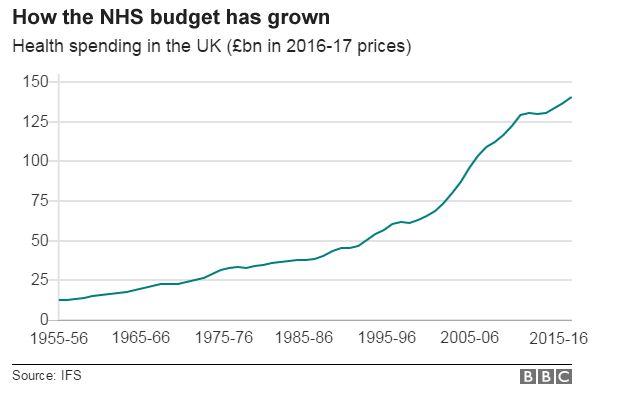
As you can see it only ever goes up. This is in "real terms" i.e. with inflation taken into account.
Usually activists who make this claim and are put under a bit of questioning pressure will admit that by "cut" they mean the budget was increased less fast than they believe necessary, which isn't the same thing.
There have been cuts to services. That is not the same as claiming there have been cuts to funding.
What is true is that the NHS has been severely underfunded (if they want to continue to provide the same services) and that services have been cut as a result. https://fullfact.org/health/spending-english-nhs/
Unless you think the NHS are burning the extra money, there are more services offered than before.
It may feel like there's less, because there's more people now, so the increase in services is offset by the increase in population. But that's also not a cut.
There's a fundamental design issue with any system that combines free healthcare with free movement. Neither party is interested in changing this situation, but Labour don't even pretend to try - they have adopted policies at their conference of essentially eliminating all immigration controls. It's hard to imagine what kind of budget a nationalised health service would require given no constraints on served population. Effectively it requires an infinite budget.
Not really, free movement has lead to more tax take to be spent on the health care system.
Health spending in every country has increased per capita (inflation adjusted), in the UK it has too. But in the UK, for 40 years, been way under that of countries like France, Germany, Switzerland, Denmark, Norway, and of course the U.S. The rate of increase hasn't increased either.
This isn't an issue of (typically working age) immigration - indeed that offsets the problem. It's an issue of an increasingly older population costing more per head. In the UK there's also an issue that people stay in hospital too long because of a failure in social care.
It is a worrying trend, and it's not just the Conservatives doing this sort of thing. It's odd to see just how many pro-Labour accounts reply to political journalist's tweets within mere seconds. Almost like bots are being used...
I feel that electoral law needs major reform in the direction of transparency and openness. It is not equipped to deal with the digital age, and asking platforms to turn down cash and refuse to publish political advertisements is the wrong way to go about addressing this issue.
It seems like the Tories have already broken the system permanently. They have far richer supporters than Labour, so more donations, and can therefore pay more to get better prominence in online advertising and so can spread their message further. They use this to win a majority in parliament. The majority in parliament gets to set the rules for online advertising. Repeat ad (pun not intended) nauseam.
I agree that the Tories tend to spend more, although the unions are a fairly big funding source for the Labour party. And the Lib Dems and UKIP/Brexit Party show that small parties can pull in large donations.
We have spending limits in the UK, so the amount that Labour and Tories can spend is roughly the same.
I've had 6 weeks of adverts aimed at a target tory/labour seat I live very close to in the North West, all from 3rd parties. The first 5 weeks it was mainly unknown groups like "Working for UK" and "Campaign Against Corbyn", all personal attack adverts on Corbyn (leader of the labour party), and when I dig deep I find the people behind these new companies (often set up in the last month or two) are people like a Conservative Councillor in London, or an Ex Conservative MP from Surrey.
In the last week there have been some "tactical voting" adverts from more establish groups (peoples vote etc)
I guess this is a way for the conservatives to get around spending limits, I guess like U.S. "Super Pacs"
That's very concerning! I live in a Labour safe seat in Wales so there's basically no campaigning here, but I was wondering what the situation is in marginals.
The Super Pacs is a good example - it does sound like the Tories are (worryingly) going down this route.
My (relatively rich, heavily remain, and mostly Tory voting) constituency is one of the rare cases that's currently polling a three-way tie between LabLibCon.
Labour (incumbent) have mostly been quiet in this HEAVILY remain-voting area, with a leaflet or two highlighting a "People's Vote". The LibDems have parachuted in a Tory defector, and have been absolutely going all out with the campaigning around "Revoke Brexit".
The Conservatives have been quietly content to stay out of the way and watch the non-Leave vote split between the former two.
This article is again trying to make it look like the Conseratives are not in talks with the U.S. about selling off parts of the NHS, which has been suggested even by Trump himself.
Even if the source of the most recent dump has ulterior motives, there's no reason to doubt the NHS implications in particular.
I understand the article is mostly focused on Johnson, so I guess in order to appear balanced they had to throw the line about Corbyn in there, but it's interesting they don't have such need for a counter narrative when writing article 1459 smearing Corbyn.
The UK online political discourse leading up to the election is so fucked, we might as well give up and declare truth dead.
For instance, take the knife attack mentioned in the article, which was carried out by a convicted terrorist who'd been released from prison. Prominent Labour MP* Yvette Cooper blamed the Tories for his release in a popular viral Twitter thread: https://twitter.com/YvetteCooperMP/status/120076129489225728...
Her claims are lies. She claims that the new arrangements which replaced Labour's IPPs failed, but they didn't apply here - he was sentenced under the old rules which still had IPPs rather than their replacements. She claimed that the Appeal Court said that his release should be left to the Parole Board and blamed the Tories for the fact that it wasn't. They didn't say that, and it was a law passed by her party in 2008 which meant the Parole Board had no say. She implied the Tory replacement for IPPs allowed serious criminals to be released early without parole board assessment, when in reality it reinstated the parole board involvment Labour had removed. There's a good summary here which backs up all of these facts: https://thesecretbarrister.com/2019/11/30/10-thing-you-shoul...
So naturally, some Tories went after those claims - and the legal blogger who wrote the summary I've linked above promptly attacked their debunkings and not the original Labour claims, and that went viral too: https://twitter.com/BarristerSecret/status/12008087678200463... In fact, that blog post above was written to specifically back up his claim that the Tories were liars. (He's technically right - that tweet is a little misleading, since the courts could avoid automatic release by imposing the IPP sentence that Yvette Cooper had falsely claimed the Tories had stopped them imposing - but it's pedantry. The claim being debunked was about what the Parole Board could have done after that sentence was handed down. That omission mostly just means the Labour claims were even more false than suggested.)
It gets better. Tory PM Boris Johnson wrote a 16-tweet thread so pedantically accurate and in line with his own claims that he couldn't discredit it as inaccurate anymore - so instead he accused Boris of stealing that blogpost which he'd written to debunk the Tory lies, implying this made the Tories the dishonest ones falsely claiming those facts supported their side: https://twitter.com/BarristerSecret/status/12010764392500879... (Note he never technically said Boris was lying, just that it was "weapons grade shithousery"). He even used the fact that they both debunked that false claim about the Appeal Court - one which Yvette Cooper had made but the Tory debunkings had not - to back up this argument. Along with the fact they both linked to literally first answer you find when searching for information on parole for extended sentences. It turns out that thanks to inattentiveness and partisanship, you can not only convince people of the exact opposite of what your own evidence shows without technically lying, you can make them believe that the people who don't believe that are the ones who've been suckered.
Meanwhile, the BBC's coverage was vague he-said she-said stuff which didn't check anything, and the Guardian was (and still is) repeating the debunked claims. (I think they did eventually write an explainer which debunked most of the claims whilst carefully avoiding tying them to any party, but I can't find it lately.) Also, the more recent BBC headlines all insist that Boris Johnson is the one who politicised this act of terrorism.
* Technically there are no MPs since Parliament is dissolved for the election, but that's pedantry.
> The UK online political discourse leading up to the election is so fucked, we might as well give up and declare truth dead.
You're right, and some back-and-forth between MPs liberally interpreting the truth, at least until caught out, has always been part of the campaign. The lies about the tories planning to recruit 50,000 new nurses for example, normally ou'd see them, they would be challenged, and then they would correct it in future interviews.
This isn't happening this time. Parties - mainly the tories - are doubling down on their lies, and ignoring anyone saying "that's wrong".
But even that is nothing compared to the fakeness that's been peddled. This again isn't new - lies about the Lisbon Treaty have been around for over a decade and still spread like wildfire online. The latest about the boy on the floor is full Orwell.
I'm an American, and haven't followed this closely. I have read the articles you mention.
His main point was that if the Tories have been in power for 11 years and haven't even brought up changing the law on early release it's disengenuous for them to argue that it's Labor's fault. If they had cared about the issue, they would have done something about it, goes his argument. You don't seem to address this.
He further argues that Johnson's comments plagiarized his. If he wrote comments that the Tories wanted to publicize, wouldn't that contradict your assertion he never criticizes labor? Furthermore, you don't seem to address the plagiarism issue; if Johnson plagiarized the tweets it doesn't matter how well written they were.
The Tories did change the law on early release, in 2012. They just didn't retroactively extend the sentences of prisoners who'd already been convicted and sentenced. Also, hiw whole complaint was that the Tories didn't publicize his comments and their correct, anti-Tory spin. Finally, the only evidence given of plagarism aside from the fact that both debunked the same claim is that they both linked to the same explanation of how parole worked for extended sentences - which is literally the first result when Googling for the topic. They weren't worded the same, weren't making the same argument otherwise, and the original blog post certainly didn't mention anywhere that Labour had made any of the claims it was debunking.
Thanks for your response. I don't know enough right now to know if you're right, and I'm not interested in doing the research necessary to find out today. I may well have been wrong. Have a nice day.
> Last week, Reddit said the document had links to a Russian disinformation campaign, raising fresh questions about foreign interference in the campaign, though the document itself seemed to be accurate.
Informing people about what their government is planning in trade talks is "foreign interference", but pressuring that government to compromise healthcare so they can profit from it is... what?


If anything social media should be praised for offering an alternative that actually connects with so many people.