The buyer for price labels is the retailer. The retailer's purpose for a price tag is to grab your eye and get you to buy more. If the price tag dissuades you from buying the product, that is a net negative from the retailer's perspective, and they are the ones that make the purchasing decisions on price tags.
Don't assume alignment of incentives. From the customer's perspective, the purpose of a price tag is to tell you the price. The customer isn't making the purchasing decisions for the price tags.
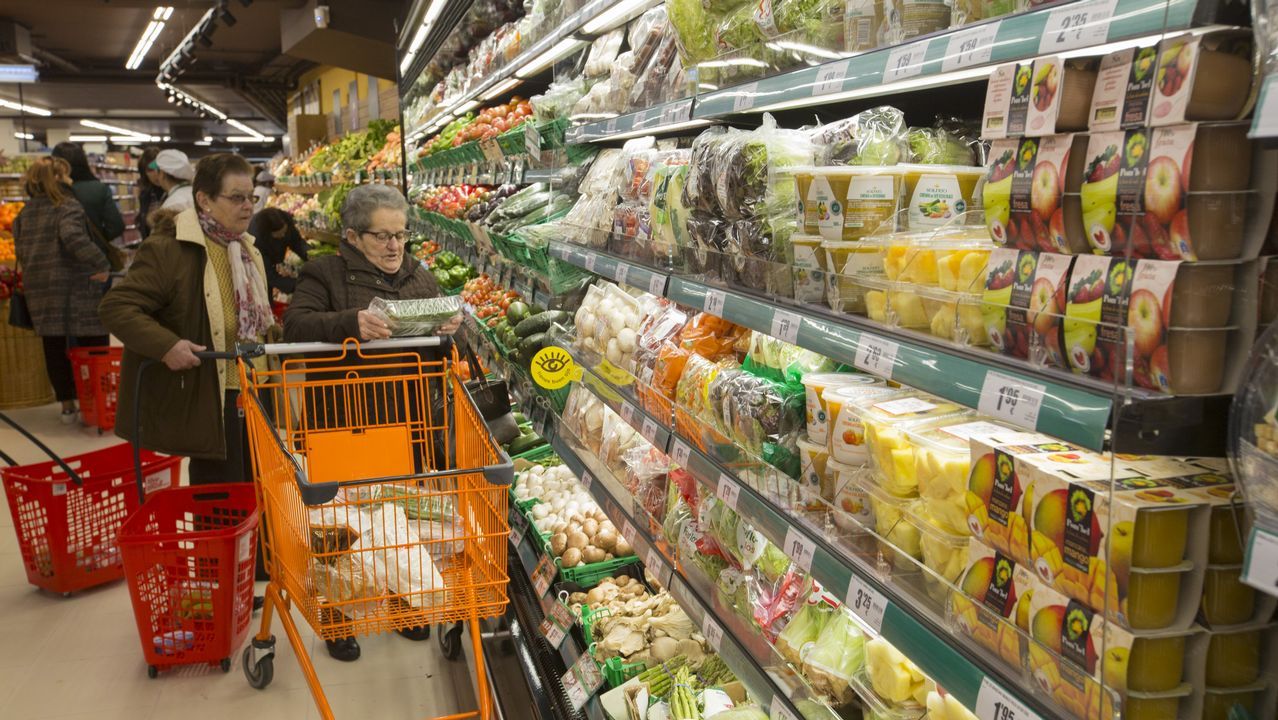
I guess this depends a lot on country and culture. In Spain, in the supermarkets I usually go to, price tags are standard, black-and-white and uniform, just telling you the price and other standardized information (like price per kg). To grab your eye towards certain products, supermarkets add additional signs near the price tags (but not instead of them).
This is a typical example: https://cflvdg.avoz.es/sc/X71nZnU3spbY_97PpRRHtVnNB20=/x/201... - the price tags are standard, but the yellow sign with the eye ("you have a keen eye!") draws your attention to a particular tag. If they want to draw your attention even more they will use a larger sign, no problem.
By the way, eInk price tags in supermarkets here are common. Far from ubiquitous, but common.
I don't know about the USA but where I live (Italy) a price tag is subject to some requirements by law. For example it shows the cost by kg or by liter to be able to compare products (of course not on, let's say, shavers.) Packaging can be as catchy as the manufacturer wishes but price tags are very standard and uniform within a store. The store can add label with discounts etc but not on the price tag.
> The retailer's purpose for a price tag is to grab your eye and get you to buy more.
I'm not sure that's really true.
What a supermarket like Tesco wants to do is sell stuff at a high price to people who don't care about the price (there are a lot of such people) while having stuff available at a low price to people who will only buy it if the price is competitive (there are also a lot of those people). One way to do that is to put the expensive stuff at eye level and the cheaper stuff on the bottom shelf. Another way to do it is to have periodic offers: some people will buy certain products only when they're on offer. Yet another way to do it is to make the prices hard to read or hard to compare. And the shops do that, in my experience. E Ink could be another tool for that. "Almost illegible from a distance of more than 40 cm" could be a selling point.
Depending on the jurisdiction, price tags also have to be correct as well.
In certain areas, the consumer laws are such that the lowest of the register price and the displayed price must be used, and in other even friendlier jurisdictions, a discount of $10 has to be applied to the shelf price if the shelf price is lower than the register price (including giving away the item for free if the item is worth less than $10).
In those jurisdictions, ensuring that the price is correctly synchronized between displays and the registers is significantly more important than in jurisdictions with weaker consumer laws.
Where I'm from, many items have to have an easily comparable and visible price per kg (or e.g. l). Works so well (for the consumer) when you are looking at a selection of a specific product category.
Handling all this data and keeping it up to date is much easier with digitised and synchronised displays.
I'm not convinced that the synchronisation is assured. While paper labels maybe subject to lack of staff or process discipline, electronic labels are going to suffer from power/battery issues, connection issues to the database, physical product ending up on the wrong shelf, etc. It'd be interesting to see independent reports on error rates between the two methods. ( Our biggest issue is double-scanning of product at the cash register.)
I don't want to be advertised to when I'm already in your damn store, I just want price information. If you try to manipulate me I am definitely less likely to buy your product. Retailers that don't care about their customers deserve to lose money.
Today I went to Tesco - a large supermarket in the UK - to buy 3 items required for dinner. I also planned to buy some chocolate of some sort.
I bought the requirements, and passed by a the crisps (potato chips) aisle on my way to the chocolate. A glance half an aisle away told me that one of the three or four kinds of crisps my partner takes to work was on offer, I had half an aisles walking where I thought about it and ended up buying it.
In the chocolate aisle I ended up buying a large bag of white chocolate that was particularly well priced (I could read every label from one place). As chocolate is a guilty luxury I've been known to leave without it if my deliberations last too long; being able to parse the information quickly led to a purchase.
--
So that is why. Most shoppers are both immediately price driven and don't want to be there. This can be used to increase spends.
Interestingly I know a little about why Tesco doesn’t use eInk price tags, having talked at length with one of the people that evaluated eInk tags for Tesco.
Top reason was simply price and maintenance. Deploy this kind of tech to 3400 stores is seriously non-trivial (something I know, from having attempted to build and sell tech to Tesco), and even very low unit costs compound fast.
Tesco top concerns with this type of tech are:
1. Price. Tesco is very capex sensitive. They generally only want to spend money on assets that have multiple uses.
2. Will it work 100% of time, or very close to it. Incorrect price tags are a serious issue for Tesco.
3. Who fixes it when it goes wrong and how?
Again these don’t seem like hard issues, but 3400 physical store makes it hard. Especially when you can’t rely on store staff to deal with uncommon problems, they aren’t given the time or training, due to retails razor thin margins.
One of the interesting non-obvious problem Tesco had with eInk price tags was simply making sure the right product tag appeared on the right shelf in the right place. This is despite has a very competent stock management system that tracks exactly what item lives on what shelf.
With paper you just swap the tags and move on. With eInk displays you can’t do that because then physical location of a tag will no longer match it’s stored virtual location.
I don't understand why Tesco couldn't just start some pilot in a handful of stores, iron out the kinks, learn about reliability problems etc. and only after that decide whether or not to roll out the tech in all stores. That's what basically every supermarket chain here does (it has to be said they are often franchises here). For example, self-scanning in the supermarket chain I've been shopping at for years started used to be in only a handful of stores, but slowly more and more stores are getting the tech.
Same for the e-ink price tags, I've spotted them in two different supermarkets of the same chain so far but I'm 100% sure that in ~2 years literally all of them will have them.
Traditionally brick and mortar retailers, for whatever reason, don't seem to use pilots and rollouts.
At least not to the extent expected.
The closest explanation I can think of is that so much of store operations' focus is on standardization (which itself is a tough problem), that deliberately disturbing standardization seems anathema.
That said, it's definitely changing in some chains. But you'll still get tons of blank looks or red tape in most, if you want to run an experiment like that.
I am a field tech for retail stores and see new technology being piloted all the time.
Rollouts are how they survive. Every tech refresh cycle is an enormous project handled by roaming teams who travel. I have done a 9-month rollout project for a huge chain. It was a great year. :)
Indeed. I was involved in trying to get some shoplifting prevention tech to POC at a single Sainsbury's location and we ran into similar issues. Unfortunately it the company wound down before we found out whether we could overcome them.
Context: Kohl's is a volume reseller, clearinghouse; known for selling products on significant discount that did not sell on the first shelf the products were on.
They advertise their % off original retail to increase volumes of sales.
Price is their theoretical business, if the products were enticing enough themselves they'd not have made it to Kohls.
Not sure about other people but for me if the price tag is not easily legible I most of the times don't bother with said item, unless it is an item that I purchase regularly and for which I know the price and especially the price per kg (I'm talking mostly about food products, here).
The advantage for the retailer is that pricing is now "soft" and can be changed as often as desired for any of a number of reasons, including sales, promotions, A/B pricing tests, etc.


Don't assume alignment of incentives. From the customer's perspective, the purpose of a price tag is to tell you the price. The customer isn't making the purchasing decisions for the price tags.