It is said that 70% of families lose their wealth by the 2nd generation and 90% by the 3rd[1]
Inequality is not static, it is rather dynamic.
Nassim Taleb makes some good points about that here[2], for instance, ~ 70% of Americans will spend a year in the top 20% and only ten percent of the wealthiest five hundred American people or dynasties were so thirty years ago.
In furtherance of this point let’s take the article’s author at face value $50m inheritance @21% is $39.5m...not bad! But let’s now be a little more realistic, the family has two kids and not 1 so $19.25m per child - now let’s say that parents died at 85 and had their kids at the age of 30 so the kids are 55 which means they can invest their money for 30 years, and let’s say they invest it in a nice vanguard balanced fund, their after tax annualized return would be 5-7% [1] If we use the past 10-20 years as a guide (this also assumes you live in a place with no state tax like TX or FL). Now inflation is 2-3% so we’re making 3-5% real which means that over our 30 year investment horizon we could expect to increase our wealth between 2.5 - 4.3x if we don’t spend a dime... let’s be real someone with that money is going to want to enjoy at least some of it! So let’s say they spend 2% (or ~$400k/year real) now that 3-5% real is 1% - 3% real or 1.4x - 2.5x the original corpus - now they pass it on to their 2 kids, they’d be lucky to pass along the same amount they inherited - spend a little more along the way, have some bad investments, get a divorce, have more than two kids and your heirs are almost guaranteed to get significantly less than their parents ... Sure they’re still rich, most rich families are in decline once the money’s been made...it may take several generations, but eventually their progeny is back working...
Wealth is just the generative form of income expenditures.
How do you tax the "wealth" that is being able to get free food from a food bank, or a monthly check from the government?
How do you tax a bunch of experiences and education?
I dont think we should tax "wealth" when it's just a choice of what to do with post tax income. And pre tax investments are taxed on their exit (eg 401k)
> Nassim Taleb makes some good points about that here[2], for instance, ~ 70% of Americans will spend a year in the top 20% and only ten percent of the wealthiest five hundred American people or dynasties were so thirty years ago.
In this specific instance wealth vs income matters because the above statement is true of income, but very untrue of wealth.
What makes you think it's untrue of wealth? 80th percentile wealth in the US is a net worth of ~$500k. That's where most people are at retirement when your house is basically paid off and there is money in your 401(k).
You're assuming "retirement" is still at 65, but increasingly it isn't. The median is actually highest at the oldest age group on that chart.
Everybody also forgets to include the net present value of social security (basically an annuity you were forced to buy), which is a disproportionately large amount of the net worth for lower income people both because they don't have as many other assets and because the income cap limits how much it adds to the net worth of the people at the top. (Though people would generally have a higher net worth without it; it pays back less than you'd have from investing the same money in an index fund.)
Maintaining wealth 100 years ago was different from today. Today, you can passively own index funds, and property rights are respected in the US. I would expect the 70% and 90% figures to decrease for future generations.
I wouldn't. People are irresponsible and like spending money. Even those who 'invest', they're probably going to attempt more dangerous investments at some point and lose significant portions of wealth.
Case in point, my father's grandfather was quite rich for the time. He owned 20+ properties and some other things. When he died, his widow went on a spending binge, gradually selling away all the property. My father grew up poor and has set the stage for my generation to become as successful as HEAD~3
I'd also assume that for the families who don't squander their resources in three generations indicates they are actually good with money. And as a family probably make wise investments that support the economy in a healthy way.
So we don't need estate tax because 1) most families will spend it all frivously anyway 2) the ones who don't are likely the best custodians of wealth in a nation
I was not commenting on the tax issue, simply providing a personal account of what that parent post described about cyclic wealth across generations. Certainly my parents have been exceptional at money management and provided stability and support for their children so they could have opportunity and find their own prosperity.
They told us kids not to expect money, they will spend it or donate it before the govt gets it.
Setup a trust to maintain wealth across generations without all the inheritance issues
I want to add that this tax only applies to people of the mid upper level incomes.
The apex families use a complex network of Trusts that outlive any of the beneficiaries and thus are not subject to an "inheritance tax".
This inheritance tax is nothing more than economic warfare by the globalist central banking cartels to disgorge the upper mid tear capitalist class who aren't big enough or careful enough to go through the complex tax loopholes the megawealthy are able to procure for themselves.
Much as I take a more moderate view about taxation (some things that taxes go to fund are in fact ineffective and wasteful), I respect strongly the inheritance tax not just in revenue raising but in behavior influencing. (those who are on the receiving end of the tax, for reasons others have given here)
And I do not for one second buy the ridiculous argument, both on this tax and other taxes, that "money shouldn't be double-taxed".
Money is taxed every time it changes hands! Money doesn't have a "history", except where we create loopholes to allow it to, which disproportionately go to those who have the means to track and create vehicles that have "history". Poor people don't have capital gains.
The inheritance tax, though you may not think it intuitively, is a strong way for our society to renew itself and find new talent. It takes work to fight against those who would silently change the rules to start favoring the old and idle. (who are the ones who most have the ability to change the rules)
You say "investing for their children". Somebody else might say "perpetuating the aristocracy". Same thing. Why do those children deserve any more investment than any other children? How does that contribute to a fair society, or even to a prosperous one?
Is there something wrong with someone making a choice that pays off repeatedly (even up to near permanently) instead of only temporarily? Assuming no, then there is nothing wrong with passive investment.
Now power via money in politics is another issue completely, but money isn't the issue, corruption is. I would wholeheartedly agree we need to fix corruption in the government. I just disagree that the fix to corruption is to make everyone marginally poorer via taxation. (at least some margin is lost to bureaucracy)
>>> Ah, yes - because of course we want people to spend all their money before they die instead of investing long-term for their children.
>> I can't think of another mechanism from preventing a permanent aristocratic class from passive investment
> I can! Spendthrift children.
Well, in that case, it's all gonna be spent instead of invested anyways, so GGP's argument is moot and we might as well just tax it instead of having employees of public sector companies subsidize the layabout.
> Well, there's a difference between passive and active investment...
If the child of the wealthy person is bad with money, then having them actively invest that money is net harmful.
And if the child of the wealthy person is not bad with money, having them actively invest that money ends up with dynasties.
And we're back to the same double bind: to defend the wealth tax, you need to either a) justify dynasties or else b) explain why we should subtract from the salaries of employees at public sector companies in order to subsidize dividend payments/bond yields for one or two generations of destructive layabouts.
(TBH there are reasonable arguments for family wealth and for allowing layabouts, but I don't think there's any way out of this bind. "oh don't worry, they'll piss away that money anyways" is a bad reason for not taxing someone.)
> "oh don't worry, they'll piss away that money anyways" is a bad reason for not taxing someone.
IMO that argument is meant to counter people disliking unearned wealth.
But to argue in favor of dynasties:
1. It might encourage a longer time horizon. "Leaving something good for your grandchildren", etc - and in a lot of ways people not doing this is why we have issues fighting climate change.
2. If investment ability is correlated across generations (and I'll eat my hat if it's not) then giving the children of competent investors more capital than those of incompetent investors will lead to better investments overall, and thus faster economic growth. And economic growth is everything. (2% difference in annualized growth for a century is the difference between the US and Mexico)
> IMO that argument is meant to counter people disliking unearned wealth.
Well, sure, for a lot of people. I care less about unearned and more about unproductive.
Hedonistic consumption on the weekends/a few weeks in the summer/20 years at the end of your life so that you can go build something during the rest of your life is net productive in most cases. Hedonistic consumption 24/7 for a lifetime is probably totally unproductive.
> 1. It might encourage a longer time horizon. "Leaving something good for your grandchildren", etc - and in a lot of ways people not doing this is why we have issues fighting climate change.
I think a huge wealth tax would be better. People would probably not let all that go to the gov. They would probably donate quite a lot. Hopefully to causes that address our most important problems (like climate change, but also healthcare, mental health, organizations to promote community fabric to fight loneliness, education, etc.).
>2. If investment ability is correlated across generations (and I'll eat my hat if it's not) then giving the children of competent investors more capital than those of incompetent investors will lead to better investments overall, and thus faster economic growth. And economic growth is everything. (2% difference in annualized growth for a century is the difference between the US and Mexico)
Well, the alternative is taxation. That could mean direct wealth redistribution. Or, that could mean war. Or, that could mean reinvestment in infrastructure/research/etc.
Now the question becomes "do you trust the grandchildren of the rich more or less than you trust the people's government?"
> Now the question becomes "do you trust the grandchildren of the rich more or less than you trust the people's government?"
Yes, I trust a collection of 3rd-generation rich more than I trust a government that is currently led by Trump. Some of those kids will be good, some will be bad - but they'll have diverse outcomes, while relying on the "people's government" is a single point of failure.
There is a difference between diverse outcomes in parallel and diverse outcomes in series. If you have a hundred people flip a coin 10 times, redistributing each time - heads they get back triple, tails they lose everything - you'll end up with around 1000x what you started with. Whereas if you flip that same coin with reinvestment ten times, you'll almost certainly have nothing at the end - even though the average outcome is the same.
The US has 50 states, and each of those states have counties, and each of those counties is further subdivided, and each of those subdivisions is again subdivided, and sometimes even once more.
And each of those jurisdictions is full of people, some quite wealthy, who can make decisions with the wealth that they generate in their own lifetime. And even beyond their own lifetime, by donating generously to churches and hospitals and schools and universities and parks and so on.
There's plenty of parallelism, and even plenty of ways to invest one's wealth in meaningful pursuits posthumously without passing it to your offspring. I don't see why third generation aristocrats are needed to achieve the diversity and parallelism you seek.
President or PM is likely the arena where you need to “have it all”, including aristocratic fluency, and it’s remarkable to any culture when that isn’t the case. It’s a similar argument to why the US should let Harvard be Harvard.
Oh, sure - I'll spend extravagantly on their education, take them travelling around the world, do everything I can to set them up for success - but if I can't leave them my company, there's no reason not to run it into the ground for short-term gains before I die. Stock market "only cares about next quarter" anyways, after all...
> Starbucks, founded 1971, fifty years old next year. Caterpillar Inc., founded 1925. Ford, 1903. 3M, 1902. Kroger, 1883. Campbell Soup, 1869. Pfizer, 1849. Proctor & Gamble, 1837. Colgate-Palmolive, 1806.
Choosing a handful of successful winners in comparison to "most firms only last about 10 years" is a selection bias.
All of the original members of the DOW Jones industrial average have declared bankruptcy or been absorbed into other companies -- except General Electric! Oh wait, they were just removed from the index
> Choosing a handful of successful winners in comparison to "most firms only last about 10 years" is a selection bias.
"Most firms only last about 10 years" is selection bias because most firms don't even last 10 years. Infant mortality is very high. The firms that do last 10 years usually last 20 or more.
Meanwhile you're ignoring my point -- it isn't a question of how many companies are destroyed, it's a question of destroying even more of them. Some evidence that maintaining a stable company is hard is not an argument for making it even harder.
> "Most firms only last about 10 years" is selection bias because most firms don't even last 10 years.
How is that selection bias?
> Meanwhile you're ignoring my point -- it isn't a question of how many companies are destroyed, it's a question of destroying even more of them. Some evidence that maintaining a stable company is hard is not an argument for making it even harder.
I suspect we’re confusing two or more concepts here - publicly traded companies versus corporations with a single majority shareholder, and perhaps more, like small and multi-generational family businesses.
In most of those circumstances, “installing the boss’s kid” isn’t “nepotism”, at least not in the common usage of the word. Giving a business to your children is not favoritism because there is no reasonable expectation for it to be based on anything other than the owner’s will.
That point aside, I think my first paragraph illustrates a big barrier to discussion on this topic. It seems like many commenters here are envisioning a multi-millionaire setting up their kids with huge trust funds and giving them a “no-show” job on the board of one of more public companies. Others are envisioning a small family business being passed down between generations.
This is one of those situations where both sides are correct. The legal structure for a huge corporation isn’t that much different from the construction contracting company down the street. Especially in cases where the business requires a lot of capital investment (like construction or farming), a relatively small family business ends up falling under the same laws as the giant company.
It’s one thing to say that the giant company should come with a 15% tax passed on to an heir; it’s quite another to say that the family business should. In many cases, the family business simply doesn’t have enough capital on hand to absorb those taxes, and the only resort the heir has is to liquidate all or some of the business to pay them. This means that small, well-run, multi-generational businesses are damaged or even lost completely.
At the end of the day, the effect is regulatory capture. The owners of those giant companies hire accountants, take advantage of the tax code in every way they can, and just plain have enough cash on hand to make this a non-issue. The owners of the smaller businesses don’t. Over time, it means that the larger a company is, the less competition it faces.
> It’s one thing to say that the giant company should come with a 15% tax passed on to an heir; it’s quite another to say that the family business should. In many cases, the family business simply doesn’t have enough capital on hand to absorb those taxes, and the only resort the heir has is to liquidate all or some of the business to pay them. This means that small, well-run, multi-generational businesses are damaged or even lost completely.
This is a great point.
But, this seems like a problem that can be routed around in any number of ways without just throwing up your hands and allowing generation wealth accumulation at worst or lifelong unproductive consumption at best. And, on a startup board, it goes without saying that this is a problem that we should solve throughout the tax code and not just in case of the death tax.
And I still think inheriting controlling interest in a private (or public) firm is nepotism.
I take it that you don't have children? Are family business gross? Sure, you could argue on a bigger level because of the power concentration, but you are applying the same thought to a small biz. Usually when the kids are not so bright, and you notice it as a father and company-owner, you just promote someone qualified -that you trust- to manage it and own some shares, but the control stays in your network. If you don't like it, go build something yourself.
Note that I can’t see the article because of the paywall.
> The proposal here is about people with 8+ figures in personal wealth. That's not the typical small family business.
Depending on how it’s set up, “personal wealth” includes the business’s assets. I don’t know what your conception of a “small family business” is exactly, but there are definitely cases where a long-running business has a lot more “wealth” than it generates.
I don’t have an easy way to verify this handy, but I’m familiar enough with farming to assert with reasonable certainty that many family farms have several million dollars in assets while generating <$200k in yearly income. For a multi-generational farm, land value becomes a bigger and bigger issue.
For instance, my grandparents owned what most would probably consider a “hobby farm” in central Arkansas. I believe their parents purchased the land originally in the mid-1800s, when it was a rural area. It’s now very much in the middle of a small city and the land is worth many multiples of what it’s being used for today. My grandmother on that side passed a couple of years ago and to be honest I’m not sure who actually owns the land now - I know it’s still in the family because one of my aunts still lives in the original home on the property.
I don’t have a direct interest in this (I see no way I’d ever end up “inheriting the farm”), but I would very much be opposed to the state essentially confiscating the land that my family has owned for five generations. The land alone has likely increased in value in the past two centuries that its fair market value is more than $10m - but as far as I know my family has no interest in selling it, and as far as I know no one in my family has the means to pay taxes on that much value.
> The land alone has likely increased in value in the past two centuries that its fair market value is more than $10m - but as far as I know my family has no interest in selling it, and as far as I know no one in my family has the means to pay taxes on that much value.
One reason for taxing property is to force productive use of the fenced-in commons. If your land isn't being used in a way that enables payment of the full tax burden, then it should probably be sold off to people who are willing to help society extract the full value of that land. And taxes on inherited land should be attenuated, in part, to ensure productive use of land.
Where you see an unfair confiscation of your family's birthright, I see an unproductive use of the commons. The whole moral justification of fencing off the commons is to enable more productive use; if that productive use isn't going to happen, then we should either take down the fence or let someone else manage the land.
Or, suppose that's not the justification for private property and everything is birthright. The just and right birthright to land settled in central Arkansas in the 1800s probably belongs to the Osage.
> If you're publicly listed, it's not your company anymore.
Well, maybe. Something can be publicly listed while being majority owned by one person. But the "short-term vs long-term" dichotomy was meant more as a commentary on valuations and discount rates in general.
> Or, you could sell the business to the person most qualified to run it well instead of installing the boss's kid as the new CEO. Nepotism is gross.
> Or, you could sell the business to the person most qualified to run it well instead of installing the boss's kid as the new boss.
What's your incentive to do that if the government is only going to take the money you got from selling it too?
In fact, nepotism is what you get when you require that, because nepotism is an alternative way of transferring wealth to your children instead of inheritance.
Whether their money is given directly to their children or given to the state does not itself determine whether that money has been invested "long-term for their children".
What matters is how that money is used.
If it all goes to decade-long revitalization projects in a distant town to which their children eventually move for a happy retirement, is that an effective long-term investment?
You're arguing in a 0/1 fashion, where the tax itself is a matter of degree.
There is a setpoint (or $ quantity vs. tax %) of this tax where the goals of helping your children are weighed against wealth-hoarding legacy family enrichment. It is most definitely a parameter that the government + people of a country should comment on.
Interesting to me is that not-taxing inheritances is sort of a giant tax break. If your parent dies and they had bought a house for $100,00 and now it is worth $1,100,000. So a capital gain of $1,000,000. If they had sold the house they would have had to pay capital gains on the house, minus an exemption amount ($250,000 for single and $500,000 for married).
But you as the beneficiary get to take that house and immediately sell it and pay $0 in capital gains on it. So that tax is actually forgiven on death. If you held on to the house then you would pay capital gains on any gains from the value of it upon inheritance.
The step up in basis is not really related to inheritance tax. Suppose you inherit the house and don't sell it. Then you're not getting any kind of tax break because you're not getting any money -- maybe there will be another housing crash in ten years and you'll lose the value, and right now you're just living in the house. But if you impose inheritance tax then there is a new tax that wouldn't be due if you were just doing what your parents were doing and not selling the house. You don't want to force people to sell their home in order to pay the tax on it.
Meanwhile the reason for the step up in basis is that the alternative would make the property inalienable, because after several decades the majority of the value of the property is "gain" and then you never want to sell it because you'll lose so much value to tax. It makes it so people can't move even if it would be more efficient because the after-tax sale price isn't enough to buy a similar house somewhere else.
And all the basis reset is really doing in most cases is accounting for inflation. If your parents bought an asset for $100k in 1950, its nominal value would now be over a million dollars even if its real value is still exactly the same, but then the government wants to claim that 90% of the value is taxable income. Indexing the basis to inflation would fix this, but then the basis reset would be irrelevant or inconsequential in the large majority of cases and could still be justified as not costing very much at that point and being a convenience because you don't have to track down the original purchase price of an asset that has been in your family for decades.
Without any estate planning, you would pay $0 in capital gains because the basis resets to FMV at the time of death and the sale would be taxed as regular income (37% marginal bracket on $1,000,000 sale).
By my reading, this doesn't seem like a giant tax break.
Edit: Totally wrong. $0 taxes owed because basis is stepped up and sale is NOT treated as income.
Well I paid $0 in taxes on my parent's death. And when we sold it no income tax was paid. Our accountant checked everything and made sure it was done correctly.
From the page it does say:
If you sell the property for more than your basis, you have a taxable gain.
But your basis is set upon the FMV (Fair Market Value) of the property upon death of the decedent.
The basis of property inherited from a decedent is generally one of the following:
1. The fair market value (FMV) of the property on the date of the decedent's death (whether or not the executor of the estate files an estate tax return (Form 706, United States Estate (and Generation-Skipping Transfer) Tax Return)).
Also, selling a house is not typically considered income. It is considered a capital gain. So you don't pay income tax on sale of a house. There might be exceptions if you are a real estate investor, but I don't have any expertise in that area.
My assumption was that a lot of estate planning would be required to avoid major taxes, but seems like the default choice is a pretty good deal (tax-wise) for those involved.
People who think billionaires are so rich have never seen a federal budget.
You could guillotine a billionaire a day and their money wouldn't pay for nought. (Not even considering that their "networths" are always tied up in stocks.
As for using the term 1%, people rarely stay in the bracket for long, people change and move through different economic brackets all the time through their lives.The biggest indicator of wealth is age.
Others have commented on it, but inter-generational wealth is important for various reasons. Cultures that plan for their children's children make a lot of sense. I'd wager the West has some weird hedonism/individuality and we rarely just stop thinking of ourselves. Adding further estate taxes just removes even more incentive to work towards creating an inter genertional family. Rich families are also just better with money because it's what they know. Redistributing that money to others could just make it end up in coin machines.
This seems like an attempt to side-track a discussion on individual wealth (and inherited wealth) with complete irrelevancies.
The Federal budget, nor how many people move into/out of a definition, have anything to do with this topic. Discussing it won't add anything, nor does its existence undercut the problem raised in any meaningful way.
Clearly you didn't read the article, otherwise you'd know that even slight increases in this tax would fund important public services. You'd also know that the U.S. has among the lowest levels of class mobility among developed nations. People born rich stay rich; people born poor stay poor.
This is simply not true, read the other comments on how much wealth is retained per generation.
As for the your last sentiment, I'd also remind people that wealthy inequality is not a very big problem if the standards of living are also improving.
Most "poor" people have plasma televisions, iPhones, fridges, their own living quarters and more choice of food than a king 300 years ago would have.
This is quite incorrect. If you guillotined the 1000 richest Americans, or at least their bank accounts, none of the rest of us would have to pay any taxes at all. It's quite a lot of money.
A good comparison was made in the early weeks of the pandemic. Instead of "reopening the economy" and killing a quarter million people, we can distribute the same amount of economic activity by just staying home and seizing all the money from the Forbes 500. Even if we had to kill them to get it, that's still a 1000x reduction in deaths.
It's not meant to be a joke. The US administration has stated that there is an acceptable body count for a given level of economic activity. The natural response would be to find the minimum number of deaths that result in the same amount of economic activity.
I have always wondered what would happen if an inheritance tax were pushed to 100% for sums greater than 10 million. At that point the only way to hide the money would be to move it off shore, but then that money would be permanently off shore. The consequence of that is that it is mostly beyond reach of US taxation but in order to access that money people would have to leave the US, so it almost becomes a citizenship tax. I am basing a lot of this reasoning on what happened to the billions in wealth when large tech companies tried to dump it in Ireland to avoid taxes. The money doesn’t just disappear unless the companies are willing to never get it back or move to Ireland (corporate offices and primary investors).
There would also be economic consequences for those not wanting to evade tax laws because there is now a compelling reason to perform the impossible: spend all that damn money before the tax man gets it. That is one hell of an economic stimulus, but also means large injections of cash into charities and scientific research, and commercial investment.
I once looked into something like this -- a UNIVERSAL, 100% death tax. When I googled it, it appeared that it could almost, but not quite, replace the federal income tax if you should solve for the fraud and loophole issues. (Which, I don't think you can btw.)
Then you think about, what happens when parents die in a car wreck to the kids? So maybe what you implement is some type of National Life Insurance federal program, geared towards minors or maybe more broadly across the population. Tweaks to Social Security survivor benefits, essentially.
There are also weird questions like, what happens to a company that's singularly owned by the newly deceased? It's sold to the highest bidder, even if it's company run by the whole family?
I don't actually favor this policy for the obvious reasons people will list. But I think it's an interesting question that gets to what it means to have something closer to equality of opportunity.
> Then you think about, what happens when parents die in a car wreck to the kids?
Assuming the parents had sufficient foresight, there would be a blind trust established for the children which will provide for them.
Or maybe not a blind trust. Maybe some other instrument or institution. Whatever it is, you can be assured it would be common to the point of being established using a standard form in the local library, much like how simple wills can be created today.
> At that point the only way to hide the money would be to move it off shore, but then that money would be permanently off shore.
Moving money offshore is how companies avoid income tax. The way families avoid inheritance tax is employment.
Your family has a business. It's worth a hundred million dollars and makes five million dollars a year in profit. The five million dollars is going to be taxable income to somebody anyway, so you pay it to your kids as salary (a tax deduction for the parents/business), and most of the compensation is paid in the form of shares in the business. By the time the parents die the kids already own most or all of the business and what's left is below the threshold for inheritance tax.
There's a reason they say the only people who pay it are the ones who didn't plan ahead.
I see no world were this doesn't end poorly. You either see mass emigration of the wealthy at old age or an incentivisation of illicit off the books banking (both domestically & offshore). I can't think of anyone who'd be willing to hand over the majority of their wealth to the government upon death. It would become common practice to attempt to circumvent this.
If everything above 10 million is taken as a death tax you can be sure no estates are going to be worth over 10 million publicly.
My thinking about the emigration is that if wealthy old people leave so that they can leave wealth to their heirs they are dooming their heirs to a hard decision: leave to access that wealth or stay with access to the wealth capped at 10 million. The only harm that I see in this is that a few inheritors leave the country.
Creatively reducing the values of estate wealth to the taxable cap would increase access to like conditions for people who normally have access to that much wealth and not much more which greatly lowers wealth distribution in the top 1% which is still a good thing.
Emigrating does not absolve one of the duty to pay taxes in the US. Renouncing citizenship does, but doing so for tax reasons is already illegal and those that do would be taxed anyway when renouncing.
Wouldn’t they just do what a
Apple did? Hold it offshore and wait for a conservative administration to declare a tax holiday that allows them to repatriate it at little to no cost.
How patient is the recipient? Either they are willing to wait, for possibly longer than their life, or they have to leave the US to access that money and not return to the US with that money.
If those are unacceptable and they have no wealth, because it’s locked up overseas, they could bring it all back for taxation minus 10 million.
I mean that is what taxes on companies are supposed to do.
In all smaller companies I know, at the end of the year, they try to spend as much of their profit as possible in a way that enabled growth the next year. They keep the profit low because it is being taxed.
For the state, both is fine - more profit leads to more tax, more growth also leads to more tax AND more employment, and better products due to research and so on.
Tax evasion and off shoring breaks this and the negative effect is far greater than the actual loss in tax. It breaks the system that incentives companies to invest in their futures rather than their shareholder's cashing out.
It's a recipe for increased inflation by increasing money velocity marginally. Not hyper inflation.
Of all the money being transferred per year, little of it is transferred via inheritance. And and even smaller amount of the total money transferred via inheritance is above $10 million range. So maybe you'd see a 0.1% or 0.01% tick up in inflation.
Setting inheritance rats at 100% above 21 million is a silly idea, but not because of a risk of hyper inflation.
>> there is now a compelling reason to perform the impossible: spend all that damn money before the tax man gets it.
> Isn't that a recipe for hyperinflation?
But of prices on... what? Yaacts? It's not like people are going to start buying 1000x more bread loaves and corollas.
On the contrary, it'd probably deflate prices of housing in major "investment" markets, as families off-load second/third/fourth houses.
And for the luxury goods, it might even drive down prices of certain goods. More demand => economies of scale => more efficient production => lower prices => suddenly affordable to a larger market => more demand => ...
But the original premise is kinda depressing. There is an alternative to blowing all your money on hedonism. You can substantially ramp up your donations, for example. I think you'd see an explosion of small churches/local colleges/community centers/etc. with $100M+ endowments.
> But of prices on... what? Yaacts? It's not like people are going to start buying 1000x more bread loaves and corollas.
And then what will the yacht company do with all of the money?
> it might even drive down prices of certain goods. More demand => economies of scale => lower prices => more demand => ...
That's not consistent with economic theory. Economies of scale don't work "forever". At some point, the per-unit price will start to rise with quantity again.
> And then what will the yacht company do with all of the money?
Employ people. Reinvest. Raise wages. Expand to new markets. Throw better Christmas parties. Buy the CEO another yacht. You know, run their business.
> That's not consistent with economic theory. Economies of scale don't work "forever". At some point, the per-unit price will start to rise with quantity again.
You mean we won't get $10 yacht?! ;-)
Anyways, that part of my original pose was supposed to be tounge-in-cheek. The point is, I don't think bidding up the prices of real estate in a few super-upper-class retirement snowbird communities is the end of the world. Yes, inflation will happen. But only in certain asset classes that I don't care much about.
It likely won't inflate the price of apples or whole chickens. It may drive up home prices or create a new market for super luxury vehicles. Consider that some big name billionaires could spend millions per day and not see a dent in their overall fortune. Imagine if you needed to spend $5 million a day, how quickly would you run out of things to buy that isn't collector cars, houses, or private companies?
Yep. The parent makes the ever-so-prevalent mistake of assuming that spending( as opposed to greedy hoarding of investments!) is what drives growth and progress.
I doubt any of us on this forum have all the information, expertise, etc to create a fully fledged tax overhaul bill. There will always be a loophole if the people writing the bills (or influencing those writing the bills) stand to benefit. We also need to address lobbying and dark money in politics. Like everything, these issues are way more complex beneath the surface than are generally understood.
Yes, especially for the top 1% and 0.1%. However, they're the ones who have enough money to pay for ways to hide their wealth from taxation, so an inheritance tax would be a high + low attack on the middle, further cementing the inequality divide.
Near me is a Gilded Age estate, a magnificent place. My understanding is that with the introduction of income tax, the family was eventually forced to turn it over to be a nonprofit in the 1970's. So, if my understanding is right, even folks who were staggeringly wealthy were not able to completely defeat the cross-generational effect of the law.
I earn money, I pay taxes, I save prudently. Now, when I die, the government decides it gets to tax that money AGAIN? Money that has already cleared of its tax burden and is mine?
Why? Just because some people arbitrarily decided that the amount I saved is too much? I did “too well” and now my family gets punished with another round of taxes before they can enjoy the fruits of my labor?
The only justification for estate tax are the people with guns who will i prison or kill you if you don’t comply.
> the government decides it gets to tax that money AGAIN?
This is what happens pretty much every other time money changes hands. I get taxed on my salary. I get taxed on my purchases made with the remaining money. I get taxed on the capital gains I make by investing the remaining money. The people I pay bills to get taxed on that income, and so on and so forth.
> This is what happens pretty much every other time money changes hands.
Money is usually taxed when there is an exchange. You buy a sandwich, you pay sales tax and the seller pays income tax.
Inheritance isn't an exchange. It's effectively a gift. Gifts normally aren't taxed. Or they are, but not separately -- if you earn a dollar you pay income tax, if you buy a thing you pay sales tax, if you give the thing to someone else it "isn't taxed" except of course for all the taxes that were already paid in acquiring it. Adding a further tax is in fact taxing the same purchase again.
Notice how abnormal "gift tax" is -- it isn't something people ordinarily pay. We have specific exemptions for moderate amounts and for charities because we don't really want it. The only reason it exists above a threshold is that everybody was using it to avoid inheritance tax. Neither should exist.
> We exempt moderate amounts because no one wants to track down the $100 in allowance they gave their kids when it comes time to file taxes.
I don't want to track down the $100 I paid a landscaper to mow my lawn, can I get the same exemption for sales and income tax?
> Charitable deductions are to incentivize donations to charitable causes
That's why they're deductible from income tax. The reason they're not subject to gift tax is that gift tax only exists because of inheritance tax.
Notice also the context here. Gifts are inherently charitable. That's what charity is. Should it really be different to give $30,000 to a scholarship fund compared to choosing a specific person and paying their tuition? Why should it be taxed differently when the scholarship fund decides who gets it instead of the donor?
That's more or less what some cities are going for albeit with shifting the released funds to community support programs, training, and other resources instead of into the pockets of donors and the rich via tax cuts and putting the strain on the deficit.
One issue is that most states and municipal governments are required to balance their budget each year or be in the black. I think there are only 2 states that don't have that law. Consider the loss of sales tax and more methods for municipal funding. Unfortunately, to meet that balanced budget requirement many may need to gut several departments through 2020/2021 and starting with the police budget is politically savvy but perhaps won't provide funding for alternative programs but just drop some red ink.
I don't think the federal government is functional, split as it is, to address these budget shortfalls and allow local governments to address these issues. I'm hopeful the (likely, by the sources I follow) pending economic disaster is recognized before the election and the feds work together to prevent another major recession slip. Unlikely but hopeful.
> That's more or less what some cities are going for albeit with shifting the released funds to community support programs, training, and other resources instead of into the pockets of donors and the rich via tax cuts and putting the strain on the deficit.
Agreed. The solution for my community? Simply reverse the trends in the graph found here:
even before the tax was cut by Bush only like 2% of estates were taxed. hardly the middle. your estate has to be millions ($23MM according to the article) for this to even begin mattering.
$23MM+ is the middle, though. Upper middle, but still middle.
You're not really a power player in national politics until you are a billionaire (i.e. the top 1%), and that's where the real power inequality lies. For example, Sheldon Adelson recently pledged to drop $100MM into Trump's 2020 campaign, and like the article mentions, he "used a different strategy involving trusts to avoid $2.8 billion in estate and gift taxes between 2010 and 2013".
There is no universe in which $23MM+ is "middle class". If you have that much money, you can live passively off of investment income basically for the rest of time.
> Sheldon Adelson recently pledged to drop $100MM into Trump's 2020 campaign
Okay but Tom Steyer (also a billionaire) spent $343M on his election, and won a humiliating 0.38% of the popular vote (0% of pledged delegates).
This universe. The upper class has become effectively hidden by the language we use to describe power dynamics in this country. And this is a problem because if they are hidden, then they can't be held accountable.
Yes, you can live passively on $23MM, but you can't influence national or global politics with your wealth, which is my point. Hence you do not wield the most power, hence you do not hold the most accountability. And sure, not all billionaires are created equal, but that doesn't disprove my point.
> you can't influence national or global politics with your wealth, which is my point.
> And sure, not all billionaires are created equal, but that doesn't disprove my point.
If your point is that billionaires can influence national or global politics by virtue of their wealth alone — that's a pretty steep claim and the burden of proof to substantiate it is on you.
Nevertheless, I'll try to show you why the empirical evidence is simply not in your favor.
Hillary Clinton outspent Donald Trump by 2x in the 2016 election, and still lost. In fact, she had far more corporate backing than Donald Trump, and still lost.
In the 2020 Democratic Primaries, Michael Bloomberg spent $1 billion (!!) on his campaign, and won just 9.4% of the popular vote (1.38% of pledged delegates).
As I already pointed out, Tom Steyer spent $343 million on his election, and won 0.38%. Interestingly, you would think he would have at least 1/3 of Bloomberg's vote, which suggests that the vast majority of the variance in Bloomberg's vote share can be attributed to his existing name recognition as a famous businessman/politician, and not simply the money. No amount of money was enough to make their core message resonate with ordinary voters.
Bernie Sanders spent $195 million on his election, having spent less than Bloomberg + Steyer and while having handily beaten both. Joe Biden spent $105 million on his campaign, less than Bernie, and still beat him by 3 million votes (and counting).
Elizabeth Warren spent $121.31 million on her campaign, and also handily beat Bloomberg + Steyer while having spent far less than them, while losing to Biden while having spent more than him.
Those are just the anecdotes (of which there are many more).
Decades of research[1] suggest that money probably isn’t the deciding factor in who wins a general election, and especially not for incumbents. Most of the research in the last century found[2] that spending didn’t affect wins for incumbents and that the impact for challengers was unclear[3]. Even the studies[4] that showed spending having the biggest effect, like one that found a more than 6 percent increase in vote share for incumbents, didn’t demonstrate that money actually causes wins. In a time period where voters are more stridently partisan, there are probably fewer and fewer people who are going to change their vote simply because they liked your ad.
While you may be right that money affords one the platform to disseminate their ideologies, at the end of the day, ordinary voters need to accept that ideology, go to the ballot box, and check the box next to the name. If I'm a left wing progressive, no amount of money will convince me to vote for a right wing politician (and vice versa). No amount of money will install a leader that cannot convince voters to vote for them in a democratic election. As such, the claim that $23MM+ is "middle class" continues to be beyond bizarre.
Agree with your points, but it's not about affecting who wins by campaign spending so much as it is controlling the winner after they've won, because then you own them. This is why lobbyists will donate to both sides.
> Compared to economic elites, average voters have a low to nonexistent influence on public policies. “Not only do ordinary citizens not have uniquely substantial power over policy decisions, they have little or no independent influence on policy at all,” the authors conclude. [1]
> much as it is controlling the winner after they've won
But they can only win re-election if (and only if) their constituents believe that they continue to represent their interests.
Also, direct donations to campaigns run by the candidates themselves are ALREADY capped, both for individuals as well as corporations. It is only uncapped for organizations that are not affiliated with the candidate directly (SuperPACs), and this is strictly regulated.
So the point that you're making is: upon winning the 2016 election, if a bunch of billionaires promised Trump that they would donate to an unaffiliated SuperPAC for his 2020 re-election bid if Trump enacted policies opposite to what he campaigned on, he might be able to win his re-election. There is no evidence of this happening. Trump's base will refuse to vote for him if he flip-flopped on his immigration stances.
Like I said, people with $23MM net worth aren't influencing national elections with their wealth, though. That's what puts them in middle -- they may live a luxurious life, but they have very little real power.
You'd seem to prefer we ignore the existence of the ultra-wealthy, without appreciating the massively outsized influence they have. By pretending they don't exist or don't matter, you are holding them unaccountable for the power they wield on a national, and global scale. Yet they have the most responsibility to bear when it comes to inequality.
So you can scapegoat the middle class, but you're just doing a favor to those ultra-rich who hold real power, by eliminating their potential middle competitors for them. This is the high + low vs middle power dynamic.
I don't think it's unreasonable to define the upper class as the group who wields the most political power. Use whatever word you want, "overlord", "elite", "oligarch", it doesn't matter. You seem to be playing semantic word games to avoid addressing my central point.
I'm entirely comfortable with noting there's a special category of super-rich, mega-wealthy, upper-upper class, top 0.1%, whatever you want to call it.
Calling someone with $23M net worth "upper middle" class remains absurd.
you can't use a non-standard definition of a word and then complain others are playing word games.
you seem to think all that matters is inequality in political power but I think inequality in, say, quality of life, protection under the law or healthcare are also important and those exist well below the 0.01% (and in non-wealth dimensions).
Also, I'm nowhere near the top 0.01% but I do donate a good amount to political campaigns and I regularly get personal calls from congress people (presumably expecting more money). I don't think people in the bottom 50% get such calls.
Wikipedia's definition includes those who "wield the most political power", so I don't think it's non-standard, per se. Although, I have complained elsewhere in this thread that the language we use to describe class and power obscures the existence of "elites" who hold the most influence.
Because elite power is hidden, it becomes unaccountable. You can scapegoat the "upper class" asshole with a Lamborghini and infinity pool, but that's obscuring the massive influence of figures like the Koch Brothers and Sheldon Adelson.
I completely agree with you that protection under the law, healthcare, etc, are important and should be rectified. But the people who are ultimately deciding that are the ultra wealthy elites [1]. So taxing multi-millionaires is rearranging the deck chairs on the Titanic, rather than addressing inequality in a meaningful way.
To do this, elite power must be held accountable. To be held accountable, it must be seen, and not made invisible by "word games".
according to gallup polling between 1-3% of people self-identify as upper class. no matter your definition that's gonna include people with merely $20MM in wealth.
and i'll add that $20MM definitely gets you regular lunch with congresspeople and maybe even a ride on airforce one (I know someone who donated enough to Trump to get this and isn't a billionaire).
Well, it's not a well defined term, that's part of the problem. I think it's worth the effort to challenge the language used to describe class and power, though, because the terminology omits the existence of the elite. I've addressed that elsewhere in the thread so won't rehash it again here, but it has revealed to me some of the weird psychological barriers in place preventing the rehabilitation of the language we use. For one, the middle doesn't want admit to themselves how far they truly are from actual power and prefer to think of themselves as high or near-high. Second, the shear exponential scale of the power disparity between the middle and high is hard to comprehend.
>You're not really a power player in national politics until you are a billionaire (i.e. the top 1%)
the 1% of wealth starts at $10MM. wealth inequality creates important power inequality way before you start dropping $100MM on a presidential campaign.
100% with you on this. I am set to inherit a large sum of money when my grandfather dies (150-200k). And yes, 'large sum' is what I said. I honestly thought about writing 'life-changing' sum, because that will allow me to eliminate all of my debt, and substantially change my lifestyle.
I'm exactly who this would bite in the ass. I have neither the know-how, nor the real money to spend on moving things around to hide it from taxation.
Edit: I know the first million, as illustrated in the scenario this article presents, is exempted. I'm using myself as an example. The point still stands - extreme wealth would be hidden, and the rest of us would have to pay.
> Putting the exemption back down to $1 million doesn’t sound like it would heavily impact you unless your grandfather had a lot of beneficiaries.
This is also the difference between an estate and an inheritance tax.
If someone has a $25 million estate and divides it evenly among 25 heirs, under an estate tax with a $23 million exemption and a 40% tax above that, each heir gets $968k. Under an estate tax with a $1 million exemption, each heir gets $616k. Under an inheritance tax with a $1 million exemption, each heir gets $1 million.
The main thing is to encourage it to be distributed to a large number of heirs because if 10 people get $1m they will spend far more than 1 person getting $1m and will pay sales tax, property tax and so on with it, also the people they spend it with will do the same and so on. The problem comes when folks pass $10m + pools down through generations.
Large accumulators of wealth simply dodge estate taxes all together. They put the money in a foundation and their heirs get a draw on the foundation for the rest of their lives.
Whatever reforms are put in place should focus on minimizing that ability to dodge the taxes.
Estate taxes are strange things in that they don't affect the poor and middle class because few people inherit more than 1 million dollars and we have exemptions for family farms and inherited small businesses.
It also doesn't hurt the ultra-rich, who easily evade inheritance taxes.
It hits a very narrow band of wealthy between the middle class and the ultra-rich.
I wonder if some sort of "non-person wealth tax" is mechanically feasible.
The goal is "big piles of money eventually go away"; estate/inheritance taxes stand at the boundary of individual ownership to try to chip away at the big piles of money when it is passed from one generation to the next.
The "loophole" is that non-person entities, in the form of corporations or trusts, do not die. Your family establishes a trust, dumps money into it, and within that trust it can be invested and grow indefinitely, even if money is taxed as it is taken out.
Assuming we don't want to just make non-corporate entities mortal -- require them to "die" and be replaced by a successor organization every 60 or 80 or 100 years -- the problem becomes "how do we keep an immortal entity from just sitting on an ever-growing pile of money, indefinitely".
So what if we just created a wealth tax and applied it to these immortal entities, of, say, 3% per year?
Could you apply it to all non-person entities, family trusts, for-profit corporations, non-profits, universities, etc? (If there is an exempt category, you're obviously going to suddenly have a lot of family chapels with billion dollar endowments.)
What would be the side effects, and which would be positive and which would be negative?
Assuming you taxed for-profit corporations on their wealth, and adjusted corporate income taxes appropriately, which sectors would benefit and which would go away? Would it be a good or bad thing for those sectors to become non-viable?
How hard would it be to reconcile internationally, could you tax entities sanely for the portion of their wealth resident in a jurisdiction, or would it be impossible to do fairly without leaving big tax havens?
With corporations and other vehicles there is a mechanism where by the ownership and beneficial rights are passed - shares are exchanged. If shares in family trusts were valued accurately - perhaps by compulsory audit for entities > $nnM then the transfer of ownership could be taxed.
But there's a large exception. You won't be taxed on that amount. You presently get the first $23 million tax-free before any inheritance tax kicks in... and then only for the amount above $23 mil.
$23 million, assuming a low yield of 5% annually, means that a person is receiving $1.15 million every year. The average income in the top 5% of the Bay Area is $808k/year [1]. This is ignoring every other source of income, and only looking at passive income received as a result of already having significant wealth.
> I know the first million, as illustrated in the scenario this article presents, is exempted. I'm using myself as an example. The point still stands - extreme wealth would be hidden, and the rest of us would have to pay.
Except, the point doesn't really stand, does it? Those with "extreme wealth" will indeed be taxed, because those sums would be much greater than 150-200k. Some percentage will find ways to avoid it, but that is true with any law, and those that do will have to make some tradeoffs to do so. "The rest of us", which in this case includes you (and me), will not at all be affected by this. We would only be affected by this as we get closer to having that kind of extreme wealth ourselves. And that's the whole point of only taxing the larger amounts -- that it does not impact the rest of us, and in fact you are precisely not someone this will "bite in the ass".
To go a bit further, you yourself say that you consider 150-200k to be a large sum of money, maybe even life-changing. All of these estate taxes, with their minimums in the millions, would absolutely still let you receive life-changing amounts of money as inheritance -- much larger than what you already consider to be life changing -- and only start taxing the portion of it that is more "excessive".
> Edit: I know the first million, as illustrated in the scenario this article presents, is exempted. I'm using myself as an example. The point still stands - extreme wealth would be hidden, and the rest of us would have to pay.
So you know that a) you will pay zero taxes under current law even if you received fifty times as much money and b) you'd pay zero taxes under the proposal in the article and yet c) you still use yourself as an example of someone who would pay taxes. Do I have it right?
> An even better approach would be to replace the estate tax with an inheritance tax. Under an inheritance tax, heirs would simply pay income and payroll taxes on their inheritance above a large exemption, just as others do on their wages.
> If an inheritance tax exempted the first $1 million received over one’s lifetime and applied the highest income and payroll tax rates to amounts above that threshold, it would raise $790 billion over the next decade.
Chaps my hide with broke journalist mentality:
"This means that 40 percent of why some Americans are extraordinarily well off has nothing to do with smarts, hard work, frugality, lucky gambles or entrepreneurial ingenuity. It is simply because they were born to rich parents."
In the US at least, it isn't hard if in lower middle class or above to invest small sums over long periods to get large amounts. It is simply that they are not doing it, or do not know why one should. To blame that one's own parents or grandparents did not do it, yet anothers did is victim blaming another's actions when they should look at their own descendants action.
Furthermore, why is an inheritance tax needed? The income was taxed upon earning, and any growth in that sum was taxed via capital gains. To then take even more via 'inheritance tax' is just government thievery.
This "multiple taxation" nonsense is nonsense. Everything is taxed multiple times: I pay income tax on my salary. I spend my salary buying apples, and I pay sales tax on this. From the money I paid for apples, the store pays the cashier's salary, and part of this goes to income tax. The cashier spends their salary on software from my employer, and part of this goes to the state as sales tax. My employer uses the cashier's money to pay my salary, and I pay income tax again to close the circle.
Money flows in circles, and every single transaction in the chain is subject to taxation. Picking out one particular tax on one particular kind of transaction -- surprisingly, one that only affects rich people -- and claiming that it is somehow extraordinary is intellectually dishonest. Abolishing the inheritance tax is what would create an exception from the general rule.
As for:
> why is an inheritance tax needed?
As a method of redistribution from the very rich to the very poor, to create a more level playing field for everyone. (I'm not claiming that there is a particularly level playing field anywhere, especially not in the US. But abolishing inheritance taxes would certainly not make it more level.)
>As a method of redistribution from the very rich to the very poor, to create a more level playing field for everyone.
That's a nice theory, but the absolute top don't pay inheritance taxes as their wealth is tied up in huge complex financial instruments that they can transfer avoiding taxation. The goal is to make sure that doctor making $300k/year never breaks out of the middle/upper-middle class cage. The super-wealthy have many schemes to prevent the lowers from ascending to their level, this is just one of them.
That is not true. The capital gains have not been taxed and won't be taxed on death. It is a giant tax free gift upon death.
If your parent dies and they had bought a house for $100,00 and now it is worth $1,100,000. So a capital gain of $1,000,000. If they had sold the house they would have had to pay capital gains on the house, minus an exemption amount ($250,000 for single and $500,000 for married).
But you as the beneficiary get to take that house and immediately sell and pay $0 in capital gains on it. So that tax is actually forgiven on death.
They have been taxed. Real estate each year is taxed on assessed value; stock market gains unless left in a single security indefinitely are taxed on the gain and placed into another security.
To then suggest the money that has been taxed at fair and accepted rates along the way, should now be taxed a large amount bc another family member has it at 20-60% seems out of bound.
The reason this thinking feels ok, is because it applies to a minority of those in society who have accumulated (which is not me - but I'm arguing the counter-point). Imagine if your house was taxed 60-80% upon purchase or sale (same concept).
Earn a living is taxed. Groceries and clothing are taxed (in my state at least). Homes are taxed. Investing your hard earned savings back into our economy is taxed.
Getting a large sum of money from your extremely wealthy parents is also taxed.
Why is the last of these things less deserving of being taxed than the ones before it? If anything, it should be the other way around.
Taxes occur on business transactions (eg: groceries, clothing) which have a high tax (say 8%) since the transactions are smaller and monetary value of the tax is low.
Taxes on assets (real estate, stock capital gains) tend to be lower percentage value bc the asset price is high, thus the monetary value of the tax is high.
Inheritance tax seems to be a high tax on large assets, when no transaction occurs - just a transfer of ownership. If we did use that transfer to parallel a real estate transfer - then the value of tax should be a small percentage.
As engineers, this is actually a very easy problem to solve multi-generationally individually for us. It is a resource constraint algorithm.
I believe the "habit" should be modified. Educate to begin saving small sums from ages 15-23. More from 24-30. Lot more as career progresses. Savings over 50 years for individuals, then pass a part on to their kids so it can compound another 70 years. Do that a few generations, and the compounding IS big.
My take away is any family, from anywhere, can become wealthy in their future lineage. Which is an amazing thought. If you are reading this, your family can! THAT is amazing - mainly bc this game has been around for thousands of years, and only a subsection act on it.
The purpose of the inheritance tax is to prevent any competition for the truly elite. Wouldn't want the middle/upper-middle classes from actually achieving financial independence over 3-4 generations and checking out of the system would you?
Inheritance is a transfer of wealth, also known as income. Why should the people receiving that income get it tax free just because it came from a family member or close friend?
> Inheritance is a transfer of wealth, also known as income. Why should the people receiving that income get it tax free just because it came from a family member or close friend?
Good point. The government also taxes the monetary value of any goods transferred. After all, if I were to grant my car to my children upon my passing, that is income and ought to be taxed.
But let's continue even more. Whenever my mother-in-law provides childcare, the government should tax me for the money I would have spent on daycare. After all, that's giving me something with clear monetary value. Or when I visit my friend for a free dinner, I should have to pay tax on that too.
>Good point. The government also taxes the monetary value of any goods transferred. After all, if I were to grant my car to my children upon my passing, that is income and ought to be taxed.
If you win a car on a game show, you are taxed on that just like you would be if you won money.
>But let's continue even more. Whenever my mother-in-law provides childcare, the government should tax me for the money I would have spent on daycare. After all, that's giving me something with clear monetary value. Or when I visit my friend for a free dinner, I should have to pay tax on that too.
They are providing a service and not wealth or income. We don't directly tax the reception of services. However you can make an argument that this is the equivalent of providing a service at a pay of $0. I'm not sure if it applies nationally, but I know many states make exceptions for the minimum wage when working with direct family members. We don't tax people on money they were saved from spending or the excess value they receive by underpaying their employees.
> Whenever my mother-in-law provides childcare, the government should tax me for the money I would have spent on daycare.
Rich people tend to have mothers-in-law who are well off and don't need to work for money, so have time for unpaid childcare and other care work. Poor people tend to have mothers-in-law who are less well off, need to work for money, and don't have as much time for unpaid care work. Poor people might therefore have to spend money on childcare that richer people get for free. This is one of the ways in which wealth begets wealth, and an example for how expensive it can be to be poor. This is an important societal issue, and it is good of you to call attention to it.
Child care should be free (as in, financed by progressive taxes) everywhere, for everyone. The government should absolutely tax those who have more disposable income more than those who have less. It's simpler and more economically efficient (you are in favor of economic efficiency, I can tell) to do this based on general income and wealth levels than by sending inspectors everywhere to determine whether they "would" have spent money on daycare.
Nah... seeing my own poor family having my grandparents watch us, I think poor people are as or more likely to use family as childcare than the rich. And I think it would be immoral to tax them on these 'wealth transfers'.
The government doesn't want it's citizens to horde money. A ton of money sitting in the bank or in assets doesn't really do anyone any good. An inheritance tax pushes the rich into using their money - instead of leaving your kids cash and assets, you leave your kids a company or something similar. They can either continue to own the company and get paid for it or sell it and get taxed on it. Regardless, a company that provides jobs is a much more interesting prospect to the gov't than just rich people with assets.
I don't disagree, but one cannot say "i want gobs of money in the future - but I'm not willing to sacrifice my lifestyle down a notch or two today to get it".
Can you show that American households are, for some reason, spending outside of their ability for non life-sustaining reasons? When we look at increasing rents, stagnant wages, and rising healthcare costs, then I don't know why what you're saying is even relevant.
I could use charts of new car loans and prices over previous 15 years, new home starts, home mortgages values, and for some, high education loans, subscription to cable, restaurant dining.
If wealth preservation were a priority - it would be: inexpensive cars, inexpensive houses, inexpensive schooling until a goal is reached.
Paycheck to paycheck is not a function of 'too little money' - but materialism and consumerism and sometimes ego (eg: I want to appear successful, I want to keep up with the Joneses)
This means that for those increasingly few home owners out there, they actually are living within their means.
> home mortgages values
How are you going to wield the personal responsibility battering ram against people then blame them for grasping one of the one levers available that yield actual material wealth. Rising home values + lower delinquency rates = good for them for growing their wealth
You're wrong on this one.
> subscription to cable
You're really reaching for threads if you're going to bust someone's balls for wanting Netflix.
> Paycheck to paycheck is not a function of 'too little money' - but materialism and consumerism and ego.
Be kind, friend. There's no reason to hate the poor just because they're poor.
I should have qualified (the materialism statement as pertaining to 'middle class'). 100% those below poverty are fighting and need as much help as they can get. I may sound harsh, but I'm really just trying to address that materialism and consumerism ARE a huge contributor to wealth inequality. My words tends to be more matter of fact than I really feel.
Cable reference was really to infer a way to save $50-100/mo for many.
That says nothing because the US has forced investment schemes (401k, HSA, etc). You may be saving substantial amounts of capital and yet still live paycheck to paycheck.
> You may be saving substantial amounts of capital and yet still live paycheck to paycheck.
I agree.
> That says nothing
I disagree.
It says a ton. We can look at stagnant wages, we can look at rising rent costs, we can look at increasing student debt, we can look at increasing consumer debt, we can look at low money velocity, we can look at rising healthcare costs, and we can look at a 20% unemployment rate.
All those things plus the 3/4 number I gave paints a grim picture.
Ah yes, the old "poor people just aren't as smart" myth. It's definitely their fault for not investing smartly and not the fact that they live paycheck to paycheck. Increasing inequality has nothing to do with the fact that wealth compounds on itself, it's just a coincidence.
The reality that you and other "bootstraps" people ignore is that there is a basic cost-of-living. People need to make rent, they need to pay medical expenses, etc. If your income doesn't rise above this cost-of-living (which is true for literally half of the US population) you don't have any small amounts of money to invest. A lot of long-term investment vehicles have costs for taking out money early, which is a significant risk if you might need that money for an emergency.
The wealthier you are, the more ways there are to increase your wealth and there is absolutely a floor under which you have no opportunities besides luck
I made no reference to intelligence, it was inferred.
Many first generation wealthy live paycheck to paycheck, grind it out, figure the rules of the current game (which take persistent observation but not smarts).
My take away is any family, from anywhere, can become wealthy in their future lineage. Which is an amazing thought.
Lower middle class people are not going to become extraordinarily well off by investing small sums over long periods. $1K set aside every month at 6% annually will reach about $1M after doing it for 30 years. $1M in savings is very, very nice but not "extraordinarily well off" as described by the article.
I agree - which is why I believe the "habit" should be modified. Educate to beging saving small sums from ages 15-23. More from 24-30. Lot more as career progresses. Savings over 50 years for individuals, then pass a part on to their kids so it can compound another 70 years. Do that a few generations, and the compounding IS big.
As engineers, this is actually a very easy problem to solve multi-generationally. It is a resource constraint algorithm.
Engineers? In your original post, you were talking about "lower middle class" people. People whose careers stocking shelves and waiting tables do not progress in a way that affords them the opportunity to save $1K per month at any point in their lives, let alone consistently through their lives and across generations.
My family trees actions included such egregious sins as being immigrants (fight a generation to survive), and then the next generation fighting to send their kids to college, that generation fighting to learn what tf this world even is, and then me and my brothers learning from mistakes / growing up in the environment where you’d have exposure to know. So you basically have a system that takes 4 generations to get into “just do the right thing” and I think that’s not altogether uncommon.
Meanwhile, Donald Trump is born to great inherited wealth and manages to, on basis, generate terrible returns on it, and is still labeled “a success” and is still wealthy. In fact we installed extra safety nets to make sure that someone that rich couldn’t hit the pavement, and even built in a back-up job as president for them. That same person ends a family tree in generation 2 or 3.
Absolutely - the first few generations grinding and boostrapping are hard. Doesn't it make you feel great thought that 3-4 generations after you, with the proper planning and effort, they could be centimillionaires?
Honestly not really, because I’m so disconnected from the first generation that I could project that out to 3-4 generations after me and realize — who am I building this for, who even _is_ that person? Maybe they’re awesome and they use it for good, maybe they don’t. It’s capricious, almost like how taking all of that money in taxes would be capricious.
It’s a fun thought exercise I guess but I wouldn’t greenfields a system like that.
It's possible to invest small sums over long periods to get a large payback IF you're aware that such avenues exist. Having an understanding of personal finance and how money works is a privilege many people take for granted.
For most folks in the socioeconomic band you're mentioning, this is not something everyone knows and understands. Many times, they are already living paycheck to paycheck. It's hard to think about anything long term when you're in that cycle whether it's investing or even having the time (and energy) to educate themselves further on personal finance.
Indeed. This is why I also take issue with the “wealth is lost in three generations” line that’s often repeated. When I worked for a Bank & Trust Company we had a lot of clients who were “broke” on paper but had a substantial trust (controlled by the bank) that paid for just about every conceivable expense.
There is a simple fix to this. You have to get rid of the stepped-up basis. Then anything passed down will be taxed at the prevailing tax rates. All these extra rules and tricks wouldn't be needed.
This is extremely unpopular because the upper 20% of society wouldn't be able to pass down their homes and what is left of their retirement accounts tax-free. That is why you have a stepped-up basis with an exclusion limit that has an extremely punitive tax rate that encourages gaming the system.
But you can see the political equilibrium. Regular folk think big inheritances are being taxed while they get to pass on their house tax free and the big inheritances go through all kinds of loopholes to avoid actual taxation. It is very American.
The step-up in basis is super useful though, because you can't ask the decedant what their cost basis was, and it's not always easy to find that out (especially if their record keeping was poor).
The current exemption amounts are rediculous though. Something closer to $1M with inflation adjustment and a lein/payment plan option for illiquid assets such as the family business/farm would make a lot more sense.
If they can't obtain the cost basis then it should be zero. The vast majority of people have assets like stocks and property where records are maintained by third parties. And if its so old or so disorganized to not know, then a cost basis of zero probably isn't too far off.
The notion that there's even significant wealth held by private individuals is total fiction. Compare yearly flows of money to private wealth. The global GDP is estimated at around $150T, and total global private wealth at perhaps $200T.
You could literally confiscate all private wealth in the world and it would run out in a few years.
Most people just don't realize this simple fact. We hear about how just a few people hold most of the world's wealth and it creates this image of enormous control and influence. But when you compare it to flows of money you realize how little of world's economic output these "super rich" people have captured for themselves.
> But when you compare it to flows of money you realize how little of world's economic output these "super rich" people have captured for themselves.
Alternatively: starting with a lot of wealth allows you to allocate your time and resources to the accumulation of power and cultural influence, often without ever experiencing life as an average person. So you end up with super powerful people who never experienced the anxiety of waiting for payday or wondering about job security with a new baby on the way.
The corrupting influence of that -- even more than the opportunity cost of the wealth -- is a good reason for a wealth tax on the very, very, very wealthy. Would Trump be president if he didn't have a $400MM head start? Would the Koch brothers have been able to exert so much influence over state policy in places like Kansas if they didn't inherit their father's wealth? And, if so, would they have the same policy preferences and demeanors? Nothing is impossible, by I wager the odds are closer to zero than to one on both counts.
Bloomberg and Steyer have pretty much disproved the notion that you can easily buy your way into politics.
Most people don't even know who Steyer is. How many Steyers are out there? When a rich person tries to become notable and fails you just don't hear about them. When a rich person does something big you assume it's because of their wealth being their most apparent unique characteristic.
President Trump is one of the few who made it. And he actually didn't spend that much money on the campaign at all. Switched to regular fundraising pretty fast. Sure, there's no question that his wealth is a big part of who he is. If anything he leveraged people's obsession with wealth rather than his wealth itself.
You're still going to deal with nation state and corporate lobbying without private wealth. Successful private lobbying efforts get all attention because of how uncommon it is.
How long have Koch brother[s] been at it? They pretty much were life long political activists. And most of that is out of personal conviction. Doesn't seem to me like they have attained any concerning levels of power at all given their dedication.
> How long have Koch brother[s] been at it? They pretty much were life long political activists.
That's... an understatement. They were life long members of the donor class. It's not like they spent their 20s-40s knocking on doors and then hit it big.
> And most of that is out of personal conviction.
Well, yes... that's what I meant by "would they have the same policy preferences and demeanors?" -- I think there are striking policy differences between Bloomberg and Kochs/Trump that are probably in part explained by the differences in their life experiences.
> Doesn't seem to me like they have attained any concerning levels of power at all given their dedication.
Democrats in Kansas can get a bit over the top, but pretty much everyone on all sides of the political spectrum agree that the Kochs are synonymous with Kansas politics.
Anyways, yes, rich people both by inheritance and self-made will get involved in politics with varying levels of types of success. But I think it's corrupting for people to spend their entire lives in the donor class. Ascending to that position breeds a different type that inheriting that position. And, to be clear, this isn't even ideological; Trump and the Kochs aren't exactly the best of friends.
Then can you say it's a fiction that individuals have significant wealth? This is what people care about: "Are wealth gains being shared, or am I just working to pay my bills, not getting ahead, while making someone else rich."
Imagine how much it would stimulate the economy if we did this! Instead of building up wealth to ensure the success of future generations, old people would be forced to use it or lose it. The Buicks, 0-entry bathtubs and high-end mobility scooters would be flying off the shelves with all this unlocked capital being forced to consume. Think of all the new JOBS!
Milton Friedman makes a good point (he completely disagrees with yours): parents passing on wealth to children is a good thing as it makes them invest. Not in trinkets of frivolous utility, but actual investments that puts money in important thinks like factories etc. If you'd. Prefer people to divert their wealth into pointless waste before the tax man gets it, then heavy inheritance tax is the way to do it.
When taken together, it means that Americans are basically unable to ever leave American taxation. No other nation has the ability to restrict their citizens like Americans do while their citizens are abroad.
This is bad news if you want to own a company while living abroad (you can't unless it's American or you'll be double taxed), live in a lower taxed country, or renounce your citizenship if you make more than something like 139k a year.
Any tax applied to America's rich would not result in money leaving the country - it's no longer really possible.
I wholeheartedly support strong inheritance tax. Dynasties are bad things and create bad systems. The US is uniquely positioned to enforce it even if it means that citizens are basically serfs to their country.
This is definitely what America is going for and definitely not the way things are right now. It’s very much possible to leave and or or move money legally.
I agree once you’ve built up a bank account as a us citizen it’s quite hard to. But if you saw this coming, you could easily have an XYZ USA, an XYZ China, etc.
I'd posit that the passing of substantial wealth and capital between generations is one of the chief drivers of social decay. In the long term, it causes an immense amount of power to devolve into the hands of a small group of people who have done nothing to prove that they have the wisdom necessary to wield such power for the benefit of humanity.
Interesting point, I think I could get behind this way of thinking. Normally, I'd prefer to be taxed mostly on consumption (sales tax, VAT, etc), so my views were that inheritance tax should be lowered - the heirs will be taxed when they spend what they got anyway (or they can sit on the unused pile of cash, fine)1. Unfortunately, society seems to equate rich with smart, hard working, or deserving in some other way, and that is not really the case with people that got their money from their parents.
1) This assumes there are no tricks around inheriting assets that have unrealized gains, I don't know how this works in the US.
EDIT: fixed (?) asterisk.
EDIT2: replaced asterisk with 1, cannot figure out how to escape it.
I've never understood why people think that just because, e.g., their parents created a business worth millions of dollars, they should get that for free.
I'll give you the benefit of the doubt and answer the question honestly. Assuming we're talking about a country where "The Government" is pretty well behaved, said government doesn't put that money in its pockets. It makes it work for the people it represents. Working for your money and becoming filthy rich is fine. But when you die, you die. None of that money is yours anymore, because you no longer exist. We, as a society, are free to decide what we do with what's left of you and your belongings. In an ideal world, we can use that to better the lives of others.
Unless you were a truly stingy person in life, your affluence will have already have had huge positive impacts on those near and dear to you. Once you're dead, why should they be any more important than any other person?
> But when you die, you die. None of that money is yours anymore, because you no longer exist. We, as a society, are free to decide with what's left of you and your belongings.
Most governments enforce a person’s will after they die. People generally elect to distribute their property to particular people, specifically to avoid it ending up in the hands of “we, as a society”.
As a society it's fine to execute a will, as long as it doesn't harm society. Entrenching generational wealth and furthering poverty seems like it's harmful. This is understood, after all that's why there is an inheritance tax in the first place. I'm argueing that it needs to be way higher.
I disagree with your assumption that entrenching generational wealth furthers poverty. When inventors believe that they can build generational wealth, they are motivated to produce better products and services, which they are able to offer at far lower prices than their value to all of us, so we all become richer. For example, I am writing this on a smartphone that cost just a couple hundred dollars. With it, I can access all of the world's knowledge and communicate with anyone instantaneously. For just a couple hundred more dollars, I sit beside an air conditioner that keeps me comfortably cool even though it is boiling outside. The barons of the gilded age could not have purchased such products for any price. So who is richer, me or them? The inventors of these products are rich, but what do I care? I am lucky to have been born into a world where these products are available for such a low price. While it hasn't been proven conclusively, anecdotal evidence suggests that more invention occurs in countries which defend generational wealth, and we all benefit.
>vilifying people for wanting to pass down their hard-earned money
In the context of the comment you're replying to, none of this is reasonable, and some of it isn't even relevant. You should consider that you're forming an emotional, hostile argument.
Perhaps the angry reaction is justified given that the comment implied that “society” should be free to do as it pleases with a person and their property when they die. Most countries today vigorously protect the bodies and property of the dead.
> We, as a society, are free to decide with what's left of you and your belongings
A country can be a society, and if that society decides that its dead bodies and their belonging need protection, then so be it. Doesn't seem like the most beneficial thing to do, but you're free to disagree with me. If a dead person's organs can be used to save the lives of others, vigorously protecting that body seems like a selfish thing to do.
Most western societies have rejected your utilitarian thinking, upholding an individual's choices over any forgone benefit to others. For example, every day people die on organ transplant waiting lists, and every day healthy people die in car accidents, but their organs are discarded because they did not check the "organ donor" box on their driver's license application.
> Your belongings and wealth belong to your estate and as the owner of it you decide how it should be distributed.
Well, that's literally the question at hand. You don't get to just say that it is so. A dead person's wealth belonged to them, but they are dead. They can't vote, they can't apply for loans, and, the parent is arguing, they can't arbitrarily pass their money to whoever they choose. They could have, while alive, but now they are dead.
> Because it's none of your business. Why on earth are you vilifying people for wanting to pass down their hard-earned money to their children?
This is just some weird non-sequitur. No one's doing any vilifying, and Parent is arguing that it is societies business (and incidentally, given that an estate tax exists, society currently agrees with the parent poster)
You're deliberately misrepresenting what's being said. We do understand the legal concept of an estate. But its validity is what's being discussed here.
No, you can't. There are all sorts of restrictions, which you already know. But since you are deliberately missing the point, I won't be responding. Feel free to get in the last word.
> Once you're dead, why should they be any more important than any other person?
Why favor your family, friends, or countrymen over any other person during your lifetime either? Everyone behaves this way. For example, why does government sponsored health care in western countries only cover their own citizens? Do the lives of people in less affluent countries not matter? Do they have less intrinsic value?
This is a poor argument - it contains no distinction from any taxed transaction. All money changing hands has "already been taxed" in the way you are using the phrase. Unless you are saying that all tax is wrong, in which case you should definitely make that argument rather than this much more specific one.
It isn't about "deserving" anything. The societal problems behind inter-generational wealth are wide and deep. This was recognized by the founders of the US, in particular Thomas Jefferson.
Adam Smith: "There is no point more difficult to account for than the right we conceive men to have to dispose of their goods after death."
This is creating a false narrative that the only way to economic mobility is through theft upon generational transfer. It conveys a message of helplessness rather than rewarding usefulness and it's a vicious cycle.
Economic mobility should be solely predicated on the expression of competence/ability in the pursuit of providing value to others in your society. It's not even that hard[1]. Get an education and a job, avoid the big economic sinks.
> This means that 40 percent of why some Americans are extraordinarily well off has nothing to do with smarts, hard work, frugality, lucky gambles or entrepreneurial ingenuity. It is simply because they were born to rich parents.
We should not fear the money landing in undeserving hands, it will rapidly be drained away if that is the case. Many(most?) very wealthy families employ wealth managers that ensure that money is profitably engaged with the society anyways, so in reality the money is not really in the heir's hands anyways, but is tied up in companies that are serving the country and employing others.
This starts with an excellent point - many bad, emotionally-driven arguments about how society works are predicated on the concept of "deserving". Bad people "deserve" to suffer in prison. Good people "deserve" every penny they make. The arguments rarely bother to go beyond those assumptions. The concept of "deserving" is real and important, but it's also commonly the linch pin of bad-faith arguments.
There are other purposes for taxes, the most famous one being Pigovian taxes, which attempt to price negative externalities into a market: https://en.wikipedia.org/wiki/Pigovian_tax.
The inheritance tax is not a Pigovian tax, but its purpose can also be primarily non-budgetary.
They money I used to buy a candy bar is post-tax dollars dollars, but I still pay sales tax on it. They money I use to pay for a taxi ride are post-tax dollars, but the taxi driver still pays income tax on it. When I sell that stock I bought with post-tax dollars, I still pay capital gain taxes on the profits.
Post-tax dollars aren't magical things that mean you never pay taxes again. They're just an accounting tool that makes dealing with some tax-exempt activities easier.
Tax money must come from somewhere. Imagine this as a zero-sum game where you have some fixed total amount of taxation that you're trying to reach and the question is just who pays how much.
Given that, is there anyone who could possibly need their money less than the dead?
"Some will argue that this example ignores any income and payroll tax the wealthy parents paid when they originally earned the $50 million. But if the couple paid their personal chef’s wages out of after-tax income, we wouldn’t think their personal chef should get credit for the taxes they paid. Similarly, we should ignore any income or payroll tax the couple paid when considering how much their son should contribute to the costs of government."
Because dynastic wealth is unearned and aggravates unequal circumstances of birth and accumulates capital in less competitive markets thus delegitimizing the purported meritocracy that is capitalism.
In fact I think the government has all the rights to take all belongings after someone dies. After all the person earned it from society, not its descendants.
It's not just the money. Imagine real estate. Today's value might be completely out of the owners. Say granny wants you to inherit their old penthouse in downtown New York (just an example, I have no idea if it is technically possible to own such a thing) or any other real estate that they used for living and is now worth tens of millions. The government won't let you have it. Or Grandpa's old company. It makes a little profit but was always in the hands of the family and it is now evaluated for tens of millions. Government forces you to sell it.
I could go on. Art collection, old cars, even immaterial rights or stocks that are massively undervalued right now for one reason or another (for instance because the founder just died suddenly).
Inheritance taxation is inherently unjust because it cannot distinguish between goods that are easily traded for and the ones that cannot easily be sold.
There is no point in building wealth or a family business other than to ensure your family will benefit from it when you're gone. Sure, childless young people with no perspective don't understand this mindset of intergenerational family businesses.
Community and society tax me for everything I do, eat or drink, all my life. Wealthier people already contribute more per capita than most other people, while getting the same benefits. What's the rationale for feeling obliged to contribute even more? Survivor's guilt?
This makes no sense. There is also no point in starting a (for profit) business except to make profit. Neither inheritance nor profit are eliminated by taxes - they are reduced.
For assets not taking advantage of the step up basis in New York (e.g. small business profits) the tax rate would be ~50% federal and state in the year earned, plus 56% federal and state when you pass. That's an overall rate of 78%... I'm not sure "reduced" is the right word here.
I work more time nowadays, to the tune for 70 billable hours per week (and generate more tax revenue to my country as I both get more revenue and my tax bracket increases) so I can give a better life for my kid, and if something happens, he will face no difficulties.
If I knew he would not get it, or would get less than half of my savings/everything else, I would not work a single hour above what we need currently to live as we do, taking decreasing tax revenue for my country. Maybe I am biased as I also am set to receive some money when my parents die, but my grandfather immigrated, worked his ass off, built savings, returned here, started a business, built properties, my father inherited it, and works hard to keep them well so I inherit them, which I will do the same for my kid. What would be the point of my grandfather sacrificing a lot of his life away from his home if not to build a better future for his future generations?
A wealth/inheritance tax does not necessarily mean 100%. The flip side of everyone working lots of hours would be the chance to spend more time with friends and family. That also seems valuable for future generations.
Can you give real numbers? How much are you currently expecting your kids to receive post-tax after your death under existing regulations? How much would it be under the proposals?
I am not American so I don't know the proposals. In my country, assuming current market situation, he would get close to a million and a half, close to a 200-300k will probably be for taxes. (not sure of the exact numbers as I am not up to date with all the little taxes you pay).
For you to have an idea, Currently, for every euro I get, I pay in taxes+social security+etc(all the little taxes around everything) around 60% of the money to the government.
We're talking about lowering the $23MM estate lower bound to a smaller number. That was the reason I asked for numbers. Nobody works hourly and has $23MM.
'I've never understood why people think that just because, e.g., their parents created a business worth millions of dollars, they should get that for free.'
This post inadvertently reminded me of why communism always fails.
Communist policy makers assumed worker-cogs that thought nothing of providing for their family which resulted in people’s productivity falling dramatically and the resulting mass starvation, etc. (historians cite >100M deaths from attempts at implementing communism! yikes)
But that isn't the argument being presented because if the parents don't will it to the children, then no one thinks the children should get it (well, a few such children might and may legally challenge the will, but that is a very small minority opinion). The actual argument is that, having paid the taxes, the ones who own the business should be able to do with it as they wish including giving it away on death. At the core is a basic question of how should taxes work. Should you pay them up front when you get money, at the end of your life when you die, all throughout depending upon your wealth (such as property tax)? Each of these has positives and negatives associated with them, which is part of a larger discussion on how taxes should work.
Indeed. This enhances generational affluence and generational poverty.
It's understandable that (grand)parents want to do right by their (grand)kids, and leaving them a pretty penny is a pretty thoughtful thing to do. But when this then has huge negative effects on society, it stops being a nice thing to do. Inherit for free up to a certain amount. Redistribute the rest.
While I generally agree that we ought to have an inheritance tax, I want to push back on this because I think it's a poor argument in favor of inheritance taxes.
The question is never about what the children think they deserve, it's entirely about what we as human beings work for. Most parents don't care about their own consumption, and instead work entirely for the well-being of their children. It doesn't matter what the children think. The argument is that it matters what the owner of that wealth thinks should happen to their own wealth, and that nuclear family values are deeply entrenched in society.
There are a number of arguments that you can make that the cost of inter-generational wealth and the benefits of taxing it far outweigh the familial considerations of wealth transfer (especially after a high enough dollar amount). But THOSE are the arguments that we need to be making.
This is one of the questions whose answer is not immediately obvious if you think only one step. If you generalize this in a society, riches will accumulate further over subsequent generations because it is easier to make money if you have money. Even if you are. It that skilled, your financial advisors will just turn your money into more money.
As a result, the split between poor and rich will widen and widen. Until at some point, where the situation will implode or be unfavorable in some significant way. Hence, to have a stable system, the limitless accumulation of wealth should be reduced.
There should be inheritance, of course, and half of few million is still lot. However, this requires some progressively adapting tax percentages, based on the amount of inherited wealth.
> I've never understood why people think that just because, e.g., their parents created a business worth millions of dollars, they should get that for free.
tl;dr the same logic that people use to justify taking more of an inheritance also is applicable against anyone having that much wealth in the first place
Because it is their parent's wealth to do with as they please? Why does death suddenly mean all or some of what you have worked for now belongs to the state? Why do the rules change when it comes to children of an estate compared to a spouse? That spouse could be there as little as a few months by the way law works.
It has been taxed as it was earned and accumulated. When it gets spent it will be taxed as well. If it is the transfer of investments they will be taxed when the recipient uses them.
It is private property and we need to stop with the jealously angle being the primary motive of voiding that right. Oh I know, some will fire back with fairness well if it is not fair for the child of a person to receive their wealth in death how was it ever fair for the person to have it in the first place?
Got to love that article, lamenting that the funds about twenty three million are ONLY taxed at forty percent. Seriously why are they taxed at all.
I don't understand why you think the government should double dip into other peoples hard earned money. If I work hard it's for my kids and family, period.
i'm glad there's at least a handful of comments like this. I'm watching my 8 year old through the window while on a conference call discussing raising KPIs for myself and my team yet again.
If I'm able to leave some money for my kids and save them from the grind i've spent the best years of my life enduring I don't see how the government has any right to one penny.
True, you can’t dig a trench valuable enough with kW/hr output to generate a billion dollars in value.
You can, however, come up with an idea that improves the lives of 1 billion people by $10 worth. It turns out that ideas are more important to improving the state of humanity than kW/hr output of hard work.
You may be arguing that being one of the billions whose life was improved by $10 is ‘others doing it for you’
Because they spent their entire life sacrificing for their children's benefit. They poured blood, sweat, and tears into their business. The parents presumably followed the laws and paid all the taxes they were legally obligated to pay.
Inheritance tax is not a wealth tax (the person who accumulated the wealth has died), it's just another income tax (which NYT wants to raise to an absurdly high rate).
Taxing wealth is far more equitable than taxing income; taxing wealth gives low-medium earners more discretion to spend on needs like housing, clothing, food, child care, education, transportation, etc (needs that differ between families, and which families are better equipped to assess than the government), while taxing income gives the government a share of people's money before they can decide what to do with it. Tax wealth while people are alive (on an annual basis), rather than destroy a company/farm/estate by having the government swoop in and take an enormous share of it (do we really want the government in the business of taking over companies and farms?)
Of course, wealthy people who don't want to pay taxes could buy yachts and fancy cars, but that could be remedied easily by instituting high sales taxes on luxury items.
Pretty much all economists agree that a wealth tax is conceptually better than an income tax for all the reasons you described, but a tax has to be practical to implement. Wealth taxes would be an endless source of problems: how much is this yacht worth, how much is this painting [which sold on the open market only once, 50 years ago] worth, how much is this opaque financial instrument worth, etc. Wealthy people would be dragging the government into court endlessly to fight tooth and nail over every last valuation. Income taxes are an imperfect proxy for wealth taxes but much easier to implement, so that's what we do.
Luxury taxes would alleviate this problem to a large extent. Someone who bought a painting just to hide their wealth would eventually want to sell it (or their heirs would). In the long run, society will get its share of the wealth in most cases.
Last time I checked, America is still the best place for a millionaire to become a billionaire. Having arbitrary thresholds where people suddenly get taxed at obscene rates is, of course, foolish.
I agree this would be a challenge, but you can limit the percentage of a person's wealth that can be transferred out of the country. It won't be easy, but I still think taxing wealth (or a wealth tax combined with lighter income taxation) would be much more equitable than our current system.
So you're saying we get to keep all of the beautiful natural resources and culture of the country, but the handful of billionaires exploiting it and its people go elsewhere and take their shitty morals with them, leaving a country with reduced economic inequality?
High inheritance taxes tend to single out individual proprietorship businesses for punishment. I remember when I was young, watching newly-widowed farm wives lose everything to inheritance taxes. It was heartbreaking. The tax code changed so that stopped happening -- too late for some.
In the end, frequent tweaks to the inheritance tax code is just a full employment act for trust & estate lawyers.
What we need instead of our current convoluted taxation scheme is a progressive consumption tax -- but that is a rant for another day. (No, I don't mean a sales tax or a VAT. The government already gets all the data on your income and your total savings/investments. consumption = income - net_savings. Apply progressive table. Done.)
1970's. The limit on what you could leave to a spouse was low enough that during a period of rapid inflation it got badly out of whack with farm land values. It caught main-street businesses, too.
Also, folks with enough money will find a way to spend it on kids and grandkids one way or another: primary residences, targeted endowments, donations to private clubs their families enjoy, businesses that will keep their ancestors gainfully employed indefinitely, and so on.
Transferable copyright is way worse imho. I have no idea why we subsidize rent-seeking by the kids of inventors (or sometimes, people who had nothing to do with the original invention).
Transferable copyright and transferable real estate are the same thing imo. Not a huge fan of either, but I don't see how being the landlord's kid is any different from being an writers's kid.
> kids of inventors
Inventions are protected by patent or by trade secret, not by copyright. Patents have short shelf lives compared to copyright, mostly because mickey mouse was copyrighted but not patented.
The difference I see is that a landlord’s kid has to do 100% of the job his parent did or risk losing his landlordship. The writer’s kid doesn’t have to do anything at all.
Also yes, you’re right. I should have said “work of art” rather than “invention” to emphasize that I mean copyright and not patent. Parents have far more reasonable durations.
> The difference I see is that a landlord’s kid has to do 100% of the job his parent did or risk losing his landlordship
Lots of people who own small numbers of properties just hire a broker/property management company to do all the work for them. Also, renting out even a single family home requires damn close to zero labor even without hiring out the work. I rent one out and spend approximately one day a year on managing the property. Property management is a job. Property ownership isn't. The former does not pay nearly as well as the latter, and for most property classes, the former mostly amounts to paying other people to do the actual work once every few years.
TBH I imagine that maintaining a copyright with significant associated royalties also requires as much or more work than managing a property. You'd probably just hire a law firm or publisher to do all the work for you. If you didn't then you'd have to be monitoring for abuse, handling lawsuits, collecting royalties on contracts with publishers/distributors, etc.
I think you probably over-estimate the labor involved in most property management, under-estimate the labor involved in IP management, and under-estimate how divorced management and ownership are in typical cases.
The first question I have to ask myself about increasing taxes is,
can the government do a better job of distributing these resources than whoever is doing that Job now?
and what does better mean?
Living in the US with the government that is currently in place I feel confident that the government can't do a better job than the current system in place to handle inheritance, no matter what the definition of better is. So giving the government more money via inheritance tax is a bad idea.
I think America could start by simplifying the tax code so the richest Americans/American corporations still pay taxes.
Then America could stop spending so much on subsidies and global policing.
Once America has done this (this == approach a budget more similar to the rest of the developed world), if it still needs to, then I think a simple wealth tax makes sense.
I don’t see the argument for taxing inheritance which is already fraught with loopholes and complicated edge cases.
I am inclined to believe it comes down to a fundamental error in our current way of taxation. Which is that we primarily tax work or the added value. While luck (the lottery, having rich parents) is not taxed at all or at measurable lower rates.
Question is why is that? And wouldn't it be fairer to tax work (effort) less and luck more?
> I am inclined to believe it comes down to a fundamental error in our current way of taxation.
This is exactly it, what almost everyone fails to notice. If you look at other civilizations that do not impose income taxes, yet were successful, they did not have this entire mess that is the US taxation system. Islam dictates a "charity tax" called Zakat, that is calculated based on net worth, or produce (e.g. for farms and cattle). It is much, much easier system to calculate, and is strictly superior to whatever the US has going, as proof by how they have to keep revising the tax code and "closing loopholes", and proposing new taxes every time.
There are several factors at play here. The most important other factor is that the modern economic system is based on parasitic, and morally bankrupt practices, most important of which is interest/usury. Take these out and the wealth inequality gap will fix itself very quickly.
The important inter-generational wealth transfer these days are a) moving to a neighborhood with good schools, and b) paying for college. To intercept this inequality with taxation, you’d need to tax the beneficiaries of these gifts enough to wipe out the lifetime earnings advantages associated with skilled labor.
If compounding returns are subject to additional taxation then why wouldnt the government be responsible for such a property itself (compounding returns on tax base for investments). For example an investment in irrigation ought to increase the output of agriculture and therefore increase their tax base...
if you're going to tax wealth because it was partially built on the achievements of others then you need to tax poverty because it's partially managed by the income of others.
I have a hard time figuring what the purpose of taxes is with our huge deficits. It's almost like taxes exist only to redistribute wealth? Recovering even 50% of all inheritances via taxes does not make a dent in the deficit.
France and many other countries already increased taxes before with devastating consequences. Don't think you can outsmart rich people and take their property without their permission.
i can't believe how many posters here defend this immoral nonsense taxing already taxed legally gained money
if the rich obtain the money legal way and taxed them why they should be punished for being more successful than others and responsibly leaving the money to children? basically what defendants of inheritance tax say you should not try to be successful because you will be punished by losers for it, it's income tax all over again (unless your country has flat rate for everyone)
This post is about sweden. Off the bat, they don't seem especially comparable because they note that spouses needing to pay inheritance tax was one of the primary problems. Spouses don't do that in the United States (for good reason).
Would be interesting to see what would happen if the tax were increased. Would there be a mass transfer before it went into affect? I wonder how the current age categories of wealth accumulation compare with previous generations.
Tax/regulation and liberty need to be balanced for a society to remain civilized. I think the attitude you're expressing is one of the most dire challenges to achieving that.
People can't be civilized if they don't take someone else's money, which has already been taxed? That's quite a threat of an unruly mob in a desire to quench jealousy.
I hope that we could carve out exemptions for first-generation wealth. Reparations may never happen in the US, but if a family went from slavery to wealth in a few generations, perhaps the least we could do is exempt them from the inheritance tax. Maybe this is a controversial take, I don’t know, but it seems like it might make a small step towards lessening inequality.
So you want to carve out an exemption that will largely benefit non-minorities and increase wealth inequality, in the name of helping minorities and closing the wealth inequality gap? That's quite some spin there.
How about we take in more tax from the wealthy, regardless of their ethnic origins, and use that money to provide better social safety nets for the poorest who are also disproportionately minorities due to system and historical racism? You know, close the wealth gap, instead of further increasing it.
Or heck, if you're really serious about this then tax the wealthy and pay actual reparations.
It doesn't make any rational sense to pass a tax cut for the wealthiest in the name of "some of them could be minorities too!" It makes far more sense to tax all the wealthy, then help minority populations who would benefit more greatly.
The top 1%'s kids will have to survive without that third house or yacht, even if they're minorities.
Why such an antagonistic reply? An honest reading of my comment is that I’m speaking primarily of black millionaires — while leaving the door open that there are other groups also deserving of exemptions.
It’s fine to disagree — but the tone is rather over-the-top considering. Let’s have a conversation. I’m open to hearing why it’s a stupid idea. But if we attack each other for posting ideas — then people won’t put forward ideas out of fear of being attacked.
I like your original post not because I agree with it but I think it outlines an important point. Allowing families to work uninhibited without fear of government coming and taking everything allows these families (cultures) to get ahead.
Honestly the exemptions are the problem. People find ways to exploit them.
Inheritance and Estate taxes don't kick in until over 1 million dollars or more and impact less than 2% of the population.
If you're the 2% of the population this applies to, you're probably already doing estate planning and can plan for a portion of the inheritance you're passing on to be immediately liquidated to pay taxes.
Rich people don't pay inheritance taxes. There are a gazillion ways to pass on money without falling prey to estate taxes. The only people effected are middle-class folks not savvy enough to avoid the tax.
The richest of the rich simply leave everything to a charity or foundation that their children draw salaries from (as well as having the use of the foundations estates, planes, etc.) Case in point... Warren Buffet; he's always going on about he isn't leaving anything to his children, but plans on giving it away to charity. What isn't frequently mentioned is that the kids 'own' the charities.
Middle-class folks are affected by a tax that starts at $23M of assets? I suspect not.
It's fascinating how much propaganda has shaped this debate. People with a few hundred thousand dollars in their 401(k) somehow got tricked into thinking the "Death Tax" had anything to do with them.
The rates vary depending on who is in power. They've been low, they've been high. You have no idea what the rate will be when you die.
The point is, regardless of the rate, the rich -- people with access to good lawyers and accountants -- don't be pay it. It's a political 'soak-the-rich' tactic used by progressive politicians to get votes... it never 'soaks the rich'.
It is unfixable.
This isn't a political issue. It's just a fact. Absent a complete totalitarian economy where every transaction is acrurinized, it will always be an easy tax to avoid.
Consider income tax... consider the massive involvement of the govt required to enforce this tax. That is, employers are required to deduct the tax from every paycheck, reams if forms, thousands of agents... all that for one simple transaction: namely, paying someone for services.
You can't have the same type of scrutiny for the totality of transactions that can effectuate the tranfer of money from one person to another.
I don't know what you mean by functioning. The US had an estate tax systems. It functions. The issue is whether it serves the purpose for which it was created.
I suspect that European billionaires find it just as trivial to legally avoid estate taxes as they do here.
There seems to be a naive understanding of the manner in which the 'rich' hold their money and wealth. It's not sitting in a nice and tidy 401(k) that is easy to identify and tax. Instead -- if they know what they are doing -- it's a convoluted web of interests in international companies, foundations, and contractual rights. If he wished, for instance, Bill Gates (just to use an example) could easily arrange things so that he 'owned' nothing, yet still lived like a billionaire.
By definition, charities (well, U.S. 501(c)(3) organizations) cannot have their assets or income inure to insiders. Can Buffett's charity pay a salary to his children? Sure. Can it pay them an excessive salary? Maybe, but the IRS will look closely upon it. Can the children buy a megayacht using charity money and sail around the world, while drawing a salary? Probably not.
I think you're overestimating the degree to which they can "own" the charitable organization. No one is denying that Buffett's children will live very comfortable lives without having to lift a finger, but that should be neither surprising of nor prohibited to one of the world's richest people, who got there by helping rise the tide.
One example I have personal knowledge of... The foundation leases an office building owned by ABC, Inc. ABC is owned by child of foundations grantor. The lease payments are double the mortgage payments. Within a few years, the mortgage is paid off. ABC then sells the building and gets the money.
Right, I'm not saying those things don't happen, but the example you gave is exactly what the IRS should be looking for -- transactions between insiders and related parties. Of course, they've been trying to gut the IRS...
You give me a law, I'll give you a way to legally avoid it. It's difficult to legislate this stuff. Indeed, I would contend it is impossible. Unless -- like we did with income -- we implement incredibly invasive procedures (such as withholding, W2s, 1099s, etc.) for ALL transactions.
It's not as simple as you think. For instance, Chelsea Clinton received a &600k salary from NBC along the following compensation from Barry Diller’s IAC/InteractiveCorp. Salary for Chelsea: $300,000. The board position also pays an annual retainer of $50,000 and a $250,000 grant of restricted stock.
This is how wealth is funneled from one generation to the next. Meanwhile, the Clinton foundation pays exorbitant fees or rents to the Dillers step-kids' charities and foundations. (As an example of how such arrangements work... I don't have any details.)
There is simply no way to keep track of who is paying whom. (Especially when you toss in the 'art' auction business... the greatest money-laundering scheme ever invented.... Rich Kid A gets $45mill for some crap painting from Rich Dad B, while Rich Kid B gets $45mill from Rich Dad A. Etc, etc. )


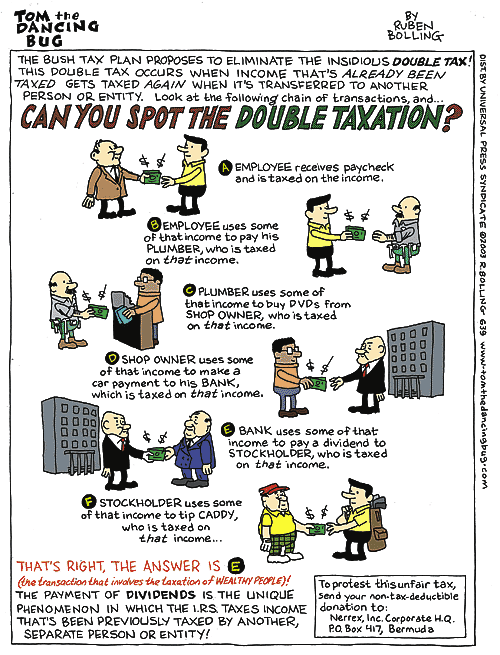
Inequality is not static, it is rather dynamic.
Nassim Taleb makes some good points about that here[2], for instance, ~ 70% of Americans will spend a year in the top 20% and only ten percent of the wealthiest five hundred American people or dynasties were so thirty years ago.
[1] https://www.nasdaq.com/articles/generational-wealth%3A-why-d...
[2] https://medium.com/incerto/inequality-and-skin-in-the-game-d...