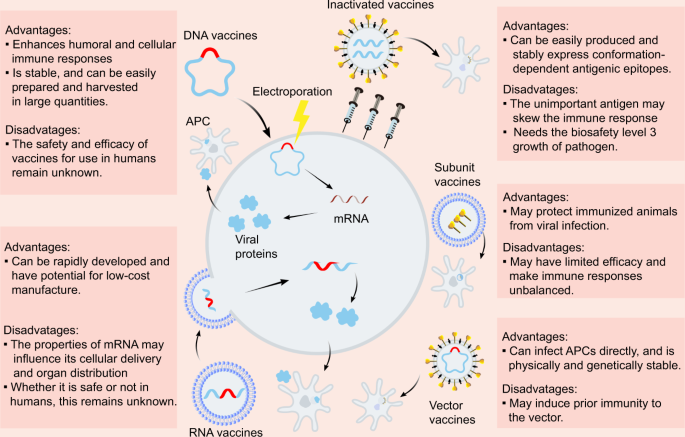
One thing that I don’t understand is what happens to the cells in which the mRNA enters. Do they die? Do they go haywire? How are the spike proteins getting out of them? And if the cells die, how many of them are going to be affected by one shot?
its a game of numbers and timing. first off there is a patrol inside that cell that cleans up mRNA that doesnt have a "hall pass" cells that are very damaged or confused will go into a procedural death mode called apoptosis, different from simple cell death as others are imformed of events and can react accordingly.
as soon as the cell expresses S protien the immune system may then tag it and take a sample then produce a great many antibodies for the price of a small number of cells death relative to the large number of antibodies
If you (or others) would humor a newbie question - assuming that host cells start expressing the spike protein, and the immune system learns to react to it, what are the chances that it will also learn to react to other proteins expressed by those cells, which are not related to the virus, and basically learn to attack its own cells?
In other words, is there a worry of MRNA causing auto-immune reaction/disease due to those proteins getting expressed by host's own healthy cells?
there is a self recognition system, the body indexes its components and will end process when the protien is recognized as self. foriegn molecules are not indexed and if large enough [as in protiens, not water or salt] they will trigger immune response a wanted poster and a bunch of antibodies are produced that tag the invader.
the mRNA of concern will not modify your DNA sequence, the expression of the S protien occurs untill the mRNA is destroyed by the cell, or the cell itself is destroyed taken apart and compared to self antigens, the foriegn antigen is expressed by MHC cells and PresenteD in a context of this is a hostile thing [a wanted poster]
this all occurs in a system of interdependent cell types and thier interactions.
your question addresses the crux of immunology, and needs a lot more attention than would be constructive here.
this is a million dollar question probably nobel prize winning.
keep in mind this is not proven but is a promising angle, CRSPR as made popular is a hijacked mechanism used to edit DNA sequences. normally this mechanism is used in prokaryotic organisms as an immune system. there are tags in the prokaryotes DNA that are used to match with foriegn DNA and signal it for destruction.
this type of arrangement MAY, possibly exist in eukaryotes as well and may be the basis of self/nonself recognition.
i have yet to talk to anyone else in professional context, this is inference on my part but it the best answer i can suggest for now.
you would want to look at antigen presentation and antibody production mechanisms, in deep detail .
It does not. All index entries that correspond to body are filtered out during aging process. If some are missed or close enough to the body proteins past puberty, you would get an autoimmune reaction
There is a guy living in a house inside a tree with huge library. The first responder cells will call him by phone and he will check the library for what to do.
Disclaimer: All I know about this comes from Cells at Work/Hataraku Saibou.
I know just enough to be dangerous :) I actually have an autoimmune disease, so that's the reason for my question, specifically wondering about the chance for an MRNA vaccine triggering or deepening autoimmune disease.
So if I understand you correctly, the self-recognition system is something built-in and doesn't change in response to foreign antigens? Or in other words, it's only the recognition of foreign molecules that will change, but this shouldn't affect the production (or culling) of T-cells that are super-sensitive to host's own self-antigens?
PS. And thank you and thanks to others for answering newbie questions on this thread! :)
Without knowing which auto-immune disease its hard to give more information (which is fine, this is not medical advice).
> So if I understand you correctly, the self-recognition system is something built-in
Yes. before immune cells are released and "primed" they go through a selection process where the receptors they have for (unknown) antigens are tested against a vast array of proteins the body normally produces, if they bind, they are killed off. Sometimes this doesn't work and if they are activated and bind their (self-)antigen when the immune system is activated (i.e. during an infection) they can attack uninfected cells. Which as a one off event is not problematic, the problem comes from the fact that those immune cells stick around when they contact their antigen, and if it is produced by the body this is a lot, and continue to kill healthy cells and cause inflammation.
> and doesn't change in response to foreign antigens?
By the time the immune cells bind to foreign agents they have already gone through the selection process.
Necessarily a vaccine will produce an immune response (or otherwise it won't have the intended effect), this could cause an autoimmune response because the atuoresponsive cells, presumably, have their antigen around.
> but this shouldn't affect the production (or culling) of T-cells that are super-sensitive to host's own self-antigens?
new ones, no. In fact if you're not a child, you aren't producing many new (unique) T-cells at all. Old ones however may proliferate if their antigen is present and an immune response is triggered (to the vaccine or the virus).
If you want real advice, don't take it from some random on the internet with only a minor in biomed, talk to your doctor or immunologist.
> specifically wondering about the chance for an MRNA vaccine triggering or deepening autoimmune disease.
I think the medical guidance has been pretty clear that you should not get the vaccine in this case. There are a lot of people who care more about their own safety than yours who may try to change your mind. Don't listen to them; don't get your medical advice on the internet. Find an expert.
i have a friend that is quite allergic to aluminum, and zinc on contact. these sort of allergies are about hypersensativity, it sounds like you may have problems with any sort of foriegn challenge to your body. A major component of most vaccines is an adjuvent and that is intended to make your immune system extremely ready to recognize foriegn antigens. this means a very good chance you will have a flare up. you want to have sound medical advice from a doctor regarding your own health characteristics. Bare minimum i would want to see direct supervision and observation after a vaccine.
Allergic reactions to adjuvants is an entirely different matter (than autoimmune reactions) and may actually not apply to these vaccines. This just goes to show, don't get your medical advice from HN.
hypersensativity is an autoimmune disorder, and by the way the use of aluminum salts as adjuvent is being phased out, there is great opportunity to formulate the liposomasal delivery vesicle to mimick a pathogenic cell wall.
My understanding is that normal viral infections cause proteins to be expressed by cells in the same way — in fact, uninfected cells also continually display a "status report" of protein fragments. Your immune system monitors this to detect cells that have gone haywire, whether by mutation or infection.
I don't honestly understand how the immune system decides which protein fragments are okay to develop a response to, but the point is that that is already part of the normal immune response pathway that learns new antigens every day; after the protein fragment shows up on the cell surface, the rest of the process is similar to the response to an attenuated-virus vaccine or a natural infection.
this is a very new and edgey statement however here goes. the self/nonself antigen profile is likely in the DNA and in eukaryotes likely functions in similar fashion to the NORMAL crspr system of prokaryotes [as in not the hijacked gene editing one of current topic]
keep in mind there is no proof yet that this is how it works but it is a promissing direction to look into.
If one gets infected with COVID19, the cells containg the virus will too produce the spike protein among other virus constituents as specified by the virus RNA.
I'm no expert either, but I don't see a difference here between virus infected cells and mRNA "infected" cells. So cells primed with mRNA simply produce less virus parts than those with the real virus?
this is hard to say yes, but i can tell you that the live virus will replicate in the cell and increase copy number of its RNA until the cell dies. the vaccine mRNA will remain until degraded and stop producing valid copies.
the vaccine is not the whole mRNA, its only the part that codes for immunogenic protien [SARS-2 S] that is exported to the cell membrane
> assuming that host cells start expressing the spike protein, and the immune system learns to react to it,
Firstly they only express it as long as the mRNA remains intact. mRNA are degraded naturally so there is a finite time window as the mRNA is not reverse transcribed into DNA and reintegrated into the genome.
> what are the chances that it will also learn to react to other proteins expressed by those cells,
T (and B cells? I can't remember) cells undergo a selection process in the thymus that select against cells with receptors that bind to self proteins, that is proteins made normally by the body. Sometimes this fails and you get autoimmune disorders. Chances are very slim and no more than any other antiviral vaccine.
because thats not what mRNA and normal cellular processes do and there is no mechanism in the body to allow that to happen.
Reverse transcription only happens when a reverse transcriptase (found in retro-viruses, e.g. HIV-1, HIV-2, Hepatitis B Virus etc) does that and the RNA is the direct viral genome or a transcript of the viral DNA (for DNA viruses). They have special marker sequences at either end to facilitate this (search for terminal repeats)
an enzyme called reverse transcriptase or its equivalent is required, the HIV virus and a number of other retrovirii do this, and implant thier code into the host DNA.
eukaryotes use splicing mechanisms that copy/delete/replicate DNA from one locus to another, this is more reliable as mRNA are unstable and become damaged quickly. cytoplasmic mRNA is not of fidelity and does not reverse compile into the dna sourcecode, or it would produce massive errors and corrupt the DNA.
If the mRNA is unstable, then what are the chances that at some point it might code for a dangerous protein such as a prion as it degrades?
The CDC and other sources argue the vaccine is safe because it doesn't alter your DNA, but I have a vivid imagination and can think of a thousand other ways something might go wrong. Having my DNA altered was never one of my concerns.
prions are a specific sequence, the danger with a prion is that they stack up on each other like building blocks and produce "plaque" structures, there is such a difference that it is about as close to zero as you can get.
what you would get is some false starts, and segment of protien if that at all.
Pardon my ignorance but is this something that could, in theory, trigger a cell to become cancerous or trigger the body to develop an autoimmune condition (as the spike protein is created by the body's own cells)?
this is not a constituative expression and the cell expressing the foriegn protien is often destroyed later in the process but not always as the vaccine mRNA is edited out of the cytoplasm not replaced by genetic expression and the novel protien goes into turnover mode.
addendum >>there is a halflife/turnover rate, in tech terms the hardware is updated very frequently, by degradation, and replacement. this is loosely what creates a constituatively expressed proteome. the S protien is not part of the program so is degraded and not replaced. if the protien insertion is too extensive or the activity of the protien is egregious for the cell then, apoptosis
These are great questions. Another one since we are talking about editing the programming “code” of the human body is: what if we got it wrong? What sorts of “bugs” might occur in execution or through unforeseen interactions?
> Another one since we are talking about editing the programming “code” of the human body is
...no? This is not gene therapy. The effects of receiving a mRNA vaccine will, apart from training the immune system (which was the whole point), be next to nothing.
Your body is continually being bombarded with random foreign DNA and RNA. That's just how life on Earth works. Yes, introducing a big pile of it at once is not normal... but it's a difference of degree, not something completely new.
If anything, problems are more likely to derive from the lipid bubbles used (at least by Moderna) to package and transport the mRNA.
Here is an article on Covid vaccines, and the second link is from its references, and explains lipid nanoparticles used in these vaccines. Both the Pfizer and Moderna vaccines use lipid nanoparticles and are very similar in their designs.
edit: Here is more specific information on lipid nanoparticles in RNA vaccines, which explains that RNA vaccines that involve lipid nanoparticles tend to cause a local inflammatory effect, i.e. shoulder soreness.
So what is causing the side effects people in the studies are suffering? There seems to be a lot of concern on people not wanting the second dose. I know flu shots will always make the injected arm hurts for days (never have that reaction with other vaccines for some reason). If this is just creating proteins and not an inactivated virus, what's causing the responses that are being reported?
The mRNA gets translated into the spike protein. And then the cell presents it in the surface for the immune cells to track and learn it. This is called MHC-I pathway. As a consequence of this, the immune system might instruct "infected" cells to self-destruction.
There are also other delivery pathways for mRNA vaccines.
The virus is not functional because the mRNA vaccine only contains one little component of the virus, the spike protein.
Does anyone understand why the FDA and other experts seem very unconcerned about long term side effects?
The safety profile in the 0-2 month timeframe is very easy to understand: they tested it, so they have actual data. But it seems for longer than 2 or 3 months you would need to make an argument based on animal trials or just biological reasoning. But I can't find anyone talking about it at all.
As mentioned in the Nature article and in another poster's comment[1], MRNA vaccines have been known for a while now (decade+ ?), and studied on animals, with some limited phase I / phase II human studies. But nobody's gone through a full phase III before covid hit, so that kind of a wide fan-out is new and exceptional because of the emergency nature of the disease.
But I don't think they're unconcerned. I think it's a combination of lack of decades-long longitudinal studies, and also that previous phase I / II studies haven't throw up significant red flags.
AFAIK some of the breakthroughs in the delivery mechanisms are relatively new. Some of the companies now making a covid vaccine were talking about running a trial for a flu vaccine in the next few years, but obviously that was far less urgent and all the steps (getting permission, getting participants, actually running the study without "unlimited" money, ...) would take longer.
(mRNA would be a good candidate for a flu vaccines because they are fast to produce, which in theory reduces the amount of guessing needed to make the "right" flu vaccine for the year, but of course a) flu vaccines already are a thing even if sometimes wrong and b) a flu vaccine isn't given as high priority overall)
They discussed this in the approval meeting. There was only one case ever in any vaccine or trial of a side effect showing up after 6 weeks, it was over 50 years ago in a live virus polio vaccine on an immunocompromised person.
Given the many billions of vaccines given of various types, it is about as close to certain as we get in this world to not expecting long term side effects ever.
The reason they aren't concerned about it is for good reason, not because they "haven't looked into it". You have to look at relative risk.
This decision to lift the total ban on this vaccine was probably the easiest decision the FDA ever had to make. This one isn't even a question.
Now they just have to lift the ban on the rest. The standard for EUA is supposed to be "net expected benefit", which they are not following. They are currently only approving EUA when they hit "no conceivable downside", which is a too high standard.
In addition to your other responses, I'll add this. There's not really a plausible mechanism that could cause problems to happen long after the fact. Although it sounds exotic, the mRNA vaccine is just using the same process every cold or flu you've ever had used, but in a more limited way since the proteins created by the vaccine cannot reproduce.
By 2 months all traces of vaccine are long gone and you're just left with an immune system trained to fight COVID (just like millions of people have already had happen naturally). So, while everybody has their eyes open, nobody can really explain the mechanism where something might happen.
> There's not really a plausible mechanism that could cause problems to happen long after the fact.
Well there are some limited circumstances, but I don’t think they justify not going forward with the vaccine. For instance there is a possibility in some individuals that the mRNA itself (not just the spike protein) as well as the lipid encasing it to protect it and transport it into the cell can cause an immune response. It’s theoretically possible that in some individuals that could result in auto immune responses to other forms of messenger RNA in their cells. [1]
“A possible concern could be that some mRNA-based vaccine platforms induce potent type I interferon responses, which have been associated not only with inflammation but also potentially with autoimmunity”
They are concerned, but it's a balancing act. COVID itself is a new virus with unknown long term side effects, and it's killing millions while causing massive economic harm triggering political destabilization in some areas. The vaccine is new and may cause issues, but current data doesn't indicate it will cause issues and it prevents death and sickness by COVID very effectively.
This paper from two years ago answers a lot more questions about how mRNA vaccines work, how long the mRNA stays active, how to prevent runaway infection, etc.
Anyone know the answer? If we can encase an rna sequence in a lipid envelope and get it into cells, why haven’t viruses ever evolved something like this? It seems like an easy run around the defenses of the cell?
this is how natural virii function, not all but a whole family of them. some virii use a protien capsule others are actually a naked RNA strand. and yes it is the first run around of defenses, but there are a number of other hurdles.
I know nothing about this so excuse any potential ignorance:
They say:
>COVID-19 mRNA vaccines give instructions for our cells to make a harmless piece of what is called the “spike protein.” The spike protein is found on the surface of the virus that causes COVID-19.
So from what I understand the vaccine itself does not contain the spike protein but is simply RNA that is injected into the cell and then the cell goes through its usual process to translates* the RNA to amino acids which then gets churned into protein (the spike protein)?
My first question is how did they make the RNA? Is it the exact same RNA as in the coronavirus or is it artificially generated by them? Does it do the exact same thing that the RNA in coronavirus does and is the spike protein the exact same spike protein found on the surface of the coronavirus or is it different (even if subtly so?)
Can anything go wrong at any point in this process (can the body misuse the RNA, or the spike protein, or anything else) and if so what?
I believe that they manufactured the rna without access to the virus, just the genome.
I am not qualified to answer whether the spike protein is identical to the one in the virus, but from what I understand it is very close. The protein just doesn't have the virus attached. It's like having a factory manufacturing car door handles but no cars.
Things could go wrong, mostly because some folks may have allergic reactions, autoimmune flare ups, or the increased immune response can cause side effects like Bell's palsy. That said, mRNA breaks down quickly on its own, and the spike proteins will be cleaned up quickly. The odds of a serious complication are very, very, very, very low from the studies performed so far. (Expect some flu like symptoms, however, as your body fights the cells with the modified RNA.)
I'm a total layperson here, just synthesizing what I've read.
I'll add a point, because otherwise your answer was excellent:
This mechanism was once explored as a means of performing gene therapy in human beings (a couple of decades past). It was abandoned because of its utter failure to produce lasting genetic effects.
That's a big plus here: we have a well-explored platform for having the cells transiently produce a protein we want the immune system exposed to, but which we already know is useless at producing lasting effects. The only lasting effect here will be in the memory of the immune system, not in the cells affected by the shot.
Not particularly - I last read about them when I was a bio undergrad, and they weren't brand new then. The key words I'd use in google scholar are 'adenovirus vector mRNA', but be sure to restrict the timeline to pre-2020.
you have the concept, the rna is a synthetic one manufactures by directing the translation of mRNA in vitro[lab glass].
if not enough is known about the spike protien it is possible, but not greatly probable that an undesireable biochemical process can be initiated but not likely.
if you know how the protien acts biochemically it may also be possible to guarantee a synthetic that is an antigen , but does not induce adverse pathology
An important thing to keep in mind is that viruses do this type of thing in your body all the time. Your cells are constantly being programmed by viruses to generate proteins that are used to build viruses, many using messenger RNA (like coronavirus).
Obviously this will be the first wide spread use of a vaccine using a mechanism viruses have used for millions of years. So although care, caution, and respect are clearly justified, I’d just like to see a little more public education on how viruses work in the first place.
It’s easy for the public to hear “the government is programming your cells” and not even understand the basics of how cells or viruses work in the first place.
Here's a longer, more technical, 43 minute video explaining them and the Moderna/Pfizer/BioNTech/Astrazeneca clinical trial processes in more detail. The biochem part starts at 12:30.
Does the fact that Covid-19 is an RNA virus make it easier to target with an mRNA-vaccine? Could this technology also be used to target a DNA virus as well?
the limitation is an understanding of the virus+host interaction at the level of molecular structure and function.
when you have the amino acid sequence of a protien that triggers the immune system you can work backward and derive an mRNA that would be responsible for coding the protien.
there are multiple layers of complexity in getting from stage 1 to end product but this is a quick simple layout.
DNA virus has some extra tricks compared to RNA virus but the core concept is the same for both.
The vaccine in this instance is all about delivering a target to the immune system's sentries. If those sentries are defective, or if the hitmen the sentries need to alert are defective, there's nothing this vaccine can do to change that.
"Immune compromise" is generally used as a blanket term, but in many people there are specific immune deficiencies, which may or may not factor into the pathway being targeted here. For instance, natalizumab screws with immune cells' translocation across membranes, and shouldn't play a role in responding to a vaccine (I mean, if it wasn't off the market anyway).
If it's a general immune dysfunction (cancer, diabetes), they will see some benefit, but it will be much reduced - specifically because both responding to the vaccine, and responding to the virus post-vaccination, require the activity of the immune system. What this means precisely will vary with the degree and nature of the immune dysfunction: some folks might see some antibody response, and benefit from repeat dosing. Others might fail to seroconvert altogether, in which case it is what it is.
Is there a reason they don't create the protein in Vito and them inject it as a vaccine? I would imagine they could use in Vito cells to generate a lot of spike proteins.
Are they using mRNA because it's easier to manufacture? Or is the protein too instable?
I was thinking that maybe because Covid is an RNA virus, there would be a shortcut to getting the mRNA sequence for creating the spike protein. The scientists could peek at the RNA in the actual virus, recognize the spike protein, and put that in the vaccine. Whereas with a DNA virus, it would require extra work.
But from your answer, it sounds like that's not what they do? Or, maybe they could do that but it's not any easier than working backwards from the amino acid sequence.
the short cut is that DNA virus has a further layer of code utilization , the DNA must be read out and transcribed to mRNA, then translated to protien. there is an extra step in there, but you can still use a synthetic mRNA to create a protien specific to putative antigens decorating the surface of the DNA virus, or of the infected cell, or both if your rich and want to make sure.
a DNA virus must be understood somewhat to find the reading frame for the protien you need, this is the case for RNA virus as well however RNA virus are limited in size due to the instability of RNA, this means less kruft to wade through until you find the FOO
This approach is like sneaking in blueprints to a factory (cell) that makes (proteins using mRNA) whatever it has blueprints for, and gets inspectors that come around occasionally (immune surveillance), or very frequently under active infection, looking for contraband.
When the body start producing this foreign proteins in the presence of something to trigger the immune system (called an adjuvant which all vaccines use to make the body recognise as bad and not harmless/irrelevant) the immune system starts producing a response against that.
adjuvent is not neccesary for immune response, it is nessecary for spreading out the antigen producing character among more doses, rather than using a concentration of mRNA that in itself produces enough protien to induce immune response
> adjuvent [sic] is not neccesary[sic] for immune response,
Completely false. Unless the immune system has been exposed to something similar before (e.g. SARS/MERS n.b. made up example I have no idea if the spikes of SARS or MERS are molecularly similar enough), no adjuvant means situation normal for the immune system. If there is nothing to signal to the immune system that this new antigen is bad then it will treat it as neutral suppressing any vaccine response, which is worse that if the vaccine had not been delivered at all.
>is nessecary[sic] for spreading out the antigen producing character among more doses
the point of booster shots is to ensure that antibodies are maintained at sufficient levels to fight off a real infection. If a response has been established, i guess adjuvants are not as necessary? (did biomed, but not a vaccine researcher) I have no idea if they are included or not for boosters.
> rather than using a concentration of mRNA that in itself produces enough protien[sic] to induce immune response
A high concentration won't do shit if the immune system doesn't have anything to activate it, it will just see a high concentration of irrelevant new, i.e. foreign protein.
>> Completely false. Unless the immune system has been exposed to something similar before (e.g. SARS/MERS n.b. made up example I have no idea if the spikes of SARS or MERS are molecularly similar enough), no adjuvant means situation normal for the immune system. If there is nothing to signal to the immune system that this new antigen is bad then it will treat it as neutral suppressing any vaccine response, which is worse that if the vaccine had not been delivered at all. <<
This is Completely false.
Natural immunity does not require adjuvent.
spreading out a scarce valuable resource by use of adjuvent is a standard practice.
ANY complex not recognized by the MHC will elicit an invader response, the immediate vigor of this response is attenuated by inclusion of adjuvent in the final formulation of the vaccine. we would all die 100% of the time if adjuvent was required to mount immune response, to infection.
Natural immunity requires activation of the innate immune system by pathogen associated molecular patterns (PAMPs) such as dsRNA, LPS or peptidoglycan. One role adjuvants play is to mimic these PAMPs.
thats right it is a way of stimulating the immune system to action. The problem is that some mistakenly believe that a synthetic adjuvent is required for a vaccine and it is not.
the adjuvent increases the gain so that you can use a faint signal- that means less mRNA has to go into a vaccine that means this expensive little molecule can be used for many more doses instead of one enormous dose of high concentration, as mentioned before if we needed adjuvents for immunity of any sort we would not be here.
the substances you are mentioning are features of live pathogens and are being mimicked by adjuvents.
Nope, you're the one who's wrong. What nicwilson said is exactly right. Without an adjuvant, unless the vaccine itself happens to stimulate innate immunity, this would end up inducing immunological tolerance.
It is true that if you have a strong adjuvant, you could get away with smaller doses of the antigen, which is good for pandemic vaccines.
P.S. I wrote a COVID adjuvant grant this past spring, and my mother studies immunological tolerance. So if you disagree can you at least share some sources?
the fact that i am still alive, the fact that people survive infection and produce antibodies are salient.
you are wrong, and its right in front of you.
please tell me about KNO3
please tell me about priming and boosting.
please tell me about innate humoral response, and cell mediated response.
i see you are still a student.
once again vaccines are not obligated to adjuvents
adjuvents increase the response to a signal allowing a weaker signal to evoke a response of threshold level.
the economic and practical bounds incurred by the expense of the immunogenic product are offset by thus exploiting, the biological property of amplification we can spread out the materials to make many more doses of vaccine requireing fewer "boost" dosages.
the big angle to work is the lack of cytoplasmic Vir-mRNA of immunogenic character. the current S protien production system is a get it shipping now product, with more work we can produce a sequence that stimulates cytoplasmic processes also involved in the induction of primary immune response.
Interferon production at scale is tedious to say the least, it is superior to induce in vivo interferon dynamics, along with immunogenic antigen translation.
while it is possible to harvest SARS genomic RNA and excise dangerous components this is expensive time and money wise and dangerous, this reduces to the better approach being a synthetic novel S protien manufactured from raw materials.
It doesn't.
The vaccine is a piece of mRNA (in this case part of the spike protein) which has a cap on one end to stop degradation from the start of the message (which would garble it completely). This piece of RNA is not replicated.
Whereas the virus encodes the whole spike, the capsid protein and whatever else the virus needs to replicate like promoter sequences and an origin of replication. It is much larger and is replicate.
Basically it skips all the viral machinery and just codes for a small piece that identifies the virus to the immune system.
It's one thing to inject an antigen that your body makes antibodies for.
It's one thing to use a viral vector to reprogram some number of cells. Due to the Emergency Use Authorization, much of the safety testing has been skipped.
AFAIU time-compressed is more accurate than skipped. Obviously, observation of long term effects has been skipped. Other mRNA vaccines have been tested though (but not introduced) so the class of vaccines does have long-term data available and there are no known risks worse than other vaccines.
Seems safe enough. Hopefully not famous last words...
MRNA vaccines don’t use a viral vector. Your thinking of several other vaccines that haven’t been approved yet.
And much of the safety testing hasn’t been skipped. The vaccine went through full phase 2/3 trials. The post trial surveillance phase was shortened, but it’s still ongoing.
nothing was skipped maybe aside from testing on animals first. it was however on a compressed observational and manufacturing timeline. normally a company doesn't want to run the next trial while the previous trial is ongoing. they compressed stages one and two(safety studies where they do tens of people and then hundreds of people to strictly look for adverse outcomes). Then they did a efficacy trial in stage three of thousands (which also looks out for large adverse outcomes). the regulatory review stage was also shortened because the drug manufacturers were supplying more real time data to the regulators to expedite the approval. the normal way they do it is to run every stage back to back and then after stage 3 is finished they would submit the data to the fda and get an approval back within a year or two. Then the manufacturing would start to ramp up... this was a moonshot type of project that hoped the trial would be successful and started to manufacture the drug before full approval occurred.
mRNA is not a viral vector. the mRNA vaccine does not contain the entire viral code, and is not carried by the SARS virion
but by a constructed liposome used as an mRNA delivery vector
Have they released the rna sequences of the pfizer and moderna vaccines? I could not find them in the patents or supplementary information in the journal papers. It would go a long way towards public trust if they released this information.
Normal drugs are required to have the chemical structure in the packaging. I wonder why they are allowed to release this one without similar chemical information.
The sequence is that of the protein. That's how it works.
The vaccine contains the mRNA sequence for the protein, so cells produce it, triggering an immune response.
The "nucleotide modified" bit just means they replace some nucleotides with nucleotide isomers like pseudouridine (https://en.wikipedia.org/wiki/Pseudouridine) to keep the vaccine itself from being attacked. The sequence remains the same.