Nuclear is great as baseload, but it is more expensive than wind/solar when you just look at pure generation without storage. So we definitely need to get nuclear built out, but you want as much cheap renewables as you can get the grid to support, and as little expensive nuclear as possible.
And it's not what you would use for CO2 capture. For that you would use renewables, because it doesn't matter what time of the day you do it, or for how long you do it continuously. So just direct excess renewable power into CO2 capture.
The problem with renewables is one of space and materials rather than energy production. Nuclear is drastically smaller in terms of the land footprint.
Focusing on cost is misleading because the costs are because we haven’t invested in fission in many decades / regulations are fairly insane. For example, the cost argument would go the other way in the 90s when wind and solar were much more expensive. Also, solar provide energy when there’s typically peak demand so you can’t really load shift for DAC. Wind you might be able to do that.
Yesterday I watched a video about the commercially available options for installing an electric power generation plant on the balcony of your rented apartment. Commercially available, now.
More seriously, off-shore wind takes up virtually no land, and on-shore wind and PV can share land use with pasture, feed crops and horticultural crops. PV actually improves crop yields in dry regions because of the shading and reduced stress on the plants. So in some places it has a negative footprint. Storage uses no more land than peaker gas, and probably less when pipeline right-of-ways are counted.
It’s about MWh per sq ft. Renewables have terrible energy production density compared with nuclear. Off shore wind isn’t really a thing and the secondary benefits are irrelevant - nothing is stopping you from using a basic shade structure / solar panels if you really want the power anyway.
They have lead, etc. In them. If not properly recycled (they won't be) that'll end up in the environment.
And they cover up and mar the beauty of the land. Maybe that's fine if you live next to a desert.
There are lead backing sheets being used with PV, but they aren't required, and are being phased out in Europe and some other places. The lead is incompatible with some PV new higher efficiency silicon PV technologies due to processing temperature, so there's additional reason to get rid of it. Bifacial PV cells would not have a backing sheet. In any case it is not a requirement for even monofacial PV.
There's plenty of space - deserts of the southwest for solar plus offshore wind could easily suffice to produce all of the power needed in the US by themselves. The issue is lack of grid transmission infrastructure, which is a reliability issue during times of extreme weather independent of whether it's a renewables based grid or not. As for materials, there are some rare earth metals that are used in some solar panels, but many others don't require them. If market conditions dictated, use of those materials would shift on it's own.
You're right! Thanks for the correction. Thin film modules use Cadmium Telluride, which includes two rare metals* (not rare earth* metals). I want to note that there are some similar supply concerns with each of those rare metals. But in any case, my larger point is that thin film modules represent less than 10% of the market, and are in no way critical to solar's success.
> The problem with renewables is one of space and materials rather than energy production. Nuclear is drastically smaller in terms of the land footprint.
If you can't argue cost, make up some other argument. Land use is generally not an issue for solar or wind, because you can dual use. You can make the calculation that putting solar on roofs and parking lots would be much more area than needed to power the whole of the US.
> Focusing on cost is misleading because the costs are because we haven’t invested in fission in many decades
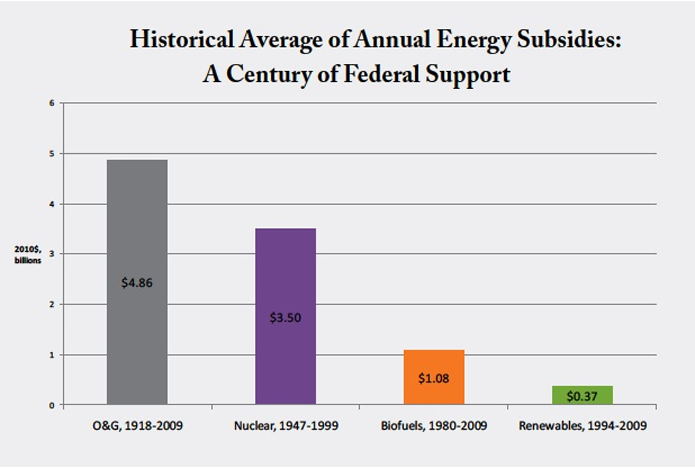
Actually nuclear has received significantly more subsidies than renewables [1, 2, 3]
> For example, the cost argument would go the other way in the 90s when wind and solar were much more expensive.
Yes and guess what all the nuclear proponents said? Don't invest in renewables. However, there is a fundamental difference wind and solar (solar more so) are on exponential price reduction curves and there is currently no indication it will stop. Nuclear on the other hand is not (prices have actually increased in many places) and there is nothing indicating that this will change.
> Also, solar provide energy when there’s typically peak demand so you can’t really load shift for DAC. Wind you might be able to do that.
How about we first transition to using carbon free energy production first before DAC. It does not make sense to produce energy using fossils (with the inherent efficiency losses) and then use another inherintly inefficient process to capture the carbon. You need much less energy if you move the first process to carbon free.
There's no problem there. Look at how much energy just rooftop solar in residential areas is capable of producing. You can also put wind turbines in the ocean and pipe the energy to land.
It could all be dual use. There is no need for any of it not to be.
If you have some ground you are not using for anything else, and is convenient to a grid tie-in, it is harmless to just put solar on that. I can't see that as using up land.
> because it doesn't matter what time of the day you do it, or for how long you do it continuously. So just direct excess renewable power into CO2 capture.
Assuming those CO2 capture plants are run on some sort of pay for service basis, there will be an incentive to keep them up and running. The owners won't want their fixed capital to sit idle.



And it's not what you would use for CO2 capture. For that you would use renewables, because it doesn't matter what time of the day you do it, or for how long you do it continuously. So just direct excess renewable power into CO2 capture.