> ArcaOS may not install or run on all systems, and Arca Noae makes no claim that it does. If you are unsure as to the suitability of your hardware for ArcaOS, please review this wiki page or contact us. *There is no trial or demonstration version available.*
Wow, that's some "You must really, really want to run OS/2" level marketing right there
This is more: I’m a bank with many old systems that are reliant on OS/2 and I need some kind of update for my systems!
There are other industries beyond finance, but that was a large one.
Personally, I’m happy for it existing. I hope that at some point open source efforts succeed or that Arca can secure access to the source at some point in the future.
Unless I'm misunderstanding your assertion, wouldn't that situation apply to the business license, priced higher, than the personal license that I linked to, which explicitly states it can't be used for commercial purposes?
It is a shame that there is no way to take it for a demo test drive.
Open sourcing it would be awesome as well. (there is no reaso to
believe they would)
There have been many requests to make it opensource, but apparently this was not possible because some part of the code are owned by both IBM and Microsoft who collaborated on OS/2 at the beginning before Microsoft decided to build its own Windows. Rumors are that while IBM was positive about open sourcing OS/2, Microsoft did not give consent.
I have been an OS/2 user back in the days, the system was great at that time, much better than the Windows counterpart, with a great UI and file system (which for example did not need defrag). It was however affected by one major issue: at the UI level it had a single event queue (http://www.os2ezine.com/v1n5/queue.html) and if some application would hang while processing its events, it would freeze the UI for good.
Fun fact: Arca Noae doesn't even have access to the source code for OS/2. All enhancements to the core OS are implemented as drivers or binary patches.
Also, how does that work given their $129 price tag? I have to separately buy a license to OS/2 and then their software modifies the distributed binaries?
This was discussed in an interview between Bryan Lunduke and the founder of Arca Noae which is sadly no longer online.
No - when you buy a copy of ArcaOS you get an OS/2 license. Arca Noae have an agreement with IBM to resell OS/2 licenses, they just don't have access to the source code.
> some part of the code are owned by both IBM and Microsoft who collaborated on OS/2 at the beginning before Microsoft decided to build its own Windows. Rumors are that while IBM was positive about open sourcing OS/2, Microsoft did not give consent.
This is very easy to believe. In Summer of '95, I interned at a tester for a group in IBM Austin that was developing a product called OS/2 Lan Server Enterprise. This was a version of Lan Server where all the underpinnings were to be replaced with the DCE product they were developing concurrently. (So we'd write scripts to do things like create a user with an LS command and verify that the user was created with a DCE command.)
One of the other concurrent goals at the time was to remove Microsoft code from OS/2. Developers on the team were classified into those who had seen Microsoft code and those who had not. Even seeing the MS code was immediate disqualification from writing anything new, and this was actively enforced.
> I have been an OS/2 user back in the days, the system was great at that time,
I'd always wanted to be excited about OS/2, and the IBM job was about as close as I got. My day to day PC at the job was an ancient (1988-era) PS/2 Model 80, and it ran even the current
versions of OS/2 surprisingly well.
Aside from IBM's odd marketing ("Get Warped" ?!?!?), Microsoft did a better job meeting customers where they were... both Windows 3 and Windows 95 are great examples of this. OS/2 was technically better, but never quite aligned with the market.
(The first release of OS/2 cost about triple what DOS did, had significantly higher system requirements, and needed specific software to enable the new functionality... which did not initially include a GUI. It was a very difficult sell. It might have gone differently if Microsoft had been able to convince IBM to require a 386... but OS/2 was part of the PS/2 strategy, and only the highest end of the four PS/2's had a 386.)
> One of the other concurrent goals at the time was to remove Microsoft code from OS/2. Developers on the team were classified into those who had seen Microsoft code and those who had not. Even seeing the MS code was immediate disqualification from writing anything new, and this was actively enforced.
IBM has always been super cautious about intellectual property. I am an opensource committer at Eclipse Foundation (which was created by IBM) and there is a strict IP review process. A copy/paste from stackoverflow is not allowed.
> I'd always wanted to be excited about OS/2, and the IBM job was about as close as I got. My day to day PC at the job was an ancient (1988-era) PS/2 Model 80, and it ran even the current versions of OS/2 surprisingly well.
I started using OS/2 Warp on a 486 66Mhz with 4GM RAM, it was running pretty smooth for me.
> Aside from IBM's odd marketing ("Get Warped" ?!?!?)
IBM originally decided to call OS/2 3.0 “Warp” as in “warp speed”, and market the OS with a Star Trek like theme, but forgot to run this by Paramount before announcing the name. Paramount wouldn’t give them permission and the name was already public so IBM had to settle with using “warp” as in “bent or twisted” rather than “extremely fast” like I’m sure they would have preferred.
They should have used the third definition of "warp" in relation to weaving. As the Web was just starting to become big at the time maybe they could have done a "Weave a web" marketing campaign.
>>The first release of OS/2 cost about triple what DOS did, had significantly higher system requirements, and needed specific software to enable the new functionality... which did not initially include a GUI.
My first job at Novell in 1988 was testing their OS/2 driver. In order to get OS/2 up and running, they had to buy a 4MB memory expansion card for my 386 box. IIRC it cost about $2000 at the time.
I used OS/2 and to say that I was annoyed at Microsoft's antics at the time would be a gross understatement. These days I use mainly Linux but I've legacy machines that still run Windows 7 which I've vowed never to upgrade for obvious reasons.
Whilst there are Linux workarounds for most Windows situations, Wine,
alternative software, LibreOffice etc., often these can be messy or inconvenient to implement (in my case they often occur when longtime Windows users ask me to upgrade their Windows machines and they don't want Win 10 or 11 installed on them.
Here, the switch to Linux is often a step too far (and often they've legacy Windows apps that won't run under Wine—for instance, certain Windows CAD programs that have no Linux version (and their dongles only complicate matters)).
This brings me to alternatives: Acra Noae/OS/2 is too old and unsuitable, this only leaves ReactOS, which is a project going nowhere—its development speed makes a snail look like a hare (why there's so little interest in this project is odd given that the payoff would be great if it were successful).
The question I've never had answered successfully is why after all these years hasn't there been a successful clone of Windows. And by that I don't mean a clone of the grossly over-bloated 7GB kind currently availale from MS—the outrageous size of these behemoths is one of the reasons why users like me want a small streamlined alternative O/S.
ReactOS would fit the bill re small size and basic features but it just doesn't work and probably never will. Nevertheless sufficient of it exists to prove the concept is actually feasible—especially, if the principal aim was limited to just building a basic utilitarian Win API- compatible OS with a basic CUA-type GUI. For many of us, a minimalist GUI-based file loader/task switcher is all that we need (the O/S I envisage would be more like OS/2, as such, given its limited features, it'd hardly even qualify as a Windows clone).
It's perplexing that a viable alternative product hasn't emerged in recent decades and I'm not totally convinced that Microsoft's saber-rattling over copyright etc. is the full reason it hasn't.
MS hasn't made any serious moves to close down ReactOS, perhaps because there aren't any copyright breaches serious enough to prosecute, or it's worried about antitrust/monopoly action being launched against it—or that it doesn't need the PR problem of being accused again of being a bully, or that it thinks that ReactOS is too insignificant and too late to worry about—or it' a combination of these factors.
MS would likely have little difficulty in scaring off 'respectable' Western money for development but I doubt that the same pressure would be just as effective in Russia or China—remember the publicly ReactOS received when it was demonstrated to Putin several decades ago? It was quite a splash.
The question is why those countries didn't take that opportunity and run with it. The economic and strategic advantages seem obvious, so does the kudos that they would've gained. Clearly, I'm missing some important factor here.
Re OS/2, it would be interesting to know details of the agreement between IBM and Microsoft and what percentage of the code each contributed to the project. If IBM did most of the development then perhaps the MS code could have been stripped out but I'd suspect the reverse was the case.
> I used OS/2 and to say that I was annoyed at Microsoft's antics at the time would be a gross understatement.
I'm a lot more sympathetic to Microsoft than most. They used some highly anti-competitive tactics, but their products fit the market well, and the competition suffered from a combination of terrible luck and serious strategic miscues.
OS/2's a great example of this. If you bought it in 1987/8, it cost three or four times the price of DOS, had higher system requirements, and gave you no benefits at all without totally new software. Windows 3.0 did well because it was cheaper and worked with the hardware and software that you already had.
> It's perplexing that a viable alternative product hasn't emerged in recent decades and I'm not totally convinced that Microsoft's saber-rattling over copyright etc. is the full reason it hasn't.
It's an expensive effort, and the ability to fund an effort like that can be inversely proportional to the willingness to take on the risks you mention.
> Re OS/2, it would be interesting to know details of the agreement between IBM and Microsoft and what percentage of the code each contributed to the project. If IBM did most of the development then perhaps the MS code could have been stripped out but I'd suspect the reverse was the case.
There was enough Microsoft development that IBM was working actively to remove Microsoft code from OS/2 in 1995. The Lan Server Enterprise was a part of that, but there was also Workplace OS, which was a fully IBM effort to rebuild OS/2 into a portable OS on top of Mach. Workplace OS feels a lot in retrospect like a way for IBM to turn OS/2 into something more competitive with Windows NT.
"It's an expensive effort, and the ability to fund an effort like that can be inversely proportional to the willingness to take on the risks you mention."
I'd say you're right and replicating Windows now would be hellishly expensive but it wouldn't have been so some decades back. After all, ReactOS has essentially proved it's possible.
Despite the fact that it's not practicability usable it sort of works in limited circumstances (I periodically test it). Given that it's a smalltime backyard effort but can run MS Office on some hardware demonstrates to me that if serious effort were put into its development it would do most of my needs.
The other problem of there not being any other API-compatible OS in competition with Windows is that Microsoft has never fixed the many problematic issues with Windows—as it simply never had to. It's too complex to discuss them here but if MS had had fair competition from another OS then end users would have had a much better run.
NOTE: it will not boot from USB. You need to burn this onto an optical disk, and boot from that disk in an optical drive, if you want to run it on hardware.
If you just want to run it in a VM, it'll be fine.
With VMs being able to run the original IBM Warp4 (didn't notice any issues when I tried), not only really really want to run it, but really really want to run it on some bare metal modern hardware.
The $129 are a lot cheaper than $250 in 1995-$, inflation-corrected probably nearly doubled since then. If someone needed it back at that time, today that's a real bargain.
Around 1995, I remember that some German PC seller (Vobis) pre-installed OS/2 (for some time together with DOS/Windows, 3.11 at the time, if I recall correctly), so most probably there were some kind of low cost OEM versions, later they had OS/2 only:
I wonder if they really tested it on Connectix Virtual PC (which according to Wikipedia did have an OS/2 version available... maybe they tested an OS/2 inception?).
I was really hopeful for OS/2 Warp as a mainstream desktop OS when it came out, even though they grossly understated the memory requirements (it really needed 8mb) I think the death knell was ultimately WIN-OS2 which discouraged developers to make 32-bit native software, had this strategy been implemented just a few years earlier, it would have had a chance to saturate in the market.
Once properly installed and running, it was clearly ahead of the curve compared to Win 3.11, or even NT 3.x.
> I was really hopeful for OS/2 Warp as a mainstream desktop OS when it came out
Yes, me too. I evangelised it for a while.
Then I saw NT 3.1 at work. I deployed it in production in 1993.
It was worryingly good, if you could afford the hardware.
Then 2Y later I got a beta of Windows Chicago, before the "Windows 95" name was formalised, and I tried it, and I shut up about OS/2. It was very clearly Game Over.
Every time OS/2 resurfaces there is a comment exchange that says, "who still uses this?!" and "I remember <Unnamed customer> was using it in <period over 10 years ago>"
Does any one have a production, nameable customer in 2022, or, is anyone willing to share why they are still running OS/2 at their work even if they can't name them? I can't quite believe that an OS that found its niche primarily in heavy IBM shops like banking and retail would not, by the same token, have been replaced by the same IBM consulting teams that deployed it when it was viable.
Who is using OS/2 today (in business)? What are the advantages over any other solution? Is it just about maintenance of legacy systems, or is there something new built on this platform?
I believe there are still some very specific scenarios in which is used, probably by Banks and in the domain of control theory.
There were news that in early 2000 it was still running the whole Hong Kong airport.
In Italy where I live, up to 2010 if not later, you could still find kiosks for buying railway tickets that were powered by OS/2. These kiosks were quite bulky because they had CRT touch screens! The CRT screens were mounted on a vertical rack inside the kiosk which had two axis, horizontal and vertical, and when you pushed the screen to tap a button the two axis would feel the pressure and would be able to identify the area of the screen that you pushed and to pass coordinates to OS/2 as if you were using a PS/2 mouse. Of course not as precise as a smarphone touchscreen, but those UI used fairly large buttons and everything was working perfectly.
In Italy I think I kept on spotting old ATMs running OS/2 until at least 2015.
I know of a large Bank, this time not Italian, that was still using OS/2 for its tellers probably around 2012. They were using a Web application already, but browsing it via a Firefox port for OS/2 https://wiki.mozilla.org/Ports/os2 They needed to do so because of certain legacy devices (cash dispensers, check printers) which only worked with OS/2.
The hobbes archive still recevies updates and uploads with os/2 software:
It's only real use is legacy systems. I have dabbled a bit with eComStation in the early aughts and even then it was already obsolete compared to Windows 2000 and later XP.
Only IBM has the full source code (and obviously they don't care much about OS/2), so the only changes made for the last ~20 years are binary patches, third-party drivers, and extensions. It's a 32-bit operating system and will never transition to 64-bit.
OS/2 now probably full of hundreds of well-known CVEs. So, any machine used out in the wild is trivially exploitable.
OS/2 was running it's own native programs, usually developed in C/C++ and compiled against it's O.S. API, which were very nicely designed for the time, much cleaner and better organized than most of the competition.
These are not easily portable as they rely on very specific and unique concepts. For example the UI elements (a window, an icon, but also folders and files in the filesystem views) were object oriented concepts in the API and in the UI system (made of WPS - workplace shell and PM - the presentation manager). If you wanted you could subclass the file object and define a new view for it, and all of the user interface would behave accordingly. Similarly you could subclass the folder view and for example add a new status bar, or a box with a shell at the bottom. This was very unique at the time and I believe in part still is today. The system was also in the background constantly tracking UI elements and file system content. So if you created an icon for a file (similar to a Windows shortcut) and then renamed the file, the icon would automatically be aware of the new name, because the file system would fire a "rename event" and the UI would be listening to such events and take appropriate actions. You never had a broken link; if you deleted a file from the command prompt the UI shortcut would be gone as well.
It was also programmable in Object Rexx, an scripting language that would be compiled into bytecode at the first execution of the script. The file system API allowed any program to attach custom attributes to files, and the Rexx runtime would attach the bytecode as a custom attribute to the file so future invocations would skip compilation unless the script was modified. Object Rexx had bindings for most if not all of the operating system APIs, so while Object Rexx interpreters exist for other operating systems, the scripts are hardly portable unless they are trivial.
OS/2 could run MS/DOS and Windows 3.1 program in a compatibility virtual machine. In this case however you would loose multi tasking for those programs because dos and Windows 3.1 did not have multi tasking. Those program would run only when in foreground.
OS/2 could run Java up to Java 1.2 programs.
And due to some volunteer effort there was a quite complete POSIX compatibility layer and a port of GCC which allowed compiling for OS/2 many Unix programs (Apache HTTP for example). There was also a port of XFree available but it was running full screen, so you either used the native UI, or you could switch to a XFree program which first would bring XFree to full screen and then you could work with the program window (of course alt-tabbing back to a native program would do the opposite)
It was very advanced in many ways, for example it supported so called "installable file systems": you could add support for a file system by loading its driver at boot time and when a file system did not support custom attributes, they would be saved in a special hidden file in the root folder. It officially supported HPFS (its own), FAT, JFS, and there existed IFS implementations for Ext2, NTFS and more which were mostly ports from early Linux.
The UI was super customizable, you could have hot corners, multiple virtual desktops, you could individually customize fonts and background of each folder (you simply dragged the font from the front palette to the folder and your preference was recorded in the file system custom attributes together with last size and position of the folder window). Similarly, to change the icon of a program, you had to open preferences and drag and drop the new icon over the previous one, so for many things it had approaches that are similar to those in place in MacOs.
I remember using some old IBM IDE that was implemented by subclassing the UI views for files and folder and enabling those special views on the file system folders representing your projects. A whole IDE integrated into the desktop by subclassing standard desktop objects. As an example, the standard file system explorer window would show IDE-specific columns in details view and a toolbar with build/run/debug buttons when you were browsing a folder which corresponded to an IDE project. Cool idea even though not perfectly executed.
Good memories.
Edit: fixed some typos and clarified last paragraph with an example.
You forgot about SOM, much nicer to use than COM, with support for implementation inheritance and meta-classes, for Smalltalk, C, C++ and eventually Java as well.
Is my recollection correct that the screen origin (for drawing stuff) is bottom left, instead of top right as it is in most operating systems? I seem to recall reading an article about how this single fact made porting software between OS/2 and other OSes quite tedious.
I am sorry I can't help you here.
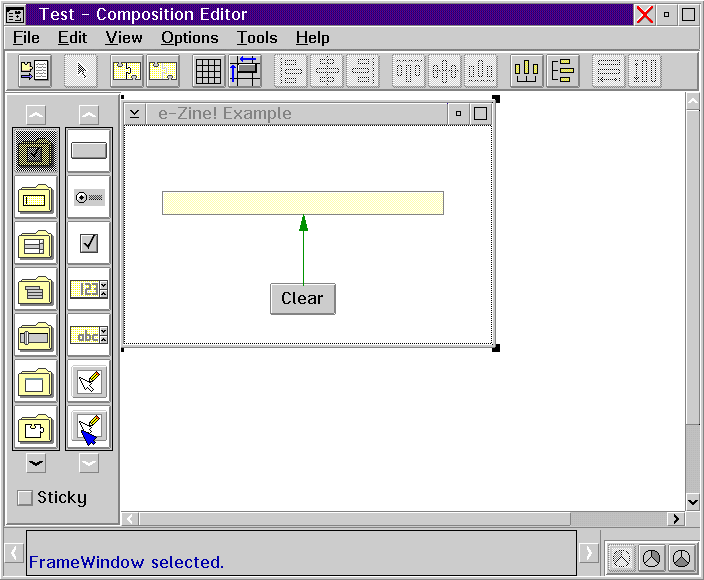
The only UI problems I implemented were rather simple, built with IBM VisualAge which had a nice drag&drop visual editor for the screens and dialogs. http://www.os2ezine.com/v1n11/vacpp1.gif
> Is it not possible to cross-compile OS/2 software?
No idea. Back in the day the hardware requirements would have been prohibitive, however you could install a compiler such as Visual Age for C++ in a OS/2 VM and download technical documentation such as the famous IBM Red Books.
Do you mean programming for the modules in the actual operating system? Then they would have to open source the entire OS. Is this what you mean will be the only way they will survive?


> Personal Edition $129
> ArcaOS may not install or run on all systems, and Arca Noae makes no claim that it does. If you are unsure as to the suitability of your hardware for ArcaOS, please review this wiki page or contact us. *There is no trial or demonstration version available.*
Wow, that's some "You must really, really want to run OS/2" level marketing right there