For those thinking about preventative solutions, there are some existing, all very expensive of course.
The simplest is placing a row of red lights in the ground at all intersections to runways. When an airplane is cleared for takeoff and until it is airborne the controller presses a button and turns all these lights red. Pilots are instructed that regardless of clearance, a red light over-rides that, and to never cross it. These lights are installed at JFK, but apparently NOT at the intersection inquisition. (https://en.wikipedia.org/wiki/Runway_status_lights).
JFK also has Airport Surface Detection Equipment (ASDE). Which is essentially ground radar including transponder/ADS-B replies. Many have automated alerts when it detects a potential runway incursion. Not known if any such system alerted the controller.
There is obviously room for more to be done in this space.
If this doesn’t provide evidence for funding the install of RWSL at that intersection, I don’t know what does. What would’ve been the cost of loss of life and both airframes? Tens of millions at a minimum.
Edit: thank you for correcting my damages estimate, I was off by at least an order of magnitude.
"In Western countries and other liberal democracies, estimates for the value of a statistical life typically range from US$1 million—US$10 million; for example, the United States FEMA estimated the value of a statistical life at US$7.5 million in 2020." [1]
That's also not the meaning of Value of Life, which is a statistical evaluation. On a commercial plane there are almost certainly multiple people whose individual Value of Life projections exceed $10 million.
In many other cases, the value of life calculation for the very pilots of a commercial flight is less than $10 million.
This all goes to show that this calculation is not for what "each human life is worth". This is a statistical evaluation for determining what would need to be paid to an individual to engage in a dangerous activity or to be paid to a survivor after a person dies from an activity. When someone decides to work at a 7-11 in a crime-ridden area for a greater pay compared to a 7-11 in a safe family area, they perform a type of Value of Life calculation.
The VSL used in this case is $11.8 million in 2021, the most recent year it’s been adjusted for [0]. $10m is the usual rule-of-thumb. When making policies, governments generally pick a single value. Those “micro” VSL choices are one way governments can arrive at that value [1], but it’s certainly not the only way — economists have developed a bunch of different models which have (in some cases) wildly divergent outcomes [2].
But the key takeaway is that, for government policy purposes in the US, all lives are treated as having the same value and that value is about $10 million.
The VSL is for the Valuation of a Statistical Life, which is shown at the first link you posted. That's entirely different from saying that all lives are treated as having the same value.
If you follow your link to the actual VSL guidance, you will see that. [1] There is even discussion regarding how advances in data science can be used for subgroup evaluation of VSLs.
I think we’re on the same page here. You are discussing that individual lives are valued at various numbers. I’m pointing out that when deciding whether to implement safety mitigations, the government will in practice use a single value. From the link you posted:
“Prevention of an expected fatality is assigned a single, nationwide value in each year, regardless of the age, income, or other distinct characteristics of the affected population, the mode of travel, or the nature of the risk.”
I think reasonable people can disagree on whether it ever makes sense to use multiple different VSLs for different types of person. I happen to think that those kind of adjustments do more harm than good. But it’s all (literally) academic — actual policy is set based on a single VSL.
WSJ article made it seem as if these lights were already in place:
"Airport officials also inspected lights meant to indicate when it isn’t safe for planes to venture across runways and verified they were working at that particular runway, according to the summary."
This is a good example of how ADDITIONAL safety systems can sometime become the de-facto safety system. A similar problem can happen with firearms, where if a mechanical safety is on, people sometimes disregard other rules of safe firearm handling, leading to accidents.
Pilots have a lot of info coming in at any given time, and there has been a move to reduce the amount of info, so they can focus on the more important items. The answer isn't always more warning lights or alarms.
Edit: By "This is a good example..." I am referring to the hypothetical situation, I am not confirming this actually happened.
Who are "they" in your sentence? I assume the lights and not the plane? Wouldn't lights like this be placed the same way on every airport implementing them?
I think what the parent want to say is that these lights do not exist. The sentence is written in a way that makes it seem they do (i.e. it's all theoretical in nature).
Google says that Quora user thinks: Can’t answer the second question, but as for the first one, there are 6,302,865 intersections for the 497 urbanized areas in the United States.
ChatGPT says: I'm sorry, I don't have an exact number for the number of road intersections in the US. However, I can provide you with some information that may help you arrive at an estimate. According to the Federal Highway Administration, as of 2020, there were approximately 4 million miles of public roads in the US. If you assume that each mile of road has an average of four intersections (which would include cross streets, driveways, and other points where roads connect), that would result in an estimated 16 million road intersections in the US. However, this is just an estimate and the actual number may vary depending on factors such as population density, urbanization, and road infrastructure.
I believe that the causes for errors in perception and communication can be rather subtle, and therefore successful mitigations can be as well.
If the root error of the pilot here happened not at the runway crossing, but earlier, when confusing the K and J taxiways, then that's the location where possible preventative solutions should be considered.
Because once a pilot has subconsciously convinced herself that she's at another runway, it becomes increasingly impossible to override that mental block, no matter how many lights and sirens you use.
If you take a look at the airport diagram (https://www.faa.gov/air_traffic/publications/atpubs/aip_html...), it just takes one wrong turn to end up on taxiway J instead of taxiway K. And, also from that diagram, once the American plane took the wrong turn, the controller had very little time to see that and stop it before it crossed the runway.
But still, if pilots internalize via training that "if you are about to cross a line of red lights, you are entering an active runway without having permission to do so, so don't do it", that should be one more layer of safety to prevent situations like this. Of course, none of these layers are 100% foolproof, but taken together...
Beyond detecting runway incursions, couldn't ASDE be integrated with some kind of RTS-like interface for ATC so they could indicate where planes should go next? Automated alerts could be broadcast to ATC and to the pilots if planes deviated from the plan, and the system could flag actions that risked costly but non-fatal ground collisions and other problems unrelated to takeoffs or landings.
Some major airports already have Follow the Greens.
Traditionally every taxiway and every possible path on each intersection will be painted with a yellow line and illuminated with yellow lights.
Follow the Greens replaces that with green lights which are controllable at a very high resolution. The result is that every plane will have a path of green lights to follow, greatly reducing everyone's workload.
Further, Electronic clearance delivery already sends instructions to the airplane electronically for their in-flight clearance. An electronic delivery of their ground clearance could be hooked up to navigation to highlight that route on the ground as well.
Yep. Both the intersection American 106 was supposed to take (cross 31L at K) and the intersection they took (cross 4L at J) have runway entrance lights.
According to https://www.faa.gov/air_traffic/technology/rwsl/pet/ the lights don't illuminate until departing aircraft are at 30 knots, so it's possible Delta 1943 was just beginning the takeoff roll and the lights weren't on yet when American 106 decided to cross 4L.
I don't think the other answers are getting at the meat of it. Consider that those red lights functioning is the only thing keeping hundreds or thousands of people from getting killed. What sorts of safety and durability requirements would you impose on them? What sorts of maintenance and training requirements?
If nothing else they need to hold up in every weather and temperature big airports exist (-80ºF to +150ºF) and get run over by airplanes all day. Already that's a non-trivial problem.
The other major concern is running reliable power to the lights. That isn’t something that can happen above ground when crossing runways, so there’s going to be at least some digging up the runway and repaving. Repaving runways isn’t cheap. It has to be done in an expedited manner since airports need all runways available during peak hours, so there’s usually a six-ish hour overnight window for work to get done and the runway left usable for the next day. This isn’t like normal roadwork where temporary metal plates can cover over unfinished work, so work must be done and the asphalt set during that window. This can mean large work crews doing highly-choreographed work that they’ve prepared (and even practiced) long in advance.
For an airport, the precision required both to not hit extant underground infrastructure and to know precisely where your newly deployed infrastructure is (for the next guy/gal to worry about) is probably a salient concern.
I'm not sure that horizontal drilling offers that degree of precision and assurance as opposed to rip-and-dig methods.
If you're not sure then you might like to forget about oil and gas drilling and look to suburban optic fibre cable laying in which a cable can be accurately laid following a curving S path about the countours of a curving road avoiding other known pipes over distances of 500+ m.
Sure they do. But then you have a tunnel under the runway that will flood and potentially freeze. Crumbling concrete and nonflat surfaces is not something you want on a runway or taxiway.
As opposed to the alternative described, where you close down the runway, dig out a full trench, lay a cable in a conduit, and attempt to compact every thing back to how it used to be?
You think that's a better alternative than just drill core'ing the conduit through?
Why can't they have two huge, red, flashing lights at either side of the crossway, thus avoiding the costs to dig up runway asphalt altogether? Better than what they seemingly have now ...
There may be designs that cut out some/most of the cost, but I made the comment because I watched a YouTube documentary on an airport that was making modifications and they had to dig up a bunch of the runways. They made a big deal out of the work, including working with a special contractor who had a practice area where they tried all the work they'd have to do ahead of time and timed themselves to be sure they could get the runway back in operating condition by the time it was needed. The amount of work they went through for something fairly minor was pretty memorable. I took from it that airports have a lot of logistical concerns that are pretty unique and the "that seems simple" take that I'd previously had about the tarmac portion of an airport being just a bunch of asphalt with some signs and lights on it was totally ignorant of all the complexity.
787 wingspan is 200ft (60m). Planes don't turn on a dime either, but the larger ones do have steering linked to the rear wheels, so their turn radius can be surprising.
The non invasive solution would be to require some kind of ground control computer link that can directly draw their controlled path for them on their displays and give them a nice loud master caution or warning if they're about to break their assignment.
Then we can start thinking about ground autopilot systems.
> and give them a nice loud master caution or warning if they're about to break their assignment.
Back in the days of the Exxon Valdez tanker incident, I wondered if the technology did not exist to positively track such major asset positions/directions, and dispatch an alarm from one or more authorities at a distance.
In terms of powering lights/signals, perhaps solar, batteries and a generator for each patch, and if there is no flashing of light visible (indicating power-loss or stuck-at failure), tower clearance must be given?
These lights would not be the only thing keeping hundreds from being killed. ATC clearances over the radio are the primary thing; this is a secondary system.
> That doesn't seem logical if the alternative is not having the lights at all.
If the norm becomes (radio clearance and no red lights), I suspect pilots will become conditioned to equate no-red-lights with landing clearance. Not 100%, but maybe at least 1% of the time. So if that happens and the red lights stopped working, you have a problem that wouldn't have existed if the red lights were never introduced.
Perhaps a more resilient system would use green lights to indicate landing clearance. Then if the lights failed, the default would be radioing ATC for guidance?
(I have no qualifications on this topic. I'm just guessing based on a bunch of Mentour videos I've watched.)
But my understanding is that the plane was taxiing. At this point, the problem isn't just the lack of red lights: the pilot took a wrong turn. There are reasons other than the possibility of crossing an active runway why you follow directions, among them that you want to end up at your destination.
That's a good point; if pilots come to expect the lights, I can see how it could be dangerous for them to fail, even if they're not supposed to be the primary mechanism.
Manufacturing certifications, installation and maintenance inspections and certifications, auditing, etc.
To put it into some relatable context, a simple electrical switch that you might grab for a few bucks at your local Home Depot would cost at least several hundreds of dollars because of all the red tape that must be satisfied for safety reasons.
Red tape isn't the phrase I'd use in this context since your point is that the switch will work 100% of the time even after being thru a literal hurricane, so the difference isn't merely the tape, but that there's been proper testing and engineering all the way down, which drives the cost way up.
Unfortunately, this is exactly how it's characterized in the aerospace industry. Often the requirements that are design to reduce/verify quality and safety requirements are talked about as "bureaucracy" and "just paperwork."
I admit my vocabulary is failing me at the moment in finding similarly concise words to describe it, but I'm happy if the meaning gets through one way or another.
Every strip of BS red adhesive has some flimsy pretext to justify it.
Nobody is saying you can't pour theoretically meaningful pork into a traffic light in the form of QA and whatnot and get an indestructible traffic light that operates for a century without being touched in return. People are questioning whether that's actually necessary for a system that's already the Nth layer of redundancy.
I don't know how airport infrastructure requirements work, but for the actual airframes themselves, the requisite level of reliability/redundancy are strictly defined. I would imagine airport design is similar. If so, it's clear if it's necessary or not.
I realize reading this now that "red tape" was not the appropriate way to convey what I'm trying to convey. I'm going to try and figure out how to rephrase that better in the future.
All those inspections, certifications, and other requirements exist for very good reasons. Reasons that more likely than not cost us blood and tears to realize their need.
>All those inspections, certifications, and other requirements exist for very good reasons
Nobody's debating that those processes work. People are questioning whether or to what degree this system should be subject to them. Just because something touches aviation somehow is not a blank ticket to pour red tape at it to satisfy some ideological lust for the "perfectly safe" system. For example, the facility lighting around an airport is just normal lighting used on any other large commercial facility, off the shelf sodium bulbs, LEDs, halogens in off the shelf fixtures, the kind of stuff you buy from all myriad of online supply houses and local suppliers. The runway lights are subject to much more specific requirements (but still very relaxed compared to the lighting on actual aircraft). Where do the traffic lights fall on that spectrum? IDK, but seeing as the system is never gonna leave the ground I'm pretty inclined to ignore whatever the people who think it needs to be designed like an aircraft have to say.
> Reasons that more likely than not cost us blood and tears to realize their need.
If/when they mandate a traffic light system at JFK will that rule be "written in blood" as you people often like to say?
When I was an intern I got to help change the blinking red light on top of a 50 story building. It’s a big deal that was scheduled weeks in advance and probably involved two dozen people, a special lightbulb and a bunch of coordination.
Even among the team working it plenty of “how many X does it take to change a light bulb” jokes were told.
But consider than a pilot depends on certain things being there when things go wrong. If the weather is bad and there’s issues with instruments, seeing that red light is the difference between life and death. There are potentially dozens or hundreds of people on a plane and if I recall correctly up to 4,000 people in the building.
When life is at risk, the standard for engineering must be higher.
There are already crews at every major airport that inspect and replace runway lights every day. Maintaining more lights doesn't seem like a massive new undertaking in the way you are describing.
Compared to the cost of an air incident, $9900 is a rounding error. You’d need an actuary to know for sure, but even small differences in safety margin can be worth the cost in aviation.
> Compared to the cost of an air incident, $9900 is a rounding error.
Doesn't matter; that's not a comparison that's relevant to any decision here.
How many additional crashes per year are prevented by the high-cost bulbs, and how many additional dollars per year does it cost to install them on every building?
Maybe the 10 $10 light bulbs need to be replaced once a year and they cost $150 / year. Maybe the one $10,000 bulb needs to be replaced every 15 years and costs $900 / year. Once you've gotten to that point, at least you know what the cost difference is.
Then you can either ask "how many planes would crash into the Chrysler building every year if it was using 10 bulbs from Home Depot, compared to the one bulb it's currently using?", and compare that to $750. In that case you'd get an answer that told you whether the Chrysler building should use a special bulb. Or you could ask "how many planes would crash into buildings anywhere in the world every year if they all used 10 bulbs from Home Depot instead of what they currently use?", compare that to $750 multiplied by the number of tall buildings in the world, and you'd get an answer that would tell you whether it'd be better for every building in the world to use commodity bulbs or for all of them to use the bespoke bulbs.
But you'd never ask "which costs more, one fancy lightbulb or one crashing plane?". That won't tell you anything.
If this system fails when needed, every cent spent on it will be considered a waste. Nobody is going to say "sure, 300 people died and a couple $150m planes were destroyed.. but we saved a couple million dollars when it was installed 7 years ago".
It would be ideologically convenient for you if people died but statistically it's just gonna be another close call since close calls outnumber accidents in this field by a ton to one.
If/when it happens the professionals who deal in this stuff will say something mundane like "this system prevented ten close calls before we actually had one slip through, that's pretty great". And they'll replace the $5 lightbulb and move the "check the bulbs" from the monthly maintenance checklist to the weekly checklist. And you'll complain much like you're complaining now.
Look at the history of aviation before it was a 5-sigma industry. The safety record was much worse.
If your point is that close calls will always outnumber the actual accidents, that’s like saying the number of doctor visits will outnumber the number of cancer diagnoses. Safety incidents are always a subset of a larger set that also contains close calls. By their nature, most safety incidents require multiple things to go wrong, which means there will be more times that some, but not all, things will go wrong to create a close call. It’s almost such a trivial point that it’s hardly salient enough to mention.
Obviously, but that's not the question I asked. Right now it's not there at all - so would it be worth installing a less reliable system, but then you could have it in more places?
Imagine you are doing barrel roll and struggling to control a plane, and you have a parachute.
So you decide, scre the airplane, a will save my life, and jump out. Only it fails to open, it was an unreliable parachite, bought by someone like you. They thought,'better a 50/50 parachite then no parachute?
So now you are plummeting to you death, thinking, that if you did not have the confidence of 'I have a parachute' you woupd have never attemped the barrel roll in the first place. And you would have done your utmost to steady the plane, and probably would succeed. And you would not waste time packing it and fuel carrying it around with you.
Why would you do a barrel roll in a plane full of passengers, when you’re being paid to operate it safely?
Your entire hypothetical is unlike the actual scenario, where this is being recommended.
Of course you have different solutions to a completely different problem — but what you haven’t addressed is why this is a bad solution to this particular problem.
The presence of a backup option affects your decision making. Human brain assumes the backup is reliable. If you install some 50/50 backup, you put more people at risk
If there's a safety mechanism that may or may not work, coming to rely on it is suicidal.
If there is no safety mechanism in the first place, you (hopefully!) never become complacent in the first place.
So it's better to either have a safety mechanism that will absolutely work every single time or nothing at all, than one that may or may not work and invite complacency.
The lights are a critical system that must operate without failure or errors.
You could do it a lot cheaper if you could accept them not working correctly sometimes. Like occasionally all the lights at an intersection would be green or something.
It wasn't a miscommunication. The pilot understood and was attempting to correctly follow the instructions of ATC. The error (as far as we can tell) was that the pilot wrongly believed that they were following those instructions, but the pilot did not know where they were.
So the next logical question is 'why didn't the pilot know where they were?', and there are a lot of possible answers to that question, which could conceivably be linked to communication (e.g.: not enough signage, they were told incorrectly, their maps were written in Klingon), but the primary problem was that the pilot believed they were crossing a different runway to the one they were actually crossing.
One solution does not discount the other. In data security we talk about security in depth, security in layers, etc. The current proposal is _a_ solution, but not _the only_ solution nor even the only component of a comprehensive solution.
> Where was the miscommunication? The pilot readback was correct.
"Runway 4L was being used for takeoffs. The American Airlines aircraft did not follow air traffic control instructions. ATC audio shows they were told to “”cross runway 31 Left at Kilo” and instead crossed runway 4 Left at Juliet, in front of the accelerating Delta Boeing 737."
Crossing a runway, which you're not cleared to cross is a pretty bad case of miscommunication in my book.
That's the case when the readback is incorrect or missing, i.e. the pilot heard something that wasn't said. In this case, the instruction was communicated correctly on both ends. But it wasn't followed correctly.
Someone saying the exact same words back to you doesn’t prevent miscommunication. If the pilot and ATC had the same understanding of the situation then the pilot wouldn’t have done something likely to result in a crash.
If they have the correctly communicated instructions as you imply, then why weren't they followed? Is it not also possible they don't follow the red light if they think ATC instructed them to use that runway?
Hard to say at this stage, but initial impressions seem to be that the pilot was following the instructions but were mistaken about what was in front of them.
> For those thinking about preventative solutions, there are some existing, all very expensive of course. The simplest is placing a row of red lights in the ground at all intersections to runways.
That's... a street light.[1] When street lights become "very expensive of course" it's time to revisit our priors about how we regulate. And I say this as someone not normally inclined to libertarian rhetoric.
[1] To be clear: a proven and effective technology deployed successfully literally millions of times over the past century of traffic control!
You make it sound much more difficult problem than it actually is. Embedded lights are nothing new, every small to medium airport has hundreds of them, larger airports thousands - marking runway and taxiway centerlines. Technical characteristics, installation requirements etc have been standardized a long time ago by the International Civil Aviation Organization and it's paint-by-the-numbers now. Such lights are literally off-the-shelf products and every airport maintenance team already knows how to install and take care of them.
As you can see, embedded lights are also represented from pg 23 onwards and red "stop bar" lights can be found on pg 38. Here's a picture of them installed: https://i.imgur.com/ThNIQaw.jpg
They're a backup system if the currently in-use systems fail. If they work only 99% of the time, they've cut accidents in the class they are designed to prevent by 99%. That's excellent. Perfection does not seem any more necessary here than in other contexts, and seems like the enemy of the good.
This compliant seems to me akin to me not backing up my computer's internal drive to this external drive I have sitting on my desk, until I can make a little RAIDed setup to address the small probability that the backup drive will fail. Having no backup at all is worse than requiring a high standard to the point that the backup may not be implemented.
It's not like if they break, nobody will notice. Install them, have a process to verify they're working regularly, fix them if they break. Any downtime whilst they're being fixed is just as risky as every day the project is delayed to to this high standard of reliability.
When it comes to airplanes 99% is never enough. It's why after every accident (or this near accident) there are months if not years of inquiries and analysis of every second leading up the incident going back days or weeks or even months. It's why flying is the safest way to travel by a huge margin.
If even one indecent like this happens hundreds of people die in a horrible all consuming fire, travel for the entire seaboard would be halted, hundreds of thousands of passenger would be dealt with for not being where they are supposed to be, and that's before the extraordinarily expensive repair to the tarmac and the scrapping of the planes.
There is, quite literally, zero margin of error.
99% is absolutely reasonable for one layer of defense among many! That is one of the best methods to achieve truly high reliability, as is needed in this case: stack many reliable systems in such a way that they all must fail to get an overall failure. It is not perfect, of course, and things can always cascade, but it is a powerful technique.
I'm guessing you've never worked in system-critical infrastructure? Airplanes are another level up from that. I'm not the one saying this, the FAA and NTSB are. Nothing is allowed to go wrong, ever.
I've been stuck at SFO for hours at least once a year because our flight had some mechanical issue. (Always on a Delta flight to ATL or MSP, don't know why.)
They did fix it and then eventually we took off. In a way that's "not going wrong". On the other hand, they didn't cancel it and send the plane to be disassembled for failure analysis. That'd certainly be safer.
Everything involved in aviation is designed to be extremely reliable, but parts are still expected to break. Airplanes have a list of parts which are allowed to be broken without grounding the airplane. Every part has a well-documented procedure for inspection, maintenance, and replacement.
Investigations happen when, despite following the documented procedures, stuff somehow still goes wrong. They are done to improve the procedures so that it can never happen again.
Inspection and maintenance is a significant source of errors, though. Nobody wants to disassemble an entire plane when a single part develops a well-isolated failure.
Air Transat Flight 236 had its engine swapped out with a spare during routine maintenance. However, the engines had a different "patch level", leading to them installing a hydraulic hose with the wrong length. This hose rubbed on the fuel line leading it to develop a leak. The subsequent flight ran out of fuel halfway over the Atlantic, and they narrowly avoided having to ditch it into the ocean.
American Airlines Flight 4439 was done on an aircraft with a faulty trim switch. Prior to the flight, maintenance engineers wanted to replace it, but this was cancelled mid-process due to the time required to acquire a replacement part. They re-installed the switch and marked it as inoperable - which is not an issue as - despite the switch being safety-critical - there are two other trim switches available. However, the faulty trim switch was reinstalled backwards, and the pilot still tried to use it due to muscle memory. This nearly lead to a pilot-induced stall.
There are literally dozens of stories like that. In aviation, there is no room for error.
The fact they didn’t take off with the mechanical issue should be a point in their favor, not against them.
More accurately though, safety critical things are not allowed to go wrong. If they do, they get investigated. What is and isn’t deemed safety critical is a document written in blood, unfortunately.
Runway lighting is 80 year old technology; we solved all those problems long, long ago. I mean, come on. It's one thing to point out that problems are inherently complicated, but to pretend that we can't deploy something as obvious as, yes, a street light because of expense is making yourself part of the problem, not the solution.
> Are they cheap? Can you buy them for next day delivery?
Yes. They are consumables comparable to bulbs and light fixtures at home, just good LEDs on a PCB in a metal/plastic case. It's sheer insanity to pretent that aerodrome lights are some magic technology.
The vast majority of road intersections do not have traffic lights. This is because they are expensive. People die every day at intersections without traffic lights. The money to put up the lights just doesn’t exist. A basic 4 way stop is about a quarter million to put in traffic lights. And even at that price you do not get lights with high availability features.
If you limited a design to traffic circles for taxiways, it wouldn’t be possible to cross any runways. Because planes can’t go around turns in the middle of their takeoff or landing. But if you wanted to prohibit any crossing of runways you could also just not have taxiways mid-runway. Probably not the most practical solution.
It would certainly be rate-limiting if every landing plane had to roll to the very end of the runway before turning off on "the taxiway". In principle this could be reduced by having planes with shorter rollouts leave the glideslope and continue level for some predetermined distance before touching down but that's got a bunch of new hazards even without adding any interesting wind.
Given how the passengers squeak with moderate turbulence, imagine how they'll take high-speed veering during takeoff? But of course a roundabout only works because all vehicles approaching are preparing to come to a complete stop if another vehicle will intrude upon their path, which can never be compatible with "accelerate steadily to racing car speed"


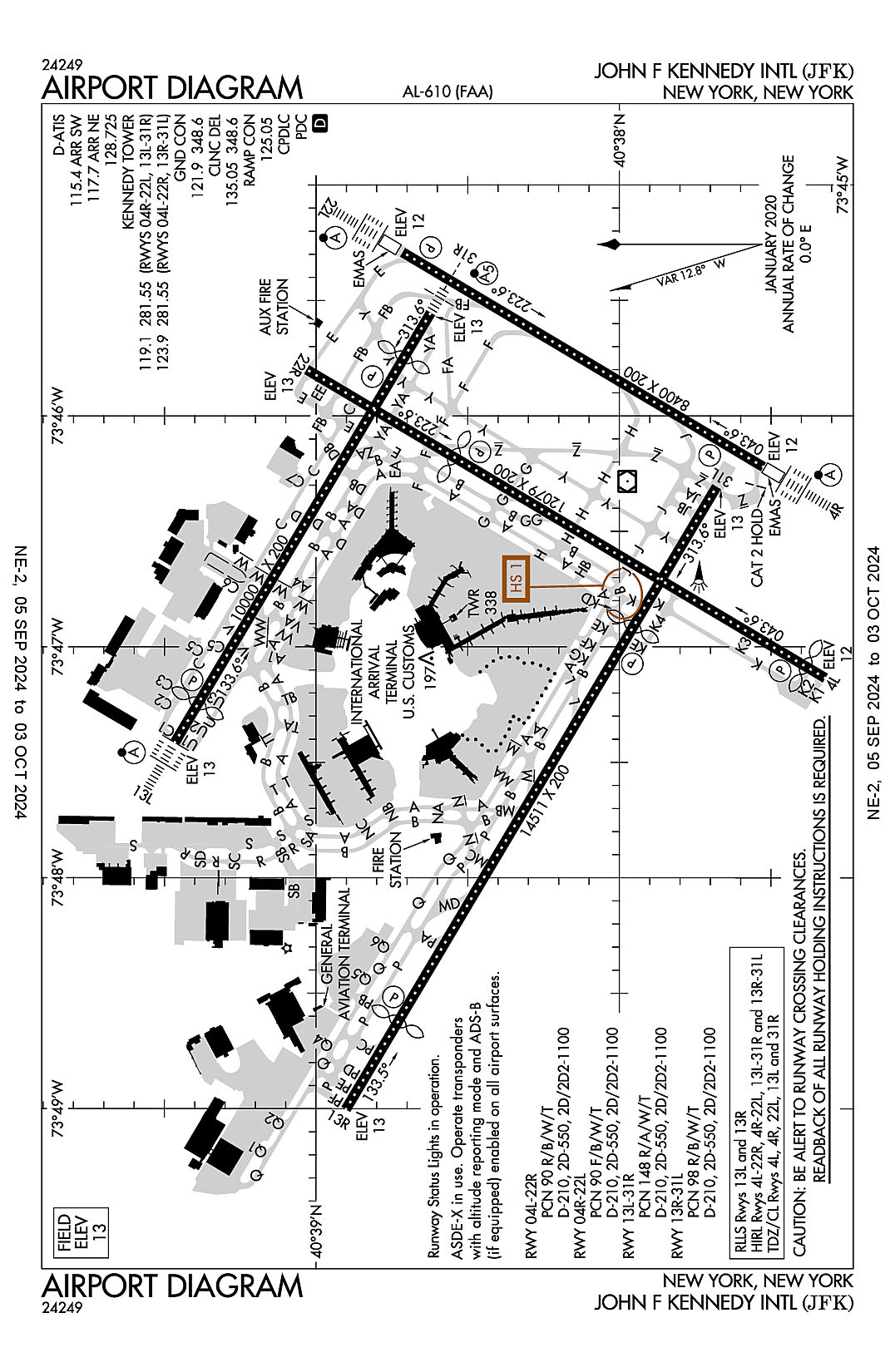

The simplest is placing a row of red lights in the ground at all intersections to runways. When an airplane is cleared for takeoff and until it is airborne the controller presses a button and turns all these lights red. Pilots are instructed that regardless of clearance, a red light over-rides that, and to never cross it. These lights are installed at JFK, but apparently NOT at the intersection inquisition. (https://en.wikipedia.org/wiki/Runway_status_lights).
JFK also has Airport Surface Detection Equipment (ASDE). Which is essentially ground radar including transponder/ADS-B replies. Many have automated alerts when it detects a potential runway incursion. Not known if any such system alerted the controller.
There is obviously room for more to be done in this space.