Calling bullshit on this. Musk reckons it’s Putin and I’ve read that some people think it’s possibly one of the Saudis but at the end of the day these billionaires have got that many assets hidden all over the place no one has any true idea.
Xi's been in charge of the hyper-industrial scale grift / corruption machine that is the Chinese economy for over a decade now. I gotta reckon he's at or near the top of the true global rich list.
I've heard there are also a lot of old old money types that actively avoid appearing on richest people lists. While I highly doubt one of them is on top, I would definitely bet a few of them are in the top 10.
I’ve also heard this and agree it’s highly likely. I think I heard it via an interview with Julia Louis-Dreyfus who comes from a billionaire family so probably a credible source.
It’s funny to me how we focus on the rich and wealthy whereas the vast majority of the HN visitors - even those with 6/7 figure salaries are closer to the homeless than to those billionaires.
You can’t have that much money and be ethical anyway. With the wage stagnation of the last few decades, we know a lot of that wealth is basically wage theft. And that’s just the tip of the iceberg
We live in a society that worships wealth because it uses wealth as its sole metric for basically everything. Intelligence, success, worthiness, importance, etc.
Those on HN are, if anything, more prone to this than elsewhere because of the original startup culture orientation. I will not be surprised if a significant portion of HNer's start cargo-culting by learning French.
> closer to the homeless than to those billionaires
To have a net worth closer to $1 billion USD than $0, you need at least $500 million USD.
Pedantry aside, do you have knowledge about the median net worth of an HN visitor, or is this a complete guess that most live in such a way that they have a very low net worth? (Or were you really just making a point that most of us have less than $500 million?)
I think it's more useful to think in terms of ratios.
A Millionaire ($1,000,000) is to a Thousandaire ($1000) as a Billionaire is to a Millionaire. E.g. they have as much wealth as a thousand of the former "tier".
What's an example of a society that's more human-oriented, that doesn't have capitalism? I feel like when people push to end capitalism, what they really mean is they want a large social safety net, higher pay for low end workers or higher taxes for the wealthy, more or better enforced regulations, etc., which doesn't necessarily negate capitalism as the fundamental driving force of the economy. Just my take.
Why is capitalism awful? It has literally lifted billions of people out of poverty. Capitalists were the original abolitionists. Capitalism and the associated innovation have given us everything that’s good about modern life.
I think the point is that it's not perfect, and nobody really argues it is. But it's imperfections aren't an argument for a better system.
Inequality is the easiest example. There's tons of inequality under capitalism, and you can point to it and say it's bad. Problem is that every other system has orders of magnitude more inequality, plus a worse overall average.
Yeah I fundamentally agree with all of that. I would generally ascribe to the idea that “innovationism” is what’s really important, and capitalism just does the best job of fostering that. I’m paraphrasing Deirdre McCloskey.
saddest thing is that they are both rich based off luxury fashion, an industry based off manipulating human psychology and effectively an industry that contributes nothing to humanity. Tech and manufacturing you can at least somewhat defend
Ad tech is "an industry based off manipulating human psychology" but nobody would say all of the tech industry is represented by that. It's certainly untrue that fashion is also entirely about manipulation.
I, for one, enjoy having options for what I wear that let me look how I want rather than dressing in standardized, homogeneous garments.
The fashion industry is essentially devoted to planned obsolescence based on arbitrary whims produced by top down influence.
Perfectly good functional clothes are suddenly deemed to be unwearable and in need of replacement. When you combine this with the fact that the industry is entirely based on exploiting cheap labor it is a deeply immoral industry.
My niece works in the fashion industry doing extremely intricate embroidering and has worked for certain very dominant designers and has had her work featured in Vogue magazine. She's already burned out and leaving because it's such a predatory industry.
So the effects are much less impactful on the environment.
Take games, they are probably non-essential for humanity (even though I would not claim they are built with planned obsolescence in mind, I still play DOOM from time to time or Tetris or Wonder Boy and a myriad of other old games), but we could stop producing them and they would stop having an effect on the World we live in immediately (in terms of, for example, energy consumption)
We can't say the same thing for the fashion industry.
The damages have already been done and some are irreversible.
- Every year the fashion industry uses 93 billion cubic meters of water — enough to meet the consumption needs of five million people.
- Around 20 % of wastewater worldwide comes from fabric dyeing and treatment.
- Of the total fiber input used for clothing, 87% is incinerated or disposed of in a landfill.
- The fashion industry is responsible for 10% of annual global carbon emissions, more than all international flights and maritime shipping combined. At this pace, the fashion industry’s greenhouse gas emissions will surge more than 50% by 2030.
- If demographic and lifestyle patterns continue as they are now, global consumption of apparel will rise from 62 million metric tons in 2019 to 102 million tons in 10 years.
- Every year a half a million tons of plastic microfibers are dumped into the ocean, the equivalent of 50 billion plastic bottles. The danger? Microfibers cannot be extracted from the water and they can spread throughout the food chain.
Microplastics are a horrific nightmare, you got me there.
But I will point out that Games rely on electricity, that is coal/nukes/ect in some countries. Not to mention whatever materials go into building the internet for multiplayer games.
The cost of water is usually the cost of pumping it and the filters for desal, or aeration or whatever cleaning method is used. If people have adequate access to water, using it on fashion is not so morally terrible.
Land-filling fibers, producing excess waste water and microplastics is "not so great" (to understate it), I agree.
> I, for one, enjoy having options for what I wear that let me look how I want rather than dressing in standardized, homogeneous garments.
Not considering that environment would like to have a word about that, it's undeniable that what I personally enjoy "contributes nothing to humanity".
Anyway it's a false dichotomy: you can have choices without the fashion industry.
My grand-grand-grandfather was a tailor, my grand-grandfather was a tailor, my grandfather was a tailor, they all made mostly the same kind of dresses (mostly men suits, they were specialized in that), because the society needed durable, robust and standardized garments and despised frivolousness. The way you dressed projected who you were in society. The choice was very large though, you could customize the "standard" in a lot of different ways: you could wear a pocket watch, a monocle, a hat (one could write a series of books on the different kinds of hats), cufflinks, a pochette or a tie in a very bold color, a combination of them, or not.
the reason why the "classic style" survived is because it rewards people that have an eye for a unique style, without punishing those that do not have it or do not have enough money to afford it. In a suit you will look good, anyway.
"Express yourself" (by dressing cheap rags) was invented by the ad industry that fueled the fashion industry (that simply attached a premium price to the same rags) to sell more of the same to more people in waves - the 60s are back! no! the 70s are back! are you kidding? 2001 is back! - and so on.
It would be exhilarating if it wasn't tragic.
> Ad tech is "an industry based off manipulating human psychology" but nobody would say all of the tech industry
Of course not, because the industry is Advertising. Everybody would say that all the ad industry is represented by that
When the day comes when people aren’t allowed to dress beautifully I know at least I will revolt.
Today men and women have the ability to dress(and to look and feel good) more or less anyway they want(more freedom to dress how you like seems to correlate strongly with societies that are liveable… go figure).
I’d rather let the world burn than live in it without beauty and beautiful people.
We’re not robots to run the machines for rich people.
Well all let it happen. The time to push back had already passed. All the little "it's not a big deal, I'll push back when it's really important" stuff has already crept up on us. We'll be eating bugs in the cold and dark thinking, ok I'll push back when I have to eat a mealworm instead of a cricket... and people will call you a conspiracy theorist for suggesting they'll ever take the crickets away.
Not me, man.
I understand the situation. The powerful elites will try to impose their restrictions, but others will resist out of principle but more importantly out of greed.
There are ways out from this path, don’t give up hope yet
> I’d rather let the world burn than live in it without beauty and beautiful people.
Have you got a subscription to "false dichotomy magazine"?
You seems to reason only in two ways: your way or everybody else is stupid and has no taste whatsoever.
I come from one of the most beautiful countries in the World, I am surrounded by beauty, a beauty that don't need to burn fossil fuels to keep being beautiful.
> When the day comes when people aren’t allowed to dress beautifully
That's exactly what nobody said.
You're the only one saying that the only way to dress beautifully is by burning a planet (????)
> I know at least I will revolt
Yeah, about that, you won't.
We all know that.
Just, please, stop it. Being flamboyant is a form of art, you think you're Vivienne Westwood (which I actually met) but you're only a little insignificant imitator (edit: wrote hater, it wasn't the word I was looking for).
> God bless those “cheap rags” I say.
Lucky us God does not exist, cheap rags are a by-product of the ad industry.
Thank them.
EDIT: Now that I think about it, I wrote "not considering the environment". Isn't this the place where the rules advice us to
Please respond to the strongest plausible interpretation of what someone says, not a weaker one that's easier to criticize. Assume good faith
I, in good faith, didn't want to talk about the environmental damages, because they are so vast and undeniable, that it would have made the entire discussion pointless. We need to ban fast fashion because we need to, you would set the World on fire before that, I would put you on fire before having to take some more drastic measures so that you could dress in rags.
And because it's immoral, unethical, and based on slavery.
Besides, a lot of garments have already been produced, it's not like we are living in an era where there's a shortage of clothes and we need to constantly make something new or your wardrobe will be empty as will your soul!
You can buy all my beautiful rags from the 70s-80s-90s for a luxury price, they are the real deal, do you want them or you just like rags that imitate the past, but are produced with new, cheaper, weaker, less durable materials?
> The choice was very large though, you could customize the "standard" in a lot of different ways: you could wear a pocket watch, a monocle, a hat (one could write a series of books on the different kinds of hats), cufflinks, a pochette or a tie in a very bold color, a combination of them, or not.
Surprise! This is literally fashion. They were literally part of the fashion industry, whether you like it or not.
> Surprise! This is literally fashion. They were literally part of the fashion industry, whether you like it or not.
Surprise, history cannot be rewritten.
They were literally part of no industry.
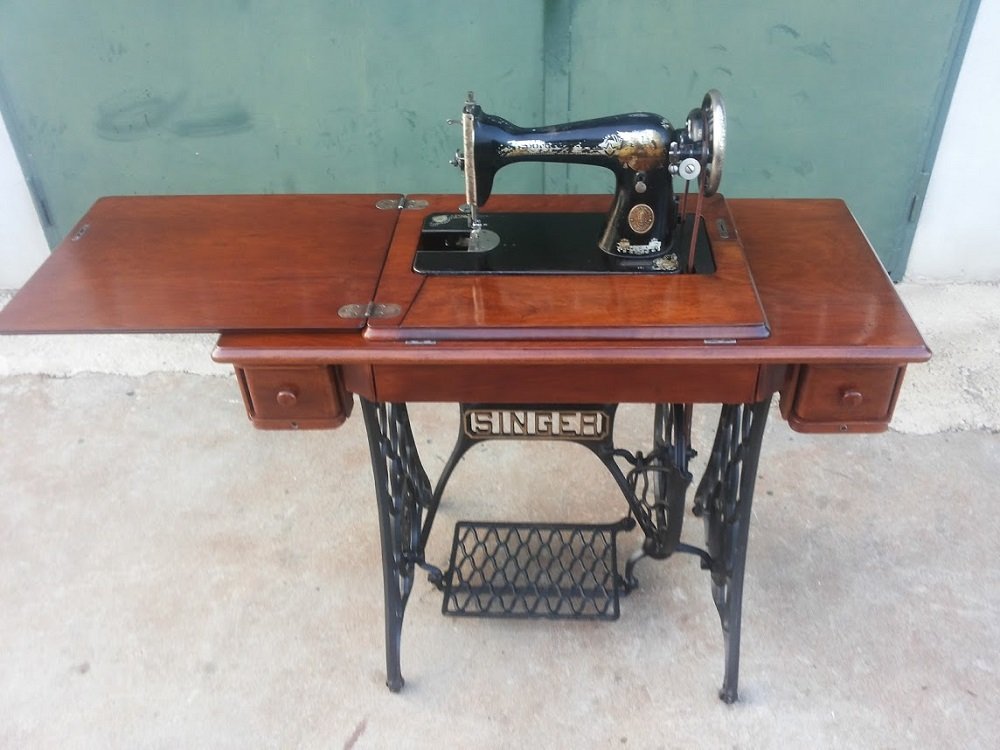
It was an artisanal kind of job. They at most had a small laboratory and very few machines (are this kind of sewing machines considered industrial machinery? [1] I don't think so.).
You know why none of my grandfather children became tailors?
Because it had became an industry and there was very little money in it and very little value could be added by expert hands.
It was already immigrants (at the time it was mostly internal migrations) in sweat shops, paid nothing, for long hours, with no rights, usually operated illegally.
The fashion industry is "the multibillion-dollar global enterprise devoted to the business of making and selling clothes".
AKA modern slavery - if the environment is not an argument for you.
Ask someone from Bangladesh, if you don't believe me.
The parent comment didn't say anything about fashion being entirely about manipulation; they said luxury fashion is based off manipulating human psychology". "Luxury" and "based off" are key words and cannot be omitted.
You also propose a false dilemma: either luxury fashion or standardized, homogeneous garments. Surely there are other myriad options, not just between extravagant luxury or dull conformity.
I disagree. "based off" means a completely different thing than "entirely": the former is not exhaustive, the latter is. "Luxury fashion" is a firmly delimited subset of fashion. The reason OP omitted "luxury" was to set up their false dilemma, which wouldn't have worked between "luxury fashion" and standardized garments (wouldn't have worked in the sense it would've been even more obvious it was a fallacy).
I overall agree with you but some luxury items do bring beauty to this world. I've watched artisans in the process of creating Hermes silk scarves and it's nothing short of fascinating and I find the end result often beautiful. I offered one to my wife, ten years ago. She still wears it.
The same can be said about high-end mechanical watches. Some are beautiful and their mechanism are a thing of beauty in themselves. Some people are in awe of the "Geneva Drive" [0] and not many won't be moved by Bartosz Ciechanowski's explanation and interactive animation of mechanical watches mechanisms [1]. I offered one high-end mechanical watch to my wife, she wears it daily..
And what's the alternative anyway? I much prefer to live in a world where Hermes scarves and mechanical watch do exist than in a planned economy where the komrades do decide what items can and cannot be manufactured / sold.
I mean: Kim Jong-Un isn't exactly known for having many billionaires thanks to the luxury items sold by North Korea. Would you want to live there?
whoa there. As a scientist, I would still strongly argue for the value of art and culture. Luxury fashion can be deeply problematic, but throwing all of clothing design under the bus and elevating tech as somehow contributing more to humanity seems misguided. It's not zero sum, and a rejection of arts leads to weird places.
Strongly disagree. Luxury fashion helps turn the trust fund kids successful people inevitably create (might not be there kids, but if it's not their kids, it will be their grand kids or great grand kids) into average people by eating through their trust fund (drugs help a lot too). Luxury goods perform a vital service of turning elites by birth who are turds by nature into proles eventually and this is drastically better than the way we used to accomplish this (revolution or war with the accompanying massive innocent person bloodshed and property destruction).
The good thing about capitalism is that people get to decide for themselves what is valuable to them, not you or any other overlord. I can't imagine what kind of dystopia we'd live in if we were forced to do everything "for the good of humanity".


I get the feeling the world would not stop if all this stuff just disappeared overnight.