> This makes it the most luminous object in the known Universe
> J0529-4351 is over 500 trillion times more luminous than the Sun
That appears to contradict Wikipedia [1] which lists SMSS J215728.21-360215.1 [2] as the most luminous at an intrinsic bolometric luminosity of ~ 6.9 × 10^14 Suns or ~ 2.6 × 1041 watts.
Are there perhaps different ways of measuring luminosity?
If I were terminally ill or just so old and frail to warrant the use of assisted suicide for whatever reason I would hope — though super unlikely - that instead of dying peacefully in a bed that instead I could be yeeted into a supermassive black hole. I just am so curious what it’s like. Of course I’d never be able to share what’s on the inside. But the experience would be worth it. Then I’d make my way to the central singularity and of course die but I’d know things no scientist would.
You would see the end of the universe. Due to the extreme time dilation you would see nothing interesting in the black hole itself (things in front of you would appear frozen in time and unmoving), but the universe outside would experience its entire lifetime as you fell in.
You'd have a hard time seeing any of it with your eyes though because light would be dramatically blue (the outside) and red (the inside) shifted. Additionally items on the inside would be so dim as to be invisible (the time dilation means the light emission also slows down, so you would see nothing). The universe though, would blast you with all of its light at basically the same time, and would be incredibly bright.
Timelike freefallers in black hole metrics do not see the infinite future because the light entering the BH with them (and behind them) is also in free-fall.
Accelerated timelike observers inside a black hole can't accelerate for long.
Inside the horizon, you won't see light that has already been further in than you are. Likewise, you can't send light to anything with is further out than you.
Except that in inside regions of some BHs -- spinning ones, notably -- you can send signals on interesting orbits and might contrive a way to communicate with another inside-the-black-hole observer. This was basically what Roy Kerr's recent no-signularity paper deals with (substituting density for "you" and the other observers and pressure for communication). Pressure, spin, and contact forces could (if Kerr is correct) come into some equilibrium that supports a nonsingular configuration of matter against further inward migration, accelerating it outwards "forever", much as contact forces within the Earth accelerates you "forever". In that case if you could stand on that matter (the enormous surface gravity would squash you very very very very flat), you would see a significant blueshift of infalling light.
Even crazier if I angled / timed it right (time and space switch spaces so yeah I dunno how that works) I could maybe make the ringularity and who knows what's on the other side. Michio Kaku thinks it'd be a portal to somewhere else -- a wormhole of sorts -- maybe I'd finally know if the other end of a spinning blackhole is a whitehole somewhere else.
For a sufficiently large black hole tidal effects are weak near the horizon, but inwards from there the Weyl tensor (or the contraction to an appropriate curvature scalar; the Weyl tensor itself is a contraction of the Riemann curvature tensor essentially encoding body-deforming curvature which preserves the body's volume) grows to the point where there will be inevitable failure under the stretch-squash. Indeed the Kretschmann curvature scalar eventually diverges, and that fact is what indicates the presence of a singularity.
Roughly, the available paths for elements of a spherical cloud of noninteracting dust will tend to deform the sphere into a prolate ellipsoid like an American football, with the long axis aligned radially, i.e., with one end pointing to the strong curvature inside the black hole. The dust's overall volume is preserved, so there must be a squashing along the other two spatial axes. As infall proceeds, the prolation extremizes -- in due course the cloud resembles a piece of string with a slight bulge along its length.
A round football has internal interactions which try to keep it round, and so is different from a sphere or shell of non-interacting dust. However, it will still be stretch-squashed as it infalls and gravitation tries to make it look like an American football. Soon enough it will tear and burst. A human in free fall will probably end up firstly rotated feet-first or head first, and quickly will feel some discomfort from the stretch-squashing, eventual disarticulation of joints, tearing of the skin and other tissues, and so on. While it still works, the human's wristwatch will count of on the order of minutes between its crossing of the large black hole's horizon and its mechanical failure.
For stellar ("little") black holes, the Weyl tensor is large enough to cause this sort of bursting (and wristwatch failure) outside the horizon.
I've heard this many times before, but for some reason now is the first time it really hit me.
Assuming this is true. What would the rate of our universe's expansion tell us about the black hole we are inside of? If matter were still falling into our black hole universe where would it show up from our perspective?
> What would the rate of our universe's expansion tell us about the black hole we are inside of?
I'm only a layman, but AFAIK, depending on the size and uniformity of the black hole, we could notice a non-uniform redshift, maybe even depending on which side faces the singularity. An observation called "dark flow" could be an indicator of this. See also: https://physics.stackexchange.com/questions/23118/are-we-ins...
We know we are not in a very large (observable-universe-sized) black hole, because with present technology we would notice a directional dependence on matter density and angle-brightness relations.
For such things, the standard cosmology's Friedmann-Lemaître-Walker-Robertson (FLRW) model is homogeneous and isotropic: everything's arranged around us spherically. A black hole model instead would tend to have everything arranged around us cylindrically, with objects like quasars and supernovae [or really, the arrangement of the spectral lines associated with them] along the axis redder and dimmer than similar things along the radius.
No universe-size black hole metric offers a decent explanation for the local physics of galaxy clusters. They're also poor descriptions: it is really hard to contrive a black hole metric which preserves the cosmological redshift for the bright parts of the observable universe, notably the direction-indepenent features of the Lyman-alpha forest. They also seriously struggle with the effectively flat spatial geometry of the observable universe clearly seen by the WMAP and Planck instruments (and in evidence as far back as BOOMERaNG/Maxima/TOCO/Saskatoon experiments in the 1990s) with support from morphology studies of high redshift galaxies.
In essence, using General Relativity to describe our universe, there is no large scale distortion associated with the Weyl curvature tensor to be found (or if you like, the gradient of the curvature density outside galaxy clusters is so negligibly small we can't even decide on current evidence which direction it grows in), and one of the chief characteristics of black hole metrics is that the Weyl tensor grows -- and ultimately diverges -- inside the horizon.
At large scales, our view of the sky is much better represented (and explained!) by the expanding FLRW metric of the standard cosmology, sprinkled with collapsing vacuoles to better capture the local physics of overdense regions (which usually contain galaxy clusters); this is called a "swiss-cheese model".
It would be hard not to notice being in a black hole whose radius isn't at least tens of orders of magnitude larger than the observable universe. We could think along the lines of embedding our cosmological Friedmann-Lemaître-Robertson-Walker metric in a black hole metric just as the FLRW metric surrounds a collapsing spacetime metric like Lemaître-Bondi-Tolman in "swiss-cheese model" (LTB is a type of black hole metric in which early gas and dust collapses spherically into a central black hole, while we'd prefer a type of metric where the gas and dust collapses in a more complicated way, evolving through star-filled galaxies and swarms of smaller black holes, before ultimately collapsing into a single gargantuan black hole). The FLRW metric would capture the observed cosmological effects induced in the vast and growing space around galaxy clusters, and "hide" the evidence of shrinking at much much larger distance scales. The problem is then how the real universe avoids giving us evidence that supports a recollapse of the expanding FLRW; this mostly means exploiting the low precision of the measurements we make when studying the shape of the universe.
Other embedding and inhomogeneous approaches are available, building on the complexity of my parenthetical in the previous paragraph, but all such approaches are likely suffer from the same problem: in order to be embedded in a collapsing spacetime, the inner expanding spacetime must be at all times very small in comparison. It is much easier to embed even an enormous collapsing spacetime into an expanding cosmology -- indeed, Einstein did just that in 1932 with de Sitter <https://en.wikipedia.org/wiki/Einstein%E2%80%93de_Sitter_uni...>, serving as a prototype of a homogenous "swiss-cheese model" for several decades before the discovery of the small temperature anisotropies of the cosmic microwave background.
To prove the geometry of the cosmos among other reasons, cosmologists actively look for distorted spiral galaxies. We are fortunate that there are several highly common types of spirals that, when not gravitationally lensed, look the same in every direction and at every cosmological redshift ("distance" or alternatively "lookback time").
Distorted spirals, especially if we get a good face-on view, reveal the large scale geometry of the universe. That alone can tell us whether we're in the middle of a sphere-like observable universe or an axisymmetric (or cylindrical) one, like if we were in a black hole or rotating cosmos. We see face-on spirals looking nice and circular in every direction and at pretty much every apparent size and brightness, whereas in something like a truly enormous black hole we'd expect those spirals to be elongated in one direction, towards the centre (of mass, for a black hole; of rotation, for a spinning universe). (We can also use radiotelescopes on nearly edge-on spirals to check whether there's an elongation along our line-of-sight, and whether whole galaxy clusters with multiple spirals at various orientations are elongated in any direction).
Spirals are also great for characterizing gravitational lenses! Such lenses are a prediction of general relativity from the 1930s (Einstein 1936, Zwicky 1937), and are a good test for the theory especially since we can now use computers to recover the images of the distant background galaxies (this effectively "weighs" the foreground mass), and the magnified super-distant background spirals look circular face-on like any other spiral, and not like a cigar.
(Funnily enough there is the Cigar galaxy, M82, known since the late 1700s and still looking pretty cigar-like through small optical telescopes. Only 20 years thanks to improvements in ground-based radio telescopes and space-based infrared and X-ray telescopes to be a nearly edge-on spiral galaxy behind some dust. It got astronomers' attention in part because it seemed so distorted and elongated, rather than obscured. Thanks to that attention we also know it has a very slight gravitational distortion after all, thanks to its interaction with a larger nearby galaxy, the beautiful spiral M81, "Bode's Galaxy". The latter has also been known since the late 1700s, but its spiral structure wasn't known until the late 1800s, some time after the Whirlpool galaxy's spiral structure was described.)
Below is a link to a bunch of spirals and a gravitational lens. They really are everywhere in the sky, in the billions.
To an outside observer, yes. But from your perspective falling in, your watch would seem to run normally, even though 1 minute passing on the watch might equal 100 years of time far away from the black hole.
For those too lazy to read: the quasar is a supermassive blackhole growing at the rate of 1 Sun per day and with an accretion disk 7 light-years in diameter.
My question is: where does it find a Sun every day to eat??
Supermassive blackholes reside in the center of galaxies which have higher density of matter / stars. Quasars are very distant and thus very old images of those galaxies from the time they were "cleaning" the area from surrounding matter. Milky way center was likely a quasar a long time ago as well, but it already passed this "cleaning" phase and there isn't much floating matter in the center anymore.
To put things into perspective: the distance from us to the nearest star is 4.3 lightyears.
With a 7-years wide accretion disk, I guess it will catch a lot of stars.
Also we see it 12 billion years in the past. The universe was a lot more dense at that time so it could catch even more.
It must be in a region of space where the density of stars is orders of magnitude higher than in our part of the Milky Way, where you only find a handful of stars within 7 light years.
Thanks to attracting far away stars for billions of years I guess?!


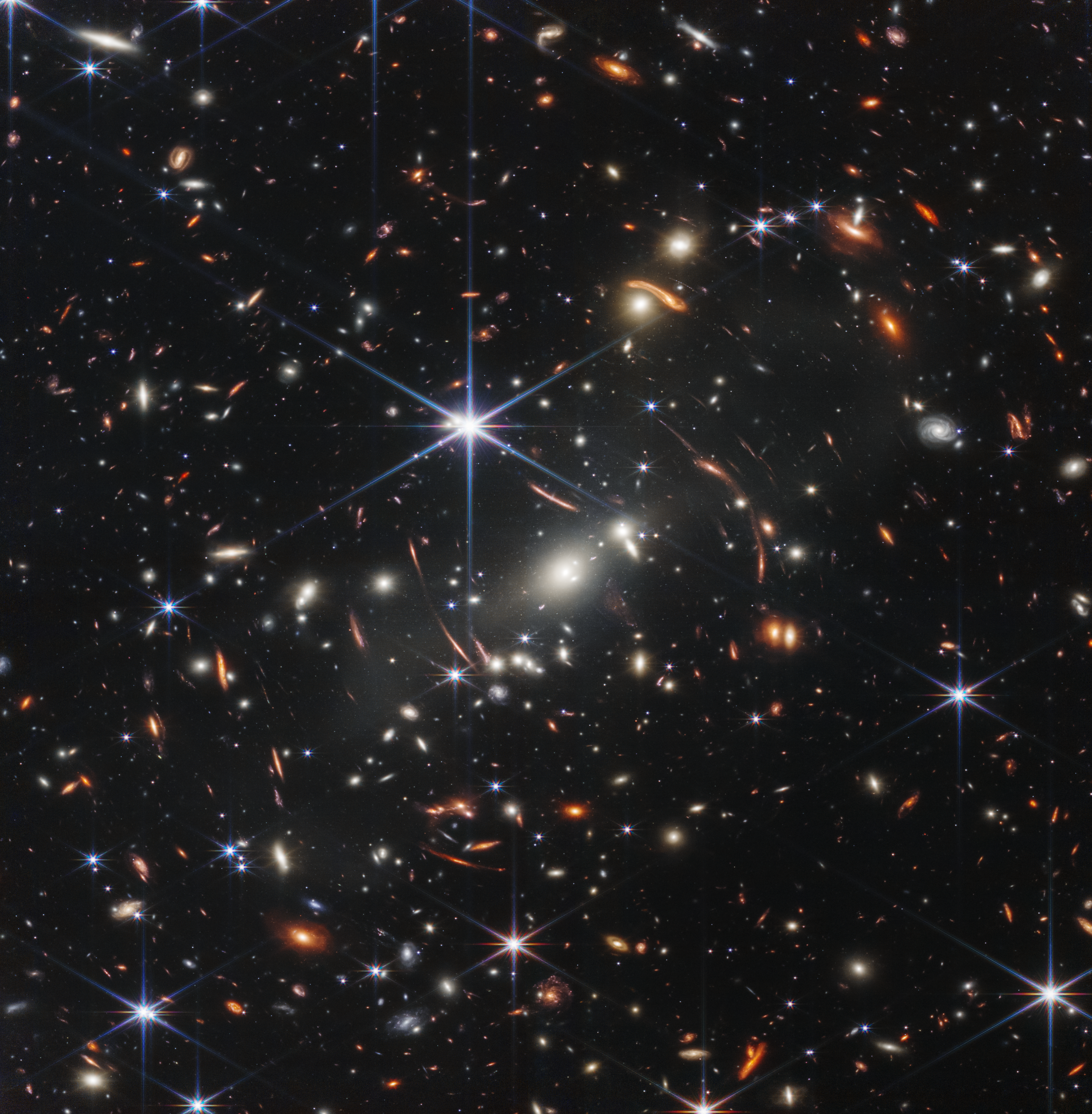
> J0529-4351 is over 500 trillion times more luminous than the Sun
That appears to contradict Wikipedia [1] which lists SMSS J215728.21-360215.1 [2] as the most luminous at an intrinsic bolometric luminosity of ~ 6.9 × 10^14 Suns or ~ 2.6 × 1041 watts.
Are there perhaps different ways of measuring luminosity?
[1] https://en.wikipedia.org/wiki/List_of_quasars
[2] https://en.wikipedia.org/wiki/SMSS_J215728.21-360215.1