Hacker Newsnew | past | comments | ask | show | jobs | submitlogin

With Oxford comma: "We invited the strippers, JFK, and Stalin." [three distinct items in the list]

Without Oxford comma: "We invited the strippers, JFK and Stalin."[two named items in the list]

Reading with or without the pause is natural either way. And massively changes the meaning of the sentence.


Without Oxford comma: "We invited JFK, the stripper and Stalin." [three distinct items in the list]

With Oxford comma: "We invited JFK, the stripper, and Stalin."[two named items in the list with an appositive affirming that we're talking about JFK the stripper and not the former president]


Yes, changing the order and the number of items (plural strippers in original to singular stripper in yours) changes the meaning. That is unsurprising.


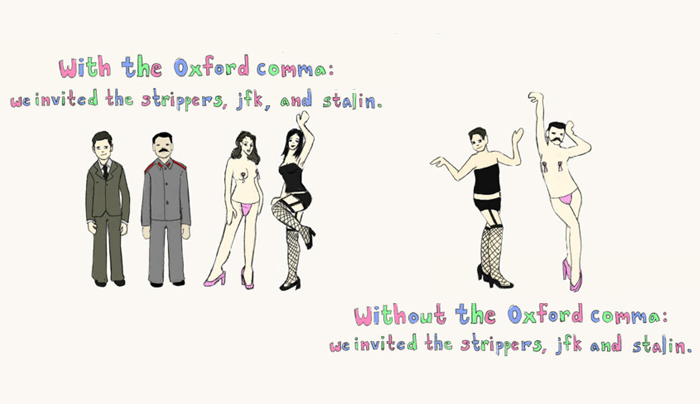
I cannot see a way that those sentences do not both mean the same (nonsensical) thing involving strippers, JFK and Stalin.

I think that your analysis in [] is wrong. Your second example says two named items but it still has three - strippers, JFK and Stalin.


> I cannot see a way that those sentences do not both mean the same (nonsensical) thing involving strippers, JFK and Stalin.

This specific example is nonsensical to demonstrate the possible confusion, but this sort of confusion is really common.

> I think that your analysis in [] is wrong. Your second example says two named items but it still has three - strippers, JFK and Stalin.

No, in the second example, JFK and Stalin are two instances of strippers. So there are three nouns, but only two people.


In the sentence with ann Oxford comma, there are a group of strippers, plus two men.

In the sentence without, there are two strippers, the first named JFK, the second named Stalin.

Here’s a drawing to help… http://helveticka.com/blog/wp-content/uploads/2014/08/oxford...


Guidelines | FAQ | Lists | API | Security | Legal | Apply to YC | Contact

Search: