Which source states that more than a few minutes will be necessary, once the adequate continental system (storage: including V2G and similar ways such as Powerwalls) will be in place?
> the efficiency is beyond terrible
... when used in transportation. Green hydrogen produced then stored nearby a turbine or fuel cell acting as backup for the grid efficiency is similar to fossil fuels' or nuclear (about .3 to .4).
> That's why no country on earth is managing with those.
> Which source states that more than a few minutes will be necessary, once the adequate continental system (storage: including V2G and similar ways such as Powerwalls) will be in place?
Ever looked at an electricity demand graph? The electricity demand isn't linear, it's not linear in a day, not linear in a week and especially not linear in months either in the northen hemisphere. And the more you decarbonize the economy, the worse it's going to get for renewables here since fossil fuels are used for highly non linear usage.
> Green hydrogen produced then stored nearby a turbine or fuel cell acting as backup for the grid efficiency is similar to fossil fuels' or nuclear (about .3 to .4).
You are mixing up two things. Nuclear, since it's a baseload technology, only needs to adapt itself to the demand, the production can mostly be planned. Renewables on the other hand need to adapt both the demand and the production.
Those efficiencies figures aren't needed for nuclear because you don't need P2G or any of that, you can just adjust the production. So you get the usual production. Nuclear doesn't drop abruptly to 5% capacity and those bandaid solutions aren't really needed.
What you are quoting is the efficiency of the production, which is a totally different subject. The efficiency of the production is more of an indication of how far you can actually go in the future.
Overproduced electricity can be stored. V2G will play a major role.
> You are mixing up two things
I doubt so. I was stating that hydrogen may become a clean backup, replacing fossil-fuel existing plants, some of them (burning methane) may be retrofitted. Water electrolysis done in centralized plants gathering electricity overproduced at continental level in order to obtain and locally temporarily store hydrogen, maybe even benefiting from co-generation, will locally burn it (gas turbine or fuel cell) in order to produce electricity when the grid needs it while renewable sources cannot provide enough.
> aren't needed for nuclear because you don't need P2G or any of that, you can just adjust the production
Nuclear can 'modulate' its output up to a certain level and frequency, which in practice are insufficient. Even over-nuclearized France never enjoyed a zero-carbon grid: each year between 6% and 12% of electricity is produced by burning fossil fuel ( https://ourworldindata.org/explorers/energy?Metric=Share+of+... ) because exploiting enough reactors to cope with the mandatory load-following and also with the peak load would be way too expensive.
There are safety-related limits (power modulation proportion, duration of a pause needed after each modulation, modulations frequency...) to nuclear load-following capacity, and the very combustible status is a major parameter. Pertinent document (French ahead!): https://www.sfen.org/rgn/expertise-nucleaire-francaise-suivi...
Proposed translation: "a reactor power output can vary from 100% to 20% in 30 minutes, then after 2 hours can go back to 100% at the same speed, and can cycle this way 2 times per day".
This is quite a good performance when it comes to load-following (French engineers are very good at this), however it is insufficient in the real world (save any ridiculously expensive over-provision of nuclear reactor, most idling) and very weak compared to gas turbines performances.
Those "bandaid" solution are needed with each and every low-carbon type of source, even nuclear. We have to consider the amount of emissions caused, in each type of system, by those solutions.
On a grid when it comes to the "production = consumption" rule there are 2 big types of challenge:
1/ short-term adjustment (under a few seconds). Nuclear, per se, just cannot cope. It is done by the sheer inertia of the turbo-alternator drive shaft. On a renewable system it can also be done this way, thanks to flywheels. It is already done.
2/ long-term adjustments. It is either done by reducing the output of production units, or storing or wasting it or (if production isn't sufficient), by a reserve of "production" units (batteries, green hydrogen turbines...).
> Those "bandaid" solution are needed with each and every low-carbon type of source, even nuclear. We have to consider the amount of emissions caused, in each type of system, by those solutions.
Well no, they simply aren't. It's true that nuclear simply cannot do the same as gas but renewables on the other hand are in a league of their own way outside of any baseload tech. That's why they are considered intermittent.
No nuclear fleet drops to 5% capacity for weeks at a time like solar or wind, that's simply not a thing.
> short-term adjustment (under a few seconds). Nuclear, per se, just cannot cope. It is done by the sheer inertia of the turbo-alternator drive shaft.
The nuclear fleet takes around 30min to adapt the production right now in France. Not only it is done but it works in real life right now, unlike large scale P2G, green hydrogen or batteries which aren't used anywhere on earth for grid management.
> Overproduced electricity can be stored. V2G will play a major role.
Unfortunately no it can't. Unless there's a new breakthrough, dams is all we have for large scale electricity storage. And we can't count on tech which doesn't exist yet.
At the end of the day, the proof is in the pudding, even Germany which built tons of supposidly green hydrogen pipes will use them for transporting ... gas.
Well no, unfortunately that doesn't work either. And the best example is winter 2022 where the whole western europe was out of wind for 3 weeks.
That's a nice idea but unfortunately it doesn't work with the real figures.
You can even check right now on electricity map, most of the EU countries have similar wind capacity production at around 20%. (Terrible figure in itself but that's another debate)
Edit : I forgot to answer that part.
> Even over-nuclearized France never enjoyed a zero-carbon grid: each year between 6% and 12% of electricity is produced by burning fossil fuel ( https://ourworldindata.org/explorers/energy?Metric=Share+of+... ) because exploiting enough reactors to cope with the mandatory load-following and also with the peak load would be way too expensive.
Unfortunately, France replaced a lot of the coal plants with gas plants to follow up renewables and is now stuck with it. France only had a single gas plant before 2010.
The consensus at the time was that those renewables would eat up the share of the gas plant and they could be removed altogether.
We now know that it doesn't work and the gas plants are there for good.
Green hydrogen is a work in progress, granted, however such "it was never done before" argument would have condemned France attempt do produce most of its electricity thanks to nuclear power.
>> Overproduced electricity can be stored. V2G will play a major role.
> Unfortunately no it can't.
What do you mean? Electricity cannot be stored?!
> Unless there's a new breakthrough
I proved (above) that stationary batteries already are a thing, quickly growing up.
> even Germany which built tons of supposidly green hydrogen pipes will use them for transporting ... gas.
Yes, due to a lack of finance and a very debatable plan (transporting hydrogen is more and more probably doomed).
> winter 2022 where the whole western europe was out of wind for 3 weeks.
> most of the EU countries have similar wind capacity production at around 20%.
20% is the usual load factor for terrestrial wind turbines. Offshore is way better (about 2x) but not as widely deployed. The goal is not to maximize a load factor but to produce enough energy to serve the needs, at minimal total long-term impacts and costs.
> France replaced a lot of the coal plants with gas plants to follow up renewables and is now stuck with it. France only had a single gas plant before 2010.
Here is a list of some fossil fuel backup plants and their building/extension dates: Brennilis (1981, 1981, 1996), Dirinon (1981), Gennevilliers (1991), Vaires-sur-Marne (2008, 2009), DK6 (2005)...
> The consensus at the time was that those renewables would eat up the share of the gas plant and they could be removed altogether.
True, however this will only be fully possible when the French fleet of renewable plants will be complete. We are far from this as France is notoriously way behind, partly because it wastes money on nuclear late-and-overbudget projects (EPR...). France was punished by the UE because it missed its own renewable objectives, there is no other case in the UE ( https://www.reuters.com/markets/commodities/eu-beats-2020-re...).
In France RTE is in charge of the grid (less the "last kilometer") and is a subsidiary of EDF (electricity producer, head of the nuclear sector. Here is what it officially and publicly declares about this: https://www.youtube.com/live/xP4jL4b_Nnk?si=g2-cryDt62TyJWuA...
Translation: "I absolutely confirm that technically every running wind turbine reduces the amount of consumed gas somewhere".
All the other existing gas plants in France were built post 2010 for renewables.
> We are far from this as France is notoriously way behind, partly because it wastes money on nuclear late-and-overbudget projects (EPR...).
France spent more than a hundred billions on new renewables alone (roughly half of the total cost of the nuclear grid). It's true that the results look even worse than the EPR though. And it's not counting these new gas plants and external costs on the nuclear grid in the total.
The renewable investments look so bad that there's people like you who think they haven't been done but they have.
There's multille reasons France is bring the nuclear program back from the dead and one of them is that the renewable investments underdelivered.
> In France RTE is in charge of the grid (less the "last kilometer") and is a subsidiary of EDF (electricity producer, head of the nuclear sector.
RTE benefits from grid investments for renewables so yeah it's not a surprise they are all for it. They are especially afraid of a merge to go back to the previous statu quo.
Remember that big hole in the production on the graph before? That's exactly the time where the president of RTE made a public speech for building renewables, when they produced closed to nothing.
You wrote that "solar and wind" can drop "to 5% capacity for weeks at a time", and I ask for the source of this, in order to check that if, contrary to all scientific studies, it is true for a mix (wind, solar...) deployed on whole continent. Guess what? It isn't! Check "How synchronous is wind energy production among European countries?" (Monforti, Gaetani, Vignati). This is also true in China (check Liu, Xiao Wang, Dai, Qi "Analysis on the hourly spatiotemporal complementarities between China's solar and wind energy resources spreading in a wide area") and America ("Is it always windy somewhere? Occurrence of low-wind-power events over large areas" (Handschy, Rose, Apt).)
> Daunkelflaute
It's "Dunkelflaute" (only one 'a')
"a single event usually lasts up to 24 hours" and "more than two days over most of Europe happen about every five years" (source: https://en.wikipedia.org/wiki/Dunkelflaute ), here is for your "weeks at a time". Moreover regions outside North of Europe are way less impacted.
> are used for very low scale grid management
And what exactly forbids to manage all local grids this way? This is more and more true, as being able to isolate a local grid is useful.
> The only large scale tech to store electricity are dams
As of 2022, the total combined energy capacity of electric vehicle (EV) batteries sold in Europe reached approximately 690 GWh, and grows very quickly.
Note: dams are a renewable source.
> The only exisitng gas plant stil used before 2010
> As of 2022, the total combined energy capacity of electric vehicle (EV) batteries sold in Europe reached approximately 690 GWh, and grows very quickly.
Lol, so for context, a single French person is using 2.5GWh/year. One single inhabitant.
France is consuming 1.2TWh of electricity per DAY in winter.
So the whole electric vehicle fleet in the whole Europe is worth half a day (being generous) of electricity just in France during the time which is the tightest in electricity. That's so low it's not even worth mentioning. And that's the whole Europe compared to a single country, that's not going to make it.
> Note: dams are a renewable source.
There's also pretty much no new place where you can build one in a developped country as it's an old technology.
> You wrote that "solar and wind" can drop "to 5% capacity for weeks at a time", and I ask for the source of this
Solar produces most of it's production during 6 months and only gives 3% of the yearly production on each month of January and February. That's the two months where the countries are using the most electricity for context and need the most production.
For wind, that happens regularly, even right now as we speak, Germany has a 7% capacity which isn't far.
> deployed on whole continent. Guess what?
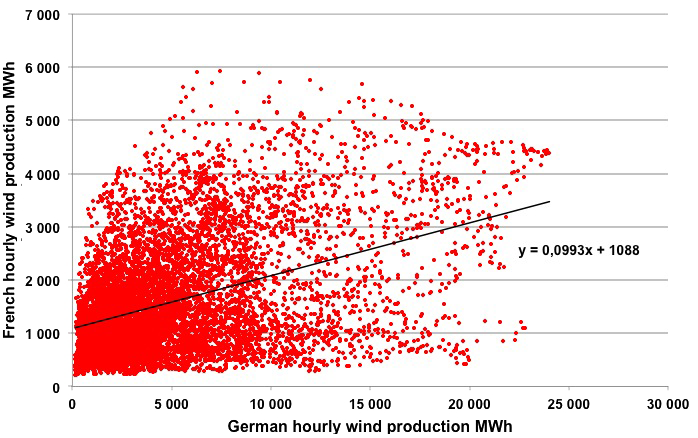
The wind production is synchronized right now, you can check it. That's another kind of strange of being shown the reality right now and denying it.
Here is the statistics, when it blows in Germany, it blows in France and when there's no wind in France, there's wind in Germany either.
> This is highly debatable as the real total cost of the nuclear fleet is disputed. Remember: EDF's debt now surpasses 50 billion €...
No it's not disputed, there's extensive reports in France on that subject as it's a common talking point.
I don't know any study about the external costs of renewables though so 100 billion for around 10% of the production is the best scenario. And calling it a failure seems pretty fair even with the most generous figures possible.
At the end of the day, the proof is in the pudding anyway, if it had worked, the nuclear program wouldn't have been brought back from the dead. France already tried ambitious renewable investments to replace the nuclear fleet during a whole decade and it failed. What the country got instead was mediocre results for the price paid and an increased dependency on gas which proved to be a huge issue with the Russian war. Those who don't learn from the past are condemn to repeat it.
Your document (Jancovici) analyzes current production of the very incomplete fleets of neighboring nations while the pertinent studies take into account wind regimes of geographic zones where wind turbines can be deployed and which are far appart. Conclusions of adequate scientific (J.-M. Jancovici expertise isn't about wind regimes) in reviewed and published studies (J.-M. Jancovici isn't) are quite different (please find some pointers in https://news.ycombinator.com/item?id=41397343 )
The last part of your answer is mostly devoid of sources, and I don't want to write about mere opinions.
> if it had worked, the nuclear program wouldn't have been brought back from the dead
> France already tried ambitious renewable investments to replace the nuclear fleet during a whole decade and it failed
Those industrial renewables are very new tech, they evolve very quickly, France missed its own objectives on renewables (sole nation in the UE to do so), France isn't rich anymore (during its nuclearization it benefited from the '30 Glorieuses' and from an intense and expensive R&D at home and in the US)...
https://sites.google.com/view/electricitedefrance/messmer-pl...
You completely forgot that there's companies using electricity and we live in a world where individuals are on the top of that electricity chain.
Your figures are completly wrong and do not include the whole electricity chain.
France produces close to 500TWh/year.
So yeah, I confirm what I said, the whole europan fleet of battery which you thought was impressive can only last half a day of a single country.
Also assuming that nobody want to use their car in Europe of course for that particular half day.
> Not true in some parts of Europe (North, esp Scandinavia, Balkans...)
That's not going to revolutionize anything, the biggest spots in the EU are already taken.
> Conclusions of adequate scientific (J.-M. Jancovici expertise isn't about wind regimes) in reviewed and published studies (J.-M. Jancovici isn't) are quite different
That's amamazing, you are plain denying reality, I'll do it once again, right now:
There you have it. The reality is in front of your eyes, the statistics confirm that the wind patterns are matching and even the real-time data that you refuse to look also does!
Sure there's some existing differences in some regions and some outliers but not nearly enough change the fact that relying on neighbors when the wind isn't blowing is a dead idea.
> Determining which project delivers a 'mediocre result' is easy.
Yeah sure it's easy, the new renewables took half the cost of the nuclear fleet for 10% of the production.
You can't put any lipstick on that sorry, you can try to tweak it the way you want, it's so bad that France had to restart its program back from the dead.
And those figures aren't even including the adaptations to the grid and the gas plants which I think they should.
> The French nuclear program was never killed. When was it killed, according to you, by who and how?
It was killed in 2012 by president Hollande and even written officially in the law in 2015 with a maximum of 50% nuclear production. The idea was to do maintenance while renewables took over. The nuclear program only got brought back from the dead in 2023, because of the Russian war and the failure of renewables to take over.
> You completely forgot that there's companies using electricity
Do you really believe that 'per capita' only takes into account electricity produced for industrial applications? It doesn't.
The subtitle ("Annual average electricity generation per person") seems clear to me.
Your "a single French person is using 2.5GWh/year" assertion is not backed up and clearly wrong. As the referenced graph ( https://ourworldindata.org/grapher/per-capita-electricity-ge... ) shows its around 8MWh/year (France is a net electricity exporter), which is more than 300 times more.
> France produces close to 500TWh/year.
Indeed.
France has approx 68 millions inhabitants.
Let's consider
(* 68M 8MWh): 544TWh
Bingo, I was right, isn't it? How much with 2.5GWh instead of 8MWh?
> The reality is in front of your eyes, the statistics
Don't you understand that in order to know if a continental 'renewable' mix will alleviate a fair part of the effect of 'intermittency' on production, we have to take into account all potential wind-turbine sites on the whole continent, NOT the very weak existing fleet (especially at the time of this document) of a few neighboring nations?
I won't answer to your mere opinions (assertions provided without any source).
According to you the French nuclear program was "killed in 2012 by president Hollande and even written officially in the law in 2015 with a maximum of 50% nuclear production."
This is complete BS: as showed in my previous answer everything ran as usual, this law didn't change anything. A law is not magically effective. What did it cause? The only theoretical effect of this law was the shutdown of the "Fessenheim" nuclear plant, the oldest one, exposed to seismic risk (Germany and Switzerland owned part of the plant and wanted it closed). This plant was only 2,8% of the fleet capacity!
Even at this date it would be moot because approximately 60% of France final energy is provided by fossil fuels, which have to be booted, implying a massive electrification and therefore a real need to produce more electricity... creating space for nuclear inside those 50%.