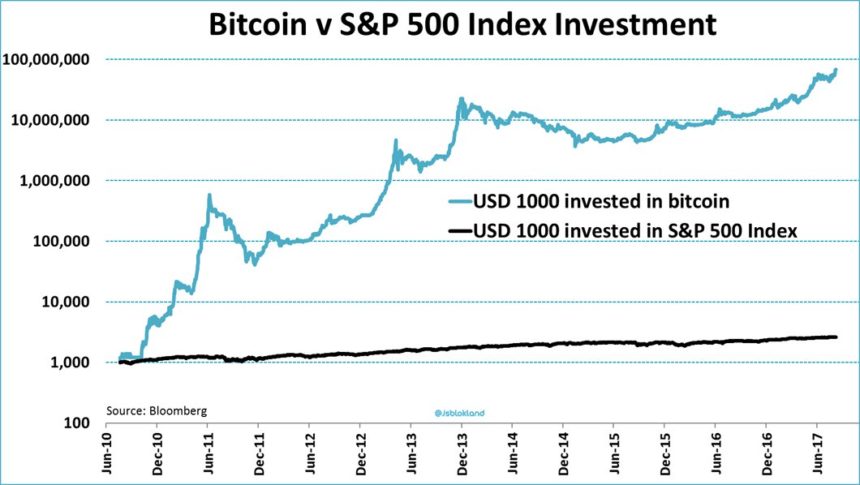
It has in dollar terms but it still hasn't on an inflation adjusted basis. One bitcoin today has less purchasing power than at its peak in November 2021. The dollar has lost about 12.5% since then so the true all time high would be around $79250.
this should be the real headline. I am certain and beyond any doubt that I speak for all of us hackernews readers when I say that I have no frame of reference on the value of cryptocurrencies without comparing first with the Malaysian Ringgit
In case you intentionally left out the /s at the end of your comment...
You'd be surprised how advanced the banking systems are in some 3rd world countries. In many cases the banks skipped over a lot of the legacy cruft that 1st world countries are struggling to get rid of now.
Also, in countries where the banking system or currency is falling apart, they use USD cash. Zimbabwe is doing this, Argentina is doing this, I'm sure more places also do this.
Also also, often where you have crumbling banking or currency, you also have crumbling internet and/or electricity infrastructure. Nobody is sitting on an upturned milk crate in their dilapidated corrugated iron shack in the middle of a slum fucking trading bitcoin on Coinbase so that they can buy bread.
Bitcoin is 99% used as a speculative investment instrument and as a means to participate in illicit markets (drugs etc). There is nothing altruistic or democratising about it.
the certainty of this post is its undoing. Someone once relayed this story .. while speaking between two intelligent but not expert adults, about the "size of the Internet" .. one said .. the Internet is so big, that there are whole social groups online, for example a popular multi-player game in Korea, that you have never heard of.. yet there are hundreds of thousands of active participants in this thing that you have never heard of.. that is how big the Internet is..
So wrt. this Bitcoin.. one armchair Admiral is going to pronounce that "electronic cryptographic money exchange Only Does This (list of things that are obnoxious).
It is parochial.. the definition of uninformed.. people who are directly involved don't know all the things that are being done with Bitcoin.. dismiss simplistic portrayals
I'd bet the biggest use case is scamming/extorting people. It has been the fastest growing use case, it must move more money than all other use cases combined.
I mean a lot of people speculate that BTC is going up due to Trump's policies and promises, but an equally logical reason is that people expect the fall of USD. Currencies tend to fall after heated elections anywhere.
USD/EUR isn't necessarily a good reference either because they could be headed the same direction - an aggressive POTUS could be viewed as bad for NATO. Even gold, because that gold is going somewhere physical.
But there's not much other evidence that the USD is weakening after the election.
That's simply untrue. There's been constant swings in valuation of around 20x recorded through the past 3000+ years (and decent evidence this also happened before that).
Pretty much all of recorded history is local govts trying to fix the price of gold to remove this instability, and in pretty much every case those govts had to abandoned the fix as actual market values caused local mints to implode.
There's ample research available on google scholar covering all of these points.
This is one of those things that people say as though it's a good thing, but since precious metals are a negative carry asset (ie it costs money to store and insure gold or silver) this means that when you take compounding into effect they have been responsible for a devastating destruction in wealth over that time. Even more so if you consider the opportunity cost of holding metals when you could be holding a productive asset.
This depends on one's consumer preferences. The CPI includes depreciating items that does not scale with income, like healthcare , cars, clothes, and food. Someone with a net worth of millions of dollars incurs likely a smaller opportunity cost.
But I agree despite the hype Bitcoin's returns are still poor and easily surpassed by the S&P 500.
This being Bitcoin, the best price reference would probably be the cost of energy. How many megawatts of energy could one Bitcoin buy at that November 2021 peak, and how many could one Bitcoin buy now?
Recent history I presume because obviously if you bought at $5 your return is still quite nice. Although, GP suggests you’d now be better of selling btc and buying the index to optimize future returns.
Note that it hit a new all-time high last night, but it's been in the ~$70ks since last March. The election results may have pushed it over the top, but it's been way up for a while.
The people who predicted it would collapse appear to have been wrong, and the people who predicted it would come back appear to be right. My own position was that it's so volatile that it will always be a roller coaster, which is why I don't invest in it anymore. I'm sure it'll crash again, and come back again, and I don't like drama when it comes to my money. But to me, this is more evidence against the Ponzi scheme narrative, which was always a lazy description that didn't match the history of the coin. BTC is something else entirely. Still scary to me, but something else.
It cannot even get to $100k despite endless predictions over the past 5+ years it would. Each cycle is getting subsequently smaller. If anything, it's reached the final stage in which the supply of new buyers to prop up the price, let alone new highs, is exhausted.
I suspect it's going to become increasingly normalized for people to put some fraction of their retirement accounts (perhaps 3% - 10%) into crypto, now that there are ETFs. I'm not saying the supply of new money won't eventually get exhausted, but there's still a ton of untapped boomer wealth out there that has yet to flow in.
No the open-minded young see the potential, buy the asset while it's cheap and the slow pension funds in the legacy financial system eventually catch on and buy in with much larger quantities, pumping the value as they do so.
The boomers' pensions will effectively fund the pensions of the young who will be living off the 0.1BTC that they bought at $3000 but which is later worth $1M by the time they retire.
It's weird that some people are still having the same arguments which were thoroughly discussed on bitcointalk.org 16 years ago. The discussion about its value were interesting when the price was $0 and people were speculating if it's possible that it gains any value at all. It was known that any value would kick off the bitcoin's inbuilt incentive mechanisms which would keep it running forever. A software that pays humans to run it; that was the genius behind it.
When the price history is already established, the theoretical basis of value is irrelevant. People value things based on their valuation history; that's how it goes. It can be broken down somewhat, but the price history should already contain all the relevant information for investors.
Bitcoin has now made it's way to the portfolios of the most boring financial institutions [0], which means that it is now firmly established itself as a part of the global financial system, and it's not going away.
> People value things based on their valuation history; that's how it goes. It can be broken down somewhat, but the price history should already contain all the relevant information for investors.
No, people value things based on their expected return, which is entirely future-looking. Which is why news -- facts that change our understanding of the future -- changes prices.
Nobody values anything based on its history -- its price history is utterly irrelevant. I mean, some people might think they can get all the info from a price history, but those are the people who end up losing all their money.
Yet, the price history is what convinces people to buy it. The longer it goes, the more convincing it becomes. Gold has been valuable for thousands of years, which is why everyone knows it will keep being valuable.
Valuations of collectibles and monetary assets, which don't change, are based on their historical price performance. The price history tells the story of how people buy and sell an asset with certain fundamental properties, and that's all the information needed to make an investment decision.
I don't know what to tell you, except that you're simply wrong about how pricing works. I don't know where you got this idea that pricing history gives you all the information you need to invest, but it's not what a single professional investor, economist, or financial executive would tell you. Not one.
If you want to learn how pricing works, you might want to start here:
In fact, it's precisely to try to correct misconceptions such as yours that a lot of financial instruments put the disclaimer "Past performance is no guarantee of future results." Because it's so easy for people who don't know any better to imagine otherwise.
As I said, this does not apply to monetary assets, which don't have returns or expected future returns, like gold or bitcoin. In addition, these assets do not change. There are no news. All we know is how the price has behaved in different market conditions, and investors try to create models based on that alone.
I didn't say that the future price could be predicted or that it is guaranteed. I just said that the historical price information should contain all the relevant information about the asset.
There is obviously fascinating history about why gold has become valuable and what fundamental properties caused it to become valuable, but it's not really relevant to investors. Same applies to Bitcoin.
> There are no news... I just said that the historical price information should contain all the relevant information about the asset.
No, the news is changes in supply and demand, and the factors behind those changes, and how we expect those to change in the future. Those determine the current and future prices.
And those are not contained in historical price data. Historical price data is irrelevant to those.
There's information about the market, like interest rates and whatever is happening in politics and how the economy is doing. Then there is information about assets, which might change or not change. Gold and bitcoin react to information about the market, because these assets don't really change.
There are plenty of companies whose stock is sought after but that never paid dividends (I think Tesla and Amazon are some example, or used to be at least)
It’s not really about dividends. If you buy a share of Amazon stock, you’re getting a cut of the value that a million+ people are producing every day by writing code or moving stuff around. The value most workers create for their employers’ shareholders is much bigger than their rent check, and capturing that value is even easier than being a landlord. Dividends are just moving money from one pocket to the other, the value created by people’s work is where the returns come from. Financial returns without value creation are an anomaly, though not necessarily a rare or short-lived one.
Never have isn’t never will, dividends and buybacks are a sign the company doesn’t have use for the money. Meta and Google both eventually started paying dividends because they’re essentially tapped out of internal investment ideas.
Telsa and Amazon on the other hand believe they have something meaningful to do with the money. But eventually successful companies just don’t have anything useful to do with their giant piles of cash.
I'm pretty sure you're not. Or at least, my grocery stores and the IRS/tax people take dollars, not SP500 or QQQ. If yours does I'd live to hear how that works (and where you are).
If you're referring to investing $1,000, having it be worth $1,500, and then selling off $300 to pay for groceries, which a Coinbase/whatever account would let you do with Bitcoin while it appreciates.
If there is someone who wants to start a dog walking service, but they don't have the capital to do so, I can lend them the money with a promise from them to pay me a share of any revenue. My money goes to create a service that real people get benefit from (their dogs are walked) and they pay for that service with a medium of exchange that represents their own labour (fiat money).
I get something in return for my capital, and the world gets a valuable service.
Bitcoin does not offer that. The only return it offers is the hope that tomorrow some other people will pay me more to take my bitcoin, in the hope that some other people will pay them more the day after to take the bitcoin, with the hope that .... you get it.
the entire ETF industry is based on either spending the distributions or reinvesting them, depending on which side of the curve your age lands on, so it's pretty much spending the index.
Oh, definitely. Those are, generally speaking, the places where it's most important that you can do so: the People's Republic of China, North Korea, Afghanistan, Egypt, Bangladesh, etc. See https://en.wikipedia.org/wiki/Legality_of_cryptocurrency_by_.... But it's legal in almost all of the world, and fairly easy, while opening an account with a NASDAQ-listed broker is near impossible for most people.
Even in the literal sense of "owning" you don't need a majority, but yes - one share does have fractional power. I voted my 1000/<a very big number> just recently.
and how much of gold price is in your opinion value of material itself? Strip out that material price and you have speculation price. Price of Bitcoin is mostly that speculation price + instead of material some mathematical properties.
So, access to a permissionless SWIFT-like system from anywhere around the world has no economic value in your opinion? Go and ask people in African countries what it means to them.
> Go and ask people in African countries what it means to them.
Probably incredibly little. I have not in the slightest looked into it, but based on bitcoins properties, I'd guess that it doesn't suit 99.9% of Africa. They use cash and frequently use mobile phones for transferring cash etc.
Most paper money intrinsically has no value at all, even the paper it is printed on can't be used as toilet paper due to its lack of softness. It is only a medium of labor exchange. For me, Bitcoin is exactly the same, but in a very new form, backed by math instead of a government.
You're quite right that neither fiat money nor bitcoin have intrinsic value, though they both have exchange value (i.e. market value). This means there must be a demand that prevents the market value from falling to zero. In the case of fiat currency, the public demands fiat currency for transaction purposes and to pay taxes. In the case of bitcoin, the demand for transaction purposes is anecdotal, almost nonexistent. So the demand for bitcoin is almost entirely speculative. (There's no other possibility as far as I know, given no intrinsic value.) In other words, people demand bitcoin because they expect that the price of bitcoin will go up. Such a demand can be sustained as long as people continue to have the same expectations. When (or if) these expectations change, the demand can evaporate quite quickly, and the price will collapse dramatically as a result. So bitcoin is not backed by math. It's backed by a speculative demand.
Yes, but even speculative demand consists of many levels of speculation. For example, I speculate (based on history) that the world will always consist of corrupt governments printing money like crazy, so "digital gold" will be much better for their citizens than what they have to offer. How reasonable is my speculation? Other people speculate that Bitcoin will double in value, while others speculate it will increase tenfold. I believe their speculation has less merit than mine (at least, that's how I see it). I also speculate that a programmable, permissionless money system, similar to SWIFT, is a very interesting idea that opens up many research avenues and there is some non zero value in it. Another example: How many gatekeepers do you think someone in a poor country has to pass through to transfer dollars internationally using their bank account? You really think there is no value in avoiding all those proxies that charge you high fees? So yes, there is a pyramid of speculations, but some of those speculations are much more reasonable than others.
Speculation is always based on future price expectations. Whether such expectations are justified is a matter of debate of course. Personally I don't find any of the rationales convincing, quite the opposite. But, look, we already have examples of irrational behaviour such as in the case of lotteries. In principle, no rational person should buy a lottery ticket, since the expected value of a lottery ticket is negative. Yet many people buy lottery tickets. The world is full of gullible people who are willing to believe that they can get rich for free.
Crypto can be used as a store of wealth when crossing borders preventing search and seizure of your wealth against overzealous governments. See Russia in the early 90s which would regularly search and confiscate cash from people leaving. That alone makes it very valuable.
They would need 300 million wrenches, one for each citizen. That leaves society in a much better position than letting them do it at scale with an sql query.
Are wrenches single-use, or are you allocating individual attackers per-citizen? In the case of a successful wrench attacker, how are the stolen funds recovered?
This is the classic time-money tradeoff. Theoretically you only need one wrench and one attacker—but even if she attacks 100 people a day it would take thousands of years to reach everyone. And word of the attacks would spread, so later victims would take steps to safeguard their money and the attacks would become ineffective.
To be maximally effective you'd need to mobilize enough attackers and enough windowless white vans to reach the entire populace within probably a day, so let's say 3 million attackers and 3 million white vans. That's when things start getting more expensive than the sql query.
that is assuming every citizen has a crypto wallet, something is not even close to be true..
i would guess that percentage of people with wallets would be very small and a relative small team could with a relative small number of white vans and wrenches could get every single one in relative short time..
and for countries that heavily monitor internet usage, like china, i bet they could have a list with pretty good assumptions on who has crypto that they can target for further investigation before sending the wrenched goons..
> What's the scenario where the government can take the digital money from your bank accounts but can't take the digital money from your crypto wallet?
In cryptocurrency's defense (I am not a Bitcoiner), it not as easy for them to do that, because they can't just order a bank to transfer it/freeze it....assuming the owner is going through a lot of elaborate, inconvenient, and easy to footgun security measures. If you have a Coinbase wallet you're in exactly the same situation as if you had cash in the bank.
HOWEVER, the cost people pay to get that is stupidly high. For every suave international drug dealer who's kept their money out of the hands of the evil government with Bitcoin, you probably have 1,000 dudes or more, who lost the keys to their wallet somehow or got their Bitcoin stolen in a hack.
So you probably shouldn't be worrying to much about duh gubbament.
These threads always leave me baffled. Some people say that only drug dealers use bitcoin. Others say the ratio of normal dudes to drug dealers is 1,000:1 or more. I guess it depends what sounds convenient at the time.
If you worry about the government seizing your money like that, you really should be someone whose money the government wants to seize [1]. Those people aren't regular dude software engineers.
[1] Also, keeping your money in a bank account almost certainly product you from those controversial civil forfeiture situations.
I think the argument is that the drug dealers are actually using bitcoin for its utility, whereas the 1000 normal dudes are just buying it as an investment, not to use.
By head count maybe, but by value you gotta include the ransomware gangs, gambling rings, weapons dealers, human traffickers, money launderers, etc. too. And then it's probably not 1000:1 anymore.
Government cannot take money from a crypto wallet because of cryptography. They could only do it if they compelled you to hand over your secret keys against your will. They also may not even know you have a crypto wallet since it is not registered in your name and is very easy to hide.
On the other hand, government can sieze funds from your bank account by seeking a court order or whatever legal instrument is needed in your jurisdiction.
Exactly, and that's why in EU a transaction to a self-custody wallet from an exchange you need to declare that wallet as your own. Then when the government want to seize your BTC they can track from that wallet onwards all transactions.
The problem with crypto as a hedge against government overreach is with fiat exchanges. I hope more businesses start accepting crypto and you won't need to go trough an exchange that often.
What they can do is (in England & Wales, for example) is to impose a confiscation order on you so when you do end up liquidating your easily traceable crypto current, they will simply come after those assets.
no, while you are typing, there are senior finance legislators that are reviewing multi-hundred page reports where "the only legal way to trade is with a licensed broker" i.e. you Joe Citizen cannot hold your own keys. If you have not heard of this, welcome to old news in the USA and elsewhere. This is not fringe or conspiracy at all.. this is lawyers in the backroom for the last year(s).
There is no scenario where the government doesn't know it exist and the Bitcoin is useful in any way to your life. If you ever use it for any thing there's a bright line directly to you. The silk road guy was taken down for screwing up one time years before he even started the website. Maybe a criminal organization that forces their grand children into it can potentially hide a wallet.
The silk road guy pretty much had a government department trying to shut him down. They don't have the resources to do that for the average individual.
It's true that bank accounts are relatively secure from seizure when crossing borders, but literally everybody I know here in Argentina who's my age or older lost three quarters of the savings in their bank accounts 23 years ago, because the government took it by converting dollars to pesos at the 1:1 pegged exchange rate and then dropping the peg. In a cryptocurrency wallet (a real one, not an exchange like Mt.Gox, Coinbase, or Binance) they wouldn't have lost anything.
Another case is when a foreign government puts you on a sanctions list and freezes your assets in the banks under their jurisdiction. This has happened to a lot of Russians and Russian companies in the last few years. (It also happened to the foreign reserves of the Russian central bank, but Bitcoin is not liquid enough to be a significant international reserve asset.)
> In freezing the bank accounts of Freedom Convoy protesters, Finance Canada bureaucrats said they did not intend to hurt protesters’ families’ ability to buy groceries or pay child support, though they admitted that may have ultimately happened, the Emergencies Act inquiry heard Thursday. (...) Two weeks ago, some Freedom Convoy organizers testified their spouses were cut off from their money and couldn’t make vehicle payments or purchase groceries and medication because joint bank accounts were frozen.
> In pursuing this novel form of politically motivated financial censorship, Prime Minister Trudeau was following in the footsteps of Russian President Vladmir Putin, who in 2019 ordered his government to freeze bank accounts linked to opposition politician Alexei Navalny.
And of course it's well known that, when Wikileaks was targeted by the US government for their journalism, Visa and Mastercard cut off their donations despite apparently having no legal requirement to do so, while Bitcoin donations were able to continue. This was crucial in enabling Wikileaks to support Snowden's escape from the US when he revealed the extent of the US's illegal spying on its own citizens.
You made a subtle, but important, pivot from the topic of “Bitcoin” to the broader topic of “crypto”.
Bitcoin specifically, with its multi-trillion dollar market cap, is built up that high purely on speculation. It is a very fragile store of wealth, especially the higher its market cap becomes.
Let's revisit this again when we can melt bitcoins and sell them.
Gold is a finite resource that has to be extracted and processed, ecoins are made out of thin air (mining them is a superficial analogy) and speculation.
this isn't why people buy Bitcoin. they buy it b/c they don't have confidence in the power of the US dollar or want to hedge their bets. It's the equivalent of gold, that is people turn to it when they think shit may hit the fan but it doesn't have the downsides of physically holding gold.
The companies in the Nasdaq don't care much about the US defaulting: The cash (and cash equivalents in treasuries, etc.) don't make up a large part of their market valuation. If US defaults USD will tank and equity prices of public companies will soar (just like every other price including oil, gold, groceries, and probably also btc).
If that happens those companies will likely see an asset sell off as owners seek cash to buy basic commodities which will perpetuate a great depression. Sufficiently sized multinationals will relist themselves on different exchanges with other more stable currencies but the general panic will cause a downward spiral for most securities.
> they buy it b/c they don't have confidence in the power of the US dollar or want to hedge their bets
no; they buy it b/c they're attracted by the fantasy of a 100x return like some people got in the past. there are no solid correlation patterns with the USD or other currencies/ stocks, unlike, say, gold
This is such a hilarious objection. Do people use gold or equities or real estate to buy coffee? Well then I guess they must all be some kind of bubble
In the UK, using bitcoin is a taxable transaction, and acquiring bitcoin requires you to do so through regulated exchanges with full know your customer checks. So the government know you have bitcoin, they know your wallet address and they can see that you made a transaction, that you should be declaring and paying tax on.
I don't want a tax evasion charge hanging over my head and I can't be bothered declaring crypto transactions on my tax return, particularly when I'm using to buy medication that I may not be legally allowed to buy.
I know you are being snarky, but i think its worth pointing out that ever increasing prices is bad for a medium of exchange not good. The higher prices decreases the liklihood of it being used like a currency.
It seems implausible that its price will increase forever. If your concern is that a bitcoin is an inconveniently large unit of value, like a kilogram of gold, you can subdivide it into individual satoshis even on the public blockchain, and at the current price of roughly US$100k per bitcoin, a satoshi is roughly a tenth of a penny, which seems adequately subdivisible to me. If Bitcoin improbably ended up at US$10M per bitcoin, it would still be a dime, which is probably still okay.
Yes, absolutely. But that’s exactly the problem. What is crypto - currency, investment, technology, religion? Apparently for all the crypto people I know, it’s somehow all of the above.
The original intent of bitcoin was to be a currency so that's how it was evaluated. The point of this thread is that despite it's increasing popularity it has never functioned as a currency. Calling it an asset is dubious since it carries no equity nor pays a dividend nor is it tied to the performance of any institution. That's why I say commodity since it trades most akin to gold although gold (like most commodities) can actually be physically used for things.
The first step in the growth of any medium of exchange is to prove itself as a stable store of value. Otherwise it can't be used as a unit of account. And the first step in proving itself a stable store of value, is to begin storing value which is where bitcoin is at right now.
How does an asset prove itself to be a capable store of value? I say the first condition is that it must have a stable (non-speculative) demand, which bitcoin notoriously lacks, and can never have because it doesn't do anything. It doesn't exist physically, therefore it can't be consumed or used as raw material. And as a financial asset it's nobody's liability, so like an IOU that promises to pay nothing. In conclusion, bitcoin's market value is driven 100% by a speculative demand and that's not a basis for a reliable store of value.
a) it has to have the fundamental properties of a good store of value
b) it requires the time it takes for most people in the world to realise this (or at least simply accept that it is a good store of value, based on the price history)
Bitcoin has far better fundamental store-of-value properties than any other asset the world has ever seen. Now we bitcoiners are just waiting for the rest of you to catch up. As you do you will store your wealth in it too, increasing the price. While it's growing like this, it experiences volatility as all growing assets do - it's called "price discovery". The waves get shallower and shallower the bigger it grows. It has the potential to store the majority of the value in the world.
To say it has no use is a big mistake to make. Possibly the biggest in your life depending on how long it takes for you to realise. It took me 10 years and cost me millions.
Incorrect - the term inflation is rooted in the inflation of a money supply, which leads to devaluation of the monetary unit and therefore a rise in prices.
Bitcoin is deflationary as at some point in the future the total supply will decrease each year (through people dying with their money etc.)
The deflation of a currency is when the currency gets more expensive, not cheaper. It's true that other goods get cheaper when measured in that currency. But what we're discussing here is whether, and how, the continued deflation of Bitcoin discourages its use as a medium of exchange, not whether some hypothetical deflation of the dollar would discourage the use of other goods such as memory cards and Bitcoin as a medium of exchange.
These are two different ways of looking at the same thing, but the crucial issue here is the direction of inflation: inflation is when prices, measured in the currency in question, go up, not down. That is to say, the value of the currency, measured in terms of any given good, goes down, not up. jsbg was getting this backwards, and your comment isn't helpful in clarifying their confused thinking.
Historically speaking, the "printing too much paper money" definition of "inflation", which is more or less what you're saying is "a perversion of the economic definition of inflation", preceded the "general increase in prices" definition you're talking about: https://en.wikipedia.org/wiki/Inflation#Classical_economics
It's like asking whether one would use ACH to buy coffee. Yes, nobody uses Bitcoin for transactions per se, but if it were to be used as a currency then one would transact Bitcoin over more efficient payment ledgers rather than the Bitcoin ledger. This analogy is similar to how Transferwise enables cross-border payments without actually sending the equivalent volume of money across borders. I know this doesn't address your main question, but either way it is worth thinking over when you think of "transacting with Bitcoin".
TL;DR from the article : Stablecoins settled $10.8T worth of transactions in 2023 of which $2.3T were related to organic activities including payments and cross-border remittances, among others
Today’s payment giants suffer from major disadvantages including high transaction costs, slower settlement times and limited transparency albeit there are tradeoffs to stablecoins too
Not quite. Stablecoins are still more decentralized than classic fiat and AFAIU it's easier to trade stablecoins to/from other coins/tokens.
Practical example, credit/debt card processors almost universally have banned/are banning many adult content sites, but those sites are starting to accept stablecoins.
While stablecoins can be tracked, transactions cannot be universally controlled, especially not by private entities (depends on the exact stablecoin of course).
To purchase goods and services with Bitcoin such as Lightning where fees are negligible. It is indeed being used worldwide. E.g., you can purchase a wide array of things with Lightning at Bitrefill.com
As someone who was paid in stablecoins, I'm not a huge fan of them, because the final exchange rate still sucks - there's a 10% drop in value from USDC to MYR. While I definitely don't recommend BTC, ADA and LINK actually convert better here.
Doesn’t even matter, because stablecoins are basically acknowledging that all of the crypto tech is a farce and all you need is a digital currency tied to IRL currencies.
Kind of. I would say blockchain hasn't really worked out. Walmart/shipping industries isn't forcing their suppliers to be on some public blockchain, that's for sure.
The on ramp and off ramp stories for crypto to/from fiat are pretty gross. I can send money with Venmo, CashApp, PayPal, etc. domestically
As soon as you talk about (probably breaking some laws) international transfers, it's an interesting tech that's getting adopted.
The blockchain aspects of it kind of don't matter. People just want to send USD-backed-something over country border walls, right?
I don't know about you, but I routinely pay for groceries with crypto.
I just ask the checker for the store's wallet address and preferred currency. Sometimes we have to negotiate about which currency I use that they also use, but this is a detail that only takes 5-10min. Once we agree on a proper currency, I pull out my 2FA dongle to auth my phone wallet app, scan their QR code, check the address twice and click send. Occasionally I will have to add or subtract a bit from the posted price, to account for market moves since I put the items in my basket.
Then I just have to wait about 20min or so for enough nodes to confirm the transaction. Then I can go with my ice cream and broccoli.
Could you please elaborate on this supposition? I assume from the context that you suspect the price does not reflect an intrinsic value of the coin. I infer that from reading your sentence as sarcasm; your implication is, it's not used to buy goods and services, therefor this is a bubble. (?)
Not really - it functions economically in a similar manner to gold. Both have a primary use - jewellery or digital payments - and a secondary function as a store of value. Iron isn't much use for financial reserves unlike bullion.
Well, yes, fiat is extraordinarily useful, and used, including for crime. However, there are many rules and mechanisms in place to stop fiat being used for crime (KYC, AML, CTF, ...). So, it is better suited to legitimate transactions, and worse for illegitimate ones. Lastly, fiat is indispensable in running a modern economy.
In contrast, crypto is designed (qua permissionlessness) to evade regulation. Since it's fairly crappy technology, it's also slow and inefficient and cumbersome. So, it is better suited to illegitimate transactions than to legitimate ones. Lastly, crypto is entirely dispensable.
I get what you are saying but it is still a wild sentence. I get monetary policy, debasement, inflation... but there is no rule/law that says "BTC MUST be a safe-haven alternative to inflation"
Nobody is alluding that it _must_ be a safe-haven w.r.t. inflation; just that it's less sketchy than USD. However, I personally wouldn't put my money there, because there exist cryptocurrencies with much stronger fundamentals. XMR is one of them: the cartels, major organized groups, money laundering industries are all doing their books in it. People often claim that Bitcoin is weak fundamentally, nobody uses it for goods and services, etc etc, well they should buy XMR—it's really strong, and indeed, stable like that.
While tempting to link the two, you really can't. Post-hoc rationalization fallacy. I've come to appreciate that all of Yahoo finance/stock news is true bullshit. Markov process, random fund manager deciding to move money, these are all potential explanations rather than an actual identifiable and causative zeitgeist. In other words, a lot if it is really just quite random (potentially with a long term trend. But let's say again, post-hoc rationalization fallacy)
Looks like it was ~65k in November of 2021, and at near the current value (~74k) earlier this year.
On a >4 year scale, yes, it's slowly going up, but keep in mind that if you bought at the 65k peak of November 2021, it took 2 1/2 more years to get back to that value.
When Bitcoin hit 20k for the first time, it took another 3 years to get back to that value after it crashed 70% in the months following the 20k peak.
I'm only suggesting that you think before purchasing on a peak. It certainly could keep going up, especially if it becomes deregulated in the US and more people can easily invest and more businesses can legally manipulate buyers.
I had a dream that Gensler wouldn't go quietly, and filed wire fraud/terrorism/laundering charges against Tether as his last stand.
Then I realized that crypto has bought a majority of the house, senate and the presidency so these scammers are here to stay and our only hope is that they run out of suckers and start scamming each other
Congratulations! Lucky you! You're a millionaire! Probably they were referring to an exchange site; the two most popular ones are Binance and Coinbase.
> Isn't Binance by far the most widely used exchange?
Ostensibly yes. But they're overseas, so what's your recourse if something goes wrong? If you wouldn't trust a random overseas Italian bank to handle your money, don't trust Binance either.
> I think that if you're unsure you need to study the topic so you can tell which "professionals" are professional con men.
To be clear I was referring to financial advisors from the traditional financial sector. Bitcoin is big enough now that they'll have a playbook for it. Don't hire a "crypto" professional.
I sure as fuck wouldn't trust a non-overseas bank to handle my money. Because I'm in Argentina, and although I'm stupid, I'm not that stupid. I have no idea where rel_ic is, but if they're in the US, they can't use Binance. If they're not in the US, it's quite likely that they'll want to use an overseas exchange for security reasons.
Using a cryptocurrency exchange isn't as risky as using a bank. You can fund your account with a small amount of bitcoin, exchange it to fiat, withdraw it, fund it with a 20% larger amount of bitcoin, and repeat the process a logarithmic number of times until all your money is changed. You don't have to leave your money in it for a long period of time, risking things like bank failure and getting locked out, and if the exchange decides to steal from you, it only gets a small amount of the total you're changing. It doesn't know in advance which transaction is the last, so it can't just wait until the last transaction to rip you off.
I agree with your recommendation to hire a financial advisor from the traditional financial sector, but they may not be familiar with this kind of situation, and some of them are professional con men as well, to a lesser or greater extent.
Your due diligence should be the same as for a financial advisor handling your USD. Bitcoin is big enough now that they'll have a playbook for it. Don't hire a "crypto" professional.
If that's the case, I'm afraid I don't know what you should do. I can tell you, as a random internet commenter, that the companies I mentioned are reputable and operate in many countries around the world. There is a tail risk that they, or your traditional bank account, freeze your funds for "suspicious activity," and that's the case where having someone working for you is most useful. I'm not sure how you should bootstrap trust in your particular situation, I'm sorry. Good luck.
- open an account at a reputable exchange that supports fiat transfers to your jurisdiction and go through KYC (this can take a while).
- transfer a small part to your BTC wallet at said reputable exchange and exchange it into some fiat of your choice.
- have it transferred to your fiat account and check that it all goes through.
- then do the rest. Note that legitimate exchanges have daily/monthly withdrawal limits that you'll probably hit, so you might have to spread over time. (Might want to split it across multiple exchanges to spread ops risk.)
Or: Go to Hong Kong or Moscow or Cambodia and go to any of the dodgy bureau de change's there, transfer BTC to the wallet address they specify, wait several hours, and take out the cash (probably worse rate than an exchange). (If you value your life and property, I would pick Hong Kong among the suggestions above.)
Imagine depositing 50 btc and then having your account locked for suspicious activity because they demand to know where you got the BTC. Who cares about liquidity when you're locked out from your crypto, which means a 100% loss or selling at $0. Your priorities are clearly wrong.
Anybody have a reliable, up-to-date pc build guide, for a full node? I find very fragmented information everywhere. I get that "most pc's can run Bitcoin core" but I'd like some more detailed information.
Any computer will do (eg. Raspberry Pi), but I think you'll need an SSD drive or the initial sync will take ages. It's possible to move it onto spinning disk after sync, and keep it up to date. Umbrel (https://umbrel.com) is an easy way to run a bitcoin node, along with other software you might want on your home network.
Behind the asset and speculators and media focus on that, these chains are development environments with a different architecture than cloud services, and an attractive pricing model that cloud services cant compete with:
pay to deploy once, unlimited free reads, and your customers pay to update the state of your app and pay to write to your storage, which you prepaid fully in the earlier deployment
account abstraction and signin is already built for you, and transaction rails are already there and you dont need a payment processor’s terms of service to think about for your business model. its unlimited payments of unlimited size to any kind of business you launch.
it also takes all the learnings of marketing funnels, and improves it: your customers already are there and want to pay to use your app. this is the most ideal funnel in web2.0 but is the default in web3
this is always going to attract developers and their entire audiences
there is a big enough audience in the crypto economy already, for a long time. there is no need to convince anyone to come into it, just provide services to people already there based on frictions those people are already having
a full node gives you data on what everyone is doing, for free, especially in the mempool, which includes activity that hasnt been written to the blockchain yet and might never be. this information can be indexed for your perusal better, or repackaged and sold to people that dont want to run a full node
I did not downvote you, but I want to respond to your question instead of taking the approach of weaponizing hn votes to simply suppress perspectives I disagree with, and I'd encourage my pro-crypto friends to do the same. We have to treat dissenters and critics with the same open-minded, good-faith, respectful dialogue we want them to offer us. I don't mean to suggest I'm not a biased partisan, but I will be a good-faith and respectful biased partisan. My views follow.
Bitcoin is not fool's gold. Bitcoin is essentially a permissionless (third world citizens, political outcasts, people governments don't like are still able to use it without the government being able to cut them off), non-inflationary (inflation is everywhere and always a monetary phenomenon - the result of too many units of currency chasing too few goods and services, almost always a result of rampant currency debasement, not possible with bitcoin's hard-coded 21 million cap) universal (every country can trust it because no one country can control it) currency.
The economic implications of these properties are incredibly powerful and difficult to overstate. This enables a framework for the working class to start saving in ways government cannot steal back from them through inflation. This enables trustless international trade settlement. This can prevent rising geopolitical tensions from currency wars over FIAT (backed by absolutely nothing, takes a a few key strokes to produce more) currency. Currently, it appears impossible to forge or fake Proof of Work, the way governments can forge and fake new currency into existence with a few keystrokes, which again, is the ultimate cause of inflation.
Proof of Work is not without drawbacks, it is computationally expensive, but again, that's the point - it takes a ton of work to do all the SHA256 hashing to get hash results with dozens of leading zeroes - governments don't appear to be able to cheat at this yet. It's worth acknowledging in good faith that these computational costs have electrical load costs, which often do have carbon emitting costs, too.
It's also worth acknowledging that there are alternative proposals to Proof of Work, such as Proof of Stake. While architecturally sound, PoS greatly simplifies and enables the rich to seize control of the whole system, and that would enable them to start stealing people's money. This is not theoretically impossible with Proof of Work, but Proof of Stake essentially streamlines that process, which is why a lot of folks like me distrust it.
I'm not opposed to the idea of pondering other alternatives to proof of work, but they will be critically analyzed, and if people like me find issue with them as I do with PoS, there's a real good possibility that they'll keep preferring PoW like I do, too.
Bitcoin is a truly decentralized, voluntarist system. Even if you seize control of the Bitcoin core wallet developer accounts, and start pushing major protocol changes, the Bitcoin community will most likely refuse to use your version, and keep the main chain intact. Bitcoin makes it fundamentally and systemically difficult to exercise force against the network to shove in changes that the actual users of Bitcoin do not want. The only way the network adopts changes is when the network likes them. Sometimes vocal minorities do play the intransigence card, and that's how we get forks like Bitcoin Cash, which anyone who wants to use is free to, but it's not Bitcoin, and the vocal minority interest hasn't fundamentally changed Bitcoin at all when this happens. Even bad actors who are secretly colluding in exercising force against the "general public" of bitcoin users don't get their way. If that's not the most tyranny-resistant form of an ethical, voluntary monetary system we can envision as a society, I don't know what is.
Ultimately, this is all just my opinion, I don't claim to be some magic oracle of absolute truth, and I think we should be skeptical of anyone who says they are.
I invite and accept all good-faith comments and criticism and want to open a dialogue for supporters, detractors, and neophytes alike. I hope we can all be kind, respectful, open-minded, and avoid name-calling and other childish gotchas.
> [PoS] enables the rich to seize control of the whole system, and that would enable them to start stealing people's money
This is no more true for PoS than it is for PoW. A 51% miner can't directly steal people's money, because users will reject a chain that does that, even if it's the longest chain. Same goes for a 51% staker. The attacker could double spend in both cases, but with Ethereum the attacker could only do that once, and then would lose all its stake.
And with Ethereum there are no particular "core wallet developer accounts." There's a protocol, an open research community, and a bunch of independent client teams which all have to agree on any changes. Their meetings are public. Ultimately, just as with Bitcoin, it's up to the users whether to run any updates or not.
What it actually is a negative sum game and all such are inherently scams.
The only disagreement is about whether the differences to a Ponzi is insignificant or are significant and we have a new kind of scam, a "Nakamoto scheme".
It is in the interest of those who bought in to praise the game because the only way they can profit is by praising it and passing their loss to a greater fool.
And no, gold and stocks are not such. Gold has buyers who create value added products (electronics, jewelry and so forth) and stocks can create dividends. None of that happens for any crypto with transaction fees.
> Bitcoin is a truly decentralized, voluntarist system
Doesn’t 1 pool account for more than 50% of the bitcoin netwoek?
It’s theoretically decentralized, but in truth, you can only meaningfully contribute to the network (and have a real chance of mining a block) if you are already wealthy enough to buy the hardware.
The issue, imo, with your stance is that it’s all rose tinted theory.
In theory, bitcoin is a decentralized store of value.
In reality it’s just another thing, akin to a collectible, that is bought and sold. Its value is based on what people are willing to pay, not based on what you can do with a bitcoin.
In theory, bitcoin is government proof, in reality governments all over the world place restrictions on trading crypto.
It’s so difficult to trade bitcoin for fiat without going through some kind of bank, that governments still have enough control as to make the “government proof” argument moot.
Just look at the price of monero after being delisted from Coinbase in anticipation of US regulation.
At worst, bitcoin (and crypto) is a greater fools game. You gain bitcoin with the only utility being that its price swings so much that you can sell it for a profit.
At best, it’s just another payment system owned by very wealthy people. (Like ethereum)
There’s a lot of theoretical benefits to decentralized currencies and governance free economies, but crypto (at least the cryptocurrencies we have today) embodies none of that and practically is a vehicle for gaming and scamming, as we’ve seen.
Those pools have thousands to millions of individual people just like you, who chose to join a pool to reduce the variance of block rewards. That doesn't mean they have any less share of the network.
In general, if you have a community with (say) 1,000,000 people, why would you expect any individual to have more than 0.000001% of the share? That doesn't mean it isn't for the people. It just means the world is a big place. And unlike an actual oligopoly, there's nothing stopping you from striking out on your own and claiming your fair and square 0.000001% if you're happy with the odds.
Thank you for offering your criticisms respectfully and in good faith.
>Doesn’t 1 pool account for more than 50% of the bitcoin network?
No. Another thing I love about Bitcoin is that it's totally open source, and the open source ethos carries through the whole ecosystem. Because all transactions conducted onchain are relatively transparent compared to say, SWIFT exchanges, there are a lot of resources online to verify things like this. At the time of writing, the largest pool (Digital Foundry) currently has less than 1/3 of the total network hashrate. See for yourself here. https://miningpoolstats.stream/bitcoin
>It’s theoretically decentralized, but in truth, you can only meaningfully contribute to the network (and have a real chance of mining a block) if you are already wealthy enough to buy the hardware.
This is a fair criticism, the average individual is not the typical profile of a miner. In truth, companies are the typical profiles of miners. For better or worse, this is how most of humanity collectively organizes efforts that require scale beyond what one person can offer, and that's increasingly true regardless of whether you're in a communist country or a capitalist one. A state-run enterprise is still an enterprise, after all. But it's not impossible for individuals to educate themselves for free, save up money for dedicated hardware, and participate. It may be financially restrictive to buy top of the line machines for people living in third world countries, but there are USB-scale ASIC miners that offer similar efficiency for under $100 USD. Now, the expected yield on these after electricity costs are factored in may be negative, so I'm not encouraging anyone to do this without doing their homework. A search engine query for "BTC mining profitability calculator" will bring you to many tools that let you specify your mining hardware and electricity prices for more precise estimates.
>The issue, imo, with your stance is that it’s all rose tinted theory.
Like I said, I am a biased partisan here, and I do tend to focus on the strongest presentation of what Bitcoin can be, this is a fair criticism.
>In theory, bitcoin is a decentralized store of value. In reality it’s just another thing, akin to a collectible, that is bought and sold. Its value is based on what people are willing to pay, not based on what you can do with a bitcoin.
I'm buying, even at all time highs, and I'm willing to pay, because I believe in what Bitcoin can be. If you think I'm the metaphorical "fool being parted from his money", I'd invite you to take the other side of the trade and profit from my willingness to buy what I see value in. That's how markets set prices, that's how we're supposed to do this.
>In theory, bitcoin is government proof, in reality governments all over the world place restrictions on trading crypto. It’s so difficult to trade bitcoin for fiat without going through some kind of bank, that governments still have enough control as to make the “government proof” argument moot.
I am sorry if I gave the impression that Bitcoin is completely and impregnably government proof. When I said that "Bitcoin makes it fundamentally and systemically difficult to exercise force against the network to shove in changes that the actual users of Bitcoin do not want", I didn't mean to suggest that makes it impossible, just fundamentally and systemically difficult - i.e. it has been deliberately designed to resist that pressure.
>Just look at the price of monero after being delisted from Coinbase in anticipation of US regulation.
Monero is a very different idea than Bitcoin, and while I am also a big fan of Monero, it is outside the scope of my advocacy for Bitcoin in the comment section of a post about Bitcoin.
>At worst, bitcoin (and crypto) is a greater fools game. You gain bitcoin with the only utility being that its price swings so much that you can sell it for a profit.
That's not the only utility I find in it. I will keep being the fool. I am buying at $75k+, I will be buying at $750k+, I will be buying at $7.5m+.
>At best, it’s just another payment system owned by very wealthy people. (Like ethereum)
This may be true from an objective point of view, but it's also true that the current alternative, the US dollar, is definitely not just owned, but controlled by the very wealthy, and is also used to coerce and internationally bully, in ways that Bitcoin does not allow.
>There’s a lot of theoretical benefits to decentralized currencies and governance free economies, but crypto (at least the cryptocurrencies we have today) embodies none of that and practically is a vehicle for gaming and scamming, as we’ve seen.
I'm familiar with Bitcoin's historical connection with scammers and bad actors. New technology tends to be adopted early by those who will profit from it. Pagers and cell phones were huge with drug dealers and sex workers. That isn't a condemnation of pagers and cell phones, is it?
By 'gaming', do you mean like 'gaming the system' / fraud, or like video games? If the latter, I'm not familiar with that. Could you please elaborate further?
> At the time of writing, the largest pool (Digital Foundry) currently has less than 1/3 of the total network hashrate. See for yourself here. https://miningpoolstats.stream/bitcoin
So 2 pools control >50% of the network.
Sorry, but when two entities can collude, push some malicious code, and cause widespread network issues that may result in a fork, you’re not really decentralized.
> When I said that "Bitcoin makes it fundamentally and systemically difficult to exercise force against the network to shove in changes that the actual users of Bitcoin do not want", I didn't mean to suggest that makes it impossible, just fundamentally and systemically difficult
Practically, this doesn’t matter. Who cares if you can’t double spend bitcoin, when your country bans the sale of bitcoin. (Assuming you don’t want to intentionally break laws)
Unfortunately, the real world trumps the crypto world.
> If you think I'm the metaphorical "fool being parted from his money", I'd invite you to take the other side of the trade and profit from my willingness to buy what I see value in. That's how markets set prices, that's how we're supposed to do this.
I’m sorry, but just because you’re a fool, so to speak, does not mean that there’s value in bitcoin.
Just value in separating fools from their money (which I hear happens quite easily)
Market prices shouldn’t be set solely on the speculation of retail investors…
> Monero is a very different idea than Bitcoin
Not with regards to my argument. Implementation details don’t really matter.
> but controlled by the very wealthy, and is also used to coerce and internationally bully, in ways that Bitcoin does not allow.
I don’t think this is true. Most ways to abuse the dollar and bitcoin are similar.
Get someone to believe some falsehood, and profit off of it.
The consensus algo for bitcoin specifically avoids double spending, but other than that, what abuses are you specifically referring to?
What can be abused for fraud in USD that absolutely can not with bitcoin?
> That's not the only utility I find in it
I am genuinely curious as to what utility that is.
> By 'gaming', do you mean like 'gaming the system'
No, sorry. I meant “gambling” but I am typing on my phone, so autocorrect must’ve got me.
I understand the promise of cryptocurrency, but I also understand that, practically, current implementations don’t provide that promise.
I used to see a lot of talk about decentralized internet pre 2020, but that seems to have almost entirely faded away since speculative markets are more viral.
Not only is the technology not solving any problems it set out to solve, but the whole crypto community is infested with scams and those preying on greater fools.
The technology isn’t there and the community (at least the loudest voices) are gross.
That’s why you get such visceral outcry against crypto too, imo.
> I'm familiar with Bitcoin's historical connection with scammers and bad actors
Way to downplay it. I’ve never seen another technology be used solely for scams the way crypto markets have.
Sure. I’ll bite as someone who was formerly “into” crypto.
> Bitcoin is essentially a permissionless (third world citizens, political outcasts, people governments don't like are still able to use it without the government being able to cut them off)
It is not substantially more useful than any other transferable assets for those that need to worry about governments. At the end of the day, those governments still have the ability to jail or kill you. Bitcoin won’t help. Ironically, the more accepted and “integrated” with the financial system in the West it becomes, the less this holds true.
> non-inflationary (inflation is everywhere and always a monetary phenomenon - the result of too many units of currency chasing too few goods and services, almost always a result of rampant currency debasement, not possible with bitcoin's hard-coded 21 million cap)
There’s been an infinite number of arguments written about inflation and why we moved to fiat currencies in the first place, I won’t rehash them. Instead I’ll put forth my pet definitions.
Money is the ability to get work done. A country’s money supply should grow with their ability to get work done, otherwise the pressure is deflationary as the economy becomes more efficient and capable. We know all the reasons deflationary currencies are bad.
> universal (every country can trust it because no one country can control it) currency.
As long as they can control you access to the internet, they can control your access to your crypto.
> currency
This is where we diverge most. Bitcoin isn’t a currency and the network will not support it becoming one. It is, as bitcoiners love to put it, a store of value. Which makes it like any other commodity, except it has no intrinsic value which makes it a purely speculative asset and it’s price is directly correlated not with usefulness but with capital seeking (higher risk) returns. This becomes more clear as institutional money goes into bitcoin, not for the purpose of transacting, but to seek gains/hedge other areas of the market.
Ironically, the more people invest in bitcoin, the worse it is as a currency, and the lower the value is to me.
> This enables a framework for the working class to start saving in ways government cannot steal back from them through inflation.
There are other assets for this.
> This enables trustless
This is the one that drives me nuts with crypto. Somewhere in a transaction, something has to happen in the real world. There is not interface between the blockchain and the real world that is truly trustless. You must depend on reality being correctly reported on.
In fact, almost all of the rent seeking in our existing system is built on adding buffers based on the amount of trust in the transaction.
Everything in the real world either depends on either trust (and the associated systems to manage risk) or power (where the whole government institution part of money comes in).
> It's worth acknowledging in good faith that these computational costs have electrical load costs, which often do have carbon emitting costs, too.
Kind of downplaying the sheer size of the carbon emitting costs here…
> (inflation is everywhere and always a monetary phenomenon - the result of too many units of currency chasing too few goods and services, almost always a result of rampant currency debasement, not possible with bitcoin's hard-coded 21 million cap)
Except when it's not, like in Japan which has had a growing money supply but near-zero inflation—and even bouts of deflation—over the last few years/decades:
> In this paper I will argue why the common misconception that “inflation is always and everywhere a monetary phenomenon” cannot be used to explain most historical hyperinflations. I will argue that “money printing” is often the response to exogenous and unusual events and not the direct cause of the hyperinflation.
> Currently, it appears impossible to forge or fake Proof of Work, the way governments can forge and fake new currency into existence with a few keystrokes, which again, is the ultimate cause of inflation.
Except it's not governments, or even central banks, that create money, it is banks through credit creation:
As we've (re-)learned recently, "high" inflation (say >4%?) is also not great. So we're in the range of 0-4% to consider. It may be thought that 0% inflation is ideal, but that is impossible to achieve. You'd think that having a fixed currency supply would do this (e.g., gold standard) but this actually moves deflation as the 1930s showed:
> The initial contractions in the United States and France were largely self-inflicted wounds; no binding external constraint forced the United States to deflate in 1929, and it would certainly have been possible for the French government to grant the Bank of France the power to conduct expansionary open market operations. However, Temin (1989) argues that, once these destabilizing policy measures had been taken, little could be done to avert deflation and depression, given the commitment of central banks to maintenance of the gold standard. Once the deflationary process had begun, central banks engaged in competitive deflation and a scramble for gold, hoping by raising cover ratios to protect their currencies against speculative attack. Attempts by any individ- ual central bank to reflate were met by immediate gold outflows, which forced the central bank to raise its discount rate and deflate once again. According to Temin, even the United States, with its large gold reserves, faced this con- straint. Thus Temin disagrees with the suggestion of Friedman and Schwartz (1963) that the Federal Reserve's failure to protect the U.S. money supply was due to misunderstanding of the problem or a lack of leadership; instead, he claims, given the commitment to the gold standard (and, presumably, the absence of effective central bank cooperation), the Fed had little choice but to let the banks fail and the money supply fall.
So if <0% doesn't work, and >4% does not work, and 0% does not work, we're left in the situation of going for an interval of (0,4).
Further a fixed currency supply ties the hands of policy which leads to stability. You want to be able to create money when economies slowdown and private aggregate demand drops:
> I would summarize the Keynesian view in terms of four points:
> 1. Economies sometimes produce much less than they could, and employ many fewer workers than they should, because there just isn’t enough spending. Such episodes can happen for a variety of reasons; the question is how to respond.
> 2. There are normally forces that tend to push the economy back toward full employment. But they work slowly; a hands-off policy toward depressed economies means accepting a long, unnecessary period of pain.
> 3. It is often possible to drastically shorten this period of pain and greatly reduce the human and financial losses by “printing money”, using the central bank’s power of currency creation to push interest rates down.
> 4. Sometimes, however, monetary policy loses its effectiveness, especially when rates are close to zero. In that case temporary deficit spending can provide a useful boost. And conversely, fiscal austerity in a depressed economy imposes large economic losses.
After the 2008 GFC it took many years for unemployment rate to go down in the US because there was no fiscal stimulus (due to GOP hampering it). Post-COVID, with giant stimulus the unemployment rate is the lowest its been in decades: that's what monetary flexibility gives you: options to help get the economy going again.
I haven't read your entire reply, but the top link has a graph relating CPI with M2 if I'm not mistaken. Is'nt CPI a terrible measurement since it uses units that change constantly. Bit like measuring distance with a meter stick that changes in length everyday.
> Is'nt CPI a terrible measurement since it uses units that change constantly.
CPI's "units" are what people buy in day to day life. It has to change because it is a model of what is happening in the real world, and while imperfect that doesn't mean it's not useful:
As a Canadian, StatCan regularly changes what's in the CPI basket of goods in my country, and that is a good thing. Because if they didn't, then we'd still be looking at video rental prices (removed in 2015), 35mm film (2013), and going back further lard (1967):
Things added over the years: ride share services, ISP prices, mobile phone plans, etc.
The goods and services that people use when living life change over the years/decades and their lifetime, so why shouldn't the CPI (which can determine the wage raises they get to pay for living) reflect that reality?
Is there a better link for this? For me this page says Bitcoin is now priced at 73,889,189.67 Argentine pesos, which is not even correct (they're using the government's fake exchange rate, which is not the one anyone buys or sells Bitcoin in) nor especially notable—peso inflation has produced "new all-time high prices" in Bitcoin in about half of all months over the last ten years. And tomorrow or next week the link will go to some other irrelevant Bitcoin price, even for people in the US.
Have you considered simply changing the currency on the page? Not sure why you have to make an entire comment about this when there's a dropdown right there
> Bitcoin surpassed $75,000 during the early European morning as Donald Trump closed in on a return to the White House. The more pro-crypto candidate had claimed victories in swing states like North Carolina and Georgia, before Pennsylvania, viewed by many as the key to the election's outcome, moved in his favor as well. BTC was recently trading over $74,000, around 1.3% lower than its new all-time high of $75,363.66, according to Coindesk Indices data. The broader digital asset market, as measured by the CoinDesk 20 Index, is over 9% higher in the last 24 hours.
What's wrong with my computer is that it's in Argentina. Coinbase serves up different pages to different people, depending on where they are in the world. That's what makes this a bad link to use. What's wrong with me is just that I'm not you, I guess.
So you're complaining that they correctly put it in your local currency? I hope you realize that would be the correct thing to do for almost 100% of the population. Don't be upset just because you don't personally want to use your own country's currency and you are literally too lazy to click a dropdown and choose a different currency.
Do you care to explain why you felt the need to write a stupid comment instead of just using the dropdown? I would love to know.
You are the same type of person that would be complaining if they put it in USD for the entire world. You would still find a way to complain.
really is depressing that Trump has brought along the absolute worst people - tech oligarchs, cryptcurrency enthusiasts (Bitcoin still uses more electricity than SPAIN, for < 10 transactions/second), racists, men and women who want to harm the health of women on a national (and international - the "Helms Amendment" still exists) scale.
truly horrific what people will do to get less SEC regulation or a slightly lower CGT rate.
Have you looked into how much power gold mining uses?
Bitcoin vs Spain - I'd turn the power off to Spain every time.
You are the brainwashed result of a system that is able to print as much money as it needs to brainwash you into believing that it should be allowed to print more.
how you guys interpretate all this price swings with barely no trade volumen increase?
i think the whole crypto narrative it's slowly dying, okay its ATH now, but yeah, we still got this huge elephant in the room called tether and well u know
I expect they will continue to get obscenely wealthy off interest payments on their US Treasuries; Others have forecasted for many years that they will collapse to zero.
noone knows, but the real question is why any govt hasnt done any significative investigation or attack on tether? the only explanation i see (from the US pov) is that they actually collaborating in deeper investigations so they let it coexist, otherwise it makes no sense how legitimated it is knowing that it's pure fake money and it's not backed up at all
I assume this is because of Musk's love of crypto and his expected high position in Trump's new government, compared to the Democrats who wanted to regulate cryptocurrencies like any other security.
It's probably because the risk of a regulatory crackdown making it hard to sell Bitcoin in the next four years has just dropped substantially, which may be what you were saying.
He also said to want a strategic reserve of bitcoin, seeded by the currently seized amounts the US Govt already has, the rest needing to be acquired
RFK was campaigning on the same
Looked like pandering, but ignoring a “crypto vote” is not going to be a mistake future politicians make :) nobody likes politicians that treat them as a joke to be ignored. That other party is always late on this and keeps trying the same strategy of “othering” the people that are already American citizen voters. Didnt work this time, oops.
A person mentioned that Bitcoin is heavily used for money laundering and similar activities. How authentic is this, and does it affect rates, like what's happening right now?
The real use case is self defense against the arbitrary devaluation of fiat currency. As wildly imperfect as crypto is at that task, it's the best we have in a fungible, digital form. So pessimistic investors flee to it. The worst case for a crypto investor is for the dollar to be restored to a stable store of value. To outcompete crypto, just whip inflation.
How well do investors understand the underlying network of computers required to maintain the public ledger and the trust and integrity of the digital currency, though?
Until nation-states fund and invest in the infrastructure, finding your confidence in cryptocurrency with little to no regulation is a massive risk.
> Until nation-states fund and invest in the infrastructure, finding your confidence in cryptocurrency with little to no regulation is a massive risk.
There are many arguments against bitcoin, but I have a hard time investing in this one.
A lot of the people investing in bitcoin are doing so specifically to hedge against nation-states. It is decentralized FOSS based on sound mathematics. If this was really a concern, wouldn't people be skeptical of TLS to access your bank? One of the most popular TLS algorithms was written largely by DJB (not a nation-state).
How likely do you think governments/central banks would keep away from inflating the currency they have complete control over, when its normally in their best interest to print currency?
That is not the definition of fungible. You can put a mark on a USD$100 bill and trace it, but it still has the same value as any other USD$100 bill, or 5 20$ bills, etc.
Then why does Coinbase lock accounts of people to transfer to darknet markets or such?
If you had the choice of receiving BTC from a brand new minted batch, or from a darknet market, which would you prefer? If you have a preference, then they do not have the same value.
I would value BTC from a darknet market less because of risks associated with spending it.
I would value freshly-minted BTC because it doesn't have any question about its providence.
If one is to believe that there is no other usage for a Bitcoin besides having a digital ticket worth 60k+ USD, then those people selling those tickets would be organizing one of these schemes.
In order for it not to be so, you need to believe in there being some other usage to a Bitcoin (indeed, there is more to your Nvidia stock than its counter value in USD).
> indeed, there is more to your Nvidia stock than its counter value in USD
With large percentage ownership, I agree. Namely board positions and votes. Failing that though, honest question, what is the value other than speculation (and the belief that asset will yield a greater return than other assets, or will serve as a hedge, all of which really are speculations with no greater value other than the countert value in USD). Hence, could you expound on what those other values are? (In the common case of someone that owns less than 1M shares)
Would be interested in hearing how you came to these conclusions, considering that none of your assertions have matched to reality as of yet.
> Soon this will all collapse, reaching all time highs isn't a good thing.
Why would the price collapse? Seems like BTC is getting mainstream adoption wit BTC ETFs. Even BlackRock's CEO seems to be pro-BTC, [1] which only increase price + demand.
> Pyramid scheme at best, ponzi scheme at worst.
Technically, every investing market is a ponzi scheme.
> I still don't know any use case for this other than speculation and people aren't even using it in the real world.
Over its history more money has been pump into bitcoin than come out. This is an inherent from the way the system works because unlike stocks, bonds, property etc there’s zero inherent income generation from dividends, rent etc. Making it on average across all transactions past and future a bad investment as miners have real world expenses.
The common argument is the current value makes up for this, but trying to actually liquidate that value would require new buyers. Eventually someone gets screwed, but hey the price might go up even more…
In all seriousness, recommend reading Broken Money by Lyn Alden. There are parts that go off the rails but the narrative about money-as-technology is solid and is very helpful for mental model purposes. There are ponzi schemes everywhere but the view that money is a societal technology, and BTC as a specific and "optimal" instance of that technology- for very precise definitions of optimal of course- is worth understanding, as the domain itself is very likely to grow under a Trump regime in the US, for better and worse. Cheers.
In terms of significance, bitcoin ranks alongside the wheel, the printing-press and the internet.
The use-case is to stop the wide-spread theft of your wealth, often (as in your case) without you realising, enabled by the fiat money printers around the world.
And like gold it has psychological value but questionable use cases (gold's is mostly jewelry). But, like Beanie Babys or anything else (diamonds), it is "valuable" because people think it is valuable.
People assign things to value things, like shiny and non-shiny rocks: