ASIC miners are, well, Application Specific Integrated Circuits -- they can't be used for anything else than their original purpose. However, I am not familiar with the original purpose -- Bitcoin mining means taking a random number, calculating the SHA256 hash twice and compare with another number. If the chips are just massively parallel SHA256 circuits then they can be reused for other SHA256 needs (if there's any on this scale...) but if their hardwired operations is the whole mining round as described then no they can't.
They're generally not usable for anything SHA256 related. The input they take is a string, and a range of nonces to attempt. The only data they return is a positive if a particular nonce gives a low enough value. There's nothing useful there except for hashcat-like operations.
Why lunacy? You need a huge amount of computing power to make a distributed currency resilient against attacks by the likes of NSA, hostile foreign states, etc.
And to answer your question, no, the chips cannot be repurposed for anything else.
This is a good point that's easy to forget. Mining is not a zero-sum game, but rather increased mining activity increases the security of the network as a whole. Whether it's worth throwing all these resources into Bitcoin in the first place is another question, but at least it's not the case that nothing changes when everybody doubles their hashing power.
I'm curious if the development of ASICs generally increases or decreases the security of the network.
It seems to me that the resilience of the network to attack doesn't depend on the total computing power of the network, but on the dollar cost of the total computing power of the network.
If ASIC deployment increases the computing power of the network 10x, but the availability of ASICs reduces the cost per unit of computing power by 11x, I would think it makes the network as a whole less secure.
In other words, the existence of ASICs increases the computing power of the network, but the existence of ASICs also makes it cheaper for an adversary to buy boatloads of targeted computing power to attack the network.
If you're defending against "random wealthy person wants to subvert the network" then I think you're right. You make it cheaper for them at the same time it's cheaper for you. Your defense is adding more people (or at least more money for legitimate mining), not technology.
On the other hand, if you're defending against e.g. the NSA, then they already have the ability to make their own hardware like this, so you're not helping them any further.
The necessity of computing power is only true if the distributed currency is based on proof-of-work. Consider PPCoin which is a hybrid proof-of-work/proof-of-stake currency -- even if you have most of the computing power, you shouldn't be able to double-spend without holding a large amount of the currency as well.
That is the trick, they are disposable (in theory). You use them to mine more than their net cost in bitcoins and then you throw them away, investing X$ in the miner getting out Y$ (where Y > X) $ in bitcoin. Return being (Y/X)/period
I doubt the ASICs can be retargeted. Although the cabinets and power supplies etc could (in theory) so you could turn around and re-populate it with SHA1 ASICs or something and start passwords or something with the boxes (would need new boards and programming though)
But that can't work. It just _can't_. While the cost of producing bitcoins < value of bitcoins, more people will mine. More miners = higher difficulty = lower reward for mining.
Except that it has, at least once that I know of, one a friend who build a 16 video card setup in a re-purposed NetApp filer box, cost them $4,500 to put together all told and they sold enough bitcoin on the first bubble to return a bit more than double that ($10K). That setup is too slow these days (and it ran for about 6 months, so figure the cost of 6 months of electricity at (basically 36kWH/day, which at 25c/kW added another $1638 to his cost, but his heating bills were lower :-)
What happens though is that the goal posts move, and of course if you get yours late and the difficulty has increased after you get one and you're under performing, well you lose. A number of people on the various forums claim to have made money on their miner setups as well but the forums are not really verifiable sources.
As far as I can tell it works when the market price for bitcoin greatly exceeds their cost to produce, and that seems to happen frequently.
Yea, but they're making money BECAUSE THE PRICE OF BITCOINS ROSE. Not because they "created value". That would have made just as much, without all the hassle, just by buying bitcoins at the initial lower price.
Think of it absolutist terms, denominated only in BTC. If you buy a bitcoin miner, today, for 50btc, what do you think your odds are for mining 50btc + enough extra to pay for electricity before the device either fails or is obsolete, or returns at such a low rate you might as well of stuck your money in municipal bonds?
Ah, I see what you were going for there. That is sort of the gold mine / oil well situation too. If you price the activity in the asset, you normalize the result to the asset and are left unitless :-). But since the asset value flows with respect to another measure (in this case dollars) you can profitably arbitrage (in terms of dollars) using btc as a proxy. Just like you can with gold or oil.
Seems like a kind of useless way to look at it though since the goal here seems to be dollars, not btc. So what insight do you gain by evaluating it this way?
That mining bitcoins is dumb, you can access the same potential reward (or loss) with normal speculation without having the money tied up in hardware - put another way, if the BTC market crashes, you have some small window of maybe getting out at 40 or 50 cents on the dollar, but if you spent all your money on asics you're stuck with a bunch of expensive, inexpensive space heaters.
BTW: This is absolutely NOT an arbitrage situation. Arbitrage is when you make 2 (or more) simultaneous transactions to take advantage of market inefficiencies.
Oh, so I don't get it, measured by dollars in vs dollars out my NetApp friend returned 50% on his investment of $4,500 in six months for an annualized rate of return of 100%. How is that not better than 3% municipal bonds?
It isn't 'dumb' its 'normal speculation' but with a different commodity.
I think TylerE's point is that further 50% gains in six months are not guaranteed. You can look at any stock index and find assets that spiked in a similar manner. Had you invested in those, you would have made the same return without having to buy, store and run hardware.
Bitmessage isn't blockchain based. Bitmessage, at the moment, is entirely separate from Bitcoin. While in Bitcoin, every full node has a complete transaction history since the network's inception, Bitmessage nodes simply hold every message since 2.5 days ago.
Assuming that the hash function does not need to be changed for some reason, of course. That is part of the risk of using hardware crypto: a vulnerability in the cryptosystem is expensive to fix.
If were talking about graphics card rigs, well I guess could attempt to re-sell them to gamers and the like to attempt to get some money back out of them (although, in the end probably still a loss unless you covered the purchase+power/cooling+maint costs in mining with them)
ASIC BTC mining hardware, I don't think can be re-purposed.
A problem with mining bitcoins is that the activity itself produces no value (But does burn silicon, rare earth metals, and electricity). Mining it is an economically pointless endeavour - it is like basing a currency on the activity of digging ditches, and filling them.
No, the mechanism by which that service is operated is inherently wasteful. You need to continuously increase your computing resources until half the resources in existence are devoted to Bitcoin mining.
Meanwhile the systems developed by crypto researchers more than twenty years ago solve the same problem, have well-defined security notions and guarantees, use substantially less power, scale better, permit secure offline transactions, and do not require a complete rethinking of modern economic theory to make sense. Of course, those systems all failed due to poor management, lack of demand, and so forth; Bitcoin has seen better management and appeals to a particular political position, and has thus succeeded (at the cost of an increasing amount of coal burned for its sake).
> Meanwhile the systems developed by crypto researchers more than twenty years ago solve the same problem
The difference is that those systems did not solve the "double-spend" problem. Every single prior ecash system required some sort of centralized trusted entity (or a pool of them) in order to ensure double-spends didn't occur.
Bitcoin is the first ecash system that is truly decentralized. This is what makes it technically superior to prior systems, and this is why it is succeeding.
"The difference is that those systems did not solve the "double-spend" problem"
Can you define "double-spend" in a precise way without a central authority? Academic systems define double spending in terms of the bank -- loosely, a double-spending attack is successful if the bank accepts more money for deposit than had been withdrawn; security against double spending is defined as the inability of any polynomial time algorithm to successfully double-spend with more than negligible probability. Note that this definition makes no mentioned of how this security is achieved, nor does it bound the number of users the attacker can control (indeed, the attacker could control all parties other than the bank under this notion of security). The definition is slightly weakened for systems that support secure offline transactions: (loosely) if and only if more money is deposited than is withdrawn, the bank will be able to identify the parties involved in the attack and can prove that those parties acted maliciously (in a way that can be verified by all other parties).
In the case of Bitcoin, you cannot make any statements about deposits or withdrawals if you try to define security. It is also unclear how one might define security, since there is nothing wrong with a party that spends more money than it receives (due to the mining protocol). At best we can only speak in vague terms and vague notions of what should happen in Bitcoin versus what should not happen with Bitcoin.
"Bitcoin is the first ecash system that is truly decentralized."
That is debatable. On paper, Bitcoin appears to be decentralized, but on paper Bitcoin scales extremely poorly. To make Bitcoin scale well, someone occasionally declare a particular branch of the block chain to be the block chain, and all the users must accept this judgment. That is basically what happens now; the Bitcoin developers ship a client with this snapshot state included.
If you doubt the power that the Bitcoin developers have over the network in practice, consider the block chain fork a few months ago. That fork was triggered by an update to the "official" Bitcoin client (worse, it was not even caused by a "snapshot;" it was caused by a seemingly harmless deviation from how the previous client worked). In practice the Bitcoin developers could trigger another fork at any time, and could potentially profit by it.
"This is what makes it technically superior to prior systems"
Except for all the technical deficiencies. Even if we take as an article of faith the fact that Bitcoin is fully decentralized, even if we ignore the complete lack of a security definition, Bitcoin has technical deficiencies compared to academic systems. No support for secure offline transactions limits Bitcoin's usefulness in real-world applications. Enormous amounts of computation are needed to keep Bitcoin running, vastly more than are needed in academic digital cash systems. Academic systems have rigorous anonymity guarantees (except for "cheating" users); Bitcoin has no such guarantee and requires someone to operate a "mixing service" to provide some kind of anonymity.
I think distributed transaction verification service is of great value.
Sometimes people forget that mining has an important property: it is relatively fair compared to other mode of distribution of coin. I would prefer a fair system rather than a system controlled by single entity that distribute the coin as it sees fit.
The mining profit is approximately the percentage of miner's computing power divided by total network computing power.
It's not - but the resource & labour cost of printing a $100 bill is many orders of magnitude different from the resources and labour you can buy with said $100 bill. (Never mind that a lot more money exists electronically, then physically.)
If that were the case with BTC, nobody would be mining it.
Is there value in maintaining safe money stores and transaction integrity? Yes. Is that value the same as the value of all outstanding currency in the world? For anything but BTC, the answer is 'Hell, no!'.
"It's not - but the resource & labour cost of printing a $100 bill is many orders of magnitude different from the resources and labour you can buy with said $100 bill. (Never mind that a lot more money exists electronically, then physically.) If that were the case with BTC, nobody would be mining it."
Err, your logic is flawed. It is the opposite. If it were the case with BTC, then many people would be mining, which is actually what is happening!
In other words: you claim that the resource & labour cost in making and mining 1 Bitcoin with an ASIC mining are huge. This is wrong. The difference in orders of magnitude is so big that this is precisely why the mining activity is currently exploding: there are huge profits to be made due to this difference between cost and value.
You're half-right - I clearly needed more coffee when I was making that post.
However, my claim that "the resource & labour cost in making and mining 1 Bitcoin with an ASIC mining is huge" is completely correct - because even it costs $8,000 of resources, to mine $10,000 of BTC, it would still be a profitable enterprise. (In the meantime, you just wasted $8,000 of resources, to make... Nothing that puts bread on the table, a roof over my head, etc.)
When printing paper money, your profit margins are orders of magnitude greater - if it weren't for the part where 'mining' it is illegal. Since the government has the sole monopoly on printing money, it is (Most of the time) far more valuable than the paper it's printed on.
BTC, on the other hand, is barely more valuable then the 'paper' it's printed on - or, the electricity that was used to produce it.
If producing BTC were anywhere nearly as resource-efficient as producing paper money, the margins for mining it would go up and everybody would be mining it, instead of doing productive work (Producing goods and services) to earn it.
The government's monopoly on printing currency is exactly what keeps it more valuable then the sum of its parts.
As such, if you think that there's value in preserving the integrity of monetary transactions, keeping track of wallets, etc, BTC is the wrong horse to bet on. It can be done a lot more cheaply and efficiently with traditional currencies.
"However, my claim that "the resource & labour cost in making and mining 1 Bitcoin with an ASIC mining is huge" is completely correct - because even it costs $8,000 of resources, to mine $10,000 of BTC, it would still be a profitable enterprise. (In the meantime, you just wasted $8,000 of resources, to make... Nothing that puts bread on the table, a roof over my head, etc.)"
I think you are completely ignoring the potential benefits that a decentralized currency has on society. Therefore you can't say that Bitcoin's proof-of-work is going completely to waste. Bitcoin is already, today, starting to concretely help people in a way similar to "putting a roof over their head":
- it is helping Argentinians escape their government's stupidity who is inflating their currency and limiting access to safer currencies (eg. USD) [1]
- it is helping Iranians working or living abroad to send bitcoins to their families [2]
- it is freeing people from financial censorship, eg. oppressive governments freezing bank accounts or donations to political opposition
- etc
Bottom line, it is too early in Bitcoin's history to tell whether the SHA256 proof-of-work is really a net waste or not. You just cannot make the claim that Bitcoin "produces no value". If I can help reduce financial censorship by spending some computing cycles on Bitcoin, I will do it.
> because even it costs $8,000 of resources, to mine $10,000 of BTC, it would still be a profitable enterprise. (In the meantime, you just wasted $8,000 of resources, to make... Nothing that puts bread on the table, a roof over my head, etc.)
Huh? I don't understand this analysis at all. If a musician takes $8,000 of resources (recording equipment, labor, etc.) and creates an album that earns $10,000, is that also $8,000 of wasted resources? You list things like food and shelter, so is your point that all resources not used directly for basic human needs are "wasted"? Remember that the musician (or the bitcoin miner) can use their $2,000 profit to purchase their basic human needs.
> Since the government has the sole monopoly on printing money, it is (Most of the time) far more valuable than the paper it's printed on.
It would be more fair if you also tried to estimate the total cost of government, or of the part of the government that manages the centralized currency. It's definitely not just the cost of making physical bills.
> BTC, on the other hand, is barely more valuable then the 'paper' it's printed on - or, the electricity that was used to produce it.
The reason a bitcoin is valuable is because it is definitive proof of difficult work. This is fundamental to how the decentralized trustless transaction log works, and is the only reason bitcoin users can be relatively certain that there is no fraud on the network. I think you see this as wasteful because you don't consider the cost of governments' management of currencies.
No, because he created $10,000 of value for society (In this case, an album.) On the other hand, creating $10,000 of paper bills does not create $10,000 of value for society - instead, it transfers value from the rest of society, to me.
Spending money to create currency does not add any value to society. (Or at least, it is a horrible investment, compared to spending 8 cents to print 100 x $100 bills)
And yes, there's more costs to printed currency then just printing bills. However, it does not come anywhere close to the value of the currency. The same cannot be said for BTC. There's 1.2 Trillion printed USD in circulation. I strongly doubt that the cost of printing it is anywhere approaching that amount. There is a billion $USD worth of bitcoin in circulation - and the amount of resources expended on producing it is a much larger fraction of the monetary base.
BTC is not valuable because it is definitive proof of difficult work - its valuable because it is 'difficult' to create, which protects your BTC against inflation/counterfitting. There is nothing inherently valuable about doing difficult, pointless work (Or any work - really), that provides no value to anyone - except shovel manufacturers.
> No, because he created $10,000 of value for society (In this case, an album.) On the other hand, creating $10,000 of paper bills does not create $10,000 of value for society
I disagree. Paper bills and bitcoin provide value for society, as a convenient and fraud-exempt (at least for bitcoin) means of exchange.
> BTC is not valuable because it is definitive proof of difficult work - its valuable because it is 'difficult' to create, which protects your BTC against inflation/counterfitting.
The "difficult to create" part is the same as proof of work.
I'm not a big BTC believer, but building that infrastructure for the paper money system took hundreds of years and is STILL evolving. That's to say nothing of how bureaucratic the entire thing was.
How are paper systems evolving? I can't think of anything besides new creative euphemisms for the thrift like quantitative easing.
Central banking is a relatively new practice from the late 1700's. Ben Franklin encouraged the printing of new notes because printing was his business (this was before he had much political sway) and I consider this one of his bad contributions.
Less than Bitcoin, at least per capita, by an enormous margin (multiple orders of magnitude). You do not need half the computing power in the entire world devoted to paper cash, the banking system, or any of the other methods of making secure payments (and even insecure payments) that exist outside the universe of Bitcoin.
Computing power is cheap and will be cheaper. People who track forgery, look after money, look after people who look after money and so on are expensive.
Consider for a moment the cost of a "51% attack" on Bitcoin. That is basically a lower bound on the cost of running Bitcoin, if you include the value of Bitcoin hardware. Now compare that cost to the amount of money that a bank spends on security, versus the amount of money that same bank processes. The ratio of Bitcoin's total value (basically low billions) to the cost of running Bitcoin (low billions) is much smaller than the scale of a bank's operations (hundreds of billions) versus the amount spent combatting fraud (hundreds of millions).
The only reason nobody notices this cost is that right now, the payoff from mining outweighs that cost. Yet a bank's operations are still vastly more profitable than Bitcoin mining (which is critical in maintain Bitcoin's security), even with the cost of fraud mitigation, and even counting only the cost of electricity required for Bitcoin; were this not true, banks would be running huge Bitcoin mining operations and only dealing in cash when they need to pay their taxes (which they sometimes do).
Do you think that only cost of traditional currencies are the resources that banks spend? What about the cost of the government that guarantees that the currency is worth anything? What about law enforcement that prevents money from being printed? What about costs of people that move and guard physical cash? What about the cost of fending of attack on your currency? What are the costs of having multiple currencies and exchanging it? What are the costs of additional risk to the people forced to operate with multimple currencies while doing business? I'm sure there are some costs of having traditional money that you are missing.
I am sure that if you add all the costs you mentioned together, it is still less than the cost of running the Bitcoin network. You need half the computing resources on the planet to be devoted to Bitcoin for it to be secure. We do not devote anything close to that to maintaining or securing paper money, even if you include the entire government (which would not be any smaller in a world of Bitcoin rather than paper money).
> You need half the computing resources on the planet to be devoted to Bitcoin for it to be secure.
Why do you say that? Bitcoin hardware is specialized and much faster at the task than general purpose computers. You need to spend just a small fraction of resources that all supercomputers cost to build and run to outpace them in calculating Bitcoin hashes.
I still wonder why people aren't paying more attention to Peer-to-Peer Coin (PPC), which uses a blockchain-growing algorithm that depends on the age of the coins you own rather than than the amount of work you do[1]. It's far better for the planet and far more resilient against an attacker with more resources (like the NSA).
Bitcoin wouldn't have the properties it does if the mining structure were changed. People seem to like bitcoin more and more as time goes on, hence bitcoin mining has value. If you don't like that answer, then just remember: all value is subjective.
Mining bitcoins produces proof of work, which has value. The only way (as far as I know) to have a decentralized trustless currency is to base it on proof of work. This is in no way analogous to digging ditches and filling them.
The mining activity produces two rewards for miners: a 25 bitcoin bonus for being the first one to find a hash for a block, and a small percentage of each transaction included in the block. The bonus will be ramped down over time and eventually go to zero, but the percentage will always be there.
IIRC, Bitcoin transaction fees aren't a fixed percentage or amount, they are something included as part of the transaction that is essentially a bounty for the miner to verify the transaction, and miners can preferentially decide which transactions to verify first based on the offered fees.
Presumably, as creating new coins stops being a source of reward for mining, the cost you need to offer with a transaction to get it verified will (assuming bitcoin remains in active use) go up.
choult said that, as he/she understands it, mining will stop because there won't be any new bitcoins rewarded with new blocks. That's not an incomplete understanding, it's wrong.
Granted, it's wrong because of an incomplete understanding of bitcoin mining, which is that there are two parts to the reward. However, an incorrect conclusion based on incomplete information is still an incorrect conclusion.
Your statement, today, is probably correct. The percentage payout per block is probably worth a lot less than the value of the 25 bitcoins currently being rewarded. As others have stated, that'll probably change as the reward drops.
Besides only including transactions that pay a higher percentage in a block, I imagine that the higher hashrates will allow more transactions to be included in each block, so there are two ways miners can increase their return. Miners aren't just competing on speed to get the next block; they also have to get the largest block that includes the most transactions. When a transaction gets included in more than one block, the larger block 'wins'.
I suspect we're going to see a parallel to the transition from faster CPUs to multi-core CPUs that occurred when CPUs stopped getting faster. Until this year, we were seeing faster and faster software and hardware used to calculate hashes for bitcoin mining, but ASICs are almost certainly the end of that advancement. So now, I think, we're going to see miners expanding their capability horizontally by hashing in parallel... Maybe by splitting twice as many transactions as typically used today into two different blocks and trying to hash both at the same time.
Indeed, all the BTC surrounding Silk Road (belonging to users and Dread Pirate Roberts) are presumed to be lost forever. 5% of all BTC in circulation are lost in one fell swoop.
I find it ironic that proponents of bitcoins tend to argue that:
1. Bitcoins will take off because it has tiny fees for wealth transfer.
2. Future mining to keep the blockchains up will be supported by transaction fees.
If all this mining power has to be kept up as the 25 bitcoin bonus runs out then the transaction fees could well end up just as high as the current 2.9% + 0.3 seen everywhere.
Bitcoin starts with 1 (mining rewards) and then moves onto 2 (transaction fees) for long-term stability. I think this is dumb if your goal is widespread adoption because it taxes the activity that causes network effects to grow (transactions).
PPC sticks with 1 for the lifetime of the system (through a slow-growing monetary base), strengthening my belief that PPC is a strictly better design than bitcoin.
The free market will decide on that, and it will be fair. Even if we end up with ~3% fees, it would be totally worth it knowing that your account can't be randomly frozen, or your funds stolen by whoever is in charge of the fake wars (eg: war on drugs).
"it would be totally worth it knowing that your account can't be randomly frozen, or your funds stolen by whoever is in charge of the fake wars (eg: war on drugs)."
Assuming that your Bitcoin money can be used at all. The government does not need to freeze your Bitcoin wallet, they only need to stop you from selling your Bitcoins for whatever fiat currency is used in your country. Until the government starts accepting Bitcoin payments for things like taxes, court settlements and fees, etc., businesses will need fiat currency, and they will demand fiat currency from their customers. Anyone operating a money-changing business will be targeted by the government; fail to do all that the law requires, and you go to prison.
There's always a way around it. Considering that BTC is basically borderless, I can get it transferred into any other currency in any other country I choose.
You are trying to claim that you can evade laws governing currency exchange by skipping around international borders. That is not how laws, borders, or currency exchange work. If you were to try exchanging Bitcoin for some currency in a country with loose regulations, you would still need to eventually get your country's own currency and would need to deal with your country's regulations on importing or exchanging currencies.
The point is not about murder or any other crime. The point is about trying to evade laws by crossing borders. At best, your strategy would shift the problem from regulations on currency exchange within your country to regulations on importing currency to your country; you still do not get a situation where your government has no power to freeze or seize your money.
You don't need to cross borders either. Guess what, I happen to live in a country where everything is banned (USD, Euro, gold, silver, etc.). That didn't stop me from saving in USD, Euro, or Bitcoin. I couldn't buy gold because nobody has that, because it's so inconvenient since you can't normally divide it, transport it, or keep it safe. But Bitcoin doesn't have any of those problems, so here we are saving in Bitcoin and not being punished through inflation, seizures, etc.
It is not about saving it is about spending. You need to buy certain things in life, like food. You need to pay taxes if you do not want to be thrown in prison. You need to do business with people who need to buy things; barter will only get you so far.
So sure, you can have your offshore savings in whatever currency you want, but at some point you need to spend that money locally. Bitcoin does not avoid this in any way; it actually adds an additional step to transactions, since you need to convert Bitcoin into your local currency (even businesses that "accept Bitcoin" usually accept payments through services that exchange Bitcoin for some fiat currency for a small fee). You might dream of a world where Bitcoin never needs to be exchanged, but that is not going to happen until governments start accepting Bitcoin payments for tax purposes (and why would any government do that?).
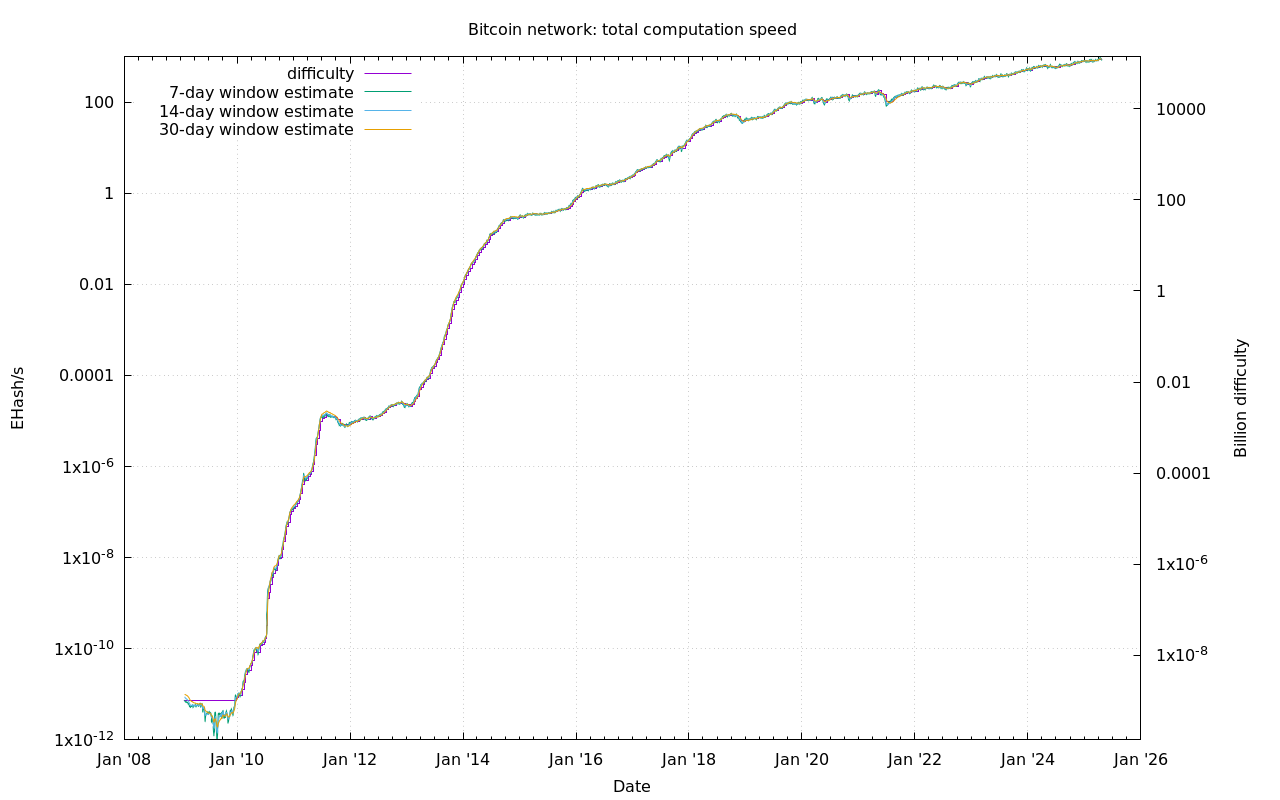
I think most people are missing the bigger picture implication here: if 1 or 2 companies can double the bitcoin network in 4 weeks, then the network is not and probably never will be safe from attacks by the likes of the NSA and such.
No. What you are missing is that there was a one-time window of opportunity for attackers due to the ASIC tech not having been deployed on the Bitcoin network 10 months ago. But now that the network is rapidly adopting ASICs, the network speed has been doubling every month for the last 10 months, so this window is quickly closing...
For example, if an attacker wanted to attack Bitcoin, they would have to get funding today, develop or acquire an ASIC design, build and develop a ~150 meggawatt datacenter, all within the next 6 months, to have a chance to attack the network.
Details: at 2.2 Phash/s today, 6 months from now we should be around 2.2 * 2^6 = ~150 Phash/s. The best ASICs, 28nm KncMiner, are approximately 100 ~Ghash/s and 100 Watt each. So the attacker would have to build 150 Phash/s of these to clearly outperform the network: that is 1.5 million chips at 150 meggawatt total. And to plan for a potential delay of 30 days, the attacker would have to build not 150 Phash/s but 300 Phash/s of ASICs to attack the network. 3 million chips. 300 meggawatt datacenter. For comparison, Facebook spent $210 million on their 28 meggawatt Prinevill datacenter. So a 300 meggawatt datacenter would probably cost $2 billion. Therefore I doubt such an attack against Bitcoin would be even within NSA's capabilities. They can't even get their Utah datacenter to run correctly and it has been delayed by more than 1 year: http://www.pcworld.com/article/2052960/nsa-data-center-suffe...
I think you're missing the implication here. Until now, an attacker could go after Bitcoin by using superior technology to compute hashes faster than everyone else. But now, these new companies are using the best technology available. There is no superior technology that would allow the NSA or any other single attacker to compete with 28nm ASICs produced in commercial volumes.
Once 28nm bitcoin ASICs are widely distributed, the bitcoin network will be safe from a 51% attack even from governments.
All I need to assert is there will never be any radically superior technology that is accessible to the NSA long before it is accessible to commercial bitcoin miners, and I think that's plausible. The NSA doesn't innovate in semiconductor fabrication, Intel and TSMC do. The only way the NSA could plausibly gain a significant hash rate advantage over commercial bitcoin miners is by breaking SHA-256, which has nothing to do with hardware.
My question would be: How will the blockchain stop attacks when all the bitcoins have been mined, but computing power continues to increase thereafter, even at a slowing rate?
Couldn't someone develop better ASICs, long after mining has ended, to launch a 51% attack? Granted it would be expensive, wouldn't that expense decrease continuously?
I suspect you're missing one critical bit: miners get the transaction fees of whatever transactions they include in the block. They're mining blocks of transactions, not coins, approximately once every 10 minutes. Coins are just blocks that the mob of users claims are valuable.
This is true even after the last "coin" has been mined. Coins are incentive to jump-start the economy when there isn't much activity, the end-game is all in mining blocks to get transaction fees, at which point it pretty much self-balances. Miners continue mining as long as it's profitable, and transaction fees maintain a level which keeps it that way (but not too profitable, or there would be more miners competing for them).
No, because the payer can decide the fee to pay, and the miner can decide the minimum he will accept. So the free market will take care of the fees for the miners.
Ahh that is kinda how "exponential growth" works.
But clearly the exponential part is recent because if you project backwards at doubling every 4 weeks you find the hash rate started at one hash every 28 days. ;-)