I find the physics of rail guns pretty fascinating. For something nominally invented in world war 1 (1918) which is now "only a few years" away from possible deployment. We are talking literally a 100 years later. We went from powered flight to flying in orbit in less time, think about that.
Is it a compelling weapons concept? Of course it is, you don't need explosives to shoot things that is pretty huge. Are wars bad? Of course they are.
That said, the concept has been around for a hundred years, so people are going to work on making a practical weapon out of it. Which means that at some point its going to be a component of a military action. And not having one of your own, will change the calculus of what you can and cannot do.
The concept is the same for any projectile weapon: I'm going to convert stored energy into kinetic energy.
Bow and arrow? Stored energy in the bow turned into kinetic energy in the arrow. Handgun/cannon/musket? Stored chemical energy in some compound, quickly converted into kinetic energy in the bullet via exploding.
A rail gun isn't much different- it's just a different means to store the energy (in electrical storage) and a different means to apply the energy to the projectile (magnets). The real problem is that these two changes require a lot of overhead in terms of gear to make it work. It's only worthwhile to do it if you intend to really, really add a lot of kinetic energy to something.
It's the same reason the electric car has taken 100 years to finally be worthwhile- chemical energy is much more dense and easy to convert into kinetic energy. Battery tech is only now catching up to the point that it's worth doing.
You put it well. The problem of of putting energy into projectiles caused a move from kenetic to chemical weapons (missiles).
But delivering chemicals to a target is expensive and at some point scaling it up becomes politically dangerous (you cannot just lauch even a conventional icbm without all sorts of risks).
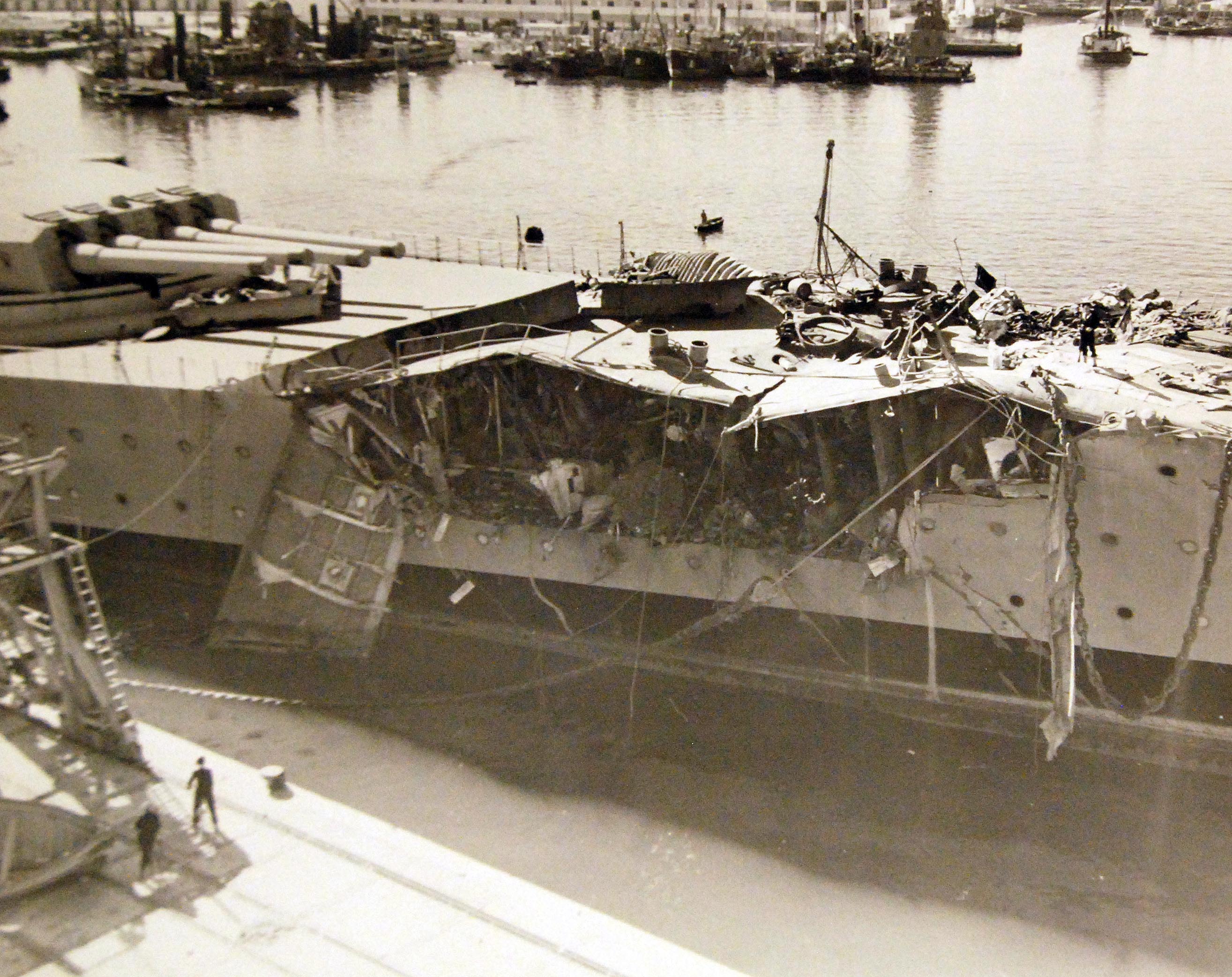
Scaling up kenetic weapons ended up with huge battleship guns that did almost as much damage to the ship itself as the target (OK, a bit of an overstatement but I doubt any of those sailors left the navy with hearing intact). They were slow to fire, extremely heavy, and required a lot of dangerous chemicals to be stored. One mistake and the ship would blow up.
This allows deep penetrating weapons containing huge amounts of energy to pierce bunkers from way over the horizon.
This is the kind of weapon the Navy will want if the Korean peninsula ever heats up to a boil.
Edit: I suspect I am being downvoted because I am discussing weapon systems. There is a difference between advocating for weapons/war and discussing them. It is better weapons are discussed in the open, than developed in secret where the public cannot weigh in. Truly horrifying things are born in the dark.
> ...huge battleship guns ... were slow to fire ...
I was curious about how fast battleships could actually fire, so I googled around and found a couple stats.
On an Iowa class battleship:
- Armed with nine 16"/50 caliber Mark 7 guns [1]
- Each 16" gun is quoted as having a firing rate of 2 rounds per minute [2]
- Each shell weighed between 1900lbs / 865kg and 2700lbs / 1225kg pounds [3]
So math says 2 rounds/minute * 9 guns is 18 shells/minute. That is 34_200 lbs (18 * 1900) and 48_200 lbs (18 * 2700) of ordinance per minute. I would not want to be on the receiving end of that!
EDIT: fixed some numbers I goofed after @CapricornNoble was kind enough to point them out. Thanks!
A few minor corrections. The 16-23 rounds/minute is for the secondary battery of 5" guns, not the primary battery of 16" guns. If you watch a video of the loading/firing process of a 16" inch gun you'll quickly see why a firing rate of 1 round per 3-5 seconds is physically impossible.
So 2/min * 9 guns * [900kg;1225kg]/gun =
16,200kg/min high explosive broadside or
22,050kg/min armor piercing broadside
Your concluding sentence is 100% correct: best to be somewhere else.
Interesting but I don't think that's sustained fire.
You see crazy him rpm for firearms. The rate of fire is restricted by the magazine size (ship guns do have magazines) and how fast the gun can cool.
The US Army changed the barrel of the M4 Carbine (automatic rifle) after some troops during a sustained defense of some hill had barrels failing after glowing white hot. Machine guns often have barrels that can be replaced during prolonged engagements.
A hot naval gun could detonate the charge if it overheats. It has happened although I don't remember how long ago.
Good point. I removed the reference to sustained fire. Still a lot of ordinance for the receiving end to dodge! The dent those guns put in the water when firing is mind boggling to me => http://i.imgur.com/5aKQulg.jpg
A fun fact is you can figure out why battleships became obsolete just by comparing Iowa's guns to more modern systems.
A 16", 2,700 pound AP shell from an Iowa class battleship contains 40.9 pound of high explosives as the payload. A 1900 pound HE shell contains 153.6 lbs. of high explosive payload. The AP shell travels at a velocity of 2,425 fps on average. The HE shell travels at a velocity of 2,615 fps on average. An Iowa class ship traditionally stored powder and shells to fire each of its 9 guns 130 times before needing to be re-supplied. The maximum range of the cannon was 24 miles.
By contrast, a Tomahawk cruise missile has a range of 1,550 miles and contains 1,000 pounds of high explosive. An Ohio-class guided missile submarine carries 152 of these on board. A single Ohio-class submarine can put more explosive payload on target than 3 Iowa class battleships firing their entire magazines dry (assuming AP shells), it can unleash its entire devastating salvo in about 2.5 minutes (as contrasted against an hour+ for a battleship), and it can do it from over 64 times the range as the battleship's cannons. Oh also the missiles are guided, and so can actually hit targets at extreme ranges where-as battleship were notoriously inaccurate outside 20 miles. At the Battle of Calabria the battleships on both sides fired a combined total of 335 large caliber shells, to one hit!
Of course the one advantage of the battleship is its shells are travelling on average ~3 times faster than the cruise missile is, and so it's far easier to shoot down a missile than it is a shell. But I hope with the above math you understand why naval planner's response to this was basically "Well if you can shoot down one of my missiles with 50% probability, we'll just fire off 5 at once and we'll still have >95% chance of landing a hit". And unlike with battleship shells, when a single missile hits you you're dead as a dodo - 1000 pounds of HE vs. 40 or 153 pounds for battleship shells.
Even if submarines and airplanes had never been invented, the big gun battleship still would've been rendered obsolete just from missiles alone. Even railguns aren't likely to change this, as we happen to have perfected hypersonic missiles at roughly the same time railguns became practical and HSMs are...I mean basically take all the advantages of a gun, and all the advantages of a missile, and put them into one thing. Hypersonic missiles are amazing/terrifying, and they will be the 'defining weapons' of 21st century naval war.
Also as an aside, can we talk about how damn cool the Ohio class SSGN is?! It's by far the coolest thing the navy currently owns IMO. It can hide in the ocean depths impervious to harm, pop to the surface and fire off 152000 pounds of high explosives, and then retreat to the safety of the ocean darkness again before its enemy even knows what happened. I own a model of it I keep on my desk and it's one of my favorite possessions.
Note: On Los Angeles class submarines the vertical launch tubes can be fired with ~1 second delay per round. So assuming the navy's technology on the Ohio's is still held to the same standard, that's 152 seconds to fire all 152 missiles or 2.5 minutes to fire the whole stock.
>And unlike with battleship shells, when a single missile hits you you're dead as a dodo - 1000 pounds of HE vs. 40 or 153 pounds for battleship shells.
I'm curious if this would be true for a heavily armored target like a battleship, though. AFAIK no modern missile is designed to penetrate ~12 inches of hardened steel armor, as no targets have that kind of armor any more.
On 10 November 1942 the Vichy French Battleship opened fire on Allied landing vessels in Casablanca after being re-floated following her sinking on 8 November. TBF Avengers were dispatched to deal with her, but they lacked AP bombs and were relying on 1000lb general purpose bombs instead. Jean Bart was struck by one such bomb on her starboard side toward the rear:
The rearward hit would go on to sink the battleship, this time permanently.
On 22 May 1941 the HMS Warspite was struck by a 500 lb from German bombers, and had her side ripped open and had to immediately steam home least she possibly tear her own guts out. It would take 4 months of repairs before she was ready to be sent back into the fight.
In both instances we're looking at about 1/10th the payload of explosives of a Tomahawk crippling or sinking a well-armored battleship with 1 or 2 lucky hits. The reason is because WW2 battleships employed "all or nothing" armor, where some parts of the ship were extremely well protected (turret, belt) and others had extremely thin armor - which meant even a non-AP bomb could sink a battleship if it was simply big enough boom to rip the ship open in these non-armored areas.
A Tomahawk is guided and carries a very big warhead, so assuming it was programmed to know where the armor on the ship it was fighting had a weak point I wouldn't be surprised if it was able to cripple or kill an Iowa class vessel in just one hit.
Also we do actually have plenty of modern missiles able to penetrate 12 inches of hardened steel armor. The AGM-65 Maverick has penetration against rolled homogeneous steel armor of between 1000 to 1500 mm, or between 40 inches and 60 inches of penetration. It's designed to kill tanks that are using modern composite armor, and needs that level of penetration to do its job. Against simple steel armor, of the kind on a WW2 battleship, it would slice through it like a knife through butter.
Right, but those bombs may have been designed with armor piercing in mind. Battleships' main batteries fired both AP and HE shells, the latter being unable to penetrate heavily armored targets.
I take your point re the Maverick. But you do need to make a big hole in a battleship to actually sink it. To kill a tank you just need to make a small hole and spray the insides.
A 16" AP shell weighs about as much as a Tomahawk and is traveling much faster. Sure, it has a smaller charge, but also a lot more kinetic energy. In fact, the charge itself was irrelevant to the shell's armor piercing capacity, as AP shells were fused to explode after the armor was penetrated.
Point of order in the definitions here: an explosive projectile is still a kinetic weapon and is notNOT a chemical weapon. A chemical weapon causes chemistry to happen in/on the target: mustard gas, VX nerve gas, etc.
This is not my opinion. This is widely accepted and a matter of many international treaties.
I fully understand what OP was trying to say. The problem is words. You can think whatever you want. If you want to deal with other people in a shared reality and influence the arc of history, I suggest learning to identify, adopt, and use rigorously defined words as intended, wherever possible, because that frees up your very limited intellectual capabilities to focus on the things you actually want to change.
Electric weapons are super neat. Their specs can put the projectile very kenetic, they can uitilize more exotic energy sources, etc.
However, in terms of a man portable gun, they just really don't have the specs needed. Sure, we can make them more ruggeded and more effective at lower KE output. But a major issue for a man portable gun is heat. Heat causes expansions and affects ductility, ductility and expansion cause jams. Jams mean you're dead.
It turns out that the brass cartridge is really really good at getting hot and then taking that heat with it as it is ejected. The HK-G11 is a good example of the issues that the lack of heat ejection can cause [0].
As we do not have super-conducting materials that can be man portable and at room temperature, there is significant heat build up in the copper rails of the rail gun. With catridges you can throw that heat away easily, with rails, you have to have a cooling system in them to continue to use the gun. Either that or you have to stop the warfighter from using the gun until it cools. This, especially when lives are on the line, is non ideal.
Hence, railguns are mostly used in much larger applications like ships. There you can have the cooling equipment to keep the gun functional and operating and you can use the ocean as a heat sink. Your heat issues are still present though. More exotic materials than cooper are used for the rails, things that need to be at LN2 temperatures. But on a ship, you have the room and weight to carry the LN2 cooling equipment. Currently, railgun tech is still being developed. Reliability is a big issue, one that was solved in chemically launched projectiles through decades of tial and error. Rail guns are likewise going to need those decades of learning to occur.
The weapons we have today are very well engineered (cheap, reliable, understood tolerances/ranges, etc). As such, where railgun tech will be used is in limited cases as compared to the well developed cheamically launched projectiles. That means that there are less cases where the railgun can be used and then learned from. Especially with weapons, you need real life testing in order to understand the engineering issues, as lab testing is generally forbidden due to loss of human life. Hunting deer and boars will only give you so much. Fortunately, we humans don't go to War too often these days (though this is very debatable to a lot of real people). Unfortunately for railgun engineers, that means there is not a lot of real world testing in the panic that is a battle.
Like, fire one of these railguns that are ship-based in rough seas at a hostile target that is shooting at you too. There's smoke, flak, little wires, mist, spray, etc in the air that can gum up the gun and jam. Does firing one of these things in a storm have interactions with lightining effects? How does that big of an EM field affect sailors over time, like the concussive blasts affected sailors previously?
But that's already something that a person can think of. It's the stuff you cannot think of that are the main issues. When the panic sets in and the battlefield is very live, what happens that will affect the armaments that you did not think of?
I don't disagree, at 100,000 feet all weapons are mass gets propelled by force, where I part ways with you is here:
"A rail gun isn't much different"
While I completely agree that in concept rail gun isn't different, making one is extremely different. That is why I would have little trouble making a bow and arrow over the weekend that would serve as a respectable weapon[1], but I would not be able to create a similarly lethal rail gun[2]. Reducing the theory to practice is neither straight forward nor obvious. People have been trying to build them for 100 years after all and we're only now seeing some that come close to being competitive with other weapon systems.
What I'm saying is that your "overhead in terms of gear to make it work" covers for a whole crapload of technology and engineering.
What I hear when you dismiss this technology is a lack of appreciation for what is involved, it sounds to me like someone saying "Making an atom bomb is pretty simple right, simply hold a super-critical mass of fissile material really tightly until you've achieved the desired number of fission events. Right?" But you can't pick up two 4 lb pieces of plutonium and bang them together like a couple of rocks and expect to get a bomb event (although you will die). There is nothing "simple" about it, even if the concept is easy to express.
[1] In part because we learned how to make bows in Boy Scouts and I spent a summer doing a survival course where I had the opportunity to build one for my final.
[2] Even though I'm a classically trained EE, understand the theory, have experience in switching fairly high currents from my Battlebot experiences and a fairly complete EE lab at my disposal.
Oh, we're definitely in agreement- conceptually the same, implementation details of a few orders of magnitude different.
Mostly I was replying to the idea that "hey, we've known how to do this for 100 years". Sure we have- conceptually. We knew that batteries/electricity + magnets could implement the same pattern as "chemicals exploding". But we sure as heck didn't know how to make it practical.
That's why it's 100 years later and very few of us have either electric cars or rail guns.
It’s not just about more kinetic energy, a larger shell gets you that. Higher speed projectiles means longer distances which saves missiles which are extremely expensive and you only carry so many of them.
Rail guns can be powered by IC engines saving you carrying oxidizer around which is really heavy and dangerous. Many ships where destroyed when their gunpowder magazines detonated, sometimes outside of battle.
Rail guns can also be powered by Nuclear which is extremely compelling of your ship is already going to have a Nuclear Reactor.
> It's the same reason the electric car has taken 100 years to finally be worthwhile- chemical energy is much more dense and easy to convert into kinetic energy.
no kidding, and that's understating it. Look at the kilojoules (or watt-hours) per kilogram in one litre of diesel versus one kilogram of lithium ion batteries, or one volumetric litre of li ion batteries. It's significantly greater.
It's not like the technology behind railguns hasn't been stable and ready to use for decades now. It's just that, until the more recent invention of ancillary technologies like supercapacitors, it's been so costly to fire them that there was no logical place for them on the battlefield, so we never bothered to operationalize them.
I can't agree with this: "It's not like the technology behind railguns hasn't been stable and ready to use for decades now.", at least not in terms of practicality. I did a bit more research on flight and found a similar comment from Wilbur Wright[1] about George Cayley.
It is very different to be able to demonstrate a principle in physics (such as flight, or accelerating a piece of metal with electricity) and building a practical application of that principle. In many ways the time it takes between those two points is likely a good indicator of just how difficult it is to reduce the principle to practice.
You yourself mention super capacitors, another comment mentions the rails, then there are the switching devices themselves, the wiring harnesses, the control system. That is why I'm pretty awestruck at the fact that they were able to make it work and get this close to being something they can field test.
[1] "About 100 years ago, an Englishman, Sir George Cayley[2], carried the science of flight to a point which it had never reached before and which it scarcely reached again during the last century." -— Wilbur Wright, 1909 --- http://www.ctie.monash.edu.au/hargrave/cayley.html
I'd be interested to know why we haven't seen intermediaries that don't need the advanced tech of a rail gun, like why haven't we seen magnetically driven mortars or artillery? These seem less demanding, is it just a case of existing tech being good enough?
The energy density of batteries is relatively low compared to the liquid hydrocarbons and other chemical accelerants. It goes from being a mortar you can throw in the back of a Jeep, to a mortar you can throw in the back of a Jeep plus a semi truck full of battery capacity.
On ships and airplanes, you can replace internal weapons bays which have substantial storage capacity. And the batteries (this is particularly an issue for airplanes) aren't terribly mass-dense either. And you can use the vessel's turbine-powered electric generators to recharge the batteries from fuel (this reduces the range, but hey, tankers).
To me, it's not entirely clear why we're bothering. Do we actually envision shore bombardment as a useful combat modality going forward? IIRC the types of ships that can mount this weapon are the same types that are currently vulnerable to hypersonic anti-ship missiles. All our potential equiv-tech adversaries have those, to my understanding. So wouldn't the railgun only be useful against lower tech opponents? And against such opponents, does it fill a substantial gap where we don't already have sufficient other tools?
A large part of the reason that guns fell out of use on warships was that they were outranged by everything - guns that can shoot up to 40km (like those on the Iowa class) aren't enormously useful against destroyers tossing missiles from 200km or strike aircraft from a carrier 400km away. Guns that can shoot down planes and incoming missiles at 100km, though? That's pretty damn useful, even if it doesn't close the distance entirely vs missiles. As for why guns at all - well, guns tend to have magazine depths undreamt of by missiles, and railguns will likely follow that pattern. If moving to railguns for AA defence means you can shoot down 3 or 4 times as many incoming missiles for the same weight, that would be enormous.
And in the fog of war... Who's to say that a DD won't be able to close to railgun range of an enemy warship? Life's a lot easier when you can stay below the horizon, after all!
There are no hypersonic antiship cruise missiles deployed today. Some ballistic missiles have limited antiship capability and they do travel at hypersonic speeds but there are reasonably effective defenses against them now.
The railguns can be used to shoot down missiles. Interception is a matter of speed. If railguns are faster they win and we are back to fighting with bullets.
I've been wondering when EMALS catapults get converted to ultracapacitors. The current energy storage system on the Ford class carriers is a motor/generator/flywheel setup, and it's a reliability headache. The catapult itself is just a linear induction motor.
Reminds me of the electric car tech, in a way. I remember reading somewhere on HN that when the cars were initially gaining traction, electric engines were an option already, even with some prototypes. The issue was that the battery tech wasn't quite there to make it efficient and have any mileage compared to gas powered cars. So we went the gas route. And only within the past 5 years, we got a sign of electric cars coming back as a real alternative to gas cars.
Yes, similar and it was more than batteries, it was also magnets and car materials Etc. Batteries are an important part of that (and still the weak link given relatively long charge times) but it would be a disservice to a Model 3 to say that if you had LiIon batteries in the 70's you could have built one then.
I think the interesting use case would be to put things into space for a lot less money. Imagine putting one or many of those new Space X internet satellites into a rail gun that goes straight up.
It doesn't need to go all the way into space, it just needs to get pretty high, then the cost to break into orbit can require a lot less fuel and make it a lot more cost effective to do space stuff.
This has been discussed before but to summarize, it doesn't work that way.
I realize you didn't say "into orbit" but it is a reasonable place to start. The disadvantage of 'gun' type launch systems are that they only get one shot at putting energy into the system and they have to do that at low altitude where the air is thickest (the biggest impediment to going fast) as a result your space craft leaves the gun and goes into the soup of the atmosphere and burns up[1]. This is a problem with the rail gun as well as hypersonic projectiles that have active payloads have to deal with friction heating and remain functional at the point where they arrive. The secondary problem is the g-force as a function of the acceleration of going from full stop to 7.9 kM/s in say 10 milliseconds. Your basic physics will tell you that is an acceleration of
80 thousand 'Gs'. If you are launching a payload you need a container that can not crush its contents. Of course all that air resistance will bleed off energy/speed so you actually have to start much faster than 7.9 km/s, as much as 10 - 12 km/s to "coast" into orbit. Now you're over 100,000 Gs to start.
[1] This is not unlike shooting a bullet into water (other than water has higher viscosity and the bullet has a lower velocity) but the effect is the same.
Is there a reason you couldn't make the railgun bigger? For example, build it up the side of a high mountain. Then you can spread the acceleration across multiple kilometers and by the time you reach the top the air is thinner.
> Imagine putting one or many of those new Space X internet satellites into a rail gun that goes straight up.
Orbit doesn't work like that. Getting 200, 300 miles up is the easy part - the vast majority of the required energy comes from going sideways at 7800m/s.
I think they were suggesting that you could save fuel for once you're out of atmosphere, so that you're not fighting air resistance when you start a burn to get into orbit.
You could save a decent chunk of your fuel this way. Maybe 25% or so.
In exchange for that, you have to build your rocket and satellite to withstand 10,000 gees of acceleration and hypersonic flight through the lower atmosphere. And somehow build a rail gun that can fire something the size of an office building.
You'd have to re-purpose something like a deep mining shaft from a diamond mine, then stick a giant rail gun in it, almost like Germany's V-3 cannon[1] but on steroids.
No we aren't aiming straight up because we need to get into orbit. We need to go sideways as fast as possible. As long as you're not aiming at the ground you will always aim "up" but not straight up.
Maybe I should rephrase and emphasize that I think this is interesting not necessarily immediately practical. From what I understand about rail guns, they're not even practical yet to deploy for military ground to ground purposes, let alone to get things into space.
I think I'm taking a lot of liberties to imagine a future where we figure out a ton of challenges to get all the engineering to match the theory of making this happen. And in general, I believe we should take an optimistic approach to the future, given that getting humans into space in scale would be a marvelous accomplishment for the human race.
Do you mean in order to use this as an ASAT or ABM system? In that case, probably - though you'd still need some sort of terminal guidance to actually achieve a hit.
If you mean "account for the sideways movement" as "give the satellite the horizontal component of the required orbital velocity" this doesn't work for a variety of reasons - #1 is that the railgun is 2000m/s and orbit is 7800m/s, and #2 is that things going 7800m/s (17450mph) at or near sea level tend to get very, very hot very, very quickly which is not particularly great for railgun projectiles and utterly disastrous for things like solar panels.
Two problems with that: going up is only 3% of the energy that is required. The other 97% is "going fast enough sideways to stay up". The other problem, even if you angle your shot, is that you need to raise the perigee so that your orbit doesn't intersect the launch site anymore. These two things combined mean that you would have to railgun a rocket that is still about half the size of a rocket that takes of normally. And liquid filled rocket would NOT like or withstand a rail gun launch. But you have should bought yourself TWO major technological problems: rocketry and rail guns. That is not economical at all. Much easier to make the rocket a bit larger (you need to develop a rocket anyway) and get rid of the complexity introduced by the rail gun.
Ronald Reagan was way ahead of you (and everyone else). Back in 1987, the Strategic Defense Initiative (SDI, also known as "Star Wars") featured this concept.
The press excoriated him (hence the derogatory name "Star Wars" being affixed to the program).
The part you mention was called "Brilliant Pebbles", and featured space-based weapons as a cornerstone of the initiative. [0][1]



Is it a compelling weapons concept? Of course it is, you don't need explosives to shoot things that is pretty huge. Are wars bad? Of course they are.
That said, the concept has been around for a hundred years, so people are going to work on making a practical weapon out of it. Which means that at some point its going to be a component of a military action. And not having one of your own, will change the calculus of what you can and cannot do.