Actually, Germany did not have a long term increase in coal/gas due to the nuclear shut down but a decrease. Coal has been in a slow but steady decline in Germany (mainly due to cost); which is on track to decline all the way to 0 as Germany is committing to getting rid of coal based production completely by 2035 or so. Gas production did grow but mainly to offset declines in coal. And even there you might argue Recent events in the Ukraine are cutting off cheap Russian supply of both coal and gas, so that looks like it might actually accelerate decarbonization and short term raise the ambition levels even more.
The thing that grew absolutely massively in the same period was wind and solar. Vastly more capacity of the latter was added than ever existed in nuclear form. It now dwarfs everything else in the German market. All without blackouts BTW.
> Recent events in the Ukraine are cutting off cheap Russian supply of both coal and gas
This is not the impression I have gotten from recent events.
The reason Germany hasn’t experienced blackouts is because they are funding the Russian Federation’s war in Ukraine in exchange for energy. Germany has advocated for the continued purchase of Russian gas and has pushed back against the EU admitting Ukraine to the union. It’s obvious that the decarbonization had not succeeded in solving their need for base load power, in fact you could argue that their denuclearization is the very reason Russia has so much leverage in the situation. So while they may be saving the planet, this is a great example of a government missing the forest for the trees.
You're confusing German gas consumption and German electricity consumption. It couldn't escape my attention that many people especially from the US make this fatal mistake (presumably because of the prevalence of natural gas electricity generation in the US - almost 40% in the US, compared to ~15% in Germany). In Germany, the vast majority of gas is being used for heating or for industrial purposes (chemistry etc.). This is not (yet) substitutable by other electricity sources.
Even if the denuclearization hadn't taken place, they'd still be dependent on Russian gas for at least a significant part of their gas supply. They can always substitute basically any gas shortfalls in the electricity sector simply by increasing coal generation, since there's a lot of unused capacity now that renewables leaped massively, and even replacing all the gas currently being used for electricity generation (because there's so little of it!) with coal would not even reach the levels of coal generation that Germany had as recently as just five years ago, so the coal plants can simply somewhat increase their output for a while. What Germans currently don't have is any way to not freeze to death and keep the industry running without Russian gas.
The other aspect of the Ukraine war used for advocating for nuclear, which the nuclear proponents like to omit is that 25% of European uranium comes from Russia, so Europe's dependence on Russia is even stronger for Uranium than for gas. It's simply dishonest to use the current situation as an argument for nuclear. If anything it shows that we should have invested into renewables much more strongly, but nuclear proponents were strongly arguing against it because it would have made nuclear even less financially viable.
I would say that comparing the purchase of gas to the purchase of uranium is uninformed, if not dishonest, for two reasons:
- Fuel costs for nuclear is only 15-20% of the total cost, half of which is the uranium itself [1]. For natural gas, the majority of the cost is the fuel, even during "normal" times. In other words, natural gas imports generate a lot more $ per GWh of energy produced, even if imported from the same country (Russia).
- The reserves of Uranium across the globa are still huge, much of which can be found in (relatively) politically stable places such as Australia and Canada. For natural gas, one is locked into imports from countries such as Russia, Saudi-Arabia (and similar Arab monarchies), Venezuela and Russia for the forseeable future.
I'm not suggesting that investment in renewables should be slowed down, only that coal and gass should be removed BEFORE nuclear. If Germany is able to produce the energy they need from renewables only, and to provide a stable supply, all the power to them.
But to bring up renewables in a discussion about nuclear vs natural gas, is just a diversion tactic (or at best a dilusion).
Oh, btw, I'm Norwegian. My country is making a $100 billion profit from the current energy situation in Europe, just this year, meaning that my household of 4 indirectly profits about $80000 from this in 2022 alone. So I'm not arguing from personal interest....
> I would say that comparing the purchase of gas to the purchase of uranium is uninformed, if not dishonest, for two reasons: - Fuel costs for nuclear is only 15-20% of the total cost, half of which is the uranium itself [1]. For natural gas, the majority of the cost is the fuel, even during "normal" times
What seems "uninformed, if not dishonest" to me is the argument that fuel price matters here. Imagine this: Your country needs seven doohickeys per year to run. What exactly those doohickeys are is unimportant; the only important thing is that you need then. Russia can provide you with four doohickeys per year. The rest of the world can provide you with only five doohickeys per year, and for many years they won't be able to provide any more than that. So you need at least two doohickeys per year from Russia, no matter what, otherwise your country stops running. So Russia can stop your country from running at any moment. Did you notice how price never entered this discussion?
> The reserves of Uranium across the globa are still huge, much of which can be found in (relatively) politically stable places such as Australia and Canada.
Reserves of uranium matter here much less than enrichment and fuel assembly production capacity. Russia has over 40% of enriched fuel production capacity (as per https://www.world-nuclear.org/information-library/nuclear-fu...). Until you build new plants for this, it doesn't matter that you can get natural uranium from Australia or Canada. You won't be able to do anything useful with it (unless your reactor is CANDU).
For Germany's risk, the the price doesn't make a big differencem, should Russia decide to cut off the supply.
As long as the supply is NOT cut off, it matters quite a lot what Germany is paying for it. If the choice (for a set period of energy supply) is to pay either 100 billion euros for natural gas, or 20 billion euroes for uranium, the difference is 80 billion euroes less that Russia could spend to keep their war machine running. That's as much as their peacetime yearly military budget.
As for Russia's enrichment capacity, that is something any advanced country could set up, just as several countries have deposites they could start mining. Ones mining and enrichment has started, it could be kept running for as long as needed.
For natural gas, on the other hand, there are fewer good sources. By far the cheapest source is from wherever it can be transported in pipes. Other countries can convert their gas to LNG for transport to Germany, but that also requires expansion of LNG facilities in both ends, and perhaps construction of more LNG ships.
I don't know which take longer, between LNG from other sources or uranium from other sources.
And even when the transfer has been made, natural gas is a more limited resource than uranium, so even if it is purchased from, say, Saudi Arabia, the global supply and demand situation isn't changed much, so Russia will still be able to find buyers for their gas. (For instance, Germany may start to buy up gas that would otherwise be exported to China. If so, China can just buy from Russia.)
This doesn't even start to go into having dependencies on fundamentalist islamic monarchies in the middle east. I would think it would be preferrable for Germany to import their energy from Canada and Australia, countries they that share most of Germany's values.
Finally, with nuclear there is always the option of setting up strategic fuel reserves. This would be analogous to strategic oil reserves, except with massively lower storage costs. Nuclear fuel is stable for 100s of years, and so dense that reserves able to last a few years could probably be fit in a single warehouse (or several small ones):
> If the choice (for a set period of energy supply) is to pay either 100 billion euros for natural gas, or 20 billion euroes for uranium
Except that's NOT the choice that Germany is faced with. In the short term, the cheapest way for Germany to cover for any decrease in nuclear generation is to increase her lignite mining, not to buy more gas, which has grown even more expensive. And also notice that this decreases the money Russia would get from 100 billion in your hypothetical example not to 20 billion but rather to 0 billion, all while being even cheaper for Germany.
> As for Russia's enrichment capacity, that is something any advanced country could set up
It would take many years to replace the 46% [1] Russian share of the global enrichment capacity. Maybe more than a few years -- a decade perhaps. After all, this is all highly controlled, specialized equipment. You can't just go and buy it in a supermarket.
> I don't know which take longer, between LNG from other sources or uranium from other sources.
It would absolutely take longer for the world to replace Russian uranium fuel production. They've built is up as a Cold War Project-Manhattan-level strategic project over more than a decade.
> Finally, with nuclear there is always the option of setting up strategic fuel reserves.
As I already responded to someone else, you can't set up a fuel reserve if your expected value of fuel consumption is higher than your expected value of of fuel production (or, acquisition in this case, really).
> It would absolutely take longer for the world to replace Russian uranium fuel production. They've built is up as a Cold War Project-Manhattan-level strategic project over more than a decade.
As I said, I don't know. (EDIT, meaning that I don't know, not that I dispute your claim. It would be nice to have actual numbers.) It does also take years to set up transportation capacity for LNG, including the tankers, terminals and other infrastructure.
Anyway, had the west realized this exposure for real in 2014, I would have expected that at least some increased capacity would be available outside of Russia already, with an increase in capacity every month as we go forward. And had the output of that capacity been put into strategic reserves, one would have some level of reserve while building up more capacity.
What it looks like from your link, is that there was an initative started last year to reduce dependancy on Russian fuel. I suppose time will tell how long it takes to reach reasonable production volumes.
And one thing is obvious. Storing and transporting nuclear fuel is orders of magnutudes cheaper than storing and transporting natural gas.
3 reasons, I suspect - if someone wants an enormous stockpile of uranium fuel they can probably do that. The volumes check out - uranium is very dense and so will not take up much space. I'm not sure if it has a shelf life, but being a rock I expect something can be sorted out.
I can't pretend to know how feasible it is in practice, but long term strategic uranium stockpiles should be doable. Long enough to weather any reasonable war. Much, much more doable than trying to store a decade of nat gas.
I hope you noticed the news about Gazprom possibly intentionally keeping gas reserves in Germany low for months before the Russian invasion in preparation of said invasion. You can't make a strategic stockpile if your potential enemy is your supplier and preventively doesn't allow you make those stockpiles in the first place so that you didn't have this way out.
You're misjudging the differences between uranium and gas. Transporting and building a uranium reserve would be relatively easy; maintaining a 10 year stockpile and importing from Canada, Australia or Kazakhstan via a circuitous route are all feasible.
This doesn't work with natural gas because they needed a lot of it and moving it around is capital intensive. The situations are completely different. The energy densities here are wildly dissimilar, and that matters a lot for the economic of building a stockpile.
> You're misjudging the differences between uranium and gas.
So do you.
> Transporting and building a uranium reserve would be relatively easy; maintaining a 10 year stockpile and importing from Canada, Australia or Kazakhstan via a circuitous route are all feasible.
See, that's the problem. One of the differences between natural gas and uranium is that (outside of CANDU reactors) you can't use the uranium "as is". To use uranium for pretty much anything useful, you need certain high-tech facilities. By production capacity, almost half of those facilities (according to [1], it's 46 percent) is in Russia.
The way things are, you can't build a stockpile if the expected value of uranium fuel production outside of Russia is lower than the expected value of uranium fuel consumption outside of Russia, which I believe is currently the case. As long as this remains to be a case, any stockpile will dwindle, not grow.
You could turn that on its head. Had Germany created uranium stockpiles in 2014, enough to last, say, 5 years, they would not be vulnerable to this tactic in the first place.
Considering that you can't use raw uranium but need fuel assemblies, you'd need a replacement manufacturer of fuel assemblies, not just a uranium stockpile. But of course Germany was scheduled to shut down its nuclear power plants in 2022-ish anyway so a stockpile would have been largely meaningless.
Pretty sure you can have your stockpiles pre-assebled, or close enough that the final step is trivial.
Anyway, my argument i built on the premise that Germany should never have shut down their nuclear power plants (except when they truely are "spent") and instead built a large number of new ones.
If their nuclear capacity was about the same as the French, it would make a lot of sense to have a strategic stockpile of ready-to-use fuel, both in case supply is restricted for political reasons and because it would serve as a hedge against price fluctuations.
Or, they could just shut down their nuclear plants and the problem with nuclear fuel stockpile goes away as well. And in fact, this is vastly easier to accomplish, and exactly the thing they're already doing.
If you scroll up the thread a bit, the context was that someone claimed that Germany would be less dependent on Germany if they had kept more of their nuclear power plants. That is something they might have figured out in 2014.
Going as heavy on natural gas as they have over the last generation, more or less ensures that they are in Russia's pocket. Shutting down nuclear plants does not make that better. In fact, I argue, it makes it worse.
Your refutation of the possibility of to use Nuclear power to gain independence of Russian energy seems to depend on German inability to achieve indepencende of Russian fuel by setting up a stockpile(1).
Which in turn is justified by claiming that the stockpile would not be needed, since they would shut down their nuclear plants(2).
Which is justified by (1), which is justified by (2) and so on.
My argument is that, had Germany decided in 2014 to increase, rather than decrease their use of nuclear power, with the aim to reduce dependence on Russia, it could be done. But given that, they would have to start looking for (possibly in cooperation with their allies) other sources of fuel to really become independent, in other words, set up agreements to buy fuel from countries like Australia and Canada, on top of whatever fuel was being bought from Russia before 2022.
Basically, my argument requires BOTH of these steps to be taken:
- Decide to keep or increase energy production from nuclear
- Decide to work towards independence of Russia by funding alternative sources + by putting any extra fuel they purchase into a strategic stockpile.
(Edit: formatting.)
These are clearly decisions that were available to Germany (as a country, provided the public had been primed to support them). I don't find the spot in your argument that refutes any of them, without already assuming that the other is impossible.
Also, I don't find where in your argument, in what way these decisions, if taken together, would NOT ensure that Germany would have more energy production capacity in 2022 than they have now.
> Your refutation of the possibility of to use Nuclear power to gain independence of Russian energy seems to depend on German inability to achieve indepencende of Russian fuel by setting up a stockpile(1).
No, my refutation hinged on 1) the fact that German nuclear power is NOT a substitute for the vast majority of German uses of natural gas (chemical and other industry, residential heaters -- neither of which is near-term replaceable with nuclear power without massive investments in electrolysis), and 2) the fact that German nuclear power has the cheapest substitute in form of unused capacity of coal plants (which recently massively dropped in their capacity factor) and accelerated expansion of renewable generation. There is no circularity in this that I see. 1) means that keeping or expanding the nuclear fleet does not decrease dependency on Russian gas, and 2) means that ditching it does not increase dependency on anything else coming from Russia.
So ditching the German nuclear fleet has no downside in terms of reducing dependency on Russia. In fact ditching the German nuclear fleet might somewhat reduce the dependency on Russia on part of the remaining global users of nuclear power, owing to the reduction of uranium fuel consumption in light of the fact that Russia possesses 46% of world's uranium enrichment capacity -- any enriched uranium on the global market that Germany would have to use in their reactors could be used by someone else at that poitnt, with less money paid for enriched uranium flowing into Russia.
> My argument is that, had Germany decided in 2014 to increase, rather than decrease their use of nuclear power, with the aim to reduce dependence on Russia, it could be done.
They could have certainly acted in that direction with such an aim, but since such actions would not have lead to achieving this aim (see above), it would have been a completely irrational course of action.
Only a tiny sliver is for non-energy, and that part could easily be purchased from other countries.
In Norway, a large percentage of heating used to come from oil, but in 2020 any fossil fuel for residential heating was banned. As long as the power is cheap, electric heating is affordable. And if the electricity is slightly less cheap, heating is still affordable if one installs a heat pump (even a cheap air-to-air pump helps a lot).
And even if you were correct in your claim that a large part of the natural gas could not be replaced by nuclear (which is just lack of imagination), your argument would be flawed.
From the link I sent, only 2% of the consumption is non-energy use, but even if that were 50%, reducing dependency by 50% is still a big deal.
> The vast majority of German natural gas use, is for the energy.
You are aware that heating is energy? Residential burners, industrial burners, etc. So this does in no way contradict what I said. Still, none of this gas consumption is directly substitutable by electricity without massive infrastructure changes, not even by nuclear electricity.
> As long as the power is cheap
In Germany, it's not, so there's that.
> And if the electricity is slightly less cheap, heating is still affordable if one installs a heat pump (even a cheap air-to-air pump helps a lot).
That's a part of the massive infrastructure changes that I'm talking about. I've already mentioned elsewhere the 2010 and 2012 EU directives that will make this happen on a timescale of decades as the building stock is progressively replaced, but you can't do this on a timescale of years.
> And even if you were correct in your claim that a large part of the natural gas could not be replaced by nuclear (which is just lack of imagination), your argument would be flawed.
It's not "a lack of imagination". I've never said these uses can't be replaced -- in fact we know exactly how these uses will be replaced (natural gas in chemistry with electrolytic hydrogen, natural gas in heating with passive houses, etc.), so no need to invoke "imagination". The problem at hand is that you can't do this transition on a timescale of a war (...and in the middle of a pandemic, and during a recession, and with a famine coming). This will not be done in months, or even years. Think two decades instead. So this will help us deal with the climate issues, but won't help with the war.
> From the link I sent, only 2% of the consumption is non-energy use, but even if that were 50%, reducing dependency by 50% is still a big deal.
It would, except this has nothing to do with keeping or ditching nuclear plants. This reduction would have to come from the fields where natural gas is being used and neither keeping not ditching nuclear plants would affect the success of such gas-saving measures.
Yes. My house, that was heated by oil 2 years ago, is heated by electricity today.
> In Germany, it's not, so there's that.
Because Germany has underinvested in electricity plants that cannot be shut down by Putin.
> It would, except this has nothing to do with keeping or ditching nuclear plants.
If Germany had kept their nuclear plants electricity plants (and ideally built a number of new ones) electricity in Europe would be cheaper. Thats just supply and demand.
> The problem at hand is that you can't do this transition on a timescale of a war
I agree you cannot transition in 2 months. I talked about starting in 2014. Shutting down the plants this year is only the culiminatino of a chain of bad decisions about energy.
But I suppose in 2014, the psychological damage was already done. It appears like Germany had already decided to get rid of Nuclear after 2011 / Fukushima. This seems to be driven by fear, more than anything.
Which I suppose is the real problem. This never was about making ration decisions about energy security, being dependent on Russia, etc. All along, this was about fear of "nuclear". The rest just looks like rationalization.
Meanwhile, energy prices have gone up all over Europe, since Germany is only the biggest country to have underinvested in electricity production. Even countries that produce an excess of electricity, like Norway, have the same prices. And believe me, ACER is getting really unpopular here, I would not be surprised if Norway is out of ACER by winter.
> Yes. My house, that was heated by oil 2 years ago, is heated by electricity today
Good, so you see how the argument that only 2% of natural gas in Germany are not used for energy applications is irrelevant for the issue of replacing residential and industrial heat sources. These are major energy applications alright -- ones that can't be readily switched to electricity without major infrastructure transitions -- which are already taking place but can't be sped up 100x on a whim.
> Because Germany has underinvested in electricity plants that cannot be shut down by Putin.
No, actually it's largely because Germany overinvested in electricity plants that cannot be shut down by Putin. Their renewable investments, just like the renewable investments in the neighboring Czech Republic, led -- rather than trailed -- the recent decreases of prices of renewable generation equipment around 2010. As a result of this, Germany has to spend much more money than they would have had to, had they waited just a few years. This made their electricity around six Euro cents per kWh more expensive. (Investments do have to be repaid, after all.)
> I agree you cannot transition in 2 months. I talked about starting in 2014.
Germany started with the transition seriously around 2005. It still takes time, and also isn't a thing that happens at a constant rate because the industrial landscape is evolving. As things such as PV panels, wind turbines, or heat pumps get more affordable, their rate of installation increases.
> If Germany had kept their nuclear plants electricity plants (and ideally built a number of new ones) electricity in Europe would be cheaper.
Debatable, judging from the recent events in the European nuclear industry (Hinkley Point-C, Olkiluoto-3, etc.). The mandated feed-in tariff for HP-C electricity is now more than double than what a wind power plant would deliver. It's inflation-adjusted, so for example around now the electricity straight from the HP-C plant should be worth around 14 Euro cents per kWh, whereas for example new German PV auctions take place at under 5 Euro cents per kWh. And European wind power as well has similar price levels to the latter nowadays.
> But I suppose in 2014, the psychological damage was already done. It appears like Germany had already decided to get rid of Nuclear after 2011 / Fukushima. This seems to be driven by fear, more than anything.
It does not "appear" that "Germany had already decided to get rid of nuclear after 2011/Fukushima". They had mandated the shutdown in binding law almost ten years before Fukushima, so Fukushima had nothing to do with this.
> Meanwhile, energy prices have gone up all over Europe, since Germany is only the biggest country to have underinvested in electricity production. Even countries that produce an excess of electricity, like Norway, have the same prices.
You know, that just might have something to do with energy trading across Europe. The fact that Norway's electricity rates are increasing is a sign of healthy market, because it shows that arbitrage works.
> Good, so you see how the argument that only 2% of natural gas in Germany are not used for energy applications is irrelevant for the issue of replacing residential and industrial heat sources.
Actually the opposite. If I personally could switch away from heating my house with fossil fuels, so could Germans. In principle, it could happen over a few months (depending on the number of electric ovens available in the market, the capacity of the grid, etc), but it is cheaper to do over some number of years.
Obviously, this would cost some money. But basic electric ovens are quite cheap, and Germany is not a poor country. Also, since I already paid that cost personally, I'm not super-inclined to feel sorry for them....
> No, actually it's largely because Germany overinvested in electricity plants that cannot be shut down by Putin.
At best, I would agree that Germany has chosen to switch to expensive energy production. The net output (as opposed to theoretical peak capacity) of renewables is still only about the same as renewables was in 1990, so that is not super-impressive, from a global warming perspective.
I don't believe that the 1990 nuclear industry was as dependent on Russian fuel, as it is today. Har Germany continued to produce electricity in their nuclear plants at the same level as 1990, it would have had the same effect on global warming as their "investment" in renewables have had so far. And any dependence that was created on Russia over this period, was by choice, and could have been reversed.
> but you can't do this on a timescale of years.
Norway made the decision to ban fossil fuels for heating in 2017, effective from 2020. Granted, it affected a smaller (but not insignificant) part of the population. But if there is a will, there is a way.
> You know, that just might have something to do with energy trading across Europe. The fact that Norway's electricity rates are increasing is a sign of healthy market, because it shows that arbitrage works.
I agree. In principle, it is not different from Norway paying full price (and then some) for gasoline/diesel. But they/we are used to to the low prices on electricity, from when local consumption was prioritized. Also, especially after the ban on oil/gas for heating, some feel tricked. So the public reaction is similar to what I imagine it would be in Germany, had Germany stopped all gas imports from Russia overnight. The government may be forced out of the common market before next winter, because of this.
> The problem at hand is that you can't do this transition on a timescale of a war
Maybe I'm being too harsh. My measuring stick is from my own (Norwegian) experience. Britian is not doing much better than Germany, and I would not expect countries like Hungary, the Baltic states, Poland etc to have the economy to turn this around quickly.
Also, Norway is obviously spoiled. We are 100% self-sufficient with renewable electricity, AND we make really good money from exporting oil and gas. We never really had to do the hard choices. (Also, Norway has still had high emissions, due to cold climate and low population density making both heating and transportation very energy intensive, as well as emissions from the oil industry)
France, though, has significantly lower CO2 emissions than Germany, and has had that since forever, even without having the resources that Norway possess. All due to nuclear, and they do it without making massively expensive investments into renewables. More for less, in other words.
So I suppose I predjudiced (postively, but maybe unfairly) when it comes to Germany. I generally expect Germany to be best-in-class when it comes efficiency and rationality, and especially implementation.
So when, in a case like this, it seems like German policies are irrational, especially when compared to French policies, it pops out as an outlier (to me, as an outsider to both Germany and France). I suppose there are good ways to explain this, based on local culture and politics, that go back more than 30 years, maybe all the way back to when France needed their nuclear industry for military use. I suppose these differences, when seen from the inside, are almost invisible because they may be taken for granted.
Maybe, from the German perspective, it is an establish fact that nuclear power is "bad" or "dirty" somehow, while fossil fuel consumption is relatively more acceptable. Maybe the Russian threat is not felt the same way that some other countries feel it. Maybe there is guilt, or maybe the taboo around annexing neighbours is not as strong.
Anyway, maybe best to end this thread. Thanks for staying reasonably polite, and good luck going forward!
And now we replay an earlier argument on if Germany would have continued with the renewable transition, we wouldn't need any stockpile oof gas or uran from Russia.
However nobody talks about blocking Russian Uranium imports, while oil and gas is all over the news. Admittedly the values we are talking about are much lower, but if it's easy to switch suppliers it should be a nobrainer, no?
I am unsure what news you are reading but when the war started there was news about switching Uranium imports away from Russia here in Sweden. I would hope that has now occurred, through as mentioned in the article, nuclear refueling occurs once every 12-18 months so who knows if that has yet to become a practical matter. The company that seems to produce most of the fuel that Sweden use is called Westinghouse Electric Company, with headquarters in Pittsburgh, and about 20% of the raw uranium that they processed before the war came from Russian.
The biggest exporter of Uranium to Europe is Niger. We also have Kazakstan, Canada, Australia, and then a bunch of smaller ones. Being close geographical isn't a major benefit for Uranium imports. Blocking Russian Uranium imports should already been done, and if its not, should be made into policy. Since it only is a small portion of the overall imports the effect should be very minor.
I would expect that the American company, by the fact of being American, are already required to follow sanctions related to Russia.
What makes you think nobody talks about that? I know that this has been a topic in my country (which operates six VVER reactors). We've definitely been talking about this.
> but if it's easy to switch suppliers it should be a nobrainer, no?
Unfortunately it's not that easy since Russians control over 40% of fuel production capacity, and additionally Western manufacturers need to learn to manufacture Russian fuel assemblies and test them and certify them for safe operation first, so even if Western production capacity were sufficient, there would probably still be some delay in the switch.
To add to that, Rosatom was even set to build a new nuclear power plant in Finland [0]. Supposedly, because the french built one is taking too long to be build.
From what I've been reading lately, South Korea is currently the country with the best expertise in building cost-efficient nuclear plants. Maybe Finland should switch vendor.
If the only method to be successful is to cheat and coverup issues then that's frightening.
> In November 2012 it was discovered that over 5,000 small components used in five reactors at Yeonggwang Nuclear Power Plant had not been properly certified; eight suppliers had faked 60 warranties for the parts. Two reactors were shut down for component replacement, which was likely to cause power shortages in South Korea during the winter.[23] Reuters reported this as South Korea's worst nuclear crisis, highlighting a lack of transparency on nuclear safety and the dual roles of South Korea's nuclear regulators on supervision and promotion.[24] This incident followed the prosecution of five senior engineers for the coverup of a serious loss of power and cooling incident at Kori Nuclear Power Plant, which was subsequently graded at INES level 2.[23][25]
> In 2013, there was a scandal involving the use of counterfeit parts in nuclear plants and faked quality assurance certificates. In June 2013 Kori 2 and Shin Wolsong 1 were shut down, and Kori 1 and Shin Wolsong 2 ordered to remain offline, until safety-related control cabling with forged safety certificates is replaced.[26] Control cabling in the first APR-1400s under construction had to be replaced delaying construction by up to a year.[27] In October 2013 about 100 people were indicted for falsifying safety documents, including a former chief executive of Korea Hydro & Nuclear Power and a vice-president of Korea Electric Power Corporation.[28]
@Gwypaas. Do you have any numbers about how much the corruption you're referring to affected the total price? It can be hard to tell from a few headlines.
Anyway, despite these cases, I would expect corruption to be a smaller problem with a Korean vendor than with a Russian one. At least in Korea, corruption is being prosecuted.
Probably Australia or some African country from the middle of nowhere, they’re the only ones left where you can now still open a new uranium project. Most probably the US and Canada still have the stuff in their soil but I don’t see them doing it, what with Idaho and parts of Colorado becoming more like California.
Uranium mining is not your weak link here -- enrichment and fuel assembly production is. As far as I'm aware, Russia has over 40% of global capacity for this.
Germany can't wave a magic wand and switch off Russian imports overnight. But they did just commit a few hundred billion to accelerate their plans to get rid of coal and gas based generation. That's a direct consequence of the Ukrainian situation. Like the US, Germany was overly depending on cheap gas until recently. Now that it has to import the gas in liquid form from the US (and a few other places), it's going to be a lot more expensive. Hence hundreds of billions to cut their dependence on the stuff entirely.
Regarding nuclear in Germany, I think you are a bit short on the facts. Nuclear in Germany was always pretty minor. What little they had is now nearly gone. During the same time, they cut coal generation from 47% to about 25%. Gas grew a bit during that time but is still smaller than their remaining coal generation and even the amount of coal capacity they got rid off. Coal is going to be gone by 2030 according to the latest plans. Indeed cheap Russian gas was part of this plan until recently. But those plans are shifting rapidly now for obvious reasons.
No. Its not total power generatian its only nuclear energy's share of electricity generation in Germany from 2000 to 2020.
From 2000 to 2009, 6 years were below 30%, 5 years below 28% and 2 years below 27%, with a low of 25.9% and a high of 32.1%. If you take the 32.1% as the maximum value with 100%, that is a little over 20% fluctuation with a clear, negative trend.
In fact there is a magic wand. Germany should just drastically reduce meat consumption or at least stop growing pigs. Animal agriculture is huge energy sink. I cannot find exact numbers, but CO2 emissions from animal agriculture in Europe is bigger than emissions from all cars. And very little of it comes from animals breathing, it is energy usage that is responsible for most of it.
Pigs are especially bad since they eat basically what humans can eat. So stopping producing pigs will solve both energy and food crisis.
And if Denmark managed to stop pigs production in 1917 almost instantly when facing a war crisis [1], then surely modern Germany can do the same.
And those plans will be reconsidered in 5 years from now. Cheap Russian gas will likely flow again. And don't forget Ukrainian recent found giant gas reserves. One of the reasons for this conflict.
Don't underestimate the Germans. They'll get this done. They'll be pretty far done executing those plans in five years and probably will raise the ambition level rather than lowering it. I also predict they will trigger a pretty big economic boom doing so. All that money flowing into the economy will do a lot of good. They've actually been criticized for holding back too much in the last few decades. This looks like it might be the trigger that fixes that in a hurry.
Cheap Russian gas might make a brief comeback depending on if Russia is able to fix its leadership issues that are causing the current crisis. Right now it is looking pretty bad. But nothing that a Russian revolution wouldn't be able to fix. If that fails to happen, I doubt the Russians are going to get a lot of gas business from Europe with Putin remaining in power. Basically right now they are dealing with the stick part of this stick/carrot strategy. But even if that does happen, the message that they can't be trusted was received loud and clear. Business as usual is not going to be a thing any time soon.
Whatever they currently still receive in terms of gas revenues will start drying up either way. Oil is going to stop flowing pretty soon. And either the Russians close of the gas or the Germans will diversify their supply to the point where it won't matter if they do because the threat of the Russians cutting them off is now both very credible and completely unacceptable as a status quo.
That will make gas a lot more expensive permanently for the Germans and will only increase their ambition level with respect to reducing their dependence on it. If heating prices double or triple permanently, people are going to be pretty eager and creative getting into more cheaper ways to heat their houses. That's already happening in a lot of places.
Don’t think the Germans still know how to “get it done”. Afaik their power transmission network hasn’t received significant improvements (even though I had last read something on the subject a few years ago, maybe things have changed) and their energy prices were among the highest in Europe before this war started. I’m also very bearish when it comes to their car industry efforts to transition to EVs, but that’s a slightly different subject.
Our energy prices are designed to be high. It's not a reflection of market. It's a tool to force everyone to reduce power consumption. It's the "steering" interpretation of Öko-Steuer and friends.
After you invest a ton of money into a sustainable solution, the one thing you won't do is invest all that money again replacing it with a temporary one.
If the war lasts for long, that gas can easily become uneconomical.
Such a simplification is very hypocritical in my eyes. Even Ukraine itself is not shutting down the Russian gas pipeline on its territory "to save Ukrainian lives". And the sanctions against Russia are not so complete that the West is blocking every cooperation. For example, no one wanted to immediately stop the cooperation regarding the International Space Station "to save Ukrainian lives", because the cost would have been too high as the station might have been lost.
Reasonable politics is always about weighing effort against benefit. Of course, anyone can have her or his own opinion where to draw the line in a particular case. But it is usually not black and white. In my opinion, the German government has done an excellent job in the last months in reducing dependence on Russian primary energy imports. It rather failed in another area: military support for Ukraine.
BTW: Does anybody know whether US's extensive uranium supplies from Russia and its sphere of influence (Kazakhstan and Uzbekistan)[1] have now ceased? I could not find any recent information about it.
Germany is paying hundreds of millions of euros per day to Russia for the gas. In March EU total payment was 700 million per day. This completely dwarfs any even billion dollar level support given to Ukraine. This is one quick graph that I could find.
https://www.statista.com/statistics/1281568/daily-russian-ga...
On Friday, Russia stopped gas exports to Finland. Electricity export to (and import from) Finland was stopped earlier already. Was Finland in a crisis? No, most people didn't even notice, because Finland had prepared for this. It certainly would have been convenient to build our heating to depend more on cheap Russian gas, but it was restrained by law, because of the risks. Finland was willing to tolerate the inconvenience of higher energy prices, to keep its political independence and safety.
But it seems Germany is not yet capable of this introspection. Germany has been too lazy and corrupt and has let itself become very dependent on cheap Russian gas. Now it's saying "we can't do anything, we are too dependent". It's not the world's fault, it's the fault of past German governments and German voters.
Germany is an industrialized and rich nation. It can start building heat pumps if the people are ready to do it. The very recent nuclear shutdown decision can also be reversed. But it would first require admitting that you have made serious errors in the recent past and then make a turn around on those decisions.
Don't pat yourself on the back too hard. Finland just now cancelled its contract to build the Hanhikivi plant, of which a third would have been owned by Russia. The contract was finalized in late 2013, more than eight years ago. The stated reason for the cancellation was not political independence/saftey but the expected inability of Rosatom to deliver the project and increased risks due to the attack on Ukraine (https://www.hanhikivi1.fi/en/press-releases/fennovoima-has-t...).
Was Finland better prepared to ensure its energy independence? Absolutely. Nevertheless, they were about to forfeit some of the independence if Russia hadn't attacked Ukraine.
The Hanhikivi plant was controversial even before Russia's latest full on attack into Ukraine. It also wasn't moving very fast because the builder was unable to supply precise enough plans to STUK to move on. STUK is the government watchdog and is considered very strict.
The reactor dome by the way would have been forged in Ukraine.
There is a two reactor plant in Loviisa that uses the Soviet VVER technology (but not Soviet automation). It has worked very well. Olkiluoto plant's reactors 1 and 2 are from Sweden, and have had extremely high uptime. Both plants were built in the seventies. Olkiluoto 3 is the infamous French EPR that is finally coming online now.
Hanhikivi would have used an eastern-western mix of technology like Loviisa.
I would agree in 99% of cases. But when it comes nuclear power vs coal and gas, the only data I can find seems to make this issue completely black and white (at least for developed countries).
As far as I can tell, nuclear is not only safer, but even MUCH safer than coal and gas, regardless of what parameters you look at. All argument to the contrary, seem to follow one of the following patters:
- Not understanding the science and math (claims about how long used fuel will be dangerous)
- Not even tryting to understand the science and math (not willing to even listen to arguments)
- Worst case interpretation of findings (ie assuming the LNT model for cancer risk)
- Treat Nuclear as an alternative to renewables instead of as an alternative to coal and gas.
- Demanding orders of magnitude more safety from Nuclear than from other energy sources.
- Some argue that from a scientific point of view, nuclear is obviously better than coal and gas, but it is not realistic to move the public opinion
Obviously a lot of this is generated from (irrational) fear of the unknown. But there is so much of this anti-nuclear propaganda being spread, that I wonder if there could be bad actors involved. It's almost like some climate activists and politicians don't want nuclear for some other reason.
Maybe they are worried that the replacement of coal with nuclear would make people less worried about the climate, remove the support for environmentalist organizations, and that this could cost them their jobs? Or it could be that the particular people who support environmentalists happen to be especially irrational on this topic, so even if the leaders understand the science, their base would not accept nuclear energy?
> But when it comes nuclear power vs coal and gas, the only data I can find seems to make this issue completely black and white (at least for developed countries).
I think you are confusing a conclusion, which can be rendered as a Yes or No decision, with the reasons that lead to such a conclusion. Even if your own conclusion is very clear, the process of weighing pros and cons can still be quite complex and difficult. This is what I meant when I said that such issues are usually not black and white. In such debates as how best to support Ukraine or how best to care for our planet, I think one should first and foremost recognise that people, who come to a different conclusion from oneself, do so with the best ethical intentions and are perhaps no less intelligent or manipulated than oneself is. Of course, there might be a lot of people on either side which are not, but I am sure there are also a lot of people, who know there math and physics very well and nevertheless come to a different conclusion. Then the real intellectual work starts: listen, listen, listen and refine your arguments. I do not mean that you should not be allowed to completely disagree, but that showing respect to other smart people's opinions is an important individual virtue as well as an important public virtue in a democratic society, which benefits much more from a reflective style of debate than from a confrontation of We against the Others.
> I think you are confusing a conclusion, which can be rendered as a Yes or No decision
No, the decision on what energy sources to use is not a Yes or No decision, unless you are willing to seriously reduce your energy consumption. This is more like a budgeting process, where the total has already been decided. Just like in a budgeting process, where you have to choose between welfare, healthcare, defence, environmental improvement, etc, a country is not likely to significantly lower their energy consumption.
In other words, "No" to nuclear is AUTOMATICALLY "Yes" to something else. And realistically, that "else" is going to be fossil fuels, since renewables are getting a lot of funding anyway.
The way I see it, there should be a hierachy:
1. Get rid of all energy from brown coal.
2. Get rid of all energy from black coal.
3. Get rid of all energy from natural gas/oil.
4. Only then, consider shutting down, or at least stop building more capacity for nuclear.
> do so with the best ethical intentions and are perhaps no less intelligent or manipulated than oneself is
There are two different groups to compare to. One is the average voter in a country. Most of them will not understand the "math and physics" involved, unless it is provided to them in an extremely well digested form.
The main problem with this group is that they (mostly) see things as either/or, good/bad, black/white. For instance, they think something is either radioactive or not, but do understand the difference between uSv (micro Sv), mSv and SV. If someone tells them they just received a dose of 300uSv, they probably worry just as much as (of not more) than if someone tells them the dose was actually 70mSv.
Similarly, with waste, if they see a picture of low level radioactive waste form 20 years back, they think it is the same as fuel that was taken out if the reactor the day before.
Similary, they tend to think that if the waste is dangerous for 100 000 years, it is almost as dangerous after 50000 years as it is after 50 years. While in reality, around 300 years is what it takes for it to become "relatively safe", even if it is still not completely harmless.
In other words, the general public is relatively easy to mislead with propaganda. Many have a natural fear of the unknown, and for those who want to, it is easy to introduce enough complication and confusion to prevent them from accepting the scientific arguments in favour of nuclear.
Then there are people groups of people who do understand enough "math and physics" to at least have ability to understand this from first principles, if they put some energy into it. Here on HN, I would expect most to be in that category (including myself, my MSc is from particle physics). It seems to me, though, that too few of these have actually looked into the information available. That would have included me, just out of university.
An the topic of Nuclear energy vs Coal/Gas (after actually doing some investigation), the data I have been able to find, indicate that the case is almost as clear as Evolution vs Intelligent Design. The difference is simply so large (around 2 orders of magnitude or more), that even if there is significant bias/skew in the data I have available, it is not likely to be enough to alter the conclusion.
I would be happy to review sources that reach a different conclusion. But those I've seen so far have relied on such huge errors that the writers either didn't know the math/physics, or was perhaps writing it with the intent to convince the general audience, rather than in search of truth.
But by any means, if you have quality scientific sources that contradict me, I will be happy to update my view.
> the decision on what energy sources to use is not a Yes or No decision
This is not exactly what I meant. With "can be rendered as a Yes or No decision" I meant that any more-or-less question "can be refomulated, so that someone can vote either in favour or against", which is what happens when a debate needs to be brought to a practical conclusion. (Well, there is of course also the option to abstain from voting, but the question is nevertheless finally a Yes/No decision.)
> a country is not likely to significantly lower their energy consumption.
There are already a lot of laws and regulation targeting energy and resource consumption in the EU. And a lot of new ones are on the agenda. However, there might exist conflicting goals: for example, shifting towards electrical cars to lower CO2 output results in larger energy consumption, because an electrical car is much heavier than a comparable conventional one. It may not always be the best solutions that end up being implemented, but the general direction is to look not only at renewable energy, but also at energy and resource conservation.
> Similarly, with waste, if they see a picture of low level radioactive waste form 20 years back, they think it is the same as fuel that was taken out if the reactor the day before.
I think that a lot of people in Germany understand the general concept between low-level, medium-level and high-level radioactive waste quite well. My generation and people older than me were victims of Tschernobyl. We were all told that radioactive iodine was an immediate threat, but will become irrelevant very quickly. We hear that radioactive ceasum is still a problem with mushrooms and wild boars from the Bavarian Forest. The concept of its accumulation in the food chain is common knowledge.
> Similary, they tend to think that if the waste is dangerous for 100 000 years, it is almost as dangerous after 50000 years as it is after 50 years. While in reality, around 300 years is what it takes for it to become "relatively safe", even if it is still not completely harmless.
The problem for long term storage of high-level radioactive waste is that after a few hundred years, when all short and medium active material has more or less decayed, the decrease rate itself almost stoped to decrease further. The waste is then about 100 times less active than initially, but it will take between 100,000 and 1,000,000 years for the waste to reach the activity level of natural uranium ore, which itself is not yet harmless.
> In other words, the general public is relatively easy to mislead with propaganda.
We are talking here about a decade long debate in an open society, where not only ordinary people, but thousands and thousands of expert of different related fields and various opinions participated. The tale of a general public that had been mislead with propaganda is a pattern of argument that is typically used by anti-democratic movements. The general public does not consist of stupid individuals. The general public of an open society is a collective rationality where people with all their different backgrounds and level of expertise can freely debate the issues that concern everyone. Its conclusions might not be perfect and not always be right, but it is the best we can hope for. If the arguments you favour do not get through, it is not because of propaganda, but because they have not (yet) been convincing. Try again. There is always another election.
> An the topic of Nuclear energy vs Coal/Gas (after actually doing some investigation), the data I have been able to find, indicate that the case is almost as clear as Evolution vs Intelligent Design. The difference is simply so large (around 2 orders of magnitude or more), that even if there is significant bias/skew in the data I have available, it is not likely to be enough to alter the conclusion.
I would say that "Nuclear energy vs Coal/Gas" is a debate of the past. Germany wants to switch completely to renewable electrical energies by 2035 (all energies by 2045). This renders plans for new nuclear power plants obsolete. Realistically it might take one or two decades to go from planning to operation. So when the plant starts it will already be obsolet.
You might argue that in the light of the current situation, Germany's last three nulcear plants to be shut down this years should run a little longer. This option was briefly considered even by the Minister of Economic Affairs, Robert Habeck from the Green party, but quickly dropped again. There were a few voices in favour of such a proposal from the industry and the Conservative opposition, but others, even from this circles, said that it was too late to realistically postpone the shutdowns already scheduled and underway. So after a few days, no one followed up on this idea.
My second reply is on whether the decision to shut down their nuclear plants at the start of the year was the correct thing to do (the black/white reference). From your final remarks, you seem to tilt toward that they should not have been shut down:
> You might argue that in the light of the current situation, Germany's last three nulcear plants to be shut down this years should run a little longer.
(or at least, that's how I interpret "You might argue that").
From my point of view, shutting those down had been a bad decision for a while, and was still wrong. You seem to argue that even if this was considered, it shot down for political reasons. I would argue, from my limited knowledge about German politics, that it is not a surprise that the Green party would not take that path.
I suppose from the perspective of the perspective of government in Germany given the pre-existing situation as the war started, this may not be black and white.
From my perspective, and I suppose many peple who see Germany from a distance, we may see this over a longer time period, back to March 2011 and perhaps beyond. In that context (and with my view on nuclear power), shutting down the plants this spring is just the culimination of a string of bad decisions. So with my context, it was clearly wrong, even if inertia may have made it inevitable.
So I suppose it depends on perspective.
> Germany wants to switch completely to renewable electrical energies by 2035 (all energies by 2045).
Germany wants to do that, clearly. But is it realistic. I'm reading articles such as this one:
This does not instil confidence, to say the least. Also, this clearly illustrated the problem with renewables, namely their intermittent nature. For ALL energy to be provided by renewables (and not depend on non-renewable production in other countries), the grid probably needs several days consumption worth of storage capacity.
Actually getting a point where Germany is able to produce a number of GWh equal to the yearly production is quite easy by comparison. Storage is the hard part. The numbers I've seen so far, indicates that many houses with solar panels have batteries with the capacity to store 5-10 kWh, but if you want to rely on batteries for a few cold, cloudy days in the winter in a row with no wind (and addition have power for your commute in your electric BMW, at autobahn speeds), you may need ~100x that, for EACH house.
Hopefully we will se a revolution in the cost of batteries over that period, but I still consider this pretty optimistic.
I will write two answers to this, as I think it has split into two topics, first about the need for education.
> We hear that radioactive ceasum is still a problem with mushrooms and wild boars from the Bavarian Forest. The concept of its accumulation in the food chain is common knowledge.
I did a quick google of this, and found this article:
According to the article (or rather one of the linked papers), the mean radiation level for some sample of meat was 4340 Bq/kg = 0.05mSv/kg. (EDIT, mSv, not mv)
Accoring to this overview, cancer risk is not measureable below 100mSv, and gradually increasing from there:
Taken together, that means that in order to have any measureable increased risk of radiation, you need to heat 2000 kg of that kind of meat.
The maximum radiation level of meat to be sold, seems to be 600Bq/kg. At this level, you have to eat 10000kg before there is any increased risk.
By comparison, massive amounts of air polution from coal and gas plants, as well as transportation is allowed. According to this article, in Germany alone, there are 62300 yearly deaths from air polution:
Most "normies" that I know, if presented with the first article, would get the impression that eating boar would be quite risky, and many would stop eating boar because of it. If they read the last one, they would just shrug. Pollution is not nice, but it is far less scary than those becquerels.
While in in fact, if every person in Berlin would eat 5 big fat boars (200kg meat each) from the contaminated area, the risk (not counting risk from obesity) would be insignificant compared to the air they breathe every day.
When presented this way, I definitely would count this as disinformation.
> The tale of a general public that had been mislead with propaganda is a pattern of argument that is typically used by anti-democratic movements.
When I claim that the general public is being mislead, it is because I crunch the numbers (hopefully without miscalculating). Air polution very measurably increases risk of death from cancer and a number of other diseases, while the case provided for Boars, for normal intakes of Boar meat, is extremely unlikely to be measurable.
Obviously (I hope) I do not suggest that we set democracy aside. But it wouldn't hurt if educated people were more active in spreading more accurate information, to counteract what I see as fear-mongering.
> saving face is more important [for Germany] than Ukrainian lives.
I understand that the propaganda works, but lets not fall in the error of blaming Germany for this war. Germany are victims in this situation, not aggressors.
This narrative just divert the focus from the only responsible.
Paying somebody for a product will not force him/her to invest the money in crimes. Russia could have spent this money in buying ice-cream for each Russian child or anything. If they choose war crimes and promoting rape and murder instead improving the Russian's lives, is not Europe's fault.
German government was perfectly aware how Russia used money they receive for energy resources. Chechen wars, Georgia 2008, annexation of Crimea and war in Donbas 2014. Moreover, sanctions against Russia imposed in 2014 were very weak and many German companies found ways to continue to export to Russia military equipment. For example, transmissions on many Russian tanks got many German components. And Russia also has used the money to corrupt politicians in Germany.
Germany kept on increasing their dependence on Russian gas imports by building Nord Stream 2 after the first invasion of Ukraine and the annexation of Crimea, instead of diversifying their gas supplies. This was an intentional and knowing decision on their part.
That depends on who you ask. Anyway, I consider him more similar to Hitler than Stalin, the way he goes after the territories of his neighbours.
From my point of view, his behaviour in 2014 was much like Hitler in 1938. What he did this year, was similar to Hitler's attack on Poland in 39.
Some people were maybe surprised in 39, but I think most reasonable people had stopped trusting him at least by the time he marched into Prague.
Just like France and England should have started much more serious rearmament after that, I would argue that EU countries should have started preparing for a conflict after 2014.
Ukraine is the victim. The main secondary victims are poor countries who depend on wheat imports.
Germany is not an aggressor, per see, but their poor judgement in their relations with Russia has certainly contributed.
Germany may point to WW2 and say "Never again", but if they insist on looking that far back, one could even argue that they made the biggest contribution of all to the apparent of Putin to surround himself with buffer states.
And while we are back in WW2, German aggression in the 1930's is one of the primary reasons everyone in Europe (except, it seems, Germany and Hungary) become so paranoid when a powerful a country start to annex it's neighbours.
Had Hitler stopped after taking the Sudetenland in 1938, modern Europeans might have been much less likely to assume that Putin would annex all of Ukraine and then proceed to Poland, the Baltics etc.
By no means to I blame modern Germans for what happened 80 years ago, but I do hope that Germany can put WW2 behind them, and do their share in contributing to stability in Europe going forward.
Imagine what the situation in Europe would be if someone like Trump wins in 2024, and decides to pull the USA out of NATO?
As I pointed out above, this would not have changed anything with respect to the need to import gas from Russia. Nuclear generation is not a substitute for gas imports.
Even worse, they can't "cancel their nuclear shutdown process" even if they wanted. First of all, the shutdown deadline had been firmly set in law twenty years ago, so it would require a major legislative effort to make another law. Second, even if they somehow managed to instantly change the law, the shutdown was "baked into" the operation and maintenance schedule for the nuclear plants. They were simply not expecting to have to run them beyond early 2020-ish so a lot of money was almost certainly saved by delaying maintenance. Hence, if they suddenly changed their minds about shutting the plants down, they'd almost certainly have to invest massive amounts of money to fix them first.
According to Wikipedia the denuclearization process was canceled until Fukushima happened.
“ On 14 March 2011, in response to the renewed concern about the use of nuclear energy the Fukushima incident raised in the German public and in light of upcoming elections in three German states, Merkel declared a 3-month moratorium on the reactor lifespan extension passed in 2010.[29] On 15 March, the German government announced that it would temporarily shut down 8 of its 17 reactors, i.e. all reactors that went online before 1981.”
And this was described as “The decision to phase-out nuclear power has been called the swiftest change of political course since unification.”
So if a disaster was all it took for a swift change in politics then the current situation is certainly a disaster.
The law I was talking about was passed in 2002, if I'm not mistaken. It specified what "remaining energy", so as to speak, would the German utilities be allowed to extract from already operating reactor units before decommissioning them, which, based on their average output, would have been around 2022-ish. I'm not quite sure how any of those things you're citing are relevant to this, since they don't say anything about repealing this law in which these things where mandated. The fact that in 2022-ish (nowadays really in 2023) Germany is going to do what Germany said in 2002 that it would do in 2022-ish hardly seems like "swift change of political course" to me.
This was just going back to the earlier phase-out decision by the red/green government. The Merkel decision to slow down the phase-out was highly controversial and would have seen mass protests. Then the Fukushima-accident (where a single earthquake was enough to take out the whole nuclear industry of an advanced industrial country) happened and the decision was reversed, again.
That's a very simplistic way to look at the situation.
At a large trade show, I once ran into a retired nuclear engineer and we had a long conversation: he had been called back into service by the state out of desperation. There weren't enough knowledgeable folks who could do safety audits of the plants for TüV. This was 14 years ago and things would be far worse today.
Restarting a complex industry (and it's ageing plants) that's been out of favor for literally decades is difficult and in this case also dangerous.
I'm a (German) physicist by training and worked at a nuclear research facility at the time.
Fair points. But maybe one could stop to ask why are there so few experts or why has the nuclear industry been out of favor for literally decades in Germany?
The anti nuclear power movement started from Denmark and they have at least two high profile nuclear startups. While they are of course not direct short term solutions to the current gas crisis, these things change how people can think about nuclear energy.
Again, so much of German writing around the subject has this very peculiar air of complete passivity, to someone looking from the outside. Things seem to just happen to Germany with no role of their own. Look outside Germany to see some counterexamples.
As far as I know in Germany any industrial equipment has to be insured for good, including any civilian nuclear operation (not, as in most other nations, with very low ceiling).
Nuclear power plants can't be used for residential heating, residential cooking, chemistry, and industrial processes like making glass for solar panels.
At least not without changing the infrastructure for that completely. Which is not going to happen overnight. And even then it can't replace chemistry.
So, no, Germany couldn't have. No matter how many Internet armchair commenters repeat this.
Nuclear power for residential and commercial real estate heating is pretty simple if it were accepted. Main issue is distance between production and consumption and then delta of heat. But later could be solved with heat pumps.
> At least not without changing the infrastructure for that completely
Was replacing that infrastructure considered when plans were made to shutdown nuclear a decade ago? At some point you have to show you're better than "armchair commenters" and actually do what needs to be done.
You can't convert about 40 million households [1] in a year or two.
Also, in the German climate and with its many 'old' buildings, merely switching the heat source won't do. One also needs additional isolation, and new radiators.
It's against logic if your only consideration is geo politics. And even then, many have argued economic cooperation builds peace and security through mutual trust and dependency. In the light of current events, this way of thinking has been discredited, but it's far from self evidently irrational.
The 2010 and 2012 energy efficiency directives guarantee (EU-wide, not just in Germany) that all buildings will eventually transition to low-energy buildings, but this is expected to take place by simply building new buildings to stricter code, not by upgrading all existing buildings in the EU in a few years. It's unlikely that there's industrial capacity for that.
The logic was "if we depend on each other, Russia isn't going to pull crazy stuff". Which works with rational people (and after Gorbachev and the German reunion, the perception was that Russia is rational), but not with Putin.
And you may have noticed that Russia is not cutting off delivery of Russian gas to Germany. Which they would if the damage was unilateral.
Also, electrical heating is one of most wasteful and damaging ways to do heating, and Germany has been moving away from electrical heating for this reason for decades now.
> Also, electrical heating is one of most wasteful and damaging ways to do heating, and Germany has been moving away from electrical heating for this reason for decades now.
Not disagreeing with the rest of the arguments, but electrical heat pumps are actually the most efficient way to heat your home (theoretically you can get about 5 W of heat for every 1W of electricity, for practical ones it's a bit more than 3W IIRC).
That said, it's not trivial to convert old houses to use heat pumps. Cost is one issue, but they typically require better insulation because they don't have the same power that you can get with a gas heater.
Not to mention that Ukraine earned some billions in transit fees, which helped upgrading their military.
What if the EU had not bought Russian gas?
Then Russia would probably have sold more to others like China or India and Ukraine would not have earned money from transit fees, nor would there be any leverage against Russia at all.
Leverage would be more like buying Russian gas but having a backup. If you have no choice but to buy Russian gas then it is not leverage—in fact it is leverage against you.
Also If EU did not buy Russian gas and China and India were the only buyers then that lowers the price and profits Russia commands. In a liquid marketplace the number of buyers available contribute to profits.
That's a trick the Germans will have to do about 50 million times to get rid of their gas dependence in all their households. That's going to be bottle necked on the availability of heat pumps and trained people to install those. It will be interesting to see how quickly that industry can scale.
Providing the electricity for those pumps is the easy part of the problem. That just requires doing a bit more of what they are already doing at scale, which would be installing wind and solar all over the place.
In Norway (of all places), the use of fossil fuels for heating was banned in 2020. Not all houses have heat pumps, there are ovens for sale that do not require those. Heat pumps do make sense when energy prices are above some threshold, though, but houses can be upgraded with that over time.
In any case, not all heat pumps are that expensive, and it is also possible to have hybrid heat pumps and air conditioners.
Had Germany decided to phase out natural gas for heating in 2014, and replace it by nuclear power, ovens and heat pumps would definitely be able to keep up with the reactor build rate.
Kazakhstan is not Russia, and in fact they're rather alarmed by recent Russian sabre-rattlijg about reclaiming land in northern KZ to protect Russian speakers etc (heard this one before?).
The current leadership is very much indebted to Putin though for saving them during a recent near-revolution, so they're walking a tightrope.
I wouldn’t be surprised if Russia had encouraged the very unrest that made them worried and indebted. Not because Putin is a Bond villain super genius but just because encouraging chaos and unrest and then playing all sides of a conflict is a standard technique of Russian foreign relations.
Edit: and also used in Russian domestic affairs, didn’t mean to leave that out!
But now Germany is committed to stopping Russian coal imports in 3 months and oil, by the year's end, and a (less format and obligatory) statement of intent to quit Russian gas too, in the next two years.
> "Actually, Germany did not have a long term increase in coal/gas due to the nuclear shut down but a decrease"
> "Gas production did grow but mainly to offset declines in coal"
This is dishonest at two levels.
First, nuclear power fell and, at the same time, renewables and gas sharply rose in Germany's energy mix. Power is fungible. It is not as if power generated by renewables substitutes for nuclear, but power generated by gas doesn't. Germany had to add up it's energy inputs to meet 100% of its needs, and it used both sources to do so.
Second, everyone in Germany knew they were supposed to get rid of coal by 2030. That's the international deadline for coal in advanced economies. But the national phase-out law, until very recently, was eliminating coal at a far slower pace - aiming towards a terminal date of 2038. One reason why was the decline of nuclear.
Renewables rose by far more than gas did. The overall market also grew. If you take coal and gas together and look at overall fossil based generation, it declined and continues to decline. The unspoken implication of nuclear proponents is that Germany started putting out more CO2 because they shut down nuclear. The reality is that there was a continuous decline in fossil fuel related emissions related to electricity production. So, who is being "dishonest" here?
Gas "sharply" rose to much less than the coal and nuclear reductions combined. Renewables are on track to grow to about an order of magnitude more than the nuclear capacity Germany ever had. New gas plants might still happen as that is part of their plan to decommission coal. Or at least it was until a few months ago. But it will probably never grow to close to the level of coal production Germany had 12 years ago when it started shutting down nuclear plants.
The decision to get rid of coal by 2030 is fairly recent. There are no international deadlines other than what was agreed at Cop 26, which thanks to China and India avoids any big explicit commitments. However, there is a lot of peer pressure especially in Europe to clean up the energy sector. Germany actually resisted that peer pressure quite long. E.g. the reason brown coal is still a thing in Germany is because until a few years ago, the CDU essentially blocked all attempts to kill that massively polluting industry to protect jobs. I think at the time of the Paris agreements they were thinking/hoping a 2050-2060 time frame. Germany even opened new coal plants as recent as two years ago. The ambition levels have of course increased dramatically in the last few years; mainly due to the success of renewables. Mostly this is driven by simple economics. People like cheap wind and solar energy. Nuclear they don't like for lots of reasons; including the bad economics.
> "If you take coal and gas together and look at overall fossil based generation, it declined and continues to decline."
In absolute terms the combined capacity of coal and gas is the same now as it was in 2010. It has fallen as a share of the total because output has increased.
> "The unspoken implication of nuclear proponents is that Germany started putting out more CO2 because they shut down nuclear. The reality is that there was a continuous decline in fossil fuel related emissions related to electricity production."
I am not a partisan in this argument. But clearly that's a strawman. The argument is that if Germany hadn't taken its nuclear capacity offline then it would have been in a better position to more rapidly decarbonise its energy mix. In one simple sense that's true: nuclear energy is clean, and so by getting rid of it you need to add more clean energy that you would have otherwise to decarbonise. That is, Germany would not have had to increase gas imports at the rate it did, and would not have had to drag out its coal phase-out.
Showing that fossil fuels have decreased in relative terms as a share of the energy mix does not show that it would not have fallen faster with nuclear online.
> "There are no international deadlines other than what was agreed at Cop 26, which thanks to China and India avoids any big explicit commitments."
I was writing in a hurry. I meant that the most respected models of the pathways to net zero tell us that coal needs to be eradicated across advanced economies by 2030. The IEA's Net Zero scenario, which is widely taken as a benchmark by policymakers around the world, says just that. Everyone in Germany knew their original 2038 phase-out date flouted their responsibilities.
I think we're discussing semantics there. Coal use fell, coal and gas combined fell, but gas alone has risen. Which goes against predictions that coal would replace nuclear, that somehow some people claim have come true when there is obvious data that shows the opposite.
I agree with the point that we should have phased out coal before nuclear, but you have to state it like that and not cling onto some dream that nuclear and not renewables are the way forward for decarbonization.
> 2030 That's the international deadline for coal in advanced economies
Of the countries that have a pledge of a phase-out of coal, most have an even earlier deadline. However a lot of countries like the US or Poland don't even a deadline.
> "Actually, Germany did not have a long term increase in coal/gas due to the nuclear shut down but a decrease"
Arguably this is semantics. But that's because the semantics of your claim is unhelpfully ambiguous. In absolute terms coal and gas make up approximately the same share of Germany's capacity as it did in 2010. In relative terms, because the total output has increased, it's share has fallen. But I say it is unhelpful because one has fallen, the other increased.
> "Gas production did grow but mainly to offset declines in coal"
I don't think this is semantics. For the reasons given, it's just wrong.
The statements together make it look like you're trying to misrepresent the facts to support a particular view about nuclear energy.
Total output decreased from 632 TWh in 2010 to 588 TWh in 2021. Coal and lignite decreased substantially 117 TWh + 146 TWh in 2010 to 55 TWh + 110 TWh in 2021 (with a substantial reduction in CO2 emissions). gas use remained stable with 89 TWh in 2010 and 90 TWh in 2021. At the same time nuclear decreased from 141 TWh and 69 TWh and renewables increased from 105 TWh to 233 TWh.
Difference might be accounted for by capacity versus actual factor use - though 2021 might not be a representative year because of COVID if you are referencing the latter. But I can only guess. Your statistics are useless without a source. Mine:
Electricity production from fossil fuels went down from 360.3 TWh in 2010 to 328.5 TWh in 2021, which is a reduction of almost 10%, while increasing electricity export from 15 TWh to 19.3 TWh.
I agree that use is more important than installed capacity, but I don't think whether the fossil fuel share of electricity generation today is the same as in 2010 or 10% lower makes any difference to my point. Saying that 'coal/gas' fell when coal fell, and gas rose, is unhelpful. And renewables did not substitute for nuclear while gas did not, because both were used to get generation back to meet 100% of Germany's needs. Basic arithmetic tells us that if you need to reach a certain proportion of renewables in your energy mix, and you take away 5% of your capacity which is renewable, you have made it harder and not easier to reach your goal. And the less renewables, the more fossil fuel generation. Hence the rise of natural gas, and the drawn out coal phase-out.
and what happens to that massive coal+gas infrastructure?Apparently , wind+solar don't work at night and you will always need the same level of coal+gas+oil
Depending on how reliable you need your energy you'll need various energy storage mixes. Judging by the uk, wind can spend an entire month producing at 15% of it's normal output and can spend days at 3%. So you need a LOT of storage if you want to be sure the lights stay on. In the high hundreds of billions of Euros (and considerable ongoing costs given they need the equivalent of replacement eveey 10-20 years) in the case of Germany.
There have been nearly no investment on energy storage in our history (for very obvious reasons). Thus, any such report done with information collected by looking at history is prone to be completely wrong.
(And yes, we are going to need a lot of storage. On amounts close to 1/3 of our daily generation capacity. We also need some long-term and transportable solutions. And yes, there are currently no options on the market, for very obvious reasons. All of those can be done.)
> There have been nearly no investment on energy storage in our history (for very obvious reasons).
By "nearly no" do you mean "tens, possibly hundreds of billions"? Batteries alone have had tens of billions in investment in the last few years.
> On amounts close to 1/3 of our daily generation capacity.
What kind of mix and overproduction are you thinking of that gets you ratios that low without brownouts? I suspect that if you want to live off wind and solar you'll need a week of capacity to get no brownouts when it's still and gray for a week unless you get nameplate capacity 10x your average needs.
A whole 5GW in the entire world? Crazy, it almost matches the 400GW of just nuclear output, and the many more of every other power source.
Wind + solar isn't a reliable energy source, period. You need a base load, whether that comes from hydroelectric, nuclear or, unfortunately, fossil fuels. Wind and solar are great at topping off things and should be deployed as much as possible for individuals to reduce the demand on the overall network, but they will never be a credible energy source, no matter how much people say "but batteries are just around the corner!". They are no, they are a waste of valuable metals and they are horribly polluting to produce.
The whole argument about base supply (not load), only made sense in the old times when there were expensive variable supplies which could quickly follow load, and cheap base supplies which would run constantly at the same output (typically coal, nuclear...).
The situation completely changed now the highly variable loads are cheaper now than the former base supplies. So you would always use your money to overbuild on the variable supplies not build constant supplies. The thing is solar and wind don't compete with gas, they compete with coal solar. However with the way solar and wind costs are going, we will likely reach a point where it makes more sense to overbuild so much to even cover the load peaks instead of using gas peakers.
There has been a lot of research that showed that this is possible with relatively little over provisioning for a place like the US or Europe. The thing that is still missing are highly integrated electricity nets, but that is improving raapidely mainly for economic reasons (with a very competitive market and integrated nets one can make quite a bit of money by selling from places we're generation is currently cheap). If we use hydro also for storage (pumping up water when electricity is cheap), you need even less overprovisioning.
Energy storage is not a short or medium term solution. Pumped hydro is already maxxed out pretty much everywhere it's possible as not all dams are suitable -- in fact most aren't. Battery storage for large grids currently covers minutes of use, a few hours may be attainable. But wind can be absent for days or weeks, and there's such a thing as winter when you're as far from the equator as Germany.
> But wind can be absent for days or weeks, and there's such a thing as winter when you're as far from the equator as Germany.
Interestingly enough for Germany, the period less likely to suffer from prolonged lack of wind is winter. So the more likely periods of decreased wind happen in summer, where they're interrupted daily by significant solar generation. At the very least in German conditions, these two events (lack of wind and lack of sun) are not only not independent, but they're actually anticorrelated. That also helps deal with the whole situation.
> The Australian National University recently disagreed
This is a worldwide assessment. Look at Northern Europe, and notice the complete lack of dots on the map.
> Interestingly enough for Germany, the period less likely to suffer from prolonged lack of wind is winter
Want you bet your freezing bottom on it? "Less likely" does not cut it for a vital commodity. Famine, drowning and thirst also occur when a commodity that's otherwise readily available on average isn't. They're considered somewhat unpleasant.
Of course we're not going to bet anything. Everyone here wants to construct a resilient and efficient energy production system. That this is unachievable with a high percentage of wind power in the mix is not obvious.
> This is a worldwide assessment. Look at Northern Europe, and notice the complete lack of dots on the map.
I'm not quite sure what you're trying to say here. Northern Europe generally doesn't need the kind of sites that this study was looking for (a pair of locations vertically separated and horizontally close with a river close to the lower location); they already have "once-through" hydro plants on rivers with reservoirs high in the mountains.
> Want you bet your freezing bottom on it? "Less likely" does not cut it for a vital commodity.
I don't have to "bet my freezing bottom" on it. The "less likely" part means lower expected value of energy needs not satisfied by a combination of solar and wind power. This lower expected value translates into lower expenditure of backup supplies such as synthetic gas being expended for that purpose, and therefore the lower average annual cost of using such supplies. That makes this approach viable.
> Energy storage is not a short or medium term solution.
The primary role of energy storage systems in renewable energy sources is to balance supply and demand. Your assertion makes no sense because it ignores even the most fundamental aspects of the problem domain.
> Pumped hydro is already maxxed out pretty much everywhere it's possible as not all dams are suitable -- in fact most aren't. Battery storage for large grids currently covers minutes of use, a few hours may be attainable. But wind can be absent for days or weeks, and there's such a thing as winter when you're as far from the equator as Germany.
Irrelevant. You're trying to put up a strawman based on a fictitious scenario where energy production comes from a single source: wind. It's the tired old meme from two decades ago.
Meanwhile, back in the real world not only are power grids distributed at a continental level but there also multiple sources of power feeding into that grid, including imported energy generated from renewable sources.
> Meanwhile, back in the real world not only are power grids distributed at a continental level but there also multiple sources of power feeding into that grid, including imported energy generated from renewable sources.
There is nothing close to the grid capacity to make this statement true.
Germany lacks base load capacity and imports energy from coal and natural gas burning neighbors when their renewables go offline. To offset this, Germany is building more base load capacity in the form of gas driven plants. This isn't a secret, it's not disingenuous to point it out.
The better option, from the point of view of carbon neutrality, is to make up that availability gap with nuclear. The Germans are unwilling to do this, and likely they hope that eventually they can import energy from neighbors that are willing to make up this gap with nuclear plants the Germans themselves were unwilling to build.
the gas plants are build BECAUSE they can switch to hydrogen produced by renewable energy. The hydrogen will be stored in the already existing gas system in form of a mix of hydrogen and methan.
If hydrogen becomes a viable technology I agree it's a game changer to the whole discussion, but today the first pilot program plants are just coming online. It's possible they answer all the open questions that the renewables leave open, I would be delighted if they did.
Today, and in the future if hydrogen hits unforeseen snags, nuclear remains the proven option.
1) nonsense. Charging batteries is very efficient. About 90-95% efficient. The idea is to use peaks in power to charge the batteries. Those peaks already exist and don't require new capacity. Every time people complain about broken wind mills, what's actually happening is that they are being turned off to reduce the output: grids are currently bad at handling supply peaks from wind and solar.
2) Yes, lots of them. Luckily, people are buying EVs (aka. batteries with wheels). Soon in the order of tens of gwh per year. Those batteries will be perfect for absorbing supply peaks (just plug the car in). And a growing number of cars can also return power to the grid. And mostly the second life for EV batteries is grid storage after they survive the car they were in. Of course other storage solutions are available as well.
I would say no. Your expensive battery on wheels with a complete integrated system is not something you want to abuse. Unless it can take for the entire lifetime of the car without significant degradation.
Compare this to racks on land with far less stringent requirements.
One the other hand, EVs can fill the same role by simply being smart consumers. You don't even lose any round trip efficiency - because storing energy in the car's battery is the work being done.
Consider a future where you can set your car to have at least 60% each morning and then 100% on Saturday, because you are going on a trip. The car will then optimize the charging times for the lowest cost. Thus balancing the grid.
Dynamic demand has the same effect on the grid as dispatchable energy. No need to complicate it further.
Germany has one of the highest electricity costs on the planet. That leads to reduction of use (as people just can't afford it) and this is before the Russian corrupt cheap gas deals. Who knows what it'll look like with higher gas and oil prices.
View your comment from the POV of the majority of the population, who aren't rich IT sector workers.
There's energy poverty in Germany. A lot of it. You don't even have to go to any “3rd world” areas of the world to see it.
Cheap energy is CRITICAL for the elimination of poverty and suffering. I know that single-mindedly obsessing about the single goal of climate change is currently popular, but please, let's not throw the baby out with the bath water.
So you really can’t see how a corrupt government can hinder the development of alternative energy sources in favor of dirty deals from which they profit themselves?
The other way round, actually. France recently had massive problems because they had to switch off multiple nuclear plants for unexpected maintenance issues, and bought lots of power from Germany
1 event does not make a rule. French nuclear reactors were turned off for maintenance, yes, but over the past 30 years, it is clearly Germany depending on French power
Doesn't matter at all. Germany is exporting tons of underpriced (or even negatively priced) electricity in peak season - when everybody has more than enough of their own, so people are using it only to mine Bitcoin and other non essential usecases - and then there would be a blackout off-season if it wasn't for neighboring nuclear power plants, gas and coal. Very weird for a country that has its mouth full with greenness and renewability.
Is this really what German press is reporting? What a gross lie. The "overheating" is neither due to the reactor (simply it getting hot naturally) nor actively threatening to the reactor: they are just stopped to avoid making the situation slightly worse. Temperature difference at the output of a nuclear plant is barely a degree.
That's kinda the point of an interconnected electricity grid, it allows you to import the cheapest energy available. I don't get the argument here. Sometimes it's renewable, sometimes it's gas, sometimes it's coal, sometimes it's hydro, sometimes it's nuclear...?
The argument here is that a country that keeps talking about green energy, ecology and renewables for decades is now using much less ecological methods of power generation than nuclear, and they keep badmouthing nuclear too.
Germany abandoning nuclear has been decades in the making, it does not come as a surprise. If we look at the whole picture without focusing on one particular energy source, then we can see that they have reduced their CO2 emissions over the years. Not by much, but it's expected to improve when they close down their coal plants.
Actually Germans say that a lot and try to enforce it through the EU. They never found support for a complete ban but they're thwarting progress as much as they can.
And then you have the Austrians who try to cancel our nuclear power plants directly through activism, etc.
I read that debate about what is supposed to be green just a political struggle to get a larger share of pot of money distributed by being anti-nuclear they could "compromise to" natural gas being allowed as green.


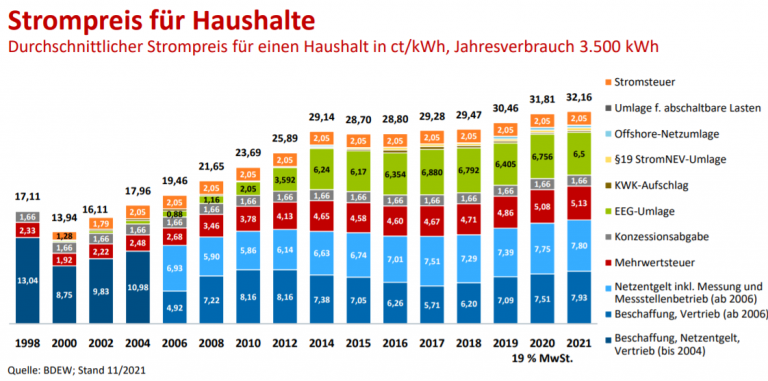


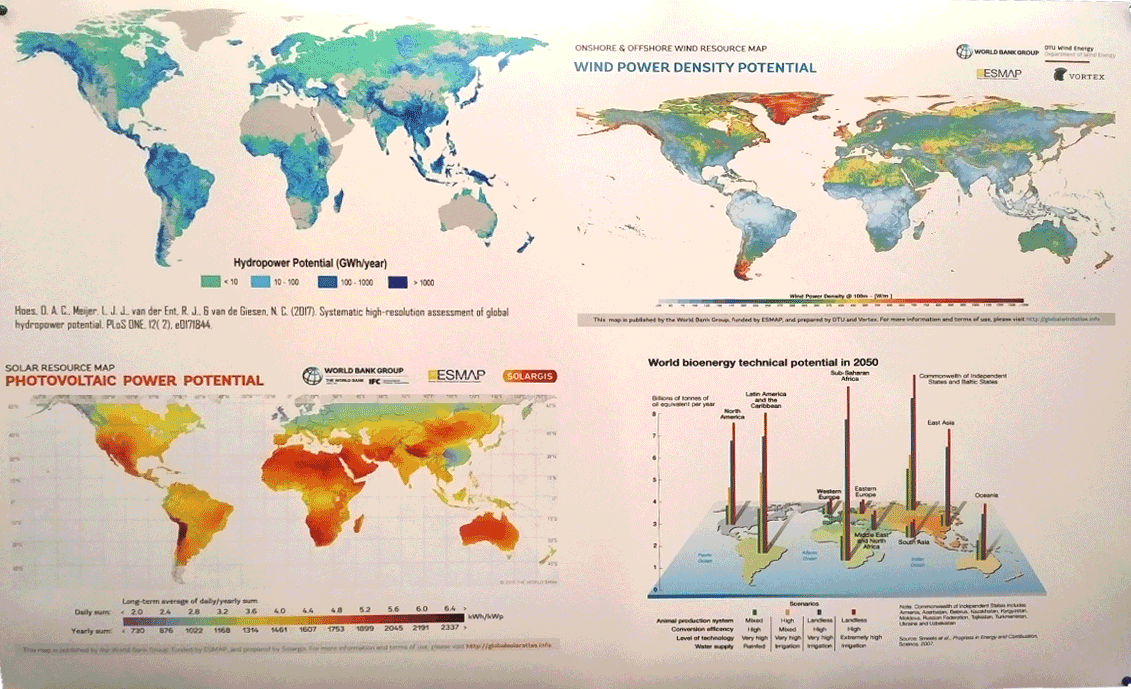
Actually, Germany did not have a long term increase in coal/gas due to the nuclear shut down but a decrease. Coal has been in a slow but steady decline in Germany (mainly due to cost); which is on track to decline all the way to 0 as Germany is committing to getting rid of coal based production completely by 2035 or so. Gas production did grow but mainly to offset declines in coal. And even there you might argue Recent events in the Ukraine are cutting off cheap Russian supply of both coal and gas, so that looks like it might actually accelerate decarbonization and short term raise the ambition levels even more.
The thing that grew absolutely massively in the same period was wind and solar. Vastly more capacity of the latter was added than ever existed in nuclear form. It now dwarfs everything else in the German market. All without blackouts BTW.