"Recently, places as diverse as Texas, California, Oklahoma/Iowa/Kansas/Nebraska (SPP), the UK, and Germany have rapidly decarbonized without nuclear."
Uh...Germany's actually recarbonized by shutting down their nuclear [increasing coal and imported electricity to pick up the slack].
"The nuclear electricity production lost in Germany's phase-out was primarily replaced with coal electricity production and electricity importing. One study found that the nuclear phase-out caused $12 billion in social costs per year, primarily due to increases in mortality due to exposure to pollution from fossil fuels."
--[https://en.wikipedia.org/wiki/Energy_in_Germany]
California's likely to have serious shortages [again] if they shut off the rest of theirs. Plus: "California's electricity rates are among the highest in the United States as a result of the changing energy mix within the state, including aggressive construction of new natural gas power plants."
--[https://en.wikipedia.org/wiki/Energy_in_California]
I don't know enough to check the rest of the article, but this certainly gives me some doubts as to its accuracy.
Actually, Germany did not have a long term increase in coal/gas due to the nuclear shut down but a decrease. Coal has been in a slow but steady decline in Germany (mainly due to cost); which is on track to decline all the way to 0 as Germany is committing to getting rid of coal based production completely by 2035 or so. Gas production did grow but mainly to offset declines in coal. And even there you might argue Recent events in the Ukraine are cutting off cheap Russian supply of both coal and gas, so that looks like it might actually accelerate decarbonization and short term raise the ambition levels even more.
The thing that grew absolutely massively in the same period was wind and solar. Vastly more capacity of the latter was added than ever existed in nuclear form. It now dwarfs everything else in the German market. All without blackouts BTW.
> Recent events in the Ukraine are cutting off cheap Russian supply of both coal and gas
This is not the impression I have gotten from recent events.
The reason Germany hasn’t experienced blackouts is because they are funding the Russian Federation’s war in Ukraine in exchange for energy. Germany has advocated for the continued purchase of Russian gas and has pushed back against the EU admitting Ukraine to the union. It’s obvious that the decarbonization had not succeeded in solving their need for base load power, in fact you could argue that their denuclearization is the very reason Russia has so much leverage in the situation. So while they may be saving the planet, this is a great example of a government missing the forest for the trees.
You're confusing German gas consumption and German electricity consumption. It couldn't escape my attention that many people especially from the US make this fatal mistake (presumably because of the prevalence of natural gas electricity generation in the US - almost 40% in the US, compared to ~15% in Germany). In Germany, the vast majority of gas is being used for heating or for industrial purposes (chemistry etc.). This is not (yet) substitutable by other electricity sources.
Even if the denuclearization hadn't taken place, they'd still be dependent on Russian gas for at least a significant part of their gas supply. They can always substitute basically any gas shortfalls in the electricity sector simply by increasing coal generation, since there's a lot of unused capacity now that renewables leaped massively, and even replacing all the gas currently being used for electricity generation (because there's so little of it!) with coal would not even reach the levels of coal generation that Germany had as recently as just five years ago, so the coal plants can simply somewhat increase their output for a while. What Germans currently don't have is any way to not freeze to death and keep the industry running without Russian gas.
The other aspect of the Ukraine war used for advocating for nuclear, which the nuclear proponents like to omit is that 25% of European uranium comes from Russia, so Europe's dependence on Russia is even stronger for Uranium than for gas. It's simply dishonest to use the current situation as an argument for nuclear. If anything it shows that we should have invested into renewables much more strongly, but nuclear proponents were strongly arguing against it because it would have made nuclear even less financially viable.
I would say that comparing the purchase of gas to the purchase of uranium is uninformed, if not dishonest, for two reasons:
- Fuel costs for nuclear is only 15-20% of the total cost, half of which is the uranium itself [1]. For natural gas, the majority of the cost is the fuel, even during "normal" times. In other words, natural gas imports generate a lot more $ per GWh of energy produced, even if imported from the same country (Russia).
- The reserves of Uranium across the globa are still huge, much of which can be found in (relatively) politically stable places such as Australia and Canada. For natural gas, one is locked into imports from countries such as Russia, Saudi-Arabia (and similar Arab monarchies), Venezuela and Russia for the forseeable future.
I'm not suggesting that investment in renewables should be slowed down, only that coal and gass should be removed BEFORE nuclear. If Germany is able to produce the energy they need from renewables only, and to provide a stable supply, all the power to them.
But to bring up renewables in a discussion about nuclear vs natural gas, is just a diversion tactic (or at best a dilusion).
Oh, btw, I'm Norwegian. My country is making a $100 billion profit from the current energy situation in Europe, just this year, meaning that my household of 4 indirectly profits about $80000 from this in 2022 alone. So I'm not arguing from personal interest....
> I would say that comparing the purchase of gas to the purchase of uranium is uninformed, if not dishonest, for two reasons: - Fuel costs for nuclear is only 15-20% of the total cost, half of which is the uranium itself [1]. For natural gas, the majority of the cost is the fuel, even during "normal" times
What seems "uninformed, if not dishonest" to me is the argument that fuel price matters here. Imagine this: Your country needs seven doohickeys per year to run. What exactly those doohickeys are is unimportant; the only important thing is that you need then. Russia can provide you with four doohickeys per year. The rest of the world can provide you with only five doohickeys per year, and for many years they won't be able to provide any more than that. So you need at least two doohickeys per year from Russia, no matter what, otherwise your country stops running. So Russia can stop your country from running at any moment. Did you notice how price never entered this discussion?
> The reserves of Uranium across the globa are still huge, much of which can be found in (relatively) politically stable places such as Australia and Canada.
Reserves of uranium matter here much less than enrichment and fuel assembly production capacity. Russia has over 40% of enriched fuel production capacity (as per https://www.world-nuclear.org/information-library/nuclear-fu...). Until you build new plants for this, it doesn't matter that you can get natural uranium from Australia or Canada. You won't be able to do anything useful with it (unless your reactor is CANDU).
For Germany's risk, the the price doesn't make a big differencem, should Russia decide to cut off the supply.
As long as the supply is NOT cut off, it matters quite a lot what Germany is paying for it. If the choice (for a set period of energy supply) is to pay either 100 billion euros for natural gas, or 20 billion euroes for uranium, the difference is 80 billion euroes less that Russia could spend to keep their war machine running. That's as much as their peacetime yearly military budget.
As for Russia's enrichment capacity, that is something any advanced country could set up, just as several countries have deposites they could start mining. Ones mining and enrichment has started, it could be kept running for as long as needed.
For natural gas, on the other hand, there are fewer good sources. By far the cheapest source is from wherever it can be transported in pipes. Other countries can convert their gas to LNG for transport to Germany, but that also requires expansion of LNG facilities in both ends, and perhaps construction of more LNG ships.
I don't know which take longer, between LNG from other sources or uranium from other sources.
And even when the transfer has been made, natural gas is a more limited resource than uranium, so even if it is purchased from, say, Saudi Arabia, the global supply and demand situation isn't changed much, so Russia will still be able to find buyers for their gas. (For instance, Germany may start to buy up gas that would otherwise be exported to China. If so, China can just buy from Russia.)
This doesn't even start to go into having dependencies on fundamentalist islamic monarchies in the middle east. I would think it would be preferrable for Germany to import their energy from Canada and Australia, countries they that share most of Germany's values.
Finally, with nuclear there is always the option of setting up strategic fuel reserves. This would be analogous to strategic oil reserves, except with massively lower storage costs. Nuclear fuel is stable for 100s of years, and so dense that reserves able to last a few years could probably be fit in a single warehouse (or several small ones):
> If the choice (for a set period of energy supply) is to pay either 100 billion euros for natural gas, or 20 billion euroes for uranium
Except that's NOT the choice that Germany is faced with. In the short term, the cheapest way for Germany to cover for any decrease in nuclear generation is to increase her lignite mining, not to buy more gas, which has grown even more expensive. And also notice that this decreases the money Russia would get from 100 billion in your hypothetical example not to 20 billion but rather to 0 billion, all while being even cheaper for Germany.
> As for Russia's enrichment capacity, that is something any advanced country could set up
It would take many years to replace the 46% [1] Russian share of the global enrichment capacity. Maybe more than a few years -- a decade perhaps. After all, this is all highly controlled, specialized equipment. You can't just go and buy it in a supermarket.
> I don't know which take longer, between LNG from other sources or uranium from other sources.
It would absolutely take longer for the world to replace Russian uranium fuel production. They've built is up as a Cold War Project-Manhattan-level strategic project over more than a decade.
> Finally, with nuclear there is always the option of setting up strategic fuel reserves.
As I already responded to someone else, you can't set up a fuel reserve if your expected value of fuel consumption is higher than your expected value of of fuel production (or, acquisition in this case, really).
> It would absolutely take longer for the world to replace Russian uranium fuel production. They've built is up as a Cold War Project-Manhattan-level strategic project over more than a decade.
As I said, I don't know. (EDIT, meaning that I don't know, not that I dispute your claim. It would be nice to have actual numbers.) It does also take years to set up transportation capacity for LNG, including the tankers, terminals and other infrastructure.
Anyway, had the west realized this exposure for real in 2014, I would have expected that at least some increased capacity would be available outside of Russia already, with an increase in capacity every month as we go forward. And had the output of that capacity been put into strategic reserves, one would have some level of reserve while building up more capacity.
What it looks like from your link, is that there was an initative started last year to reduce dependancy on Russian fuel. I suppose time will tell how long it takes to reach reasonable production volumes.
And one thing is obvious. Storing and transporting nuclear fuel is orders of magnutudes cheaper than storing and transporting natural gas.
3 reasons, I suspect - if someone wants an enormous stockpile of uranium fuel they can probably do that. The volumes check out - uranium is very dense and so will not take up much space. I'm not sure if it has a shelf life, but being a rock I expect something can be sorted out.
I can't pretend to know how feasible it is in practice, but long term strategic uranium stockpiles should be doable. Long enough to weather any reasonable war. Much, much more doable than trying to store a decade of nat gas.
I hope you noticed the news about Gazprom possibly intentionally keeping gas reserves in Germany low for months before the Russian invasion in preparation of said invasion. You can't make a strategic stockpile if your potential enemy is your supplier and preventively doesn't allow you make those stockpiles in the first place so that you didn't have this way out.
You're misjudging the differences between uranium and gas. Transporting and building a uranium reserve would be relatively easy; maintaining a 10 year stockpile and importing from Canada, Australia or Kazakhstan via a circuitous route are all feasible.
This doesn't work with natural gas because they needed a lot of it and moving it around is capital intensive. The situations are completely different. The energy densities here are wildly dissimilar, and that matters a lot for the economic of building a stockpile.
> You're misjudging the differences between uranium and gas.
So do you.
> Transporting and building a uranium reserve would be relatively easy; maintaining a 10 year stockpile and importing from Canada, Australia or Kazakhstan via a circuitous route are all feasible.
See, that's the problem. One of the differences between natural gas and uranium is that (outside of CANDU reactors) you can't use the uranium "as is". To use uranium for pretty much anything useful, you need certain high-tech facilities. By production capacity, almost half of those facilities (according to [1], it's 46 percent) is in Russia.
The way things are, you can't build a stockpile if the expected value of uranium fuel production outside of Russia is lower than the expected value of uranium fuel consumption outside of Russia, which I believe is currently the case. As long as this remains to be a case, any stockpile will dwindle, not grow.
You could turn that on its head. Had Germany created uranium stockpiles in 2014, enough to last, say, 5 years, they would not be vulnerable to this tactic in the first place.
Considering that you can't use raw uranium but need fuel assemblies, you'd need a replacement manufacturer of fuel assemblies, not just a uranium stockpile. But of course Germany was scheduled to shut down its nuclear power plants in 2022-ish anyway so a stockpile would have been largely meaningless.
Pretty sure you can have your stockpiles pre-assebled, or close enough that the final step is trivial.
Anyway, my argument i built on the premise that Germany should never have shut down their nuclear power plants (except when they truely are "spent") and instead built a large number of new ones.
If their nuclear capacity was about the same as the French, it would make a lot of sense to have a strategic stockpile of ready-to-use fuel, both in case supply is restricted for political reasons and because it would serve as a hedge against price fluctuations.
Or, they could just shut down their nuclear plants and the problem with nuclear fuel stockpile goes away as well. And in fact, this is vastly easier to accomplish, and exactly the thing they're already doing.
If you scroll up the thread a bit, the context was that someone claimed that Germany would be less dependent on Germany if they had kept more of their nuclear power plants. That is something they might have figured out in 2014.
Going as heavy on natural gas as they have over the last generation, more or less ensures that they are in Russia's pocket. Shutting down nuclear plants does not make that better. In fact, I argue, it makes it worse.
Your refutation of the possibility of to use Nuclear power to gain independence of Russian energy seems to depend on German inability to achieve indepencende of Russian fuel by setting up a stockpile(1).
Which in turn is justified by claiming that the stockpile would not be needed, since they would shut down their nuclear plants(2).
Which is justified by (1), which is justified by (2) and so on.
My argument is that, had Germany decided in 2014 to increase, rather than decrease their use of nuclear power, with the aim to reduce dependence on Russia, it could be done. But given that, they would have to start looking for (possibly in cooperation with their allies) other sources of fuel to really become independent, in other words, set up agreements to buy fuel from countries like Australia and Canada, on top of whatever fuel was being bought from Russia before 2022.
Basically, my argument requires BOTH of these steps to be taken:
- Decide to keep or increase energy production from nuclear
- Decide to work towards independence of Russia by funding alternative sources + by putting any extra fuel they purchase into a strategic stockpile.
(Edit: formatting.)
These are clearly decisions that were available to Germany (as a country, provided the public had been primed to support them). I don't find the spot in your argument that refutes any of them, without already assuming that the other is impossible.
Also, I don't find where in your argument, in what way these decisions, if taken together, would NOT ensure that Germany would have more energy production capacity in 2022 than they have now.
> Your refutation of the possibility of to use Nuclear power to gain independence of Russian energy seems to depend on German inability to achieve indepencende of Russian fuel by setting up a stockpile(1).
No, my refutation hinged on 1) the fact that German nuclear power is NOT a substitute for the vast majority of German uses of natural gas (chemical and other industry, residential heaters -- neither of which is near-term replaceable with nuclear power without massive investments in electrolysis), and 2) the fact that German nuclear power has the cheapest substitute in form of unused capacity of coal plants (which recently massively dropped in their capacity factor) and accelerated expansion of renewable generation. There is no circularity in this that I see. 1) means that keeping or expanding the nuclear fleet does not decrease dependency on Russian gas, and 2) means that ditching it does not increase dependency on anything else coming from Russia.
So ditching the German nuclear fleet has no downside in terms of reducing dependency on Russia. In fact ditching the German nuclear fleet might somewhat reduce the dependency on Russia on part of the remaining global users of nuclear power, owing to the reduction of uranium fuel consumption in light of the fact that Russia possesses 46% of world's uranium enrichment capacity -- any enriched uranium on the global market that Germany would have to use in their reactors could be used by someone else at that poitnt, with less money paid for enriched uranium flowing into Russia.
> My argument is that, had Germany decided in 2014 to increase, rather than decrease their use of nuclear power, with the aim to reduce dependence on Russia, it could be done.
They could have certainly acted in that direction with such an aim, but since such actions would not have lead to achieving this aim (see above), it would have been a completely irrational course of action.
Only a tiny sliver is for non-energy, and that part could easily be purchased from other countries.
In Norway, a large percentage of heating used to come from oil, but in 2020 any fossil fuel for residential heating was banned. As long as the power is cheap, electric heating is affordable. And if the electricity is slightly less cheap, heating is still affordable if one installs a heat pump (even a cheap air-to-air pump helps a lot).
And even if you were correct in your claim that a large part of the natural gas could not be replaced by nuclear (which is just lack of imagination), your argument would be flawed.
From the link I sent, only 2% of the consumption is non-energy use, but even if that were 50%, reducing dependency by 50% is still a big deal.
> The vast majority of German natural gas use, is for the energy.
You are aware that heating is energy? Residential burners, industrial burners, etc. So this does in no way contradict what I said. Still, none of this gas consumption is directly substitutable by electricity without massive infrastructure changes, not even by nuclear electricity.
> As long as the power is cheap
In Germany, it's not, so there's that.
> And if the electricity is slightly less cheap, heating is still affordable if one installs a heat pump (even a cheap air-to-air pump helps a lot).
That's a part of the massive infrastructure changes that I'm talking about. I've already mentioned elsewhere the 2010 and 2012 EU directives that will make this happen on a timescale of decades as the building stock is progressively replaced, but you can't do this on a timescale of years.
> And even if you were correct in your claim that a large part of the natural gas could not be replaced by nuclear (which is just lack of imagination), your argument would be flawed.
It's not "a lack of imagination". I've never said these uses can't be replaced -- in fact we know exactly how these uses will be replaced (natural gas in chemistry with electrolytic hydrogen, natural gas in heating with passive houses, etc.), so no need to invoke "imagination". The problem at hand is that you can't do this transition on a timescale of a war (...and in the middle of a pandemic, and during a recession, and with a famine coming). This will not be done in months, or even years. Think two decades instead. So this will help us deal with the climate issues, but won't help with the war.
> From the link I sent, only 2% of the consumption is non-energy use, but even if that were 50%, reducing dependency by 50% is still a big deal.
It would, except this has nothing to do with keeping or ditching nuclear plants. This reduction would have to come from the fields where natural gas is being used and neither keeping not ditching nuclear plants would affect the success of such gas-saving measures.
Yes. My house, that was heated by oil 2 years ago, is heated by electricity today.
> In Germany, it's not, so there's that.
Because Germany has underinvested in electricity plants that cannot be shut down by Putin.
> It would, except this has nothing to do with keeping or ditching nuclear plants.
If Germany had kept their nuclear plants electricity plants (and ideally built a number of new ones) electricity in Europe would be cheaper. Thats just supply and demand.
> The problem at hand is that you can't do this transition on a timescale of a war
I agree you cannot transition in 2 months. I talked about starting in 2014. Shutting down the plants this year is only the culiminatino of a chain of bad decisions about energy.
But I suppose in 2014, the psychological damage was already done. It appears like Germany had already decided to get rid of Nuclear after 2011 / Fukushima. This seems to be driven by fear, more than anything.
Which I suppose is the real problem. This never was about making ration decisions about energy security, being dependent on Russia, etc. All along, this was about fear of "nuclear". The rest just looks like rationalization.
Meanwhile, energy prices have gone up all over Europe, since Germany is only the biggest country to have underinvested in electricity production. Even countries that produce an excess of electricity, like Norway, have the same prices. And believe me, ACER is getting really unpopular here, I would not be surprised if Norway is out of ACER by winter.
> Yes. My house, that was heated by oil 2 years ago, is heated by electricity today
Good, so you see how the argument that only 2% of natural gas in Germany are not used for energy applications is irrelevant for the issue of replacing residential and industrial heat sources. These are major energy applications alright -- ones that can't be readily switched to electricity without major infrastructure transitions -- which are already taking place but can't be sped up 100x on a whim.
> Because Germany has underinvested in electricity plants that cannot be shut down by Putin.
No, actually it's largely because Germany overinvested in electricity plants that cannot be shut down by Putin. Their renewable investments, just like the renewable investments in the neighboring Czech Republic, led -- rather than trailed -- the recent decreases of prices of renewable generation equipment around 2010. As a result of this, Germany has to spend much more money than they would have had to, had they waited just a few years. This made their electricity around six Euro cents per kWh more expensive. (Investments do have to be repaid, after all.)
> I agree you cannot transition in 2 months. I talked about starting in 2014.
Germany started with the transition seriously around 2005. It still takes time, and also isn't a thing that happens at a constant rate because the industrial landscape is evolving. As things such as PV panels, wind turbines, or heat pumps get more affordable, their rate of installation increases.
> If Germany had kept their nuclear plants electricity plants (and ideally built a number of new ones) electricity in Europe would be cheaper.
Debatable, judging from the recent events in the European nuclear industry (Hinkley Point-C, Olkiluoto-3, etc.). The mandated feed-in tariff for HP-C electricity is now more than double than what a wind power plant would deliver. It's inflation-adjusted, so for example around now the electricity straight from the HP-C plant should be worth around 14 Euro cents per kWh, whereas for example new German PV auctions take place at under 5 Euro cents per kWh. And European wind power as well has similar price levels to the latter nowadays.
> But I suppose in 2014, the psychological damage was already done. It appears like Germany had already decided to get rid of Nuclear after 2011 / Fukushima. This seems to be driven by fear, more than anything.
It does not "appear" that "Germany had already decided to get rid of nuclear after 2011/Fukushima". They had mandated the shutdown in binding law almost ten years before Fukushima, so Fukushima had nothing to do with this.
> Meanwhile, energy prices have gone up all over Europe, since Germany is only the biggest country to have underinvested in electricity production. Even countries that produce an excess of electricity, like Norway, have the same prices.
You know, that just might have something to do with energy trading across Europe. The fact that Norway's electricity rates are increasing is a sign of healthy market, because it shows that arbitrage works.
> Good, so you see how the argument that only 2% of natural gas in Germany are not used for energy applications is irrelevant for the issue of replacing residential and industrial heat sources.
Actually the opposite. If I personally could switch away from heating my house with fossil fuels, so could Germans. In principle, it could happen over a few months (depending on the number of electric ovens available in the market, the capacity of the grid, etc), but it is cheaper to do over some number of years.
Obviously, this would cost some money. But basic electric ovens are quite cheap, and Germany is not a poor country. Also, since I already paid that cost personally, I'm not super-inclined to feel sorry for them....
> No, actually it's largely because Germany overinvested in electricity plants that cannot be shut down by Putin.
At best, I would agree that Germany has chosen to switch to expensive energy production. The net output (as opposed to theoretical peak capacity) of renewables is still only about the same as renewables was in 1990, so that is not super-impressive, from a global warming perspective.
I don't believe that the 1990 nuclear industry was as dependent on Russian fuel, as it is today. Har Germany continued to produce electricity in their nuclear plants at the same level as 1990, it would have had the same effect on global warming as their "investment" in renewables have had so far. And any dependence that was created on Russia over this period, was by choice, and could have been reversed.
> but you can't do this on a timescale of years.
Norway made the decision to ban fossil fuels for heating in 2017, effective from 2020. Granted, it affected a smaller (but not insignificant) part of the population. But if there is a will, there is a way.
> You know, that just might have something to do with energy trading across Europe. The fact that Norway's electricity rates are increasing is a sign of healthy market, because it shows that arbitrage works.
I agree. In principle, it is not different from Norway paying full price (and then some) for gasoline/diesel. But they/we are used to to the low prices on electricity, from when local consumption was prioritized. Also, especially after the ban on oil/gas for heating, some feel tricked. So the public reaction is similar to what I imagine it would be in Germany, had Germany stopped all gas imports from Russia overnight. The government may be forced out of the common market before next winter, because of this.
> The problem at hand is that you can't do this transition on a timescale of a war
Maybe I'm being too harsh. My measuring stick is from my own (Norwegian) experience. Britian is not doing much better than Germany, and I would not expect countries like Hungary, the Baltic states, Poland etc to have the economy to turn this around quickly.
Also, Norway is obviously spoiled. We are 100% self-sufficient with renewable electricity, AND we make really good money from exporting oil and gas. We never really had to do the hard choices. (Also, Norway has still had high emissions, due to cold climate and low population density making both heating and transportation very energy intensive, as well as emissions from the oil industry)
France, though, has significantly lower CO2 emissions than Germany, and has had that since forever, even without having the resources that Norway possess. All due to nuclear, and they do it without making massively expensive investments into renewables. More for less, in other words.
So I suppose I predjudiced (postively, but maybe unfairly) when it comes to Germany. I generally expect Germany to be best-in-class when it comes efficiency and rationality, and especially implementation.
So when, in a case like this, it seems like German policies are irrational, especially when compared to French policies, it pops out as an outlier (to me, as an outsider to both Germany and France). I suppose there are good ways to explain this, based on local culture and politics, that go back more than 30 years, maybe all the way back to when France needed their nuclear industry for military use. I suppose these differences, when seen from the inside, are almost invisible because they may be taken for granted.
Maybe, from the German perspective, it is an establish fact that nuclear power is "bad" or "dirty" somehow, while fossil fuel consumption is relatively more acceptable. Maybe the Russian threat is not felt the same way that some other countries feel it. Maybe there is guilt, or maybe the taboo around annexing neighbours is not as strong.
Anyway, maybe best to end this thread. Thanks for staying reasonably polite, and good luck going forward!
And now we replay an earlier argument on if Germany would have continued with the renewable transition, we wouldn't need any stockpile oof gas or uran from Russia.
However nobody talks about blocking Russian Uranium imports, while oil and gas is all over the news. Admittedly the values we are talking about are much lower, but if it's easy to switch suppliers it should be a nobrainer, no?
I am unsure what news you are reading but when the war started there was news about switching Uranium imports away from Russia here in Sweden. I would hope that has now occurred, through as mentioned in the article, nuclear refueling occurs once every 12-18 months so who knows if that has yet to become a practical matter. The company that seems to produce most of the fuel that Sweden use is called Westinghouse Electric Company, with headquarters in Pittsburgh, and about 20% of the raw uranium that they processed before the war came from Russian.
The biggest exporter of Uranium to Europe is Niger. We also have Kazakstan, Canada, Australia, and then a bunch of smaller ones. Being close geographical isn't a major benefit for Uranium imports. Blocking Russian Uranium imports should already been done, and if its not, should be made into policy. Since it only is a small portion of the overall imports the effect should be very minor.
I would expect that the American company, by the fact of being American, are already required to follow sanctions related to Russia.
What makes you think nobody talks about that? I know that this has been a topic in my country (which operates six VVER reactors). We've definitely been talking about this.
> but if it's easy to switch suppliers it should be a nobrainer, no?
Unfortunately it's not that easy since Russians control over 40% of fuel production capacity, and additionally Western manufacturers need to learn to manufacture Russian fuel assemblies and test them and certify them for safe operation first, so even if Western production capacity were sufficient, there would probably still be some delay in the switch.
To add to that, Rosatom was even set to build a new nuclear power plant in Finland [0]. Supposedly, because the french built one is taking too long to be build.
From what I've been reading lately, South Korea is currently the country with the best expertise in building cost-efficient nuclear plants. Maybe Finland should switch vendor.
If the only method to be successful is to cheat and coverup issues then that's frightening.
> In November 2012 it was discovered that over 5,000 small components used in five reactors at Yeonggwang Nuclear Power Plant had not been properly certified; eight suppliers had faked 60 warranties for the parts. Two reactors were shut down for component replacement, which was likely to cause power shortages in South Korea during the winter.[23] Reuters reported this as South Korea's worst nuclear crisis, highlighting a lack of transparency on nuclear safety and the dual roles of South Korea's nuclear regulators on supervision and promotion.[24] This incident followed the prosecution of five senior engineers for the coverup of a serious loss of power and cooling incident at Kori Nuclear Power Plant, which was subsequently graded at INES level 2.[23][25]
> In 2013, there was a scandal involving the use of counterfeit parts in nuclear plants and faked quality assurance certificates. In June 2013 Kori 2 and Shin Wolsong 1 were shut down, and Kori 1 and Shin Wolsong 2 ordered to remain offline, until safety-related control cabling with forged safety certificates is replaced.[26] Control cabling in the first APR-1400s under construction had to be replaced delaying construction by up to a year.[27] In October 2013 about 100 people were indicted for falsifying safety documents, including a former chief executive of Korea Hydro & Nuclear Power and a vice-president of Korea Electric Power Corporation.[28]
@Gwypaas. Do you have any numbers about how much the corruption you're referring to affected the total price? It can be hard to tell from a few headlines.
Anyway, despite these cases, I would expect corruption to be a smaller problem with a Korean vendor than with a Russian one. At least in Korea, corruption is being prosecuted.
Probably Australia or some African country from the middle of nowhere, they’re the only ones left where you can now still open a new uranium project. Most probably the US and Canada still have the stuff in their soil but I don’t see them doing it, what with Idaho and parts of Colorado becoming more like California.
Uranium mining is not your weak link here -- enrichment and fuel assembly production is. As far as I'm aware, Russia has over 40% of global capacity for this.
Germany can't wave a magic wand and switch off Russian imports overnight. But they did just commit a few hundred billion to accelerate their plans to get rid of coal and gas based generation. That's a direct consequence of the Ukrainian situation. Like the US, Germany was overly depending on cheap gas until recently. Now that it has to import the gas in liquid form from the US (and a few other places), it's going to be a lot more expensive. Hence hundreds of billions to cut their dependence on the stuff entirely.
Regarding nuclear in Germany, I think you are a bit short on the facts. Nuclear in Germany was always pretty minor. What little they had is now nearly gone. During the same time, they cut coal generation from 47% to about 25%. Gas grew a bit during that time but is still smaller than their remaining coal generation and even the amount of coal capacity they got rid off. Coal is going to be gone by 2030 according to the latest plans. Indeed cheap Russian gas was part of this plan until recently. But those plans are shifting rapidly now for obvious reasons.
No. Its not total power generatian its only nuclear energy's share of electricity generation in Germany from 2000 to 2020.
From 2000 to 2009, 6 years were below 30%, 5 years below 28% and 2 years below 27%, with a low of 25.9% and a high of 32.1%. If you take the 32.1% as the maximum value with 100%, that is a little over 20% fluctuation with a clear, negative trend.
In fact there is a magic wand. Germany should just drastically reduce meat consumption or at least stop growing pigs. Animal agriculture is huge energy sink. I cannot find exact numbers, but CO2 emissions from animal agriculture in Europe is bigger than emissions from all cars. And very little of it comes from animals breathing, it is energy usage that is responsible for most of it.
Pigs are especially bad since they eat basically what humans can eat. So stopping producing pigs will solve both energy and food crisis.
And if Denmark managed to stop pigs production in 1917 almost instantly when facing a war crisis [1], then surely modern Germany can do the same.
And those plans will be reconsidered in 5 years from now. Cheap Russian gas will likely flow again. And don't forget Ukrainian recent found giant gas reserves. One of the reasons for this conflict.
Don't underestimate the Germans. They'll get this done. They'll be pretty far done executing those plans in five years and probably will raise the ambition level rather than lowering it. I also predict they will trigger a pretty big economic boom doing so. All that money flowing into the economy will do a lot of good. They've actually been criticized for holding back too much in the last few decades. This looks like it might be the trigger that fixes that in a hurry.
Cheap Russian gas might make a brief comeback depending on if Russia is able to fix its leadership issues that are causing the current crisis. Right now it is looking pretty bad. But nothing that a Russian revolution wouldn't be able to fix. If that fails to happen, I doubt the Russians are going to get a lot of gas business from Europe with Putin remaining in power. Basically right now they are dealing with the stick part of this stick/carrot strategy. But even if that does happen, the message that they can't be trusted was received loud and clear. Business as usual is not going to be a thing any time soon.
Whatever they currently still receive in terms of gas revenues will start drying up either way. Oil is going to stop flowing pretty soon. And either the Russians close of the gas or the Germans will diversify their supply to the point where it won't matter if they do because the threat of the Russians cutting them off is now both very credible and completely unacceptable as a status quo.
That will make gas a lot more expensive permanently for the Germans and will only increase their ambition level with respect to reducing their dependence on it. If heating prices double or triple permanently, people are going to be pretty eager and creative getting into more cheaper ways to heat their houses. That's already happening in a lot of places.
Don’t think the Germans still know how to “get it done”. Afaik their power transmission network hasn’t received significant improvements (even though I had last read something on the subject a few years ago, maybe things have changed) and their energy prices were among the highest in Europe before this war started. I’m also very bearish when it comes to their car industry efforts to transition to EVs, but that’s a slightly different subject.
Our energy prices are designed to be high. It's not a reflection of market. It's a tool to force everyone to reduce power consumption. It's the "steering" interpretation of Öko-Steuer and friends.
After you invest a ton of money into a sustainable solution, the one thing you won't do is invest all that money again replacing it with a temporary one.
If the war lasts for long, that gas can easily become uneconomical.
Such a simplification is very hypocritical in my eyes. Even Ukraine itself is not shutting down the Russian gas pipeline on its territory "to save Ukrainian lives". And the sanctions against Russia are not so complete that the West is blocking every cooperation. For example, no one wanted to immediately stop the cooperation regarding the International Space Station "to save Ukrainian lives", because the cost would have been too high as the station might have been lost.
Reasonable politics is always about weighing effort against benefit. Of course, anyone can have her or his own opinion where to draw the line in a particular case. But it is usually not black and white. In my opinion, the German government has done an excellent job in the last months in reducing dependence on Russian primary energy imports. It rather failed in another area: military support for Ukraine.
BTW: Does anybody know whether US's extensive uranium supplies from Russia and its sphere of influence (Kazakhstan and Uzbekistan)[1] have now ceased? I could not find any recent information about it.
Germany is paying hundreds of millions of euros per day to Russia for the gas. In March EU total payment was 700 million per day. This completely dwarfs any even billion dollar level support given to Ukraine. This is one quick graph that I could find.
https://www.statista.com/statistics/1281568/daily-russian-ga...
On Friday, Russia stopped gas exports to Finland. Electricity export to (and import from) Finland was stopped earlier already. Was Finland in a crisis? No, most people didn't even notice, because Finland had prepared for this. It certainly would have been convenient to build our heating to depend more on cheap Russian gas, but it was restrained by law, because of the risks. Finland was willing to tolerate the inconvenience of higher energy prices, to keep its political independence and safety.
But it seems Germany is not yet capable of this introspection. Germany has been too lazy and corrupt and has let itself become very dependent on cheap Russian gas. Now it's saying "we can't do anything, we are too dependent". It's not the world's fault, it's the fault of past German governments and German voters.
Germany is an industrialized and rich nation. It can start building heat pumps if the people are ready to do it. The very recent nuclear shutdown decision can also be reversed. But it would first require admitting that you have made serious errors in the recent past and then make a turn around on those decisions.
Don't pat yourself on the back too hard. Finland just now cancelled its contract to build the Hanhikivi plant, of which a third would have been owned by Russia. The contract was finalized in late 2013, more than eight years ago. The stated reason for the cancellation was not political independence/saftey but the expected inability of Rosatom to deliver the project and increased risks due to the attack on Ukraine (https://www.hanhikivi1.fi/en/press-releases/fennovoima-has-t...).
Was Finland better prepared to ensure its energy independence? Absolutely. Nevertheless, they were about to forfeit some of the independence if Russia hadn't attacked Ukraine.
The Hanhikivi plant was controversial even before Russia's latest full on attack into Ukraine. It also wasn't moving very fast because the builder was unable to supply precise enough plans to STUK to move on. STUK is the government watchdog and is considered very strict.
The reactor dome by the way would have been forged in Ukraine.
There is a two reactor plant in Loviisa that uses the Soviet VVER technology (but not Soviet automation). It has worked very well. Olkiluoto plant's reactors 1 and 2 are from Sweden, and have had extremely high uptime. Both plants were built in the seventies. Olkiluoto 3 is the infamous French EPR that is finally coming online now.
Hanhikivi would have used an eastern-western mix of technology like Loviisa.
I would agree in 99% of cases. But when it comes nuclear power vs coal and gas, the only data I can find seems to make this issue completely black and white (at least for developed countries).
As far as I can tell, nuclear is not only safer, but even MUCH safer than coal and gas, regardless of what parameters you look at. All argument to the contrary, seem to follow one of the following patters:
- Not understanding the science and math (claims about how long used fuel will be dangerous)
- Not even tryting to understand the science and math (not willing to even listen to arguments)
- Worst case interpretation of findings (ie assuming the LNT model for cancer risk)
- Treat Nuclear as an alternative to renewables instead of as an alternative to coal and gas.
- Demanding orders of magnitude more safety from Nuclear than from other energy sources.
- Some argue that from a scientific point of view, nuclear is obviously better than coal and gas, but it is not realistic to move the public opinion
Obviously a lot of this is generated from (irrational) fear of the unknown. But there is so much of this anti-nuclear propaganda being spread, that I wonder if there could be bad actors involved. It's almost like some climate activists and politicians don't want nuclear for some other reason.
Maybe they are worried that the replacement of coal with nuclear would make people less worried about the climate, remove the support for environmentalist organizations, and that this could cost them their jobs? Or it could be that the particular people who support environmentalists happen to be especially irrational on this topic, so even if the leaders understand the science, their base would not accept nuclear energy?
> But when it comes nuclear power vs coal and gas, the only data I can find seems to make this issue completely black and white (at least for developed countries).
I think you are confusing a conclusion, which can be rendered as a Yes or No decision, with the reasons that lead to such a conclusion. Even if your own conclusion is very clear, the process of weighing pros and cons can still be quite complex and difficult. This is what I meant when I said that such issues are usually not black and white. In such debates as how best to support Ukraine or how best to care for our planet, I think one should first and foremost recognise that people, who come to a different conclusion from oneself, do so with the best ethical intentions and are perhaps no less intelligent or manipulated than oneself is. Of course, there might be a lot of people on either side which are not, but I am sure there are also a lot of people, who know there math and physics very well and nevertheless come to a different conclusion. Then the real intellectual work starts: listen, listen, listen and refine your arguments. I do not mean that you should not be allowed to completely disagree, but that showing respect to other smart people's opinions is an important individual virtue as well as an important public virtue in a democratic society, which benefits much more from a reflective style of debate than from a confrontation of We against the Others.
> I think you are confusing a conclusion, which can be rendered as a Yes or No decision
No, the decision on what energy sources to use is not a Yes or No decision, unless you are willing to seriously reduce your energy consumption. This is more like a budgeting process, where the total has already been decided. Just like in a budgeting process, where you have to choose between welfare, healthcare, defence, environmental improvement, etc, a country is not likely to significantly lower their energy consumption.
In other words, "No" to nuclear is AUTOMATICALLY "Yes" to something else. And realistically, that "else" is going to be fossil fuels, since renewables are getting a lot of funding anyway.
The way I see it, there should be a hierachy:
1. Get rid of all energy from brown coal.
2. Get rid of all energy from black coal.
3. Get rid of all energy from natural gas/oil.
4. Only then, consider shutting down, or at least stop building more capacity for nuclear.
> do so with the best ethical intentions and are perhaps no less intelligent or manipulated than oneself is
There are two different groups to compare to. One is the average voter in a country. Most of them will not understand the "math and physics" involved, unless it is provided to them in an extremely well digested form.
The main problem with this group is that they (mostly) see things as either/or, good/bad, black/white. For instance, they think something is either radioactive or not, but do understand the difference between uSv (micro Sv), mSv and SV. If someone tells them they just received a dose of 300uSv, they probably worry just as much as (of not more) than if someone tells them the dose was actually 70mSv.
Similarly, with waste, if they see a picture of low level radioactive waste form 20 years back, they think it is the same as fuel that was taken out if the reactor the day before.
Similary, they tend to think that if the waste is dangerous for 100 000 years, it is almost as dangerous after 50000 years as it is after 50 years. While in reality, around 300 years is what it takes for it to become "relatively safe", even if it is still not completely harmless.
In other words, the general public is relatively easy to mislead with propaganda. Many have a natural fear of the unknown, and for those who want to, it is easy to introduce enough complication and confusion to prevent them from accepting the scientific arguments in favour of nuclear.
Then there are people groups of people who do understand enough "math and physics" to at least have ability to understand this from first principles, if they put some energy into it. Here on HN, I would expect most to be in that category (including myself, my MSc is from particle physics). It seems to me, though, that too few of these have actually looked into the information available. That would have included me, just out of university.
An the topic of Nuclear energy vs Coal/Gas (after actually doing some investigation), the data I have been able to find, indicate that the case is almost as clear as Evolution vs Intelligent Design. The difference is simply so large (around 2 orders of magnitude or more), that even if there is significant bias/skew in the data I have available, it is not likely to be enough to alter the conclusion.
I would be happy to review sources that reach a different conclusion. But those I've seen so far have relied on such huge errors that the writers either didn't know the math/physics, or was perhaps writing it with the intent to convince the general audience, rather than in search of truth.
But by any means, if you have quality scientific sources that contradict me, I will be happy to update my view.
> the decision on what energy sources to use is not a Yes or No decision
This is not exactly what I meant. With "can be rendered as a Yes or No decision" I meant that any more-or-less question "can be refomulated, so that someone can vote either in favour or against", which is what happens when a debate needs to be brought to a practical conclusion. (Well, there is of course also the option to abstain from voting, but the question is nevertheless finally a Yes/No decision.)
> a country is not likely to significantly lower their energy consumption.
There are already a lot of laws and regulation targeting energy and resource consumption in the EU. And a lot of new ones are on the agenda. However, there might exist conflicting goals: for example, shifting towards electrical cars to lower CO2 output results in larger energy consumption, because an electrical car is much heavier than a comparable conventional one. It may not always be the best solutions that end up being implemented, but the general direction is to look not only at renewable energy, but also at energy and resource conservation.
> Similarly, with waste, if they see a picture of low level radioactive waste form 20 years back, they think it is the same as fuel that was taken out if the reactor the day before.
I think that a lot of people in Germany understand the general concept between low-level, medium-level and high-level radioactive waste quite well. My generation and people older than me were victims of Tschernobyl. We were all told that radioactive iodine was an immediate threat, but will become irrelevant very quickly. We hear that radioactive ceasum is still a problem with mushrooms and wild boars from the Bavarian Forest. The concept of its accumulation in the food chain is common knowledge.
> Similary, they tend to think that if the waste is dangerous for 100 000 years, it is almost as dangerous after 50000 years as it is after 50 years. While in reality, around 300 years is what it takes for it to become "relatively safe", even if it is still not completely harmless.
The problem for long term storage of high-level radioactive waste is that after a few hundred years, when all short and medium active material has more or less decayed, the decrease rate itself almost stoped to decrease further. The waste is then about 100 times less active than initially, but it will take between 100,000 and 1,000,000 years for the waste to reach the activity level of natural uranium ore, which itself is not yet harmless.
> In other words, the general public is relatively easy to mislead with propaganda.
We are talking here about a decade long debate in an open society, where not only ordinary people, but thousands and thousands of expert of different related fields and various opinions participated. The tale of a general public that had been mislead with propaganda is a pattern of argument that is typically used by anti-democratic movements. The general public does not consist of stupid individuals. The general public of an open society is a collective rationality where people with all their different backgrounds and level of expertise can freely debate the issues that concern everyone. Its conclusions might not be perfect and not always be right, but it is the best we can hope for. If the arguments you favour do not get through, it is not because of propaganda, but because they have not (yet) been convincing. Try again. There is always another election.
> An the topic of Nuclear energy vs Coal/Gas (after actually doing some investigation), the data I have been able to find, indicate that the case is almost as clear as Evolution vs Intelligent Design. The difference is simply so large (around 2 orders of magnitude or more), that even if there is significant bias/skew in the data I have available, it is not likely to be enough to alter the conclusion.
I would say that "Nuclear energy vs Coal/Gas" is a debate of the past. Germany wants to switch completely to renewable electrical energies by 2035 (all energies by 2045). This renders plans for new nuclear power plants obsolete. Realistically it might take one or two decades to go from planning to operation. So when the plant starts it will already be obsolet.
You might argue that in the light of the current situation, Germany's last three nulcear plants to be shut down this years should run a little longer. This option was briefly considered even by the Minister of Economic Affairs, Robert Habeck from the Green party, but quickly dropped again. There were a few voices in favour of such a proposal from the industry and the Conservative opposition, but others, even from this circles, said that it was too late to realistically postpone the shutdowns already scheduled and underway. So after a few days, no one followed up on this idea.
My second reply is on whether the decision to shut down their nuclear plants at the start of the year was the correct thing to do (the black/white reference). From your final remarks, you seem to tilt toward that they should not have been shut down:
> You might argue that in the light of the current situation, Germany's last three nulcear plants to be shut down this years should run a little longer.
(or at least, that's how I interpret "You might argue that").
From my point of view, shutting those down had been a bad decision for a while, and was still wrong. You seem to argue that even if this was considered, it shot down for political reasons. I would argue, from my limited knowledge about German politics, that it is not a surprise that the Green party would not take that path.
I suppose from the perspective of the perspective of government in Germany given the pre-existing situation as the war started, this may not be black and white.
From my perspective, and I suppose many peple who see Germany from a distance, we may see this over a longer time period, back to March 2011 and perhaps beyond. In that context (and with my view on nuclear power), shutting down the plants this spring is just the culimination of a string of bad decisions. So with my context, it was clearly wrong, even if inertia may have made it inevitable.
So I suppose it depends on perspective.
> Germany wants to switch completely to renewable electrical energies by 2035 (all energies by 2045).
Germany wants to do that, clearly. But is it realistic. I'm reading articles such as this one:
This does not instil confidence, to say the least. Also, this clearly illustrated the problem with renewables, namely their intermittent nature. For ALL energy to be provided by renewables (and not depend on non-renewable production in other countries), the grid probably needs several days consumption worth of storage capacity.
Actually getting a point where Germany is able to produce a number of GWh equal to the yearly production is quite easy by comparison. Storage is the hard part. The numbers I've seen so far, indicates that many houses with solar panels have batteries with the capacity to store 5-10 kWh, but if you want to rely on batteries for a few cold, cloudy days in the winter in a row with no wind (and addition have power for your commute in your electric BMW, at autobahn speeds), you may need ~100x that, for EACH house.
Hopefully we will se a revolution in the cost of batteries over that period, but I still consider this pretty optimistic.
I will write two answers to this, as I think it has split into two topics, first about the need for education.
> We hear that radioactive ceasum is still a problem with mushrooms and wild boars from the Bavarian Forest. The concept of its accumulation in the food chain is common knowledge.
I did a quick google of this, and found this article:
According to the article (or rather one of the linked papers), the mean radiation level for some sample of meat was 4340 Bq/kg = 0.05mSv/kg. (EDIT, mSv, not mv)
Accoring to this overview, cancer risk is not measureable below 100mSv, and gradually increasing from there:
Taken together, that means that in order to have any measureable increased risk of radiation, you need to heat 2000 kg of that kind of meat.
The maximum radiation level of meat to be sold, seems to be 600Bq/kg. At this level, you have to eat 10000kg before there is any increased risk.
By comparison, massive amounts of air polution from coal and gas plants, as well as transportation is allowed. According to this article, in Germany alone, there are 62300 yearly deaths from air polution:
Most "normies" that I know, if presented with the first article, would get the impression that eating boar would be quite risky, and many would stop eating boar because of it. If they read the last one, they would just shrug. Pollution is not nice, but it is far less scary than those becquerels.
While in in fact, if every person in Berlin would eat 5 big fat boars (200kg meat each) from the contaminated area, the risk (not counting risk from obesity) would be insignificant compared to the air they breathe every day.
When presented this way, I definitely would count this as disinformation.
> The tale of a general public that had been mislead with propaganda is a pattern of argument that is typically used by anti-democratic movements.
When I claim that the general public is being mislead, it is because I crunch the numbers (hopefully without miscalculating). Air polution very measurably increases risk of death from cancer and a number of other diseases, while the case provided for Boars, for normal intakes of Boar meat, is extremely unlikely to be measurable.
Obviously (I hope) I do not suggest that we set democracy aside. But it wouldn't hurt if educated people were more active in spreading more accurate information, to counteract what I see as fear-mongering.
> saving face is more important [for Germany] than Ukrainian lives.
I understand that the propaganda works, but lets not fall in the error of blaming Germany for this war. Germany are victims in this situation, not aggressors.
This narrative just divert the focus from the only responsible.
Paying somebody for a product will not force him/her to invest the money in crimes. Russia could have spent this money in buying ice-cream for each Russian child or anything. If they choose war crimes and promoting rape and murder instead improving the Russian's lives, is not Europe's fault.
German government was perfectly aware how Russia used money they receive for energy resources. Chechen wars, Georgia 2008, annexation of Crimea and war in Donbas 2014. Moreover, sanctions against Russia imposed in 2014 were very weak and many German companies found ways to continue to export to Russia military equipment. For example, transmissions on many Russian tanks got many German components. And Russia also has used the money to corrupt politicians in Germany.
Germany kept on increasing their dependence on Russian gas imports by building Nord Stream 2 after the first invasion of Ukraine and the annexation of Crimea, instead of diversifying their gas supplies. This was an intentional and knowing decision on their part.
That depends on who you ask. Anyway, I consider him more similar to Hitler than Stalin, the way he goes after the territories of his neighbours.
From my point of view, his behaviour in 2014 was much like Hitler in 1938. What he did this year, was similar to Hitler's attack on Poland in 39.
Some people were maybe surprised in 39, but I think most reasonable people had stopped trusting him at least by the time he marched into Prague.
Just like France and England should have started much more serious rearmament after that, I would argue that EU countries should have started preparing for a conflict after 2014.
Ukraine is the victim. The main secondary victims are poor countries who depend on wheat imports.
Germany is not an aggressor, per see, but their poor judgement in their relations with Russia has certainly contributed.
Germany may point to WW2 and say "Never again", but if they insist on looking that far back, one could even argue that they made the biggest contribution of all to the apparent of Putin to surround himself with buffer states.
And while we are back in WW2, German aggression in the 1930's is one of the primary reasons everyone in Europe (except, it seems, Germany and Hungary) become so paranoid when a powerful a country start to annex it's neighbours.
Had Hitler stopped after taking the Sudetenland in 1938, modern Europeans might have been much less likely to assume that Putin would annex all of Ukraine and then proceed to Poland, the Baltics etc.
By no means to I blame modern Germans for what happened 80 years ago, but I do hope that Germany can put WW2 behind them, and do their share in contributing to stability in Europe going forward.
Imagine what the situation in Europe would be if someone like Trump wins in 2024, and decides to pull the USA out of NATO?
As I pointed out above, this would not have changed anything with respect to the need to import gas from Russia. Nuclear generation is not a substitute for gas imports.
Even worse, they can't "cancel their nuclear shutdown process" even if they wanted. First of all, the shutdown deadline had been firmly set in law twenty years ago, so it would require a major legislative effort to make another law. Second, even if they somehow managed to instantly change the law, the shutdown was "baked into" the operation and maintenance schedule for the nuclear plants. They were simply not expecting to have to run them beyond early 2020-ish so a lot of money was almost certainly saved by delaying maintenance. Hence, if they suddenly changed their minds about shutting the plants down, they'd almost certainly have to invest massive amounts of money to fix them first.
According to Wikipedia the denuclearization process was canceled until Fukushima happened.
“ On 14 March 2011, in response to the renewed concern about the use of nuclear energy the Fukushima incident raised in the German public and in light of upcoming elections in three German states, Merkel declared a 3-month moratorium on the reactor lifespan extension passed in 2010.[29] On 15 March, the German government announced that it would temporarily shut down 8 of its 17 reactors, i.e. all reactors that went online before 1981.”
And this was described as “The decision to phase-out nuclear power has been called the swiftest change of political course since unification.”
So if a disaster was all it took for a swift change in politics then the current situation is certainly a disaster.
The law I was talking about was passed in 2002, if I'm not mistaken. It specified what "remaining energy", so as to speak, would the German utilities be allowed to extract from already operating reactor units before decommissioning them, which, based on their average output, would have been around 2022-ish. I'm not quite sure how any of those things you're citing are relevant to this, since they don't say anything about repealing this law in which these things where mandated. The fact that in 2022-ish (nowadays really in 2023) Germany is going to do what Germany said in 2002 that it would do in 2022-ish hardly seems like "swift change of political course" to me.
This was just going back to the earlier phase-out decision by the red/green government. The Merkel decision to slow down the phase-out was highly controversial and would have seen mass protests. Then the Fukushima-accident (where a single earthquake was enough to take out the whole nuclear industry of an advanced industrial country) happened and the decision was reversed, again.
That's a very simplistic way to look at the situation.
At a large trade show, I once ran into a retired nuclear engineer and we had a long conversation: he had been called back into service by the state out of desperation. There weren't enough knowledgeable folks who could do safety audits of the plants for TüV. This was 14 years ago and things would be far worse today.
Restarting a complex industry (and it's ageing plants) that's been out of favor for literally decades is difficult and in this case also dangerous.
I'm a (German) physicist by training and worked at a nuclear research facility at the time.
Fair points. But maybe one could stop to ask why are there so few experts or why has the nuclear industry been out of favor for literally decades in Germany?
The anti nuclear power movement started from Denmark and they have at least two high profile nuclear startups. While they are of course not direct short term solutions to the current gas crisis, these things change how people can think about nuclear energy.
Again, so much of German writing around the subject has this very peculiar air of complete passivity, to someone looking from the outside. Things seem to just happen to Germany with no role of their own. Look outside Germany to see some counterexamples.
As far as I know in Germany any industrial equipment has to be insured for good, including any civilian nuclear operation (not, as in most other nations, with very low ceiling).
Nuclear power plants can't be used for residential heating, residential cooking, chemistry, and industrial processes like making glass for solar panels.
At least not without changing the infrastructure for that completely. Which is not going to happen overnight. And even then it can't replace chemistry.
So, no, Germany couldn't have. No matter how many Internet armchair commenters repeat this.
Nuclear power for residential and commercial real estate heating is pretty simple if it were accepted. Main issue is distance between production and consumption and then delta of heat. But later could be solved with heat pumps.
> At least not without changing the infrastructure for that completely
Was replacing that infrastructure considered when plans were made to shutdown nuclear a decade ago? At some point you have to show you're better than "armchair commenters" and actually do what needs to be done.
You can't convert about 40 million households [1] in a year or two.
Also, in the German climate and with its many 'old' buildings, merely switching the heat source won't do. One also needs additional isolation, and new radiators.
It's against logic if your only consideration is geo politics. And even then, many have argued economic cooperation builds peace and security through mutual trust and dependency. In the light of current events, this way of thinking has been discredited, but it's far from self evidently irrational.
The 2010 and 2012 energy efficiency directives guarantee (EU-wide, not just in Germany) that all buildings will eventually transition to low-energy buildings, but this is expected to take place by simply building new buildings to stricter code, not by upgrading all existing buildings in the EU in a few years. It's unlikely that there's industrial capacity for that.
The logic was "if we depend on each other, Russia isn't going to pull crazy stuff". Which works with rational people (and after Gorbachev and the German reunion, the perception was that Russia is rational), but not with Putin.
And you may have noticed that Russia is not cutting off delivery of Russian gas to Germany. Which they would if the damage was unilateral.
Also, electrical heating is one of most wasteful and damaging ways to do heating, and Germany has been moving away from electrical heating for this reason for decades now.
> Also, electrical heating is one of most wasteful and damaging ways to do heating, and Germany has been moving away from electrical heating for this reason for decades now.
Not disagreeing with the rest of the arguments, but electrical heat pumps are actually the most efficient way to heat your home (theoretically you can get about 5 W of heat for every 1W of electricity, for practical ones it's a bit more than 3W IIRC).
That said, it's not trivial to convert old houses to use heat pumps. Cost is one issue, but they typically require better insulation because they don't have the same power that you can get with a gas heater.
Not to mention that Ukraine earned some billions in transit fees, which helped upgrading their military.
What if the EU had not bought Russian gas?
Then Russia would probably have sold more to others like China or India and Ukraine would not have earned money from transit fees, nor would there be any leverage against Russia at all.
Leverage would be more like buying Russian gas but having a backup. If you have no choice but to buy Russian gas then it is not leverage—in fact it is leverage against you.
Also If EU did not buy Russian gas and China and India were the only buyers then that lowers the price and profits Russia commands. In a liquid marketplace the number of buyers available contribute to profits.
That's a trick the Germans will have to do about 50 million times to get rid of their gas dependence in all their households. That's going to be bottle necked on the availability of heat pumps and trained people to install those. It will be interesting to see how quickly that industry can scale.
Providing the electricity for those pumps is the easy part of the problem. That just requires doing a bit more of what they are already doing at scale, which would be installing wind and solar all over the place.
In Norway (of all places), the use of fossil fuels for heating was banned in 2020. Not all houses have heat pumps, there are ovens for sale that do not require those. Heat pumps do make sense when energy prices are above some threshold, though, but houses can be upgraded with that over time.
In any case, not all heat pumps are that expensive, and it is also possible to have hybrid heat pumps and air conditioners.
Had Germany decided to phase out natural gas for heating in 2014, and replace it by nuclear power, ovens and heat pumps would definitely be able to keep up with the reactor build rate.
Kazakhstan is not Russia, and in fact they're rather alarmed by recent Russian sabre-rattlijg about reclaiming land in northern KZ to protect Russian speakers etc (heard this one before?).
The current leadership is very much indebted to Putin though for saving them during a recent near-revolution, so they're walking a tightrope.
I wouldn’t be surprised if Russia had encouraged the very unrest that made them worried and indebted. Not because Putin is a Bond villain super genius but just because encouraging chaos and unrest and then playing all sides of a conflict is a standard technique of Russian foreign relations.
Edit: and also used in Russian domestic affairs, didn’t mean to leave that out!
But now Germany is committed to stopping Russian coal imports in 3 months and oil, by the year's end, and a (less format and obligatory) statement of intent to quit Russian gas too, in the next two years.
> "Actually, Germany did not have a long term increase in coal/gas due to the nuclear shut down but a decrease"
> "Gas production did grow but mainly to offset declines in coal"
This is dishonest at two levels.
First, nuclear power fell and, at the same time, renewables and gas sharply rose in Germany's energy mix. Power is fungible. It is not as if power generated by renewables substitutes for nuclear, but power generated by gas doesn't. Germany had to add up it's energy inputs to meet 100% of its needs, and it used both sources to do so.
Second, everyone in Germany knew they were supposed to get rid of coal by 2030. That's the international deadline for coal in advanced economies. But the national phase-out law, until very recently, was eliminating coal at a far slower pace - aiming towards a terminal date of 2038. One reason why was the decline of nuclear.
Renewables rose by far more than gas did. The overall market also grew. If you take coal and gas together and look at overall fossil based generation, it declined and continues to decline. The unspoken implication of nuclear proponents is that Germany started putting out more CO2 because they shut down nuclear. The reality is that there was a continuous decline in fossil fuel related emissions related to electricity production. So, who is being "dishonest" here?
Gas "sharply" rose to much less than the coal and nuclear reductions combined. Renewables are on track to grow to about an order of magnitude more than the nuclear capacity Germany ever had. New gas plants might still happen as that is part of their plan to decommission coal. Or at least it was until a few months ago. But it will probably never grow to close to the level of coal production Germany had 12 years ago when it started shutting down nuclear plants.
The decision to get rid of coal by 2030 is fairly recent. There are no international deadlines other than what was agreed at Cop 26, which thanks to China and India avoids any big explicit commitments. However, there is a lot of peer pressure especially in Europe to clean up the energy sector. Germany actually resisted that peer pressure quite long. E.g. the reason brown coal is still a thing in Germany is because until a few years ago, the CDU essentially blocked all attempts to kill that massively polluting industry to protect jobs. I think at the time of the Paris agreements they were thinking/hoping a 2050-2060 time frame. Germany even opened new coal plants as recent as two years ago. The ambition levels have of course increased dramatically in the last few years; mainly due to the success of renewables. Mostly this is driven by simple economics. People like cheap wind and solar energy. Nuclear they don't like for lots of reasons; including the bad economics.
> "If you take coal and gas together and look at overall fossil based generation, it declined and continues to decline."
In absolute terms the combined capacity of coal and gas is the same now as it was in 2010. It has fallen as a share of the total because output has increased.
> "The unspoken implication of nuclear proponents is that Germany started putting out more CO2 because they shut down nuclear. The reality is that there was a continuous decline in fossil fuel related emissions related to electricity production."
I am not a partisan in this argument. But clearly that's a strawman. The argument is that if Germany hadn't taken its nuclear capacity offline then it would have been in a better position to more rapidly decarbonise its energy mix. In one simple sense that's true: nuclear energy is clean, and so by getting rid of it you need to add more clean energy that you would have otherwise to decarbonise. That is, Germany would not have had to increase gas imports at the rate it did, and would not have had to drag out its coal phase-out.
Showing that fossil fuels have decreased in relative terms as a share of the energy mix does not show that it would not have fallen faster with nuclear online.
> "There are no international deadlines other than what was agreed at Cop 26, which thanks to China and India avoids any big explicit commitments."
I was writing in a hurry. I meant that the most respected models of the pathways to net zero tell us that coal needs to be eradicated across advanced economies by 2030. The IEA's Net Zero scenario, which is widely taken as a benchmark by policymakers around the world, says just that. Everyone in Germany knew their original 2038 phase-out date flouted their responsibilities.
I think we're discussing semantics there. Coal use fell, coal and gas combined fell, but gas alone has risen. Which goes against predictions that coal would replace nuclear, that somehow some people claim have come true when there is obvious data that shows the opposite.
I agree with the point that we should have phased out coal before nuclear, but you have to state it like that and not cling onto some dream that nuclear and not renewables are the way forward for decarbonization.
> 2030 That's the international deadline for coal in advanced economies
Of the countries that have a pledge of a phase-out of coal, most have an even earlier deadline. However a lot of countries like the US or Poland don't even a deadline.
> "Actually, Germany did not have a long term increase in coal/gas due to the nuclear shut down but a decrease"
Arguably this is semantics. But that's because the semantics of your claim is unhelpfully ambiguous. In absolute terms coal and gas make up approximately the same share of Germany's capacity as it did in 2010. In relative terms, because the total output has increased, it's share has fallen. But I say it is unhelpful because one has fallen, the other increased.
> "Gas production did grow but mainly to offset declines in coal"
I don't think this is semantics. For the reasons given, it's just wrong.
The statements together make it look like you're trying to misrepresent the facts to support a particular view about nuclear energy.
Total output decreased from 632 TWh in 2010 to 588 TWh in 2021. Coal and lignite decreased substantially 117 TWh + 146 TWh in 2010 to 55 TWh + 110 TWh in 2021 (with a substantial reduction in CO2 emissions). gas use remained stable with 89 TWh in 2010 and 90 TWh in 2021. At the same time nuclear decreased from 141 TWh and 69 TWh and renewables increased from 105 TWh to 233 TWh.
Difference might be accounted for by capacity versus actual factor use - though 2021 might not be a representative year because of COVID if you are referencing the latter. But I can only guess. Your statistics are useless without a source. Mine:
Electricity production from fossil fuels went down from 360.3 TWh in 2010 to 328.5 TWh in 2021, which is a reduction of almost 10%, while increasing electricity export from 15 TWh to 19.3 TWh.
I agree that use is more important than installed capacity, but I don't think whether the fossil fuel share of electricity generation today is the same as in 2010 or 10% lower makes any difference to my point. Saying that 'coal/gas' fell when coal fell, and gas rose, is unhelpful. And renewables did not substitute for nuclear while gas did not, because both were used to get generation back to meet 100% of Germany's needs. Basic arithmetic tells us that if you need to reach a certain proportion of renewables in your energy mix, and you take away 5% of your capacity which is renewable, you have made it harder and not easier to reach your goal. And the less renewables, the more fossil fuel generation. Hence the rise of natural gas, and the drawn out coal phase-out.
and what happens to that massive coal+gas infrastructure?Apparently , wind+solar don't work at night and you will always need the same level of coal+gas+oil
Depending on how reliable you need your energy you'll need various energy storage mixes. Judging by the uk, wind can spend an entire month producing at 15% of it's normal output and can spend days at 3%. So you need a LOT of storage if you want to be sure the lights stay on. In the high hundreds of billions of Euros (and considerable ongoing costs given they need the equivalent of replacement eveey 10-20 years) in the case of Germany.
There have been nearly no investment on energy storage in our history (for very obvious reasons). Thus, any such report done with information collected by looking at history is prone to be completely wrong.
(And yes, we are going to need a lot of storage. On amounts close to 1/3 of our daily generation capacity. We also need some long-term and transportable solutions. And yes, there are currently no options on the market, for very obvious reasons. All of those can be done.)
> There have been nearly no investment on energy storage in our history (for very obvious reasons).
By "nearly no" do you mean "tens, possibly hundreds of billions"? Batteries alone have had tens of billions in investment in the last few years.
> On amounts close to 1/3 of our daily generation capacity.
What kind of mix and overproduction are you thinking of that gets you ratios that low without brownouts? I suspect that if you want to live off wind and solar you'll need a week of capacity to get no brownouts when it's still and gray for a week unless you get nameplate capacity 10x your average needs.
A whole 5GW in the entire world? Crazy, it almost matches the 400GW of just nuclear output, and the many more of every other power source.
Wind + solar isn't a reliable energy source, period. You need a base load, whether that comes from hydroelectric, nuclear or, unfortunately, fossil fuels. Wind and solar are great at topping off things and should be deployed as much as possible for individuals to reduce the demand on the overall network, but they will never be a credible energy source, no matter how much people say "but batteries are just around the corner!". They are no, they are a waste of valuable metals and they are horribly polluting to produce.
The whole argument about base supply (not load), only made sense in the old times when there were expensive variable supplies which could quickly follow load, and cheap base supplies which would run constantly at the same output (typically coal, nuclear...).
The situation completely changed now the highly variable loads are cheaper now than the former base supplies. So you would always use your money to overbuild on the variable supplies not build constant supplies. The thing is solar and wind don't compete with gas, they compete with coal solar. However with the way solar and wind costs are going, we will likely reach a point where it makes more sense to overbuild so much to even cover the load peaks instead of using gas peakers.
There has been a lot of research that showed that this is possible with relatively little over provisioning for a place like the US or Europe. The thing that is still missing are highly integrated electricity nets, but that is improving raapidely mainly for economic reasons (with a very competitive market and integrated nets one can make quite a bit of money by selling from places we're generation is currently cheap). If we use hydro also for storage (pumping up water when electricity is cheap), you need even less overprovisioning.
Energy storage is not a short or medium term solution. Pumped hydro is already maxxed out pretty much everywhere it's possible as not all dams are suitable -- in fact most aren't. Battery storage for large grids currently covers minutes of use, a few hours may be attainable. But wind can be absent for days or weeks, and there's such a thing as winter when you're as far from the equator as Germany.
> But wind can be absent for days or weeks, and there's such a thing as winter when you're as far from the equator as Germany.
Interestingly enough for Germany, the period less likely to suffer from prolonged lack of wind is winter. So the more likely periods of decreased wind happen in summer, where they're interrupted daily by significant solar generation. At the very least in German conditions, these two events (lack of wind and lack of sun) are not only not independent, but they're actually anticorrelated. That also helps deal with the whole situation.
> The Australian National University recently disagreed
This is a worldwide assessment. Look at Northern Europe, and notice the complete lack of dots on the map.
> Interestingly enough for Germany, the period less likely to suffer from prolonged lack of wind is winter
Want you bet your freezing bottom on it? "Less likely" does not cut it for a vital commodity. Famine, drowning and thirst also occur when a commodity that's otherwise readily available on average isn't. They're considered somewhat unpleasant.
Of course we're not going to bet anything. Everyone here wants to construct a resilient and efficient energy production system. That this is unachievable with a high percentage of wind power in the mix is not obvious.
> This is a worldwide assessment. Look at Northern Europe, and notice the complete lack of dots on the map.
I'm not quite sure what you're trying to say here. Northern Europe generally doesn't need the kind of sites that this study was looking for (a pair of locations vertically separated and horizontally close with a river close to the lower location); they already have "once-through" hydro plants on rivers with reservoirs high in the mountains.
> Want you bet your freezing bottom on it? "Less likely" does not cut it for a vital commodity.
I don't have to "bet my freezing bottom" on it. The "less likely" part means lower expected value of energy needs not satisfied by a combination of solar and wind power. This lower expected value translates into lower expenditure of backup supplies such as synthetic gas being expended for that purpose, and therefore the lower average annual cost of using such supplies. That makes this approach viable.
> Energy storage is not a short or medium term solution.
The primary role of energy storage systems in renewable energy sources is to balance supply and demand. Your assertion makes no sense because it ignores even the most fundamental aspects of the problem domain.
> Pumped hydro is already maxxed out pretty much everywhere it's possible as not all dams are suitable -- in fact most aren't. Battery storage for large grids currently covers minutes of use, a few hours may be attainable. But wind can be absent for days or weeks, and there's such a thing as winter when you're as far from the equator as Germany.
Irrelevant. You're trying to put up a strawman based on a fictitious scenario where energy production comes from a single source: wind. It's the tired old meme from two decades ago.
Meanwhile, back in the real world not only are power grids distributed at a continental level but there also multiple sources of power feeding into that grid, including imported energy generated from renewable sources.
> Meanwhile, back in the real world not only are power grids distributed at a continental level but there also multiple sources of power feeding into that grid, including imported energy generated from renewable sources.
There is nothing close to the grid capacity to make this statement true.
Germany lacks base load capacity and imports energy from coal and natural gas burning neighbors when their renewables go offline. To offset this, Germany is building more base load capacity in the form of gas driven plants. This isn't a secret, it's not disingenuous to point it out.
The better option, from the point of view of carbon neutrality, is to make up that availability gap with nuclear. The Germans are unwilling to do this, and likely they hope that eventually they can import energy from neighbors that are willing to make up this gap with nuclear plants the Germans themselves were unwilling to build.
the gas plants are build BECAUSE they can switch to hydrogen produced by renewable energy. The hydrogen will be stored in the already existing gas system in form of a mix of hydrogen and methan.
If hydrogen becomes a viable technology I agree it's a game changer to the whole discussion, but today the first pilot program plants are just coming online. It's possible they answer all the open questions that the renewables leave open, I would be delighted if they did.
Today, and in the future if hydrogen hits unforeseen snags, nuclear remains the proven option.
1) nonsense. Charging batteries is very efficient. About 90-95% efficient. The idea is to use peaks in power to charge the batteries. Those peaks already exist and don't require new capacity. Every time people complain about broken wind mills, what's actually happening is that they are being turned off to reduce the output: grids are currently bad at handling supply peaks from wind and solar.
2) Yes, lots of them. Luckily, people are buying EVs (aka. batteries with wheels). Soon in the order of tens of gwh per year. Those batteries will be perfect for absorbing supply peaks (just plug the car in). And a growing number of cars can also return power to the grid. And mostly the second life for EV batteries is grid storage after they survive the car they were in. Of course other storage solutions are available as well.
I would say no. Your expensive battery on wheels with a complete integrated system is not something you want to abuse. Unless it can take for the entire lifetime of the car without significant degradation.
Compare this to racks on land with far less stringent requirements.
One the other hand, EVs can fill the same role by simply being smart consumers. You don't even lose any round trip efficiency - because storing energy in the car's battery is the work being done.
Consider a future where you can set your car to have at least 60% each morning and then 100% on Saturday, because you are going on a trip. The car will then optimize the charging times for the lowest cost. Thus balancing the grid.
Dynamic demand has the same effect on the grid as dispatchable energy. No need to complicate it further.
Germany has one of the highest electricity costs on the planet. That leads to reduction of use (as people just can't afford it) and this is before the Russian corrupt cheap gas deals. Who knows what it'll look like with higher gas and oil prices.
View your comment from the POV of the majority of the population, who aren't rich IT sector workers.
There's energy poverty in Germany. A lot of it. You don't even have to go to any “3rd world” areas of the world to see it.
Cheap energy is CRITICAL for the elimination of poverty and suffering. I know that single-mindedly obsessing about the single goal of climate change is currently popular, but please, let's not throw the baby out with the bath water.
So you really can’t see how a corrupt government can hinder the development of alternative energy sources in favor of dirty deals from which they profit themselves?
The other way round, actually. France recently had massive problems because they had to switch off multiple nuclear plants for unexpected maintenance issues, and bought lots of power from Germany
1 event does not make a rule. French nuclear reactors were turned off for maintenance, yes, but over the past 30 years, it is clearly Germany depending on French power
Doesn't matter at all. Germany is exporting tons of underpriced (or even negatively priced) electricity in peak season - when everybody has more than enough of their own, so people are using it only to mine Bitcoin and other non essential usecases - and then there would be a blackout off-season if it wasn't for neighboring nuclear power plants, gas and coal. Very weird for a country that has its mouth full with greenness and renewability.
Is this really what German press is reporting? What a gross lie. The "overheating" is neither due to the reactor (simply it getting hot naturally) nor actively threatening to the reactor: they are just stopped to avoid making the situation slightly worse. Temperature difference at the output of a nuclear plant is barely a degree.
That's kinda the point of an interconnected electricity grid, it allows you to import the cheapest energy available. I don't get the argument here. Sometimes it's renewable, sometimes it's gas, sometimes it's coal, sometimes it's hydro, sometimes it's nuclear...?
The argument here is that a country that keeps talking about green energy, ecology and renewables for decades is now using much less ecological methods of power generation than nuclear, and they keep badmouthing nuclear too.
Germany abandoning nuclear has been decades in the making, it does not come as a surprise. If we look at the whole picture without focusing on one particular energy source, then we can see that they have reduced their CO2 emissions over the years. Not by much, but it's expected to improve when they close down their coal plants.
Actually Germans say that a lot and try to enforce it through the EU. They never found support for a complete ban but they're thwarting progress as much as they can.
And then you have the Austrians who try to cancel our nuclear power plants directly through activism, etc.
I read that debate about what is supposed to be green just a political struggle to get a larger share of pot of money distributed by being anti-nuclear they could "compromise to" natural gas being allowed as green.
The article on the site about solar is equally bad. Both are full of lots of good information but then have some key misunderstandings. The solar article doesn't acknowledge that installing a solar requires installing a gas peaker plant on the grid as well. [1] Although solar certainly reduces carbon emissions (the gas peaker plants only runs some of the time), the result is that the cost to the grid, rather than being the lowest, could be one of the highest depending on how the math actually works out. Battery can be installed instead of peaker plants, but the prices of raw materials for batteries have increased dramatically recently and it isn't possible for the mining of battery materials to keep up with the future demand. Tesla's car prices are shooting up- even though they are building huge battery factories to drive down price- it's not enough- they are now exploring mining Lithium, having already bought mining rights for it in Nevada.
The site actually has several articles about why this specific criticism is silly.
To summarize: we already have gas plants, and gas storage, leaving them turned off except as a fallback insurance is the sensible option. Even when building new plants, gas plants are the cheapest to build and simplest to run which matters a lot if they're mostly idle, which is why they get used as peakers.
I don't agree with everything they write (they seem to think "virtue signaling“ is a real thing and that renewables had nothing to do with sensible government regulation but rather the free market which reveals a bias that runs through their conclusions) but the facts are fairly incontrovertible if you actually look at them so they come to the reasonable conclusions anyway.
That’s another mostly great article you linked to. Still though it doesn’t mention the dramatic cost increase of natural gas plants when used as a peaker instead of always-on, and it assumes we can produce as many batteries as we want. It also assumes we can continue producing massive amounts of natural gas in the US and export huge amounts to the rest of the world.
The author's article on renewables and batteries states "The cost of these batteries is plummeting. Material constraints are not an issue because storage batteries do not require top-tier energy density" [1]. This was reasonable to think just two years ago but now is obviously wrong- and this assumption underpins most of the author's writings on energy.
Energy policy is very unforgiving- missing one important fact or one wrong assumption can dramatically alter the outcome.
I'm not aware of anything occuring in the last couple of years that put a hard limit on battery construction due to material constraints. Could you be more specific about what you mean?
The price of the raw materials for batteries is going up dramatically and the supply is not increasing accordingly. That's with today's demands- not a future where we need 10x the battery capacity.
There's been a lot of attention paid to nickel recently, but nickel may have enough availability with Tesla getting New Caledonia mining back online and Indonesia being ready to mine their nickel deposits. Still, the price of nickel is up ~2x right now. Cobalt is also up ~2x and has major ethical issues. But let's assume the industry can move at least grid storage applications to the LFP chemistry and reduce the pressure on these minerals.
The price of lithium is up ~5x. It's easy for this author or Elon Musk to say that there is plenty of lithium in the ground, but it's a lot harder to actually produce it. Tesla is experimenting with new lithium extraction techniques in Nevada- this will take a lot of time to come to fruition. The easiest scenario is existing mines increasing their production, but even in these cases it can be a long process to satisfy environmental concerns. Historically commodity super cycles last 10+ years with metals being much longer.
I would be interested in someone with more knowledge than me projecting the future here on both the demand and supply side, but instead in the article you linked we get "Lithium is not rare, but demand is growing so fast mining may take a few years to catch up". I don't think the author appreciates how long it takes to bring significant mining capacity online. And certainly the stated assumption that the "cost of these batteries is plummeting" is completely untrue at this point. Those with a deeper understanding are warning of a possible battery shortage [1].
There's nothing new there. Musk has been talking about how many "gigafactories" making batteries the world would need for a long time. And even battery manufacturers were a bit taken aback by the scale proposed.
> Three years ago, when the Gigafactory was first proposed, "I thought it was crazy," said Yamada. "At that time, production capacity of this Gigafactory would exceed total production of the industry. Not Panasonic. Not Japanese companies. All Japanese, Korean, and Chinese companies combined. I thought it was a crazy idea.
"But I was crazy. And I was wrong. After seeing extraordinary success of the announcing of Model 3, there is a strong demand for this battery. So, three years ago I thought this was a crazy idea. But I was crazy at the time
It's not the battery cell production that is the real issue. Battery cell production is a big issue, but production can be increased in a few years to keep pace with demand if the raw materials are available.
The new aspect is the price signal that Lithium is now sending. This means that lithium will limit the ability to increase battery production and that battery prices are not going to decline as they have in the past. The history of commodities means this situation is more likely to hold for a decade than a year.
Gas peaker plants are needed for nuclear just as much. Generally the article is looking at the most favourable conditions for the technology, e.g. only considering OCC and not interest cost for building and decommissioning of nuclear plants.
Nuclear is producing 100% output during peak power needs. Solar varies greatly but in the winter may be producing little output during peak power needs. So yes, a 100% all the time output requires peaking, but a variable power source that is not producing during peak times requires much more.
You're going to have to source this because there's been absolutely no need for gas plants in the two cities I've lived in that were both powdered by nuclear in Europe.
I just cited the section in my post. US nuclear plants can not follow load at all, some European ones have some ability, but it's generally not enough.
If you compare France and Germany gas portion of the overall electricity production is quite similar (it's a bit tricky to compare, Germany produced 12% and France 7% but in different years, France gas accounts to 10% of their installed capacity)
> Uh...Germany's actually recarbonized by shutting down their nuclear [increasing coal and imported electricity to pick up the slack].
No, they did not -- look at the fourth chart in https://www.cleanenergywire.org/factsheets/germanys-energy-c... . There's no "increasing coal". The recent changes in nuclear and coal generation correlate rather than anti-correlate. You'd need them to anti-correlate for the thing that you're claiming to be true.
Coal and other carbon sources would have been able to dive much more sharply if the nuclear capacity had remained online or been replaced appropriately. By taking down nuclear capacity, the Germans _kept_ coal and other non-renewables online and prevented them from being replaced by rising renewable sources.
More important to the discussion, note the sharp rise in coal when there is a renewable availability dip. This need to burn coal and gas when renewables have less-than-perfect availability is the conundrum for the Germans.
> Coal and other carbon sources would have been able to dive much more sharply if the nuclear capacity had remained online or been replaced appropriately.
While this is true, the claim that carbon emissions could have decreased even more than they actually decreased is very different from a claim that they increased (as opposed to decreased).
> More important to the discussion, note the sharp rise in coal when there is a renewable availability dip
Annual fluctuations are to be expected. They don't change the long-term trend. In fact you can see on the charts that the fluctuation was comparable to one year of recent trend. Additionally, this rise happened together with the abatement of the pandemic recession effect which impacts consumption of electricity. Without the anomalous electricity consumption dip in 2020 (which you can see clearly in the third chart), the rise in coal in 2021 vs. 2020 would have been about halved.
So, by how much did Germany increase its carbon output during the nuclear shutdown? Hint: it didn't. It went from 14.8 to 7.7 tons/capita. You can always argue that it could have decreased faster by keeping nuclear plants online. But please don't believe the headlines of opinion makers without looking at the actual data.
And they have a massive problem with their old plants because many are about to be decommissioned.
They need to build many new ones while the state run nuclear operator is basically bankrupt.
> reluctance to build more nukes, but Germany shutting down nukes that were already paid for and working seems crazy
Is this statement about climate change, or nuclear safety, or a bit of both?
At least for those worrying about safety, isn't this simply the wrong way round? New nuclear plants would have to be constructed to the latest safety standards, older ("paid-for") plants are the ones which were built in an era before them and have grandfathered-in approvals which might not be granted today.
From wikipeda's article, Germany has been constantly shutting down it's carbon-based energy sources for the past half decade, with dropping to a fraction of its contribution in the past six or seven years alone.
Germany currently relies primarily on wind, and wind+solar contribute more than all types of coal.
I don't know what Wiki says, but this here[0] says that right now, Germany is both producing one of the dirtiest electricity in Europe, all while still importing over 1GW.
Germany has been a large net exporter of electricity for years. 18.9 TWh in 2020. Of that 52.5 TWh were exports and 33.6 TWh were imports.
What you may have missed is: Germany is in the middle of Europe surrounded with a bunch of neighbor countries. Most of them are in the European Union which worked for years on building a joint energy market. Thus various electricity exports and imports are NORMAL. Note also that electricity may travel through more than one country in Europe.
Germany imports huge amounts of energy from other countries, given that it doesn't have much own resources of Gas, Oil, Uranium - it has some coal, though. Coal, too is imported.
Exchanging electricity with other countries will increase massively. In my region there is now a 1 GW power line to Norway to exchange electricity both ways.
Another example: Germany, Denmark, Netherlands and Belgium are investing 135 Billion Euros in a joint offshore wind project.
> Most of them are in the European Union which worked for years on building a joint energy market.
Germany and Austria severed their single electricity pricing zone in October 2018[0]. "Slow grid expansion" was identified as one of the major factors in this decision.
The demand for the grid expansion in Germany is due to increased need of transferring wind electricity from North Germany to Mid and South Germany. Germany has a large change where the energy producers will be. Handling this will take many years.
> Germany has been a large net exporter of electricity for years. 18.9 TWh
It does not mean anything if they can't decide when they export it.
Waht matters though, is that most of the time their electricity has an awful carbon footprint w.r.t what the wealthiest country in Europe should afford. All the rest is but mental gymnastics to try to justify that.
> It does not mean anything if they can't decide when they export it.
That makes no sense. The market (demand & supply) decides. The static model is long past.
> Waht matters though, is that most of the time their electricity has an awful carbon footprint w.r.t what the wealthiest country in Europe should afford.
Germany isn't the wealthiest country in Europe. That it has more inhabitants than, for example Norway, does not make the average German richer.
> That makes no sense. The market (demand & supply) decides. The static model is long past.
Indeed, the supply. And what is the very charateristic of Germany's renewable supply? That they do not have any inluence of it. They have to sell when the weather is sunny and windy, and have to buy or burn coal otherwise.
> does not make the average German richer.
That does not really matter, as the average German does not pay for a nuke plant; the federal goverment does.
> What really matters is that the we move fast to renewable energy.
What really matters is that we move fast to low-carbon energy; renewable is the cherry on the cake.
This graphs shows the carbon intensity of their electricity dropping for years. There's a small uptick in the estimated number for the most recent year, but even with that it's a massive drop, so where is the recarbonization you mention?
That site doesn't mention whether it's the intensity of electricity consumed or produced, when Germany imports electricity it tends to be from countries with higher carbon-intensity production[0]
> Uh...Germany's actually recarbonized by shutting down their nuclear
Germany has most definitely not recarbonized. Germany has consistently reduced CO2 emission over the last few years, it would have been quicker if Germany had kept nuclear online no question, but that's really how impressive renewables have become. https://ourworldindata.org/grapher/production-vs-consumption...
> it would have been quicker if Germany had kept nuclear online no question
This is a misconception.
Germany invested in renewables because we wanted to get rid of nuclear, not to save the climate. Germany has a population of about 80 million. That's a sufficiently large sample, so one cannot expect Germans to be psychologically or morally different to any other large population in the world. And none of those countries has managed to do something about the climate in any meaningful sense. Consequently, neither would have Germany.
Without a nuclear phase out, there would have been almost no investments in wind & solar from Germany. Consequently, neither wind nor solar would look as impressive as they do now because today's prices would have been reached only in a decade or so.
The level of coal power would have been mostly unaffected.
> “The nuclear electricity production lost in Germany's phase-out was primarily replaced with … and electricity importing.”
Germany increased imports of electricity from France and Czech that is generated by nukes.
This is similar to my purchase of “green power” in Palo Alto which really just changes the allocation of how much hydro generated electricity California imports.
Well, no. The entities united in the European Union are still Countries - Sovereign States, "governments over permanent populations in defined territories enabled to relate with peers, entering as part of the international community after recognition from at least one peer". They have embassies and deal with embassies.
The distinction you are trying to convey, allegedly changing the scenario in energy trade, is not clear.
EU law arguably has a greater weight than individual constitutions now. There are some countries like Poland which claim to not accept that, but the principle of EU law supremacy has become generally accepted (even without a referendum in that sense...)
The actual situation is a bit more complex. Basically, the EU would argue that EU law trumps national law, and this is also in some of the contracts... however, there is no higher authority here in Germany than the consitution, some parts of which cannot be changed. Basically, if our constitutional court decides that some of the things going on in the EU are unconstitutional, and the legislative can't change those paragraphs in the constitution, then Germany would crash out of the EU. This is similar for a lot of the other member states, so there's a lot of careful maneuvring to avoid these kinds of confrontations.
One situation where this almost happened was during the discussion on Eurobonds. [0]
The EU Council and the EU Commission can issue "Directives", which States must implement, and "Regulations", direct laws, with power to override national ones. (Plus "Decisions", "Recommendations" and "Opinions" - see https://european-union.europa.eu/institutions-law-budget/law... ) The possibility of "Regulations" is clearly and explicitly a delicate matter which has to find the right space for movement in a collection of Sovereign States.
Constitutions and laws are very different entities: a Constitution is the Social Contract to which citizens subscribe, the collection of the guidelines defining the National Project. This already entails, a Constitution indicates a Country - it strengthens the point.
This said, I am still confused about that original idea some proposed, according to which Countries and Not-Sovereign States have critical differences in energy trade.
EU law is always supreme. If a law in France violates EU law, then any foreign EU national in France with standing can use French courts to have the law annulled.
> The revolutionary case of NV Algemene Transport-Expedite Onderneming Van Gend en Loos v Nederlandse Administratie der Belastingen (9), addressed this matter, but also the issue of supremacy. In regard to Article 12 EEC (now Article 30 TFEU), The ECJ held ‘the objective of the EEC treaty… implies that this treaty is more than an agreement which merely creates obligations on individuals but is also intended to confer upon them rights’ (10), giving the article direct effect. This permits the rights of individuals and organisations to be enforceable in national courts, as a way of creating uniformity amongst member states to maximise the efficiency and application of EU law, despite the fact that the treaty articles generally regulated trade between member states [0].
This is known as the Doctrine of Direct Effect. The ECJ is effectively a 'supreme court' for the EU.
They no longer control their supreme law, nor do they control their own money.
Since there are in a fixed currency arrangement, it makes no sense to see 'nuclear' stopping at the German border. The price is the same across the Eurozone, and the grids are interconnected.
Compare that with the current imports from the UK which not only varies with the exchange rate, but the export influences the exchange rate.
Germany declared itself a nuclear free zone in the same way that Derbyshire declared itself a nuclear free zone in the UK. They knew the nuclear power would come over the grid from areas they were pegged to that weren't so bothered.
No, the math doesn’t add up. The most recent reactor to open in France was in 2002. In the last 30 years France has opened a total of 5 new reactors with 7.300 MW of nuclear energy capacity (not subtracting the ~3.500 MW it decommissioned in the same period). In the same period Germany has closed 17 reactors with total capacity of around 18.000 MW (assuming I tallied correctly).
So unless France has significantly changed their energy production for their domestic usage (or reduced their energy consumption by a lot), this myth is simply false. Germany is not replacing their domestic nuclear energy with France’s.
There is also the notion that the energy market overall has grown quite a bit and continues to grow. Nuclear has been declining for a long time. Both in absolute and relative terms.
Germany is still a net exporter of electricity. France benefits from that, because in recent years they had to shut down their nuclear plants during heatwaves, when the rivers they use to cool them got too warm. I guess that will only get more frequent in the future.
This is a funny argument against nuclear. Some nuclear reactor have to shut down for a few days to avoid heating the rivers is a big problem. But the solar panel being down more than half the time (night or clouds) and the wind turbine also being down depending on the wind in uncontrollable ways is Ok.
Shutting down and restarting nuclear plants is super expensive and that actually adds to their cost problem. Predictable intermittencies of solar and wind are a given and mainly a challenge for other energy sources on the grid. For example, a lot of gas plants originally intended for base load are now pushed into the role of peaker plants. When there is cheap solar and wind power available, it's cheaper to shut down gas production. Of course that vastly reduces overall profitability of these gas plants. Any time they don't produce, they still cost money. Nuclear peaker plants are not a thing. It's just not practical.
At the moment half of France's nuclear plants are down for months and France is relying on imports. But this no the argument against nuclear. The argument against nuclear is that it simply is far too expensive.
How many wind turbines have to be down to have the same effect as one nuclear power plant being down?
Not to mention that some people think Putin could attack other countries after Ukraine.
That's not the time you want nuclear power plants as possible target.
How long did it take to repair the damage in Berlin after WW2, for how many years has Chernobyl power plant been a problem? And how many years will it remain so?
In any case, I have not heard of any fears that Russian missiles could damage Ukrainian wind or solar power plants.
Very difficult to interpret that fact when dealing with renewable-heavy grids. Germany probably doesn't have a lot of control over when the energy is being generated - so it is entirely possible that they are exporting but still reliant on electricity imports - if power is being produced when it is not needed.
All those words. I want to highlight what I think it a theme there that is relevant to the framing of today's article:
Nuclear was undergoing a series of massive technical improvement as humanity discovered an exciting new technology. Then people got scared and strangled all innovation out of the nuclear industry some time in the 70s.
Heavy regulation makes it really, really expensive to experiment with new approaches. If we'd kept pushing on with nuclear, the existing nuclear technologies would probably have been obsoleted by now and we'd be using something different, cheaper and better with much more attractive cost structures. There is no point trying to improve a technology that governments are trying to regulate out of existence.
I think we should be building the best LWRs right now to decarbonize immediately: ABWR, APR-1400, AP1000. My favorite decarbonize rapidly at scale idea is to build a shipyard-based nuclear reactor gigafactory and mass-produce floating PWRs. (This was actually almost done in the 1970s in Jacksonville Florida. They had a manufacturing license from the NRC, the world's largest gantry crane installed and, everything [1]).
Assuming we do build 1000+ gigawatts soon, then we will need to look into nuclear fuel recycling with breeder reactors. The most popular Gen-IV concepts in this area are sodium-cooled fast reactors (SFR) and thorium molten salt breeder reactors (T-MSRs). We have 450 reactor-years of experience with SFRs and like 5 with MSRs. Many of the SFR years were not great, and the MSR tech performance has never been seen at industrial scale (though China is about to turn on a T-MSR really soon!)
So yeah I'm kind of a "decarbonize now with what we know 100% works" person. Focus on Gen-IV is fine for some people, but I think the industry and fans of the industry are way too overhyped on Gen-IV and not nearly hyped enough about Gen-III+. Japan can build gigawatt-class ABWRs in 36 months.
We had a ABWR licensed and ready to build at South Texas Project but we just let it sit there. What a sad sad thing. That's a billion carbon-free watts we are not using.
The most advanced one is Russia's BN-800 (now burning 60% MOX). Its planned big brother was cancelled "In 2015, after several minor delays, problems at the recently completed BN-800 indicated a redesign was needed. Construction of the BN-1200 was put on "indefinite hold", and Rosenergoatom has stated that no decision to continue will be made before 2019."
https://en.wikipedia.org/wiki/BN-1200_reactor
This is not due to a lack of interest or funding because Russia launched a new project towards another architecture and builds a small reactor: https://en.wikipedia.org/wiki/BREST_(reactor)
So if nuclear is significantly more expensive that wind/solar like stated in the original article and faster to build (or are you disputing the numbers?), why would we not use the same money to instead build more renewables to get us there faster?
The classic answer is storage and on-demand production. Massive pumped storage is one partial solution the solar energy but I think the environmental impact is great enough that it would prevent it from ever being implemented in the United States.
I haven't seen the numbers that justify that wind/solar are cheaper than nuclear if you aim to fully de-carbonize (get rid of coal and gas completely). Massive amounts of storage would be needed, which is hard except in areas with a lot of hydro dams available.
Existing plants are barely competitive with the worst wind/solar from the LCOE graphs I've seen.
There's NO WAY a new LWR will ever beat LCOE of solar + wind + battery. And that is current day prices that doesn't count forthcoming sodium ion storage, LFP, and solar/wind cost improvements.
And it won't come online for a decade at best, with inevitable massive cost overruns.
LWR/PWR is all the crap with waste, fuel rod reprocessing, only using select isotopes of uranium, and while I'm not an expert at nuclear plant economics and accounting, have tons of unpriced externalities.
I wouldn't support any LWR/PWR unless it had LFTR or other reactors built with it that could "online process" the waste. And if we had those, why bother with the huge shield domes?
I'll read your blog posts though carefully, maybe I'll change my mind. But a cursory look seems like it is caged too much in the baggage of the last century of nuclear, which IMO are just dead ends that won't practically advance nuclear for the next century.
As in, we need a couple decades of wind/solar to wipe clean the current slate of nuclear, from politics to actual installations.
Edit: The old designs are interesting, but they are huge and expensive.
What I look forward to in next gen nuclear is basically all of these:
- breeds (so you can use thorium and reprocess old spent waste to usable stuff)
- meltdown proof (LFTR has the melt plug and cooling tank that will decriticalize the liquid)
- scalable to a bunch of shipping containers or smaller (LFTR allegedly fit in a closet for the demo)
- 99% fuel use (per the docs, no idea if this is true or not)
LFTR promises those, if it can deliver due to containment degradation issues, who knows.
When I look at the gee-whiz LFTR presentations, what sticks out to me is the closed fuel cycle/complete usage, promise of breeding old waste to non-waste or new fuel, and so many other things that fix the errors of nuclear history.
The other thing that is missing is computer simulation. We should be able to develop far more usable designs with modern simulation software. We know the military has a lot of fission simulation software. Materials degradation and so many other things can be calculated far better than was available in the 1960s.
The final thing holding back nuclear is that despite a lot of their idiocy, the fact of the matter is that the "greenies" were correct about nuclear energy. It was poorly designed from a long term perspective, played fast and loose with waste, and many other considerations which probably derived from its military inception. The military only cares about the end result, and giving a 100,000 people cancer from spillage/meltdowns, dealing with the full cycle of waste, or actually maintaining safe operation.
Tepco, a japanese company with all the supposed strict adherence to process, was operating the reactor incompetently. Fukushima wasn't an outlier, it was an indictment of the large reactor design over the long haul.
LFTR design addresses SO MUCH of that. Far better meltdown protection, and full fuel use so there's practically no waste (not by the old solid fuel rod standards).
So if the nuclear industry doesn't reformulate around things that LFTR can do, then it will just fail in the long run again.
Targets to ban internal combustion engines will put an enormous strain on battery costs. Someone mentioned "massive pumped storage" but there's hardly any water where you'd want to build solar plants.
Industry and even the modest of living standards depends on energy density & reliability. So there's really no way to get completely off of fossil fuels without nuclear or literally starving people. That's your choice.
If Fukushima wasn't an outlier, then I wouldn't want to live anywhere close to a traditional reactor. Yet accident statistics & population trends don't really support that conclusion.
So the previous poster talked about how nuclear is so much more space efficient and the first picture I see on your waste page is a large field of temporary dry cask storage. So what is the size of the facility (including safety zones), is there a no fly zone around it and if yes how large is it?
Do you have news on Westinghouse? Is had filled bankruptcy, did they survive? how?
Are they in maintenance mode or do they pursue evoltution of their models?
China has bought their patent and is in the process of upscaling the original Westinghouse design, is westinghouse still collaborating with china? Have they abandoned their own models? It seems according to their website they are joining the small reactor fad..
Here's some recent news: China's announced that they're building 4 more Westinghouse AP1000 PWRs. They'll use the Chinese supply chain, but it's still a big win for W.
I really wish we could get a few more orders in the USA so that we could leverage the learning and supply chain being so painfully built in Georgia for the AP1000s there.
So do we just wave a magic wand and suddenly nuclear power does not cost anything. The article clearly laid out the cost and why even with deregulation LWRs are not cost competitive (while other technology is just not there yet). Or is your argument the government should even heavier subsidise nuclear to make electricity cost nothing? But why electricity and not e.g. housing?
Realistically the quickest way to get to the stage where you don't need to think about your electricity usage is put a solar installation on your roof + battery. Now you have to invest up front (and it might not even be a good investment), but it shows that nothing comes for free.
We have at least 6 magic wands:
1) if the VVER 1200 truly cost 1.4 billion to construct in 4 years, nuclear economics are saved.
2) building a lot of marine nuclear plants
https://whatisnuclear.com/economics.html#economies-of-scale-...
They require far less concrete (no need to protect against seisms) and much less redundancy because the cooler (water) will always be there (the ocean won't disappear) hence preventing radiations escalation in a passive way.
3) using disruptively simpler/cheaper models
https://www.iaea.org/sites/default/files/publications/magazi...
4) using more complex but significantly more efficient models (I'm mainly talking about the underresearched supracritical reactors)
5) if SMRs are not a scam and can really have a fordism era
6) rationalizing et reconciloating regulations with cost effectiveness.
at current costs of fuel maybe power would be too cheap to meter, but is uranium really so abundant to meet demand? I thought I read there was only a couple hundred years supply, but maybe that was propaganda one way or another... I know it exists in seawater but is it easy to extract?
Yeah uranium can power the entire world for about as long as the sun will run. This requires breeder reactors, which were first proven in 1952 at the EBR-1 in Idaho.
Indeed, and there AFAIK were some "tandem" (desalination+uranium) projects, however nothing appeared therefore there may be severe practical constraints or technical hurdles. Maybe later(?)
Part of it I think is Uranium is easy to get economically right now, and has a pretty limited set of potential buyers (and the set isn’t growing very quickly).
Most Uranium mines (15000 worked claims in the Midwest in particular) no one even bothers with.
Cool or not, if one of the 5 major mines decides to cut prices, you’d better be awfully efficient right now.
Uranium was cheap from the 1960 until now, bar ~3 years around 2007 (a 'Bubble'), however research towards ways to not depend on it (mostly towards breeder reactors) was very intense in many nations from the 1950's to 2000, because of an economic perspective (there is no clear reason for uranium prices to stay low, especially after a nuclear 'Renaissance' and given that it is tied to ore grade, which gets lower and lower), a social perspective (breeders and such reduce the amount of nuclear waste and risk associated to it), and for some nations also a strategic perspective (all existing uranium sellers live under a superpower).
It has nothing to do with economics, nuclear energy is stagnant because the industry is a regulatory hell. From eia.gov:
Of the 104 operating nuclear power reactors in the United States:
The last construction permit for a nuclear power plant was issued in 1978 for Progress Energy Inc.'s Shearon Harris plant, near Raleigh, North Carolina.
The last operating license for a nuclear power plant was issued in 1996 to the Tennessee Valley Authority's Watts Bar Unit 1, near Spring City, Tennessee after initial construction began in 1973.
Nuclear power is not profitable. It has nothing to do with regulation and everything to do with economics. If nuclear power were profitable, you could not stop it. If nuclear power were profitable, the regulations would change with a quickness, because motivated investors remove any and all roadblocks to their money. If it wasn't for the absurdly bad economics, bad track record proven bad for 7 decades bad, you could not stop investors from building a nuclear power plant in every county in the US.
I promise you that you can have all the nuclear power plants you want, but all you need to do is make it make money. Make nuclear power profitable, and the world is your oyster. Because we need it, and the pronuke crowd is stuck in the mud moaning about regulations and doing nothing but being annoying. It isn't the regulations. Even if the nuclear industry were entirely unregulated, it still couldn't generate profit. There is a huge problem, and it isn't the regulations. Every new plant design is more expensive than the last. Make cheaper nuclear plants. It is that simple. Scale it down or scale it up, I don't know, but do something other than allow it to be unprofitable and keep bitching about regulations... rather than design a plant that has a sane build and operating cost, draw in investors, let them deal with the regulations, and retire with a fortune. But no, instead we get blaming and finger pointing. It is the money, and that is all it is. Make it make money, please, make it make money.
> There is a huge problem, and it isn't the regulations. Every new plant design is more expensive than the last. Make cheaper nuclear plants. It is that simple. Scale it down or scale it up, I don't know, but do something other than allow it to be unprofitable and keep bitching about regulations... rather than design a plant that has a sane build and operating cost,
Part of the problem here is encapsulated in "every new plant design". What you aren't saying is that practically every new plant is a new design.
There are multiple reasons for this. One is a bit of a chicken and egg issue: because starting up new nuclear power projects is rare, it has probably been quite a few years since the last time someone started one. So the last plans you used probably need a serious update. Another is NIMBYism that takes the firm of objections thrown up arbitrarily that require changes to be made.
You're mixing up the matters and has gotten it backwards. The industry has been regulated to teeth after scare mongering by environmentalists post Chernobyl/3-mile-island. It has wiped out any hopes for private industry to build and hope to bring down costs by economies of scale.
Too much regulation leads to death of economies of scale.
If software was regulated like nuclear power, say because of hypothetical AI risks; then we'd never have anything. Software would have been written by large corporations who have the funds to penetrate the regulations.
Let's not take one iota of blame away from regulations. It needs to be brought naked to people to see why environmentalists have gotten themselves into a chinese finger trap (want to save the world but without nuclear).
Seriously did nobody read the article?! Is this reddit or Slashdot?! The article goes through the calculations, it shows that even with deregulation LWRs would not be competitive. It says that other designs might be, if they ever get off the ground.
And let's not discuss the fact that regulation affects many markets which work perfectly fine and when lifes depend on it they should be. I'd rather not that the CRT gives me a deadline dose of radiation because the programmer was playing fast and loose with his unit conversions.
> And let's not discuss the fact that regulation affects many markets which work perfectly fine and when lifes depend on it they should be.
I'm unconvinced a sane person could look at the other most heavily regulated market, healthcare, and say it works "perfectly fine".
> The article goes through the calculations, it shows that even with deregulation LWRs would not be competitive.
The numbers given in the article of $53/MWh are currently less than half the current UK wholesale electricity price and renewables impose increasing costs as they become a larger share of your electricity mix (renewables are not even remotely competitive if you also had to pay for even a single day of electricity storage, which would cost at least $4000/kw[1]).
Deregulated nuclear would be much cheaper than wind&solar+storage.
In that case, the problem wasn't conversion units, but race conditions. Anyway, three people died because the radiation therapy unit burnt them with lethal doses of radiation, because of a software error.
A nuclear power plant costs between $6B - $9B to build, before it generates any electricity, that is just the construction cost these days for a 1100MW plant
Regulatory costs for a nuclear power plant will range between $7M - $15M annually.
Do the math: it is definitely not the regulations. Any time someone complains about regulations, you know there is a Republican agenda. We need regulations, because they are the only thing preventing Big Business from enslaving you and me and worse. Regulations are good. Unless you make more than $400K/yr, stop doing the 1%er's jobs for them making sure most of the wealth is controlled by just a few by... removing regulations which really only bothers them because it means they make slightly less of the fortune they'd make without it.
The money is what is important. Your money should be important to you, so please make sure you only support agendas that work for your personal economic interests rather than the interests of the richest of the rich. If everyone always voted in their personal economic interests, we'd see a boom economy. The problem is, 99% of the Republican Party is literally voting adversely to their economic interests. They are voting to keep themselves economically stagnant and also to make sure the rich stay rich, for that day that will never come when they are rich, or maybe it is the absolute distractions that do not affect economy, like abortion or 2nd A. issues. If everyone only voted in their personal economic interests, and ignored all other concerns, there could not be a Republican Party. Well, there would be, but it would only have about 20 members, all listed among the top 25 richest Amercans. Most people aren't rich, and could benefit from better opportunity, which will never come so long as a minority party somehow has and has had control of the Senate for 18 of the last 20 years. If you care about your money, you should be on board with making DC and Puerto Rico legitimate US States, tax them and let them vote, and let's progress as a nation, rather than stagnating.
A nuclear power plant is "just" a steel cylinder in a concrete building, attached to a very ordinary steam turbine hall and a set of transformers.
The expensive part is not the building! That steel is not some unobtanium, and while the concrete is the highest grade, it's not $billions expensive. The fuel pellets are surprisingly cheap also. That's... kind-of the point! You're not burning thousands of tonnes of coal in these things. The low fuel costs are a selling point.
The reason for the expense is because every single nut, screw, and bolt needs to have a mile high pile of paperwork. Because every pipe, pump, and filter needs to be certified. Every sensor needs to be purpose-built and documented by expensive PhD-wielding scientists, not just obtained at the local engineers shop. And so on, and so forth.
The Westinghouse design paperwork specified the type of paint used for the dividing lines between the parking lot divisions.
Not to mention the lawsuits by NIMBYs, which means you often can't even start construction for 6-15 years. No other business in the world is held up in red tape for as long, or as intensely.
PS: This is why China can slap down AP1000 reactors down half a dozen at a time, like they're playing Sim City. Over there, with an authoritarian government, they simply don't have these red-tape / certification problems. Some high-up politicians simply make the decision, and that's... it. Time to start pouring the foundations.
... so the truth is probably somewhere in the middle. Nuclear is expensive, but too expensive in western countries. Realistically, they're probably not worthwhile long term unless subsidised by the nuclear weapons industry...
> A nuclear power plant is "just" a steel cylinder in a concrete building, attached to a very ordinary steam turbine hall and a set of transformers.
If you save the quite expensive steel cylinder and concrete casing, that quite ordinary steam turbine and set of transformers can run on coal just by themselves. And guess what, this is already too expensive to compete with the alternatives nowadays.
(And no, there is nothing ordinary about that steel cylinder.)
> A nuclear power plant costs between $6B - $9B to build
Why? Why not $20M or at the absolute worse $200M?
> Regulatory costs for a nuclear power plant will range between $7M - $15M annually.
This is disenginous number. Every single supplier, compliance, proposal, EVERYTHING about nuclear is regulated.
Behind this $7M-$15M on paper costs, lies the true cost of regulations: $6B-$9B.
> The money is what is important. Your money should be important to you, so please make sure you only support agendas that work for your personal economic interests rather than the interests of the richest of the rich.
I feel like if you need to ask a question like "Why can't this thing be built for $20m, or 0.03% of the cited $6bn cost?" then you don't understand the problem well enough.
Probably the same reason that SpaceX was able to build human rated orbital rockets with a marginal cost that’s a fraction of what came before.
The incumbents are corrupt, the regulations are overbearing and bloated, the government has no interest in solving the problem. Fortunately, it doesn’t really matter what we think, the Chinese will continue to advance and deploy the nuclear state-of-the-art and become an energy superpower, while the US and Europe debate the issue until we’re made irrelevant.
Someone asked that question and is building 100x cheaper rockets. Soon to be 1000x cheaper.
They got there by solving some hard problems over multiple decades by understanding the domain and the difficulties in it. They didn't start by saying "Why aren't rockets 1000* cheaper?" They started by saying "What happens if we solve these problems?" and ended up with cheaper rockets. In another domain they might have had a different outcome, or failed to solve the problems.
I can agree with that but also SpaceX absolutely started with the question "Why aren't rockets cheaper". Thus followed resuability with an question "Why are we building single use Rockets?". Either way, we should question all of this. The entire house of Nuclear industry is probably filled with bureacratic termites.
I would even question why construction costs so much in US vs. say China. It is all entirely full of regulations. Not labor. Material costs are probably minscule % if you scoure the entire supply chain for regulations.
The discussion whether certain regulations (OSHA) are needed or not is an entirely different conversation, but having worked on large government/military contracts ($1B+); I have seen the shitshow with my own eyes and mind.
Gross incompetence of Gov (and its contractors) x Regulatory Capture x Lack of Innovation = Current dysfunction.
I am not saying China is the role model for safety regulations, but we need to take a deep look at what's necessary and what's not.
SpaceX will make reusable rockets a few orders of magnitude cheaper than anything NASA has produced. And current NASA administration has been forthcoming in working with private industry (SpaceX, BO, Rocketlab, Firefly, etc.). Good.
> I would even question why construction costs so much in US vs. say China.
The difference is in manufacturing and labor costs. If you want to build cheap, you can do so in Mexico at half the manufacturing and labor costs of China, which is about 1/7th that of good ol' fashioned USofA manufacturing and labor.
You should have already known this. Nothing to see here.
I think they're suggesting that industry motivated by profits will out-lobby environmentalists and anyone else. I've seen it suggested that the anti-nuclear message was propped up by the coal industry who saw it as a direct threat.
Environmentalists have made minimal headway against Murdoch media here in Australia, struggled to make progress against coal/mining, etc. Industrial lobbyists have far more money and power.
I mean, I would like to say that "people have made them profitable" "but then they blew up"
But I would be being too hyperbolic, as I would not say per se that the rmbk reactors where all that profitable at the time, tho they were certainly cheap tho
But yeah, issue with nuclear is a cursed triad of
Having nuclear reactors be cheap
Having nuclear reactors be on schedule
Having nuclear reactors be safe
Choose 2 from above
Even the AP1400 fail the test above, as more than a couple of them at least in China have been build over/close by seismic faults and in shores with tsunami risk
The fact that Toshiba nearly went bankrupt trying to build ap1000 nuclear reactors ought say it all
If by "nuclear" you mean pressurized solid fuel reactors, well yeah I agree.
But EVERY nuclear idea out there? Come on, the orders of magnitude of power density, availability of thorium an others for fuel, there has to be SOME design that is safe and economical.
But "economics" is a moving target with Solar/Wind cost improvements year on year.
That will eventually stabilize. Then there's a fixed target.
I hope that:
1) this target puts all the PWR people and their entrenched regulatory influence and reprocessing and lobbying to death. That does exist, and it is a major blocker. Too many people are making money as old nuclear circles the drain.
When that gets permanently put to bed, then ...
2) Then some LFTR/pebblebed/whatever design starts getting actually researched and invested in. The LFTR people claim that it's illegal to do liquid reactor research, which is why the pebble bed is being researched. I don't know the regs to know if they are telling the truth, but it does show lots of "chilling effects".
Then you target an actual number. Probably would require an iterable and scalable design.
Space may be the other good pusher.
But it's going to be a couple decades before nuclear should think about pushing anything to market, and the old nuclear should be shut down when battery storage gets good enough to replace it.
A couple decades is a generation, and it will clear the table of the old guard.
> Even if the nuclear industry were entirely unregulated, it still couldn't generate profit.
I recommend doing some simple arithmetic here. This is simply false:
As the article points out, reactors used to be under $2000/kw (this is with some regulation, just not onerous amounts). The UK electricity wholesale price is currently at £100/MWh, so at current prices your new plant in the deregulated world (which will take 5 years to make) will make back its construction costs (ignoring operating costs for now as nuclear is dominated by capital costs) in two years of operation.
That's a damn good rate of return compared to most businesses.
Regulations aren't some random worthless bullshit imposed by bureaucrats. They are the consequence of nuclear accidents. Dreaming of a world without regulations in the nuclear sector is just as stupid as a world without regulations in the airline industry. It just won't happen and pretending that there some kind of environmentalist plot behind the regulations won't make these regulations less necessary.
There is no way you can recover the investment costs of a modern nuclear plan in two years. It takes a very long time to recover the money (decades), and this is the main reason why investors are just not interested in nuclear plants. They have to lend money long term, and in that time lots of things can happen - from renewable technology being discovered, to changes in prices of nuclear fuel and geopolitics. You essentially can't predict the profit of a nuclear plant in the far future, and that means you can't predict how fast the investment is going to get repaid. It's just not an attractive investment, which is why some modern nuclear plants can't go ahead without some kind of government support.
These regulations are only cost effective if you have a value of human life at a billion dollars!
Looks at the actual accident rate and how bad they were in the 70s when nuclear power was reasonably priced. It is very much not worth increasing the price of nuclear by 5x, can just keep the regulations as they were and invest that money in healthcare to save 1000x as many people.
> It takes a very long time to recover the money (decades
In the overegulated world where nuclear power is 5x more expensive than it once was, yes. We aren't talking about that world though.
> These regulations are only cost effective if you have a value of human life at a billion dollars!
If other energy souces were regulated to the same degree of safety, I would expect nuclear to become the cheapest one again.
The main reason nuclear is expensive, is because people consider it to be worse if a person dies from radiation than from air polution, construction accidents, etc.
> In 1957 the internationally recommended limit for radiation exposure was about 15 times the natural background radiation that people absorb from rocks and cosmic rays. Without evidence of harm from exposures within the 1957 limits, the U.S. had by 1991 ratcheted its public limits down to less than a third of natural background radiation.
This is a common theme that the WSJ opinion pages push. Much of the regulation put out by Washington isn't about safety, but more about bureaucrats protecting themselves from every being too loose with regulation. It's rare, if ever, that a federal agency gets in trouble for having rules that are too strict. They do get blamed if something happens in an industry they regulate, and people scream that more regulation is needed.
I think the root cause here is that people are afraid to live near nuclear plants, and would get mad at their political representatives if they got built in their area. Making these limits more stringent makes it look like the politicians are forcing the plants to be safer, when really they are just blocking the plants from being built in their districts at all.
I’m not an expert but I feel like there is an actual merit behind these regulations. I mean I just did a quick google for "Hanford Cancer Rate" and immediately see stuff like:
> study shows that Hanford workers were 11 times more likely to develop mesothelioma, a cancer of the lungs strongly tied to asbestos exposure, than in the general population.
I know that Hanford was an exceptionally bad Nuclear Plant, but it is also a plant which was build in the laxer regulatory environment of the military with an excuse that appeals to "national security". But that is kind of the point though, without the regulations I would expect these plants to be at least as bad as Hanford.
This rhetoric about nuclear power plants being to heavily regulated is starting to feel a bit conspiratorial.
Just going off your quote, I’d say asbestos exposure has little to do with radiation exposure? I’d imagine where there is radiation, there may also be asbestos, but that’s about it.
How many people working in that facility, too? Without ignoring safe working environments, his is a somewhat rare cancer and making precise statements about incidence may be tricky.
Finally, regardless of any of this, I’d probably rather work at a nuclear plant than a coal mine or oil platform.
> I’d probably rather work at a nuclear plant than a coal mine or oil platform.
For what it’s worth. You might only be saying that because the nuclear industry is regulated. Nuclear workers aren’t dying of new asbestos exposures any more (but the would be barring regulations). The coal and the oil industry are notorious for their lax regulations. Environmental disasters and bad working conditions are aplenty.
I don’t know any of the details and it is plausible to me that there might be a higher cancer rate. But maybe the mesothelioma was due to actual asbestos? That also seems plausible to me.
I literally just took the first search result. If you go down the list there is no shortage of studies linking cancer to nearby residents and workers. E.g. the same study which found the mesothelioma at 11× also found multiple myeloma at 3× the risk along the same workers. My second search result shows a study linking thyroid cancer to downwind residence.
Cancer risk is not the only thing that made Hanford a terrible site. They also systematically leaked radioactive water into the Columbia river for over 25 years. The cleanup effort is now one the the biggest employer in the region and the cost is estimated at $113.6 billion
I would expect that if the nuclear industry wasn’t as regulated that we would see numbers like these (including the deaths by asbestos) throughout the country.
I live in Europe. Currently, instead of the small risk of a nuclear plant going near me going bad (which even in the worst case scenarios has led to very limited loss of life), we're instead funding a country that is actively threatening nuclear retaliation for some of our policies.
So personally, I'd be happy to trade the small risk of a nearby industrial accident for the small risk of a massive fucking bomb exploding in my general vicinity.
Yes! Yes I would! I currently live about 4 miles away from a coal plant. I know it's giving us various health issues the slow way.
I'd much rather live next door to a nuclear plant. Even if you falsely assume we'd have a Chernobyl-style disaster every 10 years once we switched most of our coal plants to nuclear power (which would be extremely unlikely with competent system planning and operation, things we have learned well by now) - it would still be much safer with nuclear once you realize the health costs of coal plants - nuclear simply is the way to go.
Sorry - why not? I can think of definitely devastating infrastructure - I have experienced wind turbines, for example -, and I am not aware of issues related to living near a nuclear power plant (apart from the very rare critical accidents).
Do nuclear power plants cause pollution in the surrounding territory?
Well, my country sadly has virtually no suitable geography for "traditional" hydro. We have dams worth several hundred MW of generation (out of ~9 GW of average generation). So a dam suddenly getting built in your backyard is a non-issue here.
Those regulations are designed with the knowledge that 100% compliance is impossible, so a safety buffer is designed in that ensures people are kept as safe as possible even within an imperfect regulatory compliance regime. Those limits are a target, and plants will likely exceed them slightly from time to time. That might not be caught for months, and keeping them at such low levels means the plants can have reasonable time to return to compliance without shutting everything down.
That's over and above the possibility of catastrophic disasters, which are covered through other regulations.
Some regulations are bad, sure, but there's generally a ton of thinking and precedence behind those related to safety.
When it comes to regulations, there are cultural differences in compliance. In places like Germany and Scandinavia, I'm pretty sure that such over-provisioning through regulation is overkill.
Anyway, a lot of old nuclear plants are still in use, and the total number of deaths is extremely low. We would have to lower safety standards quite a lot for the average safety of the new plants to be lower than the average of the pre-existing ones.
I said that phrase so that people that care know this article was pushed in their opinion section.
Opinion pages don't mean they lie, it means they will use facts to back up an opinion the writer is expressing. Their opinion pages have a slant for sure, but tend to be much on the rails that some other papers.
You are welcome to argue against the point WSJ editorial board (or guest writers, such as the piece I linked) is making on their pages, but outright discounting an argument because of a source is intellectually lazy. Yes, we need to discriminate by source at least some, but that should make us skeptical, not out right reject a point being made.
> Opinion pages don't mean they lie, it means they will use facts to back up an opinion the writer is expressing
This is simply untrue of the WSJ opinion pages, they've been publishing climate change denials for the last 30 years, so "factual" is absolutely not something you can just take for granted if you find it there. This is why I found it incredible that you implied it would be a mark of quality.
Maybe low carbon power sources like nuclear would have done better if the WSJ hadn't been telling people that Climate Change didn't exist/wasn't a problem/wasn't caused by humans/was being pushed by communist beaurocrats for their own devilish purposes.
That's not their opinion as far as I can tell. They have published Lomborg a lot that mainly says that it is changing, but the impact won't be that bad and can be mitigated. Holman Jenkins also has a similar stance.
One of the points that the article brings up is that a nuclear power plant takes around ten years to build, and that's ignoring the political red tape that you mentioned which would add on another 5+ years, plus the huge upfront capex costs.
With the energy industry changing so rapidly at the moment, that's a huge risk for anyone wanting to invest.
In that ten years for construction its likely that battery, solar, and wind prices all drop by two or three times. So by the time that the nuclear plant is completed its very likely to be far too expensive.
As the article mentions, the only future for nuclear is going to be small, cheaper reactors that are quick to construct.
> the only future for nuclear is going to be small, cheaper reactors that are quick to construct
But even those will be nonstarters unless the regulatory environment is fixed. Nuclear has always been held to much, much stricter standards than any other energy source, for no good reason.
As far as I understand the regulation that exists was added to prevent disasters of the kind that occurred previously. You seem to be arguing some of the added regulations were unnecessary for safety? Which ones are they, and how much money can be saved by getting rid of them?
> As far as I understand the regulation that exists was added to prevent disasters of the kind that occurred previously.
What "disasters" are these that you speak of? In the US, which is the country with the most dysfunctional regulatory requirements on nuclear power, there have been no incidents with commercial nuclear reactors that have caused harm to the general public. The worst US incident, Three Mile Island, caused harm to a fair number of plant workers, but no members of the general public were harmed.
In comparison to the harm done by fossil fuel energy sources, nuclear isn't even in the same ballpark. For example, orders of magnitude more coal miners have been killed or severely injured than nuclear plant workers, even if we normalize by units of energy generated. Plus, if we take into account things like air pollution and its contribution to respiratory illness, there has been significant harm done to the general public by fossil fuels. Yet fossil fuels are regulated much less strictly than nuclear.
> You seem to be arguing some of the added regulations were unnecessary for safety?
I am saying that if we were really concerned about safety, we would have looked objectively at the harms caused by each energy source per unit of energy generated, and regulated them accordingly. That would have meant we would have shifted a large fraction of our base load power generation to nuclear energy decades ago, since per unit of energy generated it causes much less harm than fossil fuels. And when an incident like Three Mile Island happened, instead of panicking and acting like it was a world-shaking disaster, we would have looked objectively at what flaws in the plant design and operation the incident exposed, and fixed them, and gone on with nuclear power.
That's a myth. Regulatory requirements for all large scale power generation have to deal with very similar regulatory requirements, which typically scales with size of the project. In fact wind had likely to deal with more restrictions than nuclear (largely to protect the nuclear investments of operators), let's not even talk about certain housing communities not allowing rooftop solar for aesthetic reasons.
> Regulatory requirements for all large scale power generation have to deal with very similar regulatory requirements
As far as the general regulatory requirements for large scale power generation, that may be true. But there are additional requirements that nuclear has to meet that no other power source does. One is the completely irrational requirement for a waste disposal plan that has to last ten thousand years or more--instead of just reprocessing the waste, which is what every other country that uses nuclear energy does. That requirement alone basically killed nuclear power in the US for several decades.
> As far as the general regulatory requirements for large scale power generation, that may be true. But there are additional requirements that nuclear has to meet that no other power source does. One is the completely irrational requirement for a waste disposal plan that has to last ten thousand years or more--instead of just reprocessing the waste, which is what every other country that uses nuclear energy does. That requirement alone basically killed nuclear power in the US for several decades.
What do you mean? There does not exist a fully worked out waste disposal plan anywhere in the world AFAIK. All larger long-term deposits are still in the investigation phase. So by that argument no nuclear power plants should have every been built. Also saying it is irrational to require this, why should nuclear be exempt from requirements that everyone else has to follow? If I build a house I have to specify what I'm going to do with the waste. Regarding reprocessing, unless you plan to make nuclear bombs, reprocessing is uneconomical. Moreover it actually increases the amount of waste. The produced waste is lower grade, but still needs special long-term disposal, especially because its half-life is typically very long.
Indeed. One of the first big rulings that nuclear fans complained about was that nuclear had to comply with a law that applied generally to all industrial activities, the National Environmental Policy Act (NEPA). The AEC had interpreted their responsibilities under this act very narrowly, and lost in court on that when sued.
> > the only future for nuclear is going to be small, cheaper reactors that are quick to construct
> But even those will be nonstarters unless the regulatory environment is fixed. Nuclear has always been held to much, much stricter standards than any other energy source, for no good reason.
The stricter standards are addressable. What's missing from the above is the word "standardized". As it is, practically every large reactor built is a custom implementation. Smaller, cheaper, standardized reactors that are built in a dedicated facility (I'm not sure "factory" is quite right) and then shipped to the installation site should fix that problem.
These statements do not seem factual. Didn't the NRC issue a construction license for Virgil C. Summer units 2 and 3 in 2012? Which subsequently failed to be built despite spending 9 billion dollars, because companies like Westinghouse are structured solely for the purpose of robbing the American public blind.
Yes. If wikipedia is correct, construction on two new reactors at Virgil C. Summer started in 2013 and the project was abandon in 2017. The bankruptcy filings cited 9 billion dollar loss. This affair is dubbed The Nukegate Scandal.
And before that, at the Alvin W. Vogtle plant in Georgia, there are 2 new reactors under construction. Approved by the NRC in 2009, they are projected to open next year at the cost of over $30 billion. Initial planning had the reactors open in 2016-2017 with an upper estimate of $16.4 billion. Big surprise, there is also a bankruptcy case aligned with this construction, which is the only nuclear project under construction in the USA.
$10 billion for a gigawatt of the cleanest, safest, most energy-dense, most thermally efficient, and most reliable power you can find
vs $4 billion for a gigawatt wind farm that takes up 100-1000x the land, always has a few % of its installed capacity down for maintenance, and doesn't provide predictable output unless you mine about half a million pounds of lithium
We can not build nuclear at $10/GW, that's a fantasy.
The use of the land is quite different too. When a wind farm "uses" 100x-1000x the land (and I am not accepting those numbers, just quoting you), that land is still available for other uses. The fraction of "used" land is so neglible as to not matter at all. So to discuss it in the same terms as a reactor doesn't make sense at all.
Wind turbines are often sited on operating farms. The point that was being made is that while a field of wind turbines may be spread over a large area, most of that area can still be farmed.
my point is that the advantages of nuclear both outweigh its cost by a mile, and address most of the issues we're dealing with in transitioning to renewables and conservation. i'd throw hydro, desal, and terraforming projects like nawapa in that category too.
even with mixed use i'd still say renewables have a footprint problem, but the bigger problem i see is that the output is unstable and too low relative to input, and we're already seeing blackouts in part because of just that. we can't move down the energy ladder if we want to keep improving everyone's standard of living, and we have a moral imperative to do that
Another thing about the land assessment is that nuclear requires extremely specific land: either access to a massive body of water, or a huge resource of wastewater (e.g. Arizona's reactor)
This severely limits the amount of nuclear we can use in the biosphere, as every TWh of useful energy results in roughly a TWh of heating that needs to be dumped somewhere without negatively impacting the environment.
Meanwhile, solar and wind do not have that scaling problem, and there is way more spare land available to generate more energy that we can currently imagine what to do with.
As for intermittency, we will simply design the future electrical grid exactly the same we design it now: we build our minimum capacity to the the maximum usage. We haven't done that yet with renewables because we are still building. Anti-renewables nuclear advocates never seem to realize that about our current grid, that we have huge huge huge capacity that is almost never used. It will be the same in the future, with renewables, to an even greater degree. The difference is that renewables don't have fuel, so unlike all those peaker gas plants, the cost of using that additional energy capacity is near zero, as long as there is transmission capacity.
A grid powered by renewable energy is one where we will have incredibly energy abundance, huge amounts of curtailed energy that are not used because the energy is not in the right time or place. The amount of excess energy will be determined by the relative cost of generation capacity versus arbitrage capacity for place (transmission capacity) or time (storage).
A renewables powered grid is a huge step up on the energy ladder, and will enable far far cheaper and more abundant energy than a nuclear grid ever could.
Which isn't to say I'm against nuclear; if the industry ever gains some basic competence and can keep their promises, and the promises are competitive or complementary to storage plus renewables, let's build more. But it is the responsibility of the industry to improve, and prove to others that it has finally improved. And as long as people are running around blaming nuclear's decades of failure on everything except the true root cause, poor construction, nuclear will never have a chance to improve.
Practically irrelevant unless you're Singapore or the like.
> always has a few % of its installed capacity down for maintenance
That's true for a nuclear power plant fleet as well. There's always some downtime for maintenance and/or refueling (although usually you prefer to do both at the same time, sometimes unplanned outages are still a thing).
> and doesn't provide predictable output unless you mine about half a million pounds of lithium
Nonsense. Why would wind power plants require any lithium?
BTW in my country, $10B are close to providing 1 GW in average solar PV power output -- that is, capacity-factor-adjusted -- and it would have been more than 1 GW of average output if it weren't for our terrible PV capacity factor, so other countries fare much better. But even that would be on par with your 1 GW reactor (since that is slightly below 1 GW on average due to its own capacity factor). Yet PV costs keep decreasing year by year while reactor costs are increasing. The future will be very interesting...
That's a good euphemism for "this solution is a spectacularly bad one". Storing electricity in lithium batteries is the last thing you want to do when balancing the grid. You want to start with demand response, then continue with overgeneration, then continue with pumped hydro. In the future (when we will have replaced natural gas by synthetic hydrogen as part of the demand response) then possibly continue with expending stored synthetic gas in a CCGT plant (this would be especially suitable for the "dunkelflaute" events).
Grid storage lithium batteries for large-scale storage (not things like frequency regulation) are somewhere at the end of the cost scale and it's not something you really want to do since you need those batteries primarily for mobile applications. Even if you wanted lots of stationary batteries, there might be better candidates -- I still want to see some company to cut their teeth on advanced NiFe batteries, for example.
One thing you could do as part of the demand response step, however, is modulating the charging rate of BEVs. But personally I consider this to be more a part of the transportation sector than energy generation as such.
> You want to start with demand response, then continue with overgeneration, then continue with pumped hydro.
Pumped hydro is in the class of solutions I had in mind. An example would be a refrigerated warehouse using off-peak power to freeze large blocks of ice to be used later as heat sinks.
> Even if you wanted lots of stationary batteries, there might be better candidates
For some applications (an orbital LINAC/railgun, for example) you would want large banks of capacitors rather than batteries.
And many do not. So? Considering that you want to build very large grids to smooth over your generation (my country is a part of a synchronous grid supplying almost half a billion people with electricity), it's very hard to argue with "but where will we put these things?", because in almost all cases you will find a place.
It is practically irrelevant in the sense that you can virtually always find an acceptable place to put a wind turbine in in a several hundred kilometer radius. While there are places with very densely populated territories, there are no places with territories that are very densely populated over hundreds of thousands of square kilometers.
Look at the situation in Germany. "An" acceptable place, yes, but given how many of the Windräder you need, finding enough such places is a different task, because many less populated places are wildlife refuges.
And yes, German wind power is expanding into old growth forests and mountains, which provokes embittered fights with classical nature protectionists who do not want to allow such damage to the last remnants of preserved landscape. The entire "do we need to protect local vulnerable species or do we have to sacrifice them to reduce global climate change by 0.1 per cent" debate is very bitter and as the Green party leans towards the latter, it may yet lead to emergence of an anti-Green pro-Naturschutz movement, which, in all likelihood, would be co-opted by the far right.
Germany has more problems with north-south transmission lines than with places to put wind turbines in. Their windy coast would serve them perfectly well if they managed to push those transmission projects through.
Dfunny how the article directly mentions that because the economics don't work out, nuclear proponents try to shift the discussion to misleading metric such as space occupied. At least consider the size of the nofly zone and the safety zone around your nuclear power plant.
Considering how difficult it is to build just a house without the magical "pre approved plans" from the contracting agency or the realtors I don't even want to take a glimpse at nuclear regulatory code. If someone manages to build a new reactor we should also research how to create energy from lawsuits, because everyone in the country will sue them for absolutely every illness they get.
It takes billions to stand up one of these plants, and decades for the projects to pay for themselves with a nearly a 38% projects failing to be completed. And let's not forget that we haven't really ever built a nuclear plant (outside of academic or the military) that hasn't been double if not triple the estimated cost.
And the article is a bit misleading in that, sure there has been new permits, for new plants, but there are several plants being added on to most notable Vogtle which has been for the last 10 years building 2 new generation units. they are currently some $15 billion dollars over budget. and still not fully operational.
And attempting to building nuclear plants in N.C. and Georgia, bankrupted Shaw, and Westinghouse in 2008-20013.
it honestly seems that it is an unappealing investment, that only applies to those that look at profits over decades not quarters and are willing to gamble billions on projects that nearly 1 in 3 fail.
The point of regulatory capture is that regulatory hell is actually good for the established businesses in an industry. Sure it costs them money to comply, but the regulatory hell keeps new entrants out of the market completely, so the protection from competition is well worth the price.
Look no further than how Nuclear Regulatory Commission (NRC) tried to cover up Three Mile Island. Catastrophic failure within 3 months and they hid it from the public for fear of nuclear backlash. Here we are 40 years later
Or France, the most nuclear friendly country in the world since forever. Yet, they are slowing nuclear power to favour eolic and solar (https://en.wikipedia.org/wiki/Energy_in_France).
Actually China seems to be the only country where nuclear is alive and thriving. There were some hiccups for some years due to lack of experience with 3G designs, as well as US sanctions (forcing some companies to drop France's AP-1000 design and to design their own), but they have now solved those problems and are ramping up nuclear fast because they are serious about 2030 peak carbon target. Source: David Fishman, who's an expert on the energy sector in China. You can find a lot of info on his Twitter, for example https://twitter.com/pretentiouswhat/status/12939610958922792...
2 of them were built in China. The project reached 60% overcost, was 5 years late and according to the French financial Court of Audit may not reach the break-even point. Then one of the reactors had an incident and is shutdown since mid-2021. Not sure all this is "thriving"...
https://www.cnn.com/2021/07/31/asia/taishan-nuclear-plant-in...
UAE's plants are, certainly in retrospect and probably earlier, a mistake. They produce output at something like 5x the cost per kWh of what utility scale solar can achieve there (about $0.013/kWh for large utility scale solar). In the time between the process to build those plants was started and when they came online, solar has crashed in cost by nearly an order of magnitude.
I believe the UAE's plants are being built by the south Koreans, who have been the biggest builders this century. Unfortunately even with so many plants being built south Korea has been unable to lower costs.
Imagine if fossil and biofuel combustion plants had to insure themselves against the air pollution deaths they are known to directly cause. 4.2 million dead per year, year after year, according to the WHO [1].
And then there's climate change.
It's wild that nuclear has to insure against things that may happen while 80% of our primary energy sources don't have to pay at all for the deaths and climate change they cause during normal operation.
Heh yeah if we did apples to apples, then compared to that nuclear insurance would be an amazing bargain.
So you say: don't look believe the researched article which has plenty of researched evidence, but instead believe my one meaningless data point instead.
If you read the article, it goes through the cost analysis and even calculates the numbers for heavy deregulated, it still does not add up.
Indeed. As the article points out, reactors used to be under $2000/kw. The UK electricity wholesale price is currently at £100/MWh, so at current prices your new plant will make back its construction costs (ignoring operating costs for now) in two years of operation.
Regulation has increased the cost of new nuclear sixfold (see Hinkley Point C).
Well, the article makes a fine point that that regulatory hell is the logical consequence of real life incidents with nuclear. Either way, it's part of the cost equation. Deregulating nuclear is not something that is very likely to happen.
This is a solid write-up. I particularly like this part:
> Most fusion concepts are just a more complicated way to heat water.
It's kind of wild that our means of power production do ultimately mostly boil down (pun intended) to turning a turbine with steam and, as the article notes, this is an inherent cost problem whereas solar is a direct form of energy. I hadn't really thought about it in those terms but it's true.
It's also kind of wild to consider that we want to heat up hydrogen to a 100 million degrees... to boil water and turn a turbine.
I'll also highlight this:
> As we've seen, traditional LWRs have a cost problem. That is why the PR ignores costs or focuses only on operating costs.
My own view:
1. There are several hundred nuclear power plants in the world. Not one of them has been built without government assistance. This goes to the capital cost issue;
2. Nuclear power plants take too long to plan, build and bring online. IIRC it's at least 11 years;
3. We still don't have a good long-term plan for dealing with processing waste at scale;
4. We still don't have a good long-term plan for dealing with fuel waste at scale; and
5. I just don't trust humans, particularly within the corporate structure, to build and operate nuclear power plants safely. The temptation is simply too high to increase profits by cutting costs.
There is a known way to handle "nuclear waste": burn it in fast-neutron reactors [1]. The waste is mostly still uranium. The rest can still be burned, turning it into much less active isotopes and producing energy.
Yes, these machines produce plutonium suitable for nuclear weapons. But plutonium is a perfectly good nuclear fuel, too, and the US already has nuclear weapons, longer than any other country.
The best impermeable rock (ie. granite) formations for this purpose are in the eastern US. Congress excluded them from consideration as sites when they mandated the selection of Yucca Mountain as the sole site in 1987.
Exactly: the waste problem is a political one, not an engineering problem.
But it's moot anyway, because the US doesn't reprocess it's waste. So today's nuclear waste is a source of fuel later and it's be a waste to bury it before reprocessing anyway.
No one has done that. It's not clear it can be done reasonably or economically. You'd have to isotopically separate the LLFPs from stable isotopes of the same elements.
I will say that if those LLFP can be separated, it's probably simpler and cheaper to just shoot them into space for disposal.
> 3. We still don't have a good long-term plan for dealing with processing waste at scale;
Who is 'we' that should come up with the plan? Government? Most westerners don't like government planning - your own post considers government involvement as a downside. We expect the market to manage most things, but markets don't come up with long term plans, that's not their function.
If you come with a subject at random and ask, 'do we have a long term plan for X', generally the answer is no.
We don't have a good term long-term plan for dealing with global warming, the oil running out, falling birthrates for some nations, rising house prices, or for anything really.
> Who is 'we' that should come up with the plan? Government? Most westerners don't like government planning - your own post considers government involvement as a downside.
I think an even broader we was implied, that of human civilization as a whole.
Right now, collectively we are optimizing for return on capital on a sliding scale, those who have the most capital get the highest returns (or if not a higher return, then lower risk for the same return).
Over longer time frames we see the pattern failing periodically when inequality gets too severe resulting in societal breakdown in the form of wars or revolutions that end up redistributing assets through various means, including less direct ones like increased labor costs, no matter who "wins".
> 3. We still don't have a good long-term plan for dealing with processing waste at scale;
> 4. We still don't have a good long-term plan for dealing with fuel waste at scale; and
Because there isn't enough waste produced to make such a thing economical versus current storage method i.e. there isn't enough economy of scale.
> 5. I just don't trust humans, particularly within the corporate structure, to build and operate nuclear power plants safely
Fukushima was built despite studies warning of the dangers. At some higher level, there wasn't enough caution in the planning stage.
Among the fusion concepts that does not heat water is Helion's. For that reason (and some others) I consider it the least dubious of the various commercial fusion approaches.
> Nuclear power plants take too long to plan, build and bring online. IIRC it's at least 11 years
It's crazy what people come to believe. To generalize the pathetic bureaucratic failures like the EPR to all model couldn't be farther from reality.
Russian commercialized VVER 1200 models take 57 month to build.
Their successor, the VVER-TOI take 40 month, so 3.5 year to build. It output 1300MWe
Besides the russian competitive advantage, China build plants in 6 years.
Finland was trying to get one VVER 1200 built, with an option to build another later. The political approval for the project was given in 2010 and the contract with Rosatom was signed in 2014. In the following 8 years, Rosatom failed to produce the blueprints and other documents required for the actual construction permit. Meanwhile, Russia bombed some factories in Ukraine that were supposed to build key parts for the power plant, and it's looking increasingly unlikely that the construction will ever start.
In contrast, the EPR reactor built by Areva only needed 3 years from the political approval to the construction permit. While Rosatom is probably more competent in the actual construction, they seem to have major issues in operating in countries where the regulatory authorities are strict (but still pro-nuclear).
I would be interested in understanding what drives this. Even in Korea, where large scale infrastructure projects like new subway lines get built very quickly, new nuclear reactors seem to take >10 years (both the ones installed domestically in Korea and the export ones in places like UAE).
Nuclear technology requires ridiculous complexity, with miles upon miles of piping that need precision, accurate welds to last 40 years. It requires high performance concrete. It requires huge logistics to get all the concrete pours and rebar and everything in place.
These things are massive projects, utterly massive. There's no reason to think they should be cheap.
That's absolutely false, check out what has happened in Georgia and South Carolina and you will not be able to find any government interference or regulation slowing things down.
It's just rank incompetence, bad management, and three-party contracts where each party is preparing for failure and a gigantic lawsuit in the end.
Meanwhile, the latest excuse for the recent US failure in building was that they commenced building before design was complete, and if we just try again now that designs are complete, everything will proceed smoothly. Meanwhile others in this thread are complaining that the NRC requires complete plans before building.
Those who complain about imaginary regulations can neither state the regulations that slow things down, nor describe suitable regulations, nor apparently even agree on what the current regulations are.
I've been asking "which regulations" for years, nobody has ever, literally ever pointed me to which. They just have supreme confident that it's the answer, despite not knowing specifics.
Yet again, I don't see any recommendations to change particular regulations. I do see some regulations that changed, increasing costs in the 1970s, but that I'm not sure anybody wants to change:
-Triaxial accelerometers and spectrum recorders were added to much equipment, piping, and containment.
-Reg Guide 1.117 required protection from 360 mph tornado winds, in some cases increasing building wall thickness from 18 inches to 24.
-Drain systems for firefighting waterflow had to both prevent fire from spreading and also sample water for radiation.
-Swing diesels at multiunit plants were prohibited by RG 1.81.
-Liquid radwaste had to be solidified before shipping with cement systems costing $20/kW.
-Anti-sabotage measures attempted to avoid any one person in the maintenance crew from working on a set of redundant equipment
Are you suggesting that these should be changed and that these will reduce costs significantly?
Because it's not these regulations that caused massive overruns in Georgia and South Carolina, so I don't know why that will help. There are far far deeper issues in the industry, which is deeply troubled and incompetent.
Later on the venerable 2018 MIT report is cited, which is a far far far better root cause analysis of nuclear failure than "regulations." It doesn't recommend changes in regulations, but it does suggest more speedy approval of design changes during construction, to which I say, great. Make nuclear construction agile.
>Dr. Greg Jaczko, former Chairman of the U.S. Nuclear Regulatory Commission
Prof. Wolfgang Renneberg, former Head of the Reactor Safety, Radiation Protection and Nuclear Waste, Federal Environment Ministry, Germany
Dr. Bernard Laponche, former Director General, French Agency for Energy Management, former Advisor to French Minister of Environment, Energy and Nuclear Safety
A few years ago I got to sit in a meeting between reps from a bunch of GenIV reactor startups, and a former chair of the NRC (not Jaczko). The reactor people said their main problem was that the NRC required near-complete blueprints before they would even look at a design. Getting to that point took several hundred million dollars. Then the NRC would give a flat yes or no. If no then you were out of business.
That's a pretty difficult environment for investors. The reactor people said just breaking the process into phases would be a huge help. The NRC person was unsympathetic, said it wasn't the NRC's job to help develop nuclear technology, and was uninterested in climate change.
So if I want to build a house I have to come to the building authority with blueprints and ask if that building design is OK. I can't just ask step by step: is it OK if I use these walls, these windows... And build up my house like that.
Why would that be different for a nuclear regulatory body? Moreover, they are designing new reactor technology much more complex and less understood than a house. I imagine for safety assessments one would need to look at the whole design, just look at the example on cable trunks given in the article.
I wonder what the startups would say if the agency would approve their first steps, but then disapprove the full blueprints, because even though the steps made sense the whole does not meet requirements. Or do they want guarantees?
I think all they want is to use modern, iterative development principles. It's fine to have the final 'yes' take the full lump sum and a 'no' being a real possibility. What they want is to be able to get multiple opportunities to fail and get a 'no' earlier in the process, when the stakes are smaller.
While your building analogy is nice, I'll propose a different one - pharmaceutical companies face a similar, lengthy, expensive regulatory process, but a new treatment doesn't just go from a single prototype to human trials - there are many steps, costing more and more as you get closer to certification, and each can block the entire thing. We need a similar path for new nuclear designs if we want to be able to live on this planet for long.
It would be nice if, say, ten million dollars into the process of preparing blueprints, the agency could look over the prints and the plans for the remaining prints and say "yes it looks like you're on the right track, make sure the reactor wall you decide on isn't too heavy for those struts." In a much more precise way that probably costs a million bucks, of course.
Regulatory intervention could happen at any point in the process. You could imagine an even worse world where the first inspection is after the plant is built, and changes are typically requested to the high level design.
NRC's services don't necessarily need to be free. But they should be reasonable, both in fees, and in the process. They are a service run by government.
being in service of the public good is not offering a service. Their job is to regulate industry, not offer it a service.
If you want a service you hire someone to fulfill it. The US government created the 'service' but not for industry, but for the regulation of industry. The 'service' isn't offered to industry for the good of industry. It's the opposite of a normal understanding of service.
If you are regulated have no choice whether to take the service or not, and your say in their 'services' is extremely limited.
Calling it a service is an activity in intentionally misleading what an organization like the NCR does. They are not a service. They are a regulator.
You are intentionally conflating two disparate definitions of service ('they offer a service' vs 'they are in the service of') and really for no gain except to come up with your own mandate for an NCR that already has one, and doesn't care about your opinion because they receive their mandate from government and not from you and your intentionally misleading arguments.
At home, I have a water pressure regulator. It came welded shut by the manufacturer because, no water flowing at all means no risk of overpressure at all.
Regulation doesn't means only hindering the industry, but accompanying its development safely through overseeing.
I think the point is a valid one. Not all nuclear regulators are as blinkered as the NRC. Canada, for example, has a very effective regulatory regime, while being much friendlier to new technology. Terrestrial Energy, a molten salt reactor company in Canada, is making good progress and has spoken highly of their regulators. But I don't think anyone would say that Canada makes unsafe reactors.
It seems strange to me that they'd want that rather than finding out up-front before they spent a much greater amount of money actually building something which might be rejected.
The issue is that the NRC requires this process even for subsequent versions of the same design. That's just nonsense, if it's a copy of an approved design this process is unnecessary.
Requiring blueprints would seem critical to actually being able to have a product to review for safety. Not only blueprints, but detailed material specs as well.
Nobody was asking for complete approval without blueprints. They just wanted an early indication along the lines of "sure, you're on the right track" or "don't waste your time, no way in hell we're approving anything like that." Or maybe "that sorta works but we would require X and Y," and then they could incorporate that into the design.
I'm not sure how a statement describing nuclear power as "too costly... too costly and risky... unsustainable... financially unsustainable... militarily hazardous... inherently risky due to unavoidable cascading accidents... subject to too many unresolved technical and safety problems... [and] too unwieldy and complex" can be construed as anything other than opposition to nuclear power.
They can be construed as opposition to tax payer founded nuclear power which technically is so something else then nuclear power. One is a policy the other a technology.
>A report by Nuclear Regulatory Commission Inspector General Hubert T. Bell accused Jaczko of "strategically" withholding information from his colleagues in an effort to keep plans for the Yucca Mountain nuclear waste repository from advancing.
>In October 2011, all the other four NRC commissioners—two Democrats and two Republicans—sent a letter to the White House expressing "grave concern" about Jaczko's actions at the NRC. On December 14, 2011, Commissioner William Ostendorff, a Republican, told a House oversight committee that Jaczko's "bullying and intimidation... should not and cannot be tolerated."
I live in South Korea. One thing people miss about nuclear power in South Korea is that natural gas is expensive in South Korea, because there is no pipeline connection and it is imported liquified. The article quotes $25/MWh for natural gas in PJM, where comparable number in South Korea is $100/MWh.
Truth is, if South Korea had pipeline connection to Siberian natural gas field (not an absurd supposition, there was fairly concrete plan proposed in 2012 which fell through due to politics), nuclear power would be uneconomical in South Korea no matter how it keeps construction cost cheapest in the world. Therefore, economical nuclear power in the United States can never happen by copying South Korea, because natural gas is cheap in the United States.
If pipelines between russia and germany ( who had ties stretching centuries and pipelines for decades ) are such an issue for the US, any pipeline between russia and korea or russia and japan are non-starters. After fukushima, we allowed japan to buy lots of gas from russia. There was even talk about Japan and Russia building pipelines. But that got squashed real quick. Instead we forced japan to build LNG terminals for gas shipments by sea. Far costlier, more inefficient and much slower.
It's an example of politics trumping economics. Russia has the largest gas reserves in the world by far. Japan and Korea are relatively wealthy but energy poor nations. A pipeline between Russia and Japan/Korea makes all the economic sense in the world. You'd expect there be a bunch of pipeline already and more scheduled to be built in the future. But no. Not a single pipeline.
Unfortunately it also has the paranoid aggressive Russian security apparatus in charge that brought us to where we are, which for some strange reason you entirely omit.
Also, we have climate change, remember? We are supposed to not use up all the available fossil carbohydrates! The more we bring up the more even more large-scale issues we will have. Making fossil fuels cheap and easy does not lead us to somewhere good.
> It's an example of politics trumping economics.
Which is good especially in this case, so I don't understand your point.
One thing I don't understand is why nobody in German government (I'm German), not even the Greens, mentions that the kick in the rear that we get from the threat of Russia cutting gas is actually good for us, otherwise we would happily continue to rely on lots and lots of cheap natural gas and climate goals be damned because it's soooo convenient.
We would need to make big changes to our (German) economy to use significantly less fossil fuels even if Russia had a nice and peaceful government.
> Russia has the largest gas reserves in the world by far.
Which should remain where it is, underground! Or 50 °C will be the new normal in some heavily populated areas of this world, and other very inconvenient changes.
The plan for some seems to be to ignore the laws of thermodynamics and spend even more resources and energy on collecting carbon from the atmosphere and returning it underground using technology, instead of just letting it sit where it already has been sitting for several hundreds of millions of years. Funnily enough, this inefficient and leaky and destructive busywork adds much to GDP, compared to doing nothing (leaving the carbohydrates and not raising and using them).
I will start this off by saying I am very pro nuclear. However, I think it is likely that the last nuclear power plant to be built in the United States will be built in the next 5-10 years. Looking at the trajectory of renewables and energy storage it seems that every other method of generating power will slowly be priced out of existence.
Given the politics (fission) and uncertainty (fusion) of nuclear, I think it is highly unlikely that there is a long term future for the industry (100 years). Even though we will need some level of baseline power for when the sun isn't shining or the wind isn't blowing, I think it is likely that geothermal or natural gas plants will fill that role.
Nuclear is too bespoke, and you need a massive amount of capital before you generate one watt of power.
I have nothing against solar, except I am not persuaded by its promise. Would like for it to be able to deliver all that it promises. But right now, you have diminishing output as panels age, you don't have a storage solution that works at scale, you will have a large volume of panel waste at the end of panel lifetime. I seriously doubt even the average life time of a solar panel will be enough. I just looked up some numbers and apparently the embodied energy of a kilowatt installed panel is 3700 kw. One kilowatt will, apparently, produce on average 850kw per year (again, looked it up online, if you have better figures, please!). This means you need to run your panel for 4 years, assuming you use all the power produced in a meaningful way, in order to break even with 1 solar panel.
I simply don't see how we can decarbonize at this rate. Now with residential panels, that's for sure.
The degradation seems to be quite slow in practice. Below 0.5% per year, i.e. less than 15% after 25 years.
> on average 850kw per year (again, looked it up online, if you have better figures, please!)
I think the number is closer to 900-1000kWh per year for Central Europe and 1200KWh/year for Southern Europe and California, but I don't know whether the higher average temperature at those places increases aging.
> This means you need to run your panel for 4 years
The article doesn’t include the word “baseload”, which is an important consideration. Utilities pay more for peaker capacity. For the same reason, market pricing regulations need to encouraging sources that provide a base amount of power despite weather conditions: network reliability and security of supply are valuable. (Let’s ignore Texas though).
In New Zealand, we are dependent on seasonal rain for our hydro-power, and in some years we run dry and the whole economy is affected. In NZ the 1992 power crisis due to a 1:100 year drought required 10%-15% reduction in power usage nationwide, which caused a 0.6% reduction in the NZ GDP: https://www.nzherald.co.nz/nz/how-we-learned-the-lessons-fro...
NZ is lucky that if we install solar electricity, we can effectively store it in our existing lakes, no batteries needed. We are unlucky that politically our government wastes money[1] on subsidising electric cars, when they could subsidise solar instead (in fact it just needs political will, private investors have $X*100 million plans already designed for solar, but surprisingly held up by lack of interest by government).
[1] https://www.1news.co.nz/2022/05/16/29b-climate-change-boost-... “A new scrap-and-replace scheme to help low-and-middle income New Zealanders buy EVs and a nationalised curbside waste collection service is part of a significant $2.9 billion investment into tackling climate change and reducing New Zealand's emissions.”
While the governments' (plural, all the recent ones) car-centrism and lack of action on new energy are disapppointing (so 20th century), I disagree for a couple of reasons.
Main reason: end-user subsidies of any kind (whether for cars or for rooftop solar or $asset) are merely a transfer from poor taxpayers to high-income or wealthy people, those who own their homes or can afford to purchase the asset. They entrench inequality.
I'd be able to tolerate subsidies if NZ funded them with a smallish fraction of a capital tax/land value tax and/or a capital gains tax. (Such taxes being recommended by the Tax Working Group but rejected by successive governments).
The idea of low-income people buying EVs is ludicrous. The typical budget for a "good" car where I work is NZD $2000 - $6000, and it's a very significant purchase.
Second reason. NZ doesn't actually have a lot of land suitable for solar that doesn't have higher-value uses, but it does have a lot of wind, and wind power can share land use. Although wind is not as cheap as solar, it's cheaper than everything else (except already-built hydro). Wind farms are being built now in unsubsidised projects with ordinary commercial leases from land owners.
Bonus reason: hydro operators don't need subsidies; it's worth them installing some solar on their lakes today. They are merely as anti-entrepreneurial as the governments.
Yeah, I mostly agree with your gist, although I feel you have straw-manned me with the points you brought up;)
> NZ doesn't actually have a lot of land suitable for solar that doesn't have higher-value uses
Do you have any references? I know somebody involved with a bid, and solar could heavily outbid farming ($ per hectare per annum) for the location they looked at. A solution only needs some land, not “a lot of land” as you put it, although there are constraints and objective function variables (hours of sunshine, nimby, high voltage network access, land value per hectare, , etcetera).
> rooftop solar
Expensive wasteful rooftop solar makes economic sense for some individuals, which really shows up the inefficiency of our electricity market design, since utility scale solar generation makes more economic sense in New Zealand. Government intervention would be useful if it fixes market failures.
> hydro operators don't need subsidies
Psychologically loaded point. An electricity market should be designed to price in long-term requirements (like security of supply, CO2 costs, network reliability), which could be thought of as cross-subsidisations. Of course, be very careful of perverse market incentives (law of unintended consequences). . . https://www.sas.upenn.edu/~haroldfs/540/handouts/french/unin... The government could invest in high-risk research, even if network generators/operators are freeloading, so long as it helps NZ much more than it costs, we all win.
Sometimes the government can take on risk, for example the broadband fibre rollout. I strongly disagreed with that at the time: the goal of technology literacy was a lie and the system looked to me like a subsidy to NetFlix et al. Although it happened to work out well during Covid lockdowns, and it looks like it will make financial sense to the government, and hopefully the social gains well outweigh the social losses.
Private markets can’t make long term investments if the cost of utility scale infrastructure is dropping too fast. This is a market failure that can be fixed by appropriate financial incentives (regulation or market design to pay for the long term gains to the country).
No, I don't have specific references - you got me! :-)
I live not far from "NZ's largest grid-connected solar power plant" (2.1 MW nameplate: feeble), and also not far from one of the larger wind farms. The solar plant is on valuable dairy land, that's true. I wish Todd would publish some figures for it, although it hasn't been operating for long.*
When I wrote "higher-value", I had just been thinking about NZ's trade problem: it exports dried milk, red meat and a few other low-value-add bio-materials in order to buy everything else. Land is valuable to the country as a whole for its export revenue.
I had also been re-reading Vaclav Smil's Energy in Nature and Society, in which he says the areal (per square meter) power intensity of PV production is approximately the same as the areal power consumption of cities, so we need the same order of magnitude of land that cities take up if we use PV primarily. And it can't be too erosion-prone.
That (value/national interest) is also an issue (and this is specifically what I had been thinking about) for carbon farming conversions of hill country sheep and beef stations into Radiata monoculture plantations. Privately profitable, but probably against the national interest, and due to policy.
> Private markets can’t make long term investments if the cost of utility scale infrastructure is dropping too fast.
Design, legal, permitting, interconnect, civil, structural and electrical balance of system, and present value of O&M collectively dominate now,* and they are not subject to the same rate of cost decline as panels and inverters (and batteries), so overall, the cost isn't dropping super fast any more. (The PV version of Amdahl's law, perhaps.)
* Total installed capacity of wind power seems to be at least two, possibly three orders or magnitude higher than that of PV solar in NZ. Maybe this is due to the "social licence to operate" / nimby factor, but maybe not. It does suggest that rooftop solar is a tiny niche in the ecosystem, so maybe the market structure isn't all that bad?
* In NZ finance costs a lot too, because policy privileges residential real estate investment so greatly.
investment cost and payoff. a gas turbine plant can deliver returns in as little as six years and requires minimal oversight. a nuclear plant may take as long as 30 years before it returns a profit, and it lives under a government regulatory and security magnifying glass.
personal opinion but the modern american investor has no patience for anything but instant profits. nuclear could be great but the executives you have to convince are all well familiar with and scarred by their 60 year old reactors.
WHy would any executive be interested in an investment that takes a decade to even pay its first dollar when renewable prices are dropping exponentially? For all we know solar, which is already cheaper than nuclear, will be cheap enough by the time a nuclear plant is done to make that plant completely obsolete.
Energy crises are caused by cheap energy. When energy is cheap people use a lot and stop investing in new sources. The resulting crisis causes high energy prices which causes people to be more efficient and to invest in new energy sources. It takes 20 or 30 years for this to play out. (mid 1970s, early 2000s, current 2022)
Each cycle leaves behind a tranche of books that reprise the last crisis, with the interesting effect that the literature often looks like a stopped clock.
One bit of stoppage is that people still compare nuclear to coal, although coal has been uneconomical in North America since the 1980s. One issue is that a coal burning plant (like a current nuclear plant) has a huge steam turbine that's more than 10 times the size of gas turbines used for aircraft engines and for generating power from natural gas.
It's no accident therefore that we stopped building coal and nuclear plants at the same time. The Amory Lovins "soft energy path" was not a transition to renewables but rather a transition to methane.
There's not just the capital cost of the steam turbine but also the cost of the heat exchangers, if you look here
the image is roughly to scale and you see that there are multiple "steam generators" that individually are as large as the reactor vessel and are every bit as safety critical as the reactor vessel because a breakage could lead to a loss of coolant accident.
The cost of the heat handling parts is substantial enough that even if the cost of the core was zero and the heat was free the LWR would still struggle to compete.
A reactor that runs at higher temperature using liquid metal, liquid salt, or a gas coolant like helium, could drive a Brayton cycle gas turbine powerset which would fit inside the employee break room of the turbine house of an LWR.
Of course it's tricky: we have quite a bit of experience with liquid metal reactors, and a little bit with other types. The closed-cycle gas turbine however is a work in progress
Closed cycle gas turbines still need heat exchangers (at least two).
One very interesting grid energy storage concept (currently being commercially developed by Babcock & Wilcox) involves heating sand using electric resistance heating to about 1200 C, storing then using that heat to drive a gas turbine (round trip efficiency > 50%). I mention this because you can transfer heat from sand to compressed air in a very compact and cheap device that mixes the two, then separates the air with cyclone separators.
(This concept would likely also need something to destroy thermal NOx in that air, though.)
Nuclear is going to have to compete with heat from cheap renewables stored in sand, then turned back to power using a machine like this with only the one really cheap heat exchanger.
Geothermal is popular in more or less every area that has the right geology for it. It's just that those faults that being usable thermal energy close to the surface are few and far between.
Quite the contrary. Places where geothermal is accessible, like Iceland, have extremely cheap Energy costs. That's why they export a lot of bulk aluminum [1]. It's very energy intensive - it basically involves arcing electricity through rocks - so much so that aluminum ore is shipped to Iceland to get processed there.
No, renewables would not be cheaper for Iceland. Solar potential that far north is minimal. Wind would be very intermittent and require vast importation of fossil fuels to fill in times of non-production. And if would have to be shipped in in LNG vessels.
I am seriously skeptical of the claim that a renewable grid would be cheaper for Iceland. Do you have a source to back up this claim?
Intermittency requires the use of dispatchable energy sources. This can be delivered through hydroelectric power, for those regions that have hydroelectric potential. But for those that don't have the right geography for hydroelectricity, fossil fuels are the only dispatchable source.
Energy storage could theoretically avoid the need for alternative energy sources during periods of non production. But storage solutions capable of being deployed at relevant scales only exist in white papers, as has been explained to you numerous times before.
You insist, vociferously, that renewable energy storage infrastructure has not been built out yet. But we all knew that already.
It has already been explained to you numerous times that spending on storage would be foolish until we have enough renewables built out to charge it while also meeting demand; for now, money is much better spent on generation capacity. When it does become useful, storage will be radically cheaper to build out than now, as its cost is falling very, very fast.
The gating condition has not been met since the last time it was explained to you. Be assured, you will know when it comes about. We will not require further such reminders in the meantime.
The gating condition has been met several different places. California, Hawaii, and parts of the southwest. But the assured transition to energy storage has not happened, despite energy prices going negative on a regular basis. Why? Because storage remains nowhere near cost effective. Batteries and hydroelectric storage aren't cheap enough, and the former is actually getting more expensive as supply chains get clogged. Real world examples disprove your claim that storage will be built once a surplus of intermittent energy is produced. There is no solution. Only prototypes and wishful thinking, and hostility to those that point this out.
As you are surely already well aware, "going negative" for short moments does not indicate enough surplus renewable generating capacity to charge up storage.
As early as 2017, California started seeing hours of surplus electricity prices. Not minutes. Yet even after half a decade, the assurances that people would start storing and reselling this energy have not panned out. It turns out that white papers and prototypes are different from building the real thing.
You can keep telling yourself that cheap, scalable energy storage is just around the corner. But fantasy is not reality, and energy storage remains a fantasy.
Yet, money in California is still better spent on renewable generating capacity, because there is is not enough of it yet to wholly displace fossil fuels. And, in fact, that is where money is still being spent, because they have a grid to run and nothing to prove to you.
Most nuclear power plants are designed for constant power output, so they still need some other thing (like batteries?).
Some are engineered for changing their output power quicker, but that means higher costs (lower usage), more complicated design and for short periods (<30 Minutes) some other energy source/sink while the power is adjusted.
Why do these article never lay any blame on the industry itself? From the recent history of nuclear power in America it seems clear that the large-scale civil engineering business is replete with grifters trying to skim a few billion off the top for delivering nothing. PV and wind win against these because they do not need the involvement of the large-scale civil engineering profit complex. Instead of examining these evident facts, the articles always focus on regulatory and political headwinds. I don't understand why the industry itself is ignored.
A common theme I see, is tech venture capital types without any physics background complaining about the over regulation of nuclear energy. If there's one technology you'd rather over regulate than risk a catastrophic externality, it's nuclear.
I'm just imagining what a shit show it would be if the "move fast and break shit" Silicon Valley mentality was applied to nuclear energy. No thanks.
I would strongly prefer a cautious but ambitious government plan spear headed by physicists from the national labs.
My theory - technology advances at the rate of half life of each buying cycle. Phones advance quickly because people replace them every 2-3 years. Cars, every 7-10 years. Nuclear reactors every 59 years. Hence the slow rate of advancement.
Simple, because we have a society who's worldview involves believing that quantum energy from crystals heals them and the alignment of the planets determines their fate.
And they have decided that nuclear is scary. Honestly we get what we deserve.
I am reminded of an amusing incident in the Netherlands: the prime minister talked about new reactors and made the faux pas of mentioning specific locations.
Immediately a shit storm brew up and he was forced to publicly apologize.
Keep it vague. We all love nuclear now. But not a single spade in the ground by order of NIMBY!
NuScale power just went public. Their modular 77 megawatt reactor was designed to be easy to operate and have passive failure modes.
https://www.nuscalepower.com/
I don't think it's stagnant. I continue to see stuff like small modular reactors making progress. The obvious reason why it doesn't get more play is because it doesn't serve anybody's political goals. Renewables and carbon taxes or other measures to try and reduce quality of life (or opposition to those) get attention because they have good political value. Actually spending money and generating sustainable power, not much you can do with that, it doesn't match an ideology. Same with carbon capture and storage. There are good technical motivations to climate change, they just don't have a political champion.
Small modular reactors don’t actually solve any significant issues for the nuclear industry. Construction costs are dwarfed by operating costs and the idea that N small reactors with N times as many parts will somehow require less maintenance is wishful thinking.
They very well could be slightly cheaper over the first 15 years, but nuclear reactors are designed for ~50 year lifespans and are really expensive to decommission.
Look at say Palo Verde it’s close to 4GW with a 82.80% lifetime capacity factor, but needs 2,055 full-time employees and that’s the best case.
That's totally wrong about operating vs construction costs.
Nuclear plants are cheap to run once you have them built, but they are expensive to build when everything goes right and frequently they don't.
There has been a lot of hand-wringing about the costs of the nuclear fuel cycle and frankly it's a bit ridiculous. For instance, they were expecting Yucca Mountain to cost $100 billion to run back when they were planning to run it.
People look at that and think "that's a lot of money" but a nuclear reactor makes about $500 million worth of electricity a year so that is 2 years worth of electricity from the 100 reactors that operate in the US.
(It's more absurd that we'd bury nuclear waste in Yucca Mountain when 98% of the energy content of the fuel remains in the waste! A reprocessing cycle would cost "more" but not much compared to the capital cost of building the reactors.)
2000 staff represents well over 10 billion dollars in just salary over 50 years. Add in replaced equipment, fuel, insurance, etc and it’s a long way from cheap.
The assumption they are cheap to operate simply doesn’t hold up even the most basic investigation.
That's not the point, construction costs should be ~< 8 billion.
current mini reactors cost 1 billion per unit (although I expect those costs to shrink)
However 2000 employee is absurd and only a result of insane paranoid regulation and also because those plants were designed before modern computer science, therefore they probably underexploit sensors, and semi-autopilot abilities or autotuning.
Russian models are actively reducing the needed number of employee for maintenance:
construction cost:
Specifications include a $1,200 per kW overnight construction cost
54 month planned
requiring about 35% fewer operational personnel than the VVER-1000
This was for VVER 1200
however the new VVER TOI will be the first to use software?
> United information space is a multi-platform software and hardware complex intended for control of the engineering data for engineering, designing, as well as arranging communication between territorially-distanced project participants.
edit:
can someone help me calculate the construction costs of a VVER 1200 ?
it output ~1200MWe of energy
Specifications include a $1,200 per kW overnight construction cost
if 1 MWe is 1000Kwh (don't know if we're talking per hour..)
then total construction cost would be
1200 * 1000 == 1200000 dollars
1200000 is a mere million, that doesn't make any sense, how to calculate?
https://en.wikipedia.org/wiki/VVER#:~:text=Specifications%20...
edit I was dumb the equation is
1200 * 1000 * 1200 == 1440000000.
Therefore, if that is to be believed,
a VVER 1200 produce 1200MWe and only cost 1.4 billion in construction costs (without the small interest rate and the operating cost)
That is extremely cheap, the pathetic and hyped small reactors from rolls royce cost 1 Billion per unit and produce < 200 MWe...
That makes the VVER 1200 6 times cheaper and probably the cheapest energy source on earth (again assuming those numbers are true), and the VVER TOI successor should be even cheaper given it is constructed in 17 months less.
No western country will be touching Russian nuclear power plants anytime soon. Maybe they could go for a Korean plant though. And yes, SMRs likely have an even bigger economics problem than regular sized plants but at least the upfront capital costs are lower and that makes (private and state) investors happy.
> the idea that N small reactors with N times as many parts will somehow require less maintenance is wishful thinking.
Not sure that's necessarily true. Building a lot of something allows you to learn fast and update designs for higher reliability/maintainability. Building smaller units could also free up costs that go into current designs, just because of their size. Certainly designing for zero-staff, eliminates one big source of unreliability.
Then you need three of them or to refurbish the first one twice to reach the equivalent of a 50 year lifespan. At which point construction costs again smaller than operating costs.
It’s the same thing with steam turbines, they last a long time but not 50 years. So initially they are part of construction costs but eventually they are part of maintenance costs.
Essentially 50 years is used because cooling towers, buildings, plumbing, etc can last at least that long so decommissioning early is a waste. But eventually repair or replacement gets too expensive.
compress the CO2 to 1500 psi and inject it underground into a saline aquifer. Hardly anybody does it because it's expensive and nobody pays them to do it.
If there was a carbon tax that made it uneconomical to not do that, or if there was a subsidy for pumping carbon underground then people would do it.
It is all the same for nuclear power, extensions of renewables and other technologies that aren't profitable on their own.
It is a deal with the devil however to do so because it is a withdrawl from the government's legitimacy bank account. It's certain that any carbon trading system is going to lead to a few carbon traders getting rich and them feeding back 1% of their profits to politicians to keep their privileges. It's less certain that the planet gets saved.
It seems to be a more realistic plan to develop a technological revolution that really is cheaper than the alternatives... Because then you've saved the planet and the job is done
Small modular reactors are not even small. They're 400MW each and size-wise they conveniently don't include the containment building and all the supporting equipment and machinery. I don't know who came up with that name but it's not very descriptive term.
A potential SMR power plant from NuScale contains 5 SMR that each can be individually replaced. You forgot to qualify your "each". Each power plant can do 400MW but each individual SMR only does 77MW.
Compare that to conventional nuclear reactors where a single reactor does 400MW and the entire plant does 1.6 GW
Nuclear power is a terribly difficult engineering problem. You can't just put a nuclear power plant in your backyard. You can do that with wind or solar though.
Carbon taxes are hated by average citizens more than nuclear power because of the evil tax word.
This is a good summary article. It appears many commenters haven't read it so here's the key paragraph:
"Even if you think that natural gas should be banned or taxed away, nuclear will still end up uncompetitive. By the time you finish a single LWR, investors will build enough solar and storage to eat high daytime electricity rates. If you assume current nuclear plant operating costs and a very optimistic OCC then only a modest decline in cost makes solar + storage cheaper for 24/7 power. Solar and batteries have declined over 90% in price over the last decade, and the learning curve powering growth looks to continue."
I will add that using just batteries for 24/7 solar is also not the cheapest way to get to 100% renewables. Solar + wind + batteries + hydrogen reduces the overall cost of providing "synthetic baseload" (in Germany, modeling using historical weather data, the inclusion of hydrogen there cuts the optimum cost nearly in half.)
The neo-liberal economy is at total odds with this industry.
For a private enterprise to succede at nuclear power, it would take someone crazy and with very deep pockets like Elon Musk, but even then, his model wouldn't work as failure is not an option. You can't fail and iterate.
So what we have instead is privately run nuclear power plants, that are entirely publicly funded, with 0 risk taken, in typical neo-liberal fashion: socialisation of the costs and risks, privatisation of the profits.
Because nuclear power plants and the associated fuel cycle industry is incredibly dangerous and the participants have consistently lied about that danger for all of history?
Note: not a tree hugger. I believe nuclear power (in conjunction with significant restrictions on consumption) must play a big part in decarbonization. But...so many lies for so long. Put down the Kool-Aid and admit these things are not safe and therefore need to be sited well away from human populations (as they were originally in the 1950s).
It's the history and detailed analysis of every nuclear accident, from the discovery of the radium to current days. You'll learn in passing that people used to drink radioactive cola to "improve" their health...
My main take away is that if you don't know exactly what you're doing, nuclear will kill you very very quickly. It's been quite reassuring about the security of existing plants
With today's battery prices, I would expect nuclear to be cheaper if x is high enough.
Maybe in 10 years, batteries will be cheap enough for renewables to be competitive without relying on fossil fuels or hydro plants during cloudy days with no wind.
> Hard to estimate that, when putting $10^x into nuclear for serious R&D may yield surprising results.
It might however that money could spend making solar panel factories for enxt gen solar cells which yields real results.
> Also, why not benchmark $10^x in nuclear vs. $10^x in coal or fossil fuels?
You can do that comparison, however since coal is not competitive in that metric you will not learn anything about how society should allocate money. We are proposing an intervention in the economy. We should try to only do the most efficient allocations.
So a 10^x investment now in atomic power will continue to do that for 10 years until that has an effect. (You will not develop a cheap new reactor type and build it out at scale with less then 10 years)
A 10^x investment in solar & storage now will curb the need for 10^x being spend on fossile stuff over the next 10 years.
True. Tesla just installed a huge solar farm and battery pack near Las Vegas. It will be interesting to see the grid of the future. I think it would be a shame if mankind never harnessed the power of the atom though.
Having Studied this for decades,
It is on purpose and through sheer incompetence.
1) the 'greens' in the 60's were authentic but then they were co-opted by fossil fuel and military industrial complex that didn't WANT competitive nuclear power construction industry.
2) corruption and incompetence: unions killing big construction in general. when is the last major water project...dam or otherwise (alaskan water pipeline project planned since 1950's) that the u.s. was able to pull off. ?
3) conspiracy: the only thing really stopping nuclear power being built all over the west , and being built properly in the east ( there is a construction explosion in india/china) ---is proper spent fuel reprocessing.
nuclear spent fuel is the biggest impediment to building plants. and despite how seemingly simply the problem would be to solve if you threw enough money and regulatory power at it----it is still 'unsolved'.
this is ridiculous. and the solution is not 'thorium' or other as of yet unproven technologies. it's just 'processing' the waste in any number of existing processes--that are feasible if the engineering is built out. but it's not.
the opposite. yucca mountain used the idea of 'burying the fuel' to steal money for skunkworks in a tunnel, or just for more tunnels.
> Ppl dont understand that we can build reactors that not only can be powered up bu old nuclear waste but also are physically impossible to explode.
we would be able to yes, but we can't. not because it's technically impossible, but because people are stupid.
fukushima did not happen because it wasn't safe, fukushima happend because people were stubborn. Tepco knew what will happen and dismissed it because they were greedy (their offical report on that matter was "we did not do it, because it would scare people...").
thats why nuclear will never work, because we humans operate it.
if we would build as much plants as we need, it would be 100x the amount we have right now which would also raise the death tool by accidents.
and there is also no reason for nuclear, since wind and solar is cheaper and can replace nuclear.
I also will never understand why people write about nuclear that often. what nuclear provides is solved with wind and solar.
however no matter if we go the nuclear route or the renewables we still need to figure out how to reduce gas and built peaker plants that run on technology that is way more carbon friendly, but nobody ever writes about that.
Every grid needs a stable source of electricity. Wind and Solars are not stable sources of electricity.
If its not windy -> turbines are useless. If its cloudy -> solars are almost useless.
Nuclear Plant on the other hand produces stable amount of electricity everyday.
And molten salt reactors are resistant to human stupidity. Its literally impossible to cause a disaster with this type of reactors. Its physically not possible to do anything that will cause the core to meltdown.
you know in america and europe solar and wind is stable.
it's not like the whole of america is in clouds or has no wind, neither holds true.
the problem with the grid is that it's hard to support a wind/solar grid somewhere else.
nuclear is not as stable as you wish, just look at france the last months. they imported energy from germany, because a lot of their power plants were down.
> And molten salt reactors are resistant to human stupidity. Its literally impossible to cause a disaster with this type of reactors. Its physically not possible to do anything that will cause the core to meltdown.
there is no such thing. really not even in wind and solar. most deaths there were because of stupidity.
and while it's physically impossible to do so when correctly built, people will always find the most stupid cost measures...
Nuclear is not popular because the fossil fuel industry co-opt the environmentalist to fight on their behalf. We should have better developed nuclear for the last few decades and we would be in a much better energy posture. Especially for an EV future.
What would environmental organizations coopted by the fossil fuel industry care about wolves? Their ineffectiveness at anything other than stopping nuclear power plant construction is a symptom of what TrispusAttucks said.
Since fossil fuels campaigning against nuclear is a "conspiracy theory". Here are some threads to pull on.
--
"At the top of the list of sources of antinuclear rumblings is, not surprisingly, the fossil fuel industry itself. There’s been a long and rather nefarious history of attacks from the fossil fuel industry against both supporters of nuclear power and the industry itself. We’ve seen documented instances of the funding of ads opposing nuclear power plants, such as this one by the Oil Heat Industry opposing the construction of the Shoreham Nuclear Power Station by LILCO, using the deceptive slogan “SOLAR, NOT NUCLEAR.”"
"Instead of actively engaging in the almost-expected business behaviour of criticising and opposing market competitors, they have followed a strategy of allowing surrogates to be the public faces of the opposition to nuclear energy.
As anti-nuclear surrogates successfully waged battles over safety, nuclear waste, siting, financing, regulations, radiation protection and exports constraints justified by carefully stoked fears of nuclear weapons proliferation, the fossil fuel industry took advantage of a slowing competitor."
The reason we don't have reactors that recycle nuclear wastes is because ecologists have attacked the next-gen model with a bazooka.
https://en.wikipedia.org/wiki/Superph%C3%A9nix#Rocket_attack
This is why we can't have nice things, the ecologists have prevented the solutions from the issues that legitimate their political existence.
In germany and in the U.S the shutdown of nuclear has been a blatant lobby too.
No, the reason we don't have reactors that recycle nuclear wastes is because they are economically ludicrous. Uranium is cheap, enrichment has become cheap, so there's no incentive to reprocess for plutonium the use of which would increase the cost of fueling a reactor.
The fundamental problem as i see it:
Nuclear is profitable/possible only at large scale,
it cannot 'scale down', unlike e.g. wind/wave turbines
you can't buy a mini-reactor because the industry is very regulated(and for a very obvious reasons).
the closest scaled-down nuclear has got is RITEG , which was built without these regulations(and would horrify Americans as much recreational nukes).
https://en.wikipedia.org/wiki/Radioisotope_thermoelectric_ge...
How can i invest in nuclear innovation? Most investment options seem to be either quasi government nuclear utilities or uranium commodity investments. Also a few of the fusion startups are only VC/acceedited investor options
I think it has to do with a declining IQ score among Western nations. There are simply not enough employees with the education and competentency level required to safely operate these plants anymore.
This is probably a very real problem. Perhaps not biological IQ per se, but culturally Western populations have been dumbed down significantly over the past few decades.
This is actually my only objection to nuclear power: it requires a certain level of technical savvy in the populace to supply the engineers and technicians, which sadly our lawyer-ruled society does not appreciate.
Absolutely. No amount of lipstick can transform a pig into a prince[ss], but sadly GIGO still holds and the trash in the ether distracts and stupefies. That is, you can make a potentially smart person into a dumb one.
20 years ago, I was talking with a co-worker, the HR director in the company I used to work in back then. Her background was a PhD in horse breeding. We talked about topics such as this.
She said, based on her background with horses and by watching which of her friends had the most kids, she was not very optimistic about future generations.
From the stats, it looks like it is only the rich (7 digits) and the very poorest that currently have fertility above the replacement rate:
> Recently, places as diverse as Texas, California, Oklahoma/Iowa/Kansas/Nebraska (SPP), the UK, and Germany have rapidly decarbonized without nuclear.
Nuclear is still part of the UK's strategy and new nuclear is still being built.
The nuclear energy industry needs to lay down the pipe dreams of long building times and long CAPEX expenses
Nobody is paying for this anymore. "Oooh but the efficiency" the efficiency of something that produces 0kWh is 0
Nuclear needs its SpaceX moment where you attack the costs and processes (without compromising safety). As SLS has shown, building on top of old projects is just a money sink.
Storing nuclear waste for 10,000+ years is also unpopular and no-one wants it stored in their backyard and further does it add up to put aside proper funds to steward waste for 10,000 years.
Most of the waste is Uranium which can be put back into reactors, the most dangerous long-lived element in the waste is Plutonium which is also a good nuclear fuel.
Remove those elements plus the higher actinides (Neptunium, Americium, Curium, ...) and almost all of the radioactivity in the fission products has decayed by 500 years... It's less radioactive at that point than the Uranium ore was when it was mined.
Burying the fuel rods was a half-baked idea that was come up with in a hurry in the 1970s because of racist fears that brown people would learn to reprocess nuclear fuel and develop nuclear weapons. Now we are facing the certain danger of getting fried by global warming as opposed to a hypothetical threat of nuclear war.
Nuclear waste is not a problem at all. There's just a very very tiny amount of it produced, so storing and securing it, even with super-high expensive security is very cheap from the general viewpoint.
Which is just another derailment phrase and completely useless for the discussion of nuclear waste.
Yes it is very radioactive but that doesn't mean that the rest can be stored on a landfill. It is still so radioactive that we don't have a proper solution for it's storage. Only because the fuel is SO MUCH MORE radioactive, doesn't make the rest disappear or the football field argument valid in any way.
While true, this does not make it popular or lead to NIMBYs changing their mind. How important this is varies by nation, but it’s not nothing in most places.
Nuclear power is unpopular because of media messaging. Coal releases more radiation into the environment on average, even accounting for Chernobyl and Fukushima.
Also because of the naturalism fallacy, and because of word association between “nuclear power” and “nuclear weapons”, and because of the zero-risk bias (most people have a preference for reducing a small risk to zero over a greater reduction in a larger risk).
If you weren't aware, General Fusion is currently building their demo plant. They use liquid metal to both contain the fusion reaction and extract the heat from it.
Regulations.
Lack of investments.
Lack of scale.
Scare mongering.
Lack of research.
After 60' not much money went into research for nuclear power. While solar power, betteries etc. become much cheaper due to a huge stream of money flowing into research for that area. If comparable sums would be used for research into nuclear power, probably the power plants would be cheaper and nuclear energy would be cheaper to produce.
The article covers this; in excruciating detail. The regulations add to the cost but even without that it would be costly. And a lot of the regulations have come from actual real life incidents. It's not like nuclear operators would be able to cut lots of corners on safety without regulations.
Solar and wind definitely benefited from lots of government support. Just like nuclear did back in the day. Unlike nuclear, wind and solar are now commercially viable even without subsidies.
It wasn't that long ago that wind and electric weren't economically viable sources of energy. But after putting a lot of effort into making them more efficient they are now somewhat practical. As far as I know, similar levels of research and innovation haven't happened for nuclear fission. At least not yet.
The "industry" is stagnant because it's private, so NOT to deliver a service but to make profits, it's like nation-wide fiber-optic networks in less dense areas, profit is INCOMPATIBLE with quality of the service for all.
Nuclear works only as a way to have a constant (as much as possible) amount of power over time, something for the whole society something that's only viable if done by FULLY public utilities only owned by States who just need to deliver electricity to power anything.
My only hope in this regards is that as much as the crisis bite more and more people realize that the neo-feudal society neoliberals have built is against 99% of the people and so react ERASING the private-public sector confining to States-only public show for ALL essential services like:
- natural resource management
- energy production and supply
- water supply
- health, pharmaceutical sector included
- TLCs
- academia (well founded public research, for the public, powerful and strictly not patentable or obtainable in any exclusive way by the private sector)
- weapons
- basic food production to ensure survival of resident in any area for an undefined period of time
- basic nation-wide logistics
Like it WAS in the very recent past. Of course such changes accompanied with life sentences for most relevant private-sector and public traitors and criminals against humanity not to punish them, that's simply impossible, but to teach others not to never ever try again their criminal path.
Yes, I'm serious, no, I'm not at all "an extremist" from the right or left part of the spectrum.
Society has chosen not to meaningfully incentivize addressing climate change. From that perspective, why not just continue taking the free energy from the ground? (Or use solar and other renewables, but only if cheaper.) Why bother with scary, expensive nuclear?
NIMBY, overregulation driven by FUD that's often funded by other entrenched energy interests, misguided do gooders that decades ago were worried about global warming (now climate change) who also hated nuclear because it's less environmentally friendly than renewable.
That last one is tragic. We could have a massively smaller carbon footprint right now if we'd gone big down that path, presuming we also dumped resources for research into alternative uses for spent fuel & safe long-term storage. Instead of buying an electric cars that right now are powered by fossil fuels producing electricity (potentially even less efficient if the energy still comes from coal) electric might have hit their "killer app" stage a few years ago. (I'll concede that battery tech might not have advanced any faster with cheaper clean electricity and so we might still be just as ICE dependent as we are now)
At this point nuclear might be moot. I'm not sure, honestly. But we seem to be approaching a tipping point where off-peak storage mechanisms for renewables are almost maturing enough for national-grid scale build outs. This would make the faster & cheaper build out of renewables (compared long expensive nuclear builds) more viable as replacements for plants that are currently needed for base load capacity, which is where nuclear's economic sweet spot is at. It takes a relatively longer time to ramp up/down the output of nuclear plants compared to others, and they have high overhead to begin with relative to others (natural gas plants that ramp down in off-hours don't have to pay for the gas they don't but) so while more flexible variable output nuclear plant designs are maturing they may be too late in the game. Right now the future for nuclear appears to be more niche applications. Relatively portable rapidly deployable units for instant infrastructure, for example. (I believe this is currently under research by US military)
Anyway, that's a bit of a digression. The TLDR is sociopolitical facts killed nuclear (caveat: China is going very big on nuclear, they still see value there) and we've now reach a point where the issue is moot(ish).
but it's less straighforward and developed. Uranium-based nuclear power produces plutonium. non-uranium based nuclear power is possible but requires technology development that in practice has taken much longer than expected.
Part of that development delay is the deliberate decision of the US (and other countries) to build the types of reactors that can produce weapons grade plutonium - for the express purpose of using it for nuclear weapons. Nuclear reactors are crazy expensive, so if the money comes from people who want Pu, then that's where the R&D goes.
Russophobia aside, the next-gen russian nuclear model (first exporter in the world, of nuclear plants) is built in 3.5 years, which is state of the art. And at the same time has a high throughput (1300MWe) (much higher than the billion dollar mini-reactor fad) and state of the art longevity.
It's very difficult for me to find the actual prices, of the different nuclear plants models competitors, but since most of the cost is construction cost and 3.5 year is SOTA, I assume, if Russia price them reasonably that this will shift the balance of nuclear energy competitivity worldwide. (china nuclear is already price competitive however they don't export (yet?))
No EU or CANZAUKUS country would import a Russian design in the current environment or foreseeable future, as the Russians will be the ones to have the expertise to maintain it.
Don't need any Russophobia to see that Russia will have troubles to maintain it's fleet pretty soon if those sanctions keep on running. They are already missing significant parts which came from the West for all kinds of manufacturing and it will get worse and worse. While China can provide basic parts at a high price, they can't provide it all.
I wonder how long it will take until the nuclear fan club starts recognising the risks which will result from this development. Not only in Russia but also in countries which bought into a nuclear/energy dependency from Russia.
Same considerations should go for countries which buy into nuclear dependencies from China.
yes so 5 billion per plant and ~4 year construction time.
However some of this cost might be a lucrative margin for russia?
The estimated construction cost of a VVER 1200 on wikipedia is 1.4 billion. 1.5 with interests. The rest would be frozen money for operating the plant during its 60-80 year lifespan? Or constructions costs would be higher than estimated?
Expected annual generation is 35 billion kWh when complete.[2]
Maybe it's more expensive because it's being built in a tectonically active area? Though one of the most stable regions, or even the most stable region in Turkey.
I don't get why Germany gets shit for importing gas from Russia when whoever supports that (or depends on Russian nuclear fuel) directly finances the russian nuclear weapons program which is being led by the very same company, Rosatom.
Competitively priced to renewables is a moving target. You do not just need to match it the moment you build it but over the expected life time.
Has anyone built a facility to store the waste for 1 million years yet?
I think Finland is the only country in earth who started for real.
It is mind boggling to me that people even consider building more waste before having the slightest idea what to do with nuclear waste. And the talking about how clean it is. Lol.
Non-nuclear power kills far more people each year than nuclear has killed during its entire existence. "...before having the slightest idea what to do with nuclear waste." implies that there is some way to do so that will result in a hundred thousand deaths annually. I don't know of a way to botch the job that badly?
That’s not how whataboitism works. When you are choosing between two options, you are inherently deciding based on the pros and cons of each. You might claim false dilemma by saying that we don’t need either nuclear or fossil fuels, but it’s perfectly valid to say that if the choice is between “what exists now” and nuclear, fossil fuels kill far more people.
No. China, Russia and India are the only countries who started for real. Thermals reactors waste to fuel fast reactors. France used to be, but dropped out of the race
Probably for the same reason we don't see massively expanding horse carriage industry. Nuclear is on the way out despite enormous government subsidies. Just fundamentally too burdensome, expensive, and outcompeted by modern tech.
"Modern tech" is still vastly inferior to nuclear power. Think of it as humanity scoring a roll of the dice to discover 22nd century technology in the 20th.
Depends what you mean by "inferior". A horse-drawn carriage has less carbon emissions than an automobile, doesn't it? However, that's not the sole criteria.
> horse-drawn carriage has less carbon emissions than an automobile
Is it? Especially if counting by miles of travel, I'm not sure about it. Also, if by "carbon emissions" I believe we mean "greenhouse gas emissions" -- including methane yes.
Much like carriages, more modern alternatives have rendered it obsolete despite the loud voices that continually refuse to accept its eventual extinction.
The only superior potential more modern source of energy we're aware of that can match energy density, resource efficiency and carbon-free characteristics of nuclear fission is nuclear fusion. Other alternatives lose on one or more parameters, especially when it comes to environmental costs.
Actually that "modern tech" of yours is the subsidized one. President Obama was basically trumpeting how many new and awesome futuristic jobs those solar parks will create when the government unleashes the cash flood.
Nothing competes with nuclear. It's just pure physics - atom is the biggest source of energy on this planet according to current physics. Whoever can't agree with that reality fact should see a psychiatrist.
Despite all the obstacles, nuclear constantly develops and will continue to do so, because market.
Industries can't run on calculator batteries. Sorry.
I think you would benefit from reading TFA. It looks at the actual operating costs of current designs and the dropping price of renewables and points out that the fundamental economics of the nuclear industry are not great right now. It also points out that most of the high-priced daytime usage is about to be scooped up by renewables. This may or may not be fatal to the nuclear industry, but it points to the need for substantial innovation or subsidies.
Sorry. Largest power density is still in the atom. Can't work your magic around this. The only reasonable and sane strategy is to R&D around nuclear. Whoever gets it right will rule, the others will be ruled. Not single bubble kept its integrity; renewables will burst as well.
Read the article. The advantages of the high power density are negated by the inefficiencies of the heat cycle, construction costs etc.
Yes, it makes sense to focus some R&D on nuclear. However after seven decades, it would seem that an alternative to turbines is not so straightforward. The alternatives mentioned in the article are at least a decade (and probably much more) away from commercial use. Even then the other overheads would remain.
As with many engineering problems, an apparently decisive advantage can be overwhelmed by secondary effects.
Why are you choosing a meaningless metric to decide on the technology? Utilities or consumers don't care about energy density of fuels, they care about cost.
High energy density can in principle matter, a lot, from a societal point of view. If you only need a tiny amount of fuel to make the world's energy, then the overall impact on land, minerals, ecosystems, wildlife, etc. can potentially be very small, assuming you deliver the rest of the fuel cycle and reactors with reasonably small footprints as well. The fact that current markets don't yet value these things is more a issue with the current markets than a critique of energy density.
A sackcloth and ashes approach to civilization, where nuclear's low land use is preferred because we're also going to (for example) ban agriculture because it uses land, is a nonstarter. Society has decided that agriculture is ok, because the concerns of people are more important than the putative concerns of unfettered nature. And if agriculture is ok, so is the land use of PV and wind (which produce much more value per unit area than agriculture does.)
(A similar argument applies to materials. Compare the materials used by a renewable energy system to the materials used by industrial society as a whole.)
At global scale, these kinds of things end up mattering a huge amount. This is the basis of Komanoff's "price scales primarily with fleet size" argument. No one remembers that rule, but at planetary scale even seemingly small externalities end up driving costs. Case in point: do you know how many individual anti-wind organizations there are in Germany?
No, they don't. At a global scale, land is enormously available. So are the materials from which renewable energy sources can be built. Are you worried about running out of silicon, iron, or aluminum? If so, stop being silly. Focusing on these is just to ignore the physical realities of what's available to work with.
Considering power density meaningless puts you in direct confrontation with reality. In physics you can't create energy, you can only convert it. So from what you're converting from is the key consideration to take as that also determines the cost.
And while nuclear is expensive at first, its longevity and reliability pays for itself. As it's further developed, that initial tax will only be reduced.
As if you guys don't realize that this "renewable" stuff is pushed by a nuclear reaction that happened thousands of years ago in the core of a plasma ball that is 8 light minutes away? That is not efficient.
What nonsense. I'm not denying power or energy density of nuclear is higher, I'm denying that this bare fact is relevant to any decision that we might make about using nuclear to power civilization.
And no, power and energy density do not determine cost, in general. They might if all else were equal, but all else is NOT equal. Renewable sources can omit entire categories of equipment that thermal power plants require, and have a much lower requirement on reliability (both because the individual units are smaller, and because the consequences of their catastrophic failure are vastly smaller.)
And no, nuclear's longevity and reliability do not pay for themselves. You're engaging in a bit of confrontation with economic reality there.
Pointing to nuclear reactions occurring in the Sun and pretending that justifies using nuclear on Earth is just completely absurd.
> Why are you choosing a meaningless metric to decide on the technology?
Learn to express yourself better. It's like building a house - your first choice is what ground you build it on - quick sands, swamp, or solid rock. If you don't take power density into consideration you're not going to make the right choice and then all your efforts will be meaningless.
Why focus on energy or power density (ostensibly because they affect cost) when you can focus on cost itself? The answer to that is because if you focus on cost, nuclear loses big, so the dishonest nuclear proponent has to obfuscate things and pretend that individual input that indirectly affects cost (along with many other inputs) is somehow dominant.
Not sure what you mean by "nothing competes with them". There are fewer nuclear power stations in the world than there were five years ago, and there will be fewer in five years than there are today. Hardly anyone wants to build them anymore. They just don't make sense.
That is just politics speaking. Massively subsidizing renewables and smack talking nuclear is an easy pass to a political career. But reality is immutable - nuclear energy is without competition.
Check the above. Denmark is 100% nuclear free (runs on mostly renewables but it imports), Germany i think runs on about 10% nuclear. France runs in 70% nuclear. The cost speaks for itself.
By the time anything could be finished, much cheaper renewables will render any such plant redundant. Spending $billions on a plant that will be cancelled partway is unappealing. None of the money is ever given back.


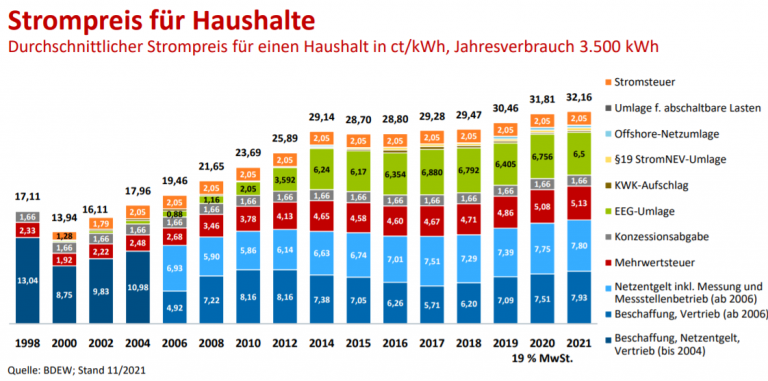


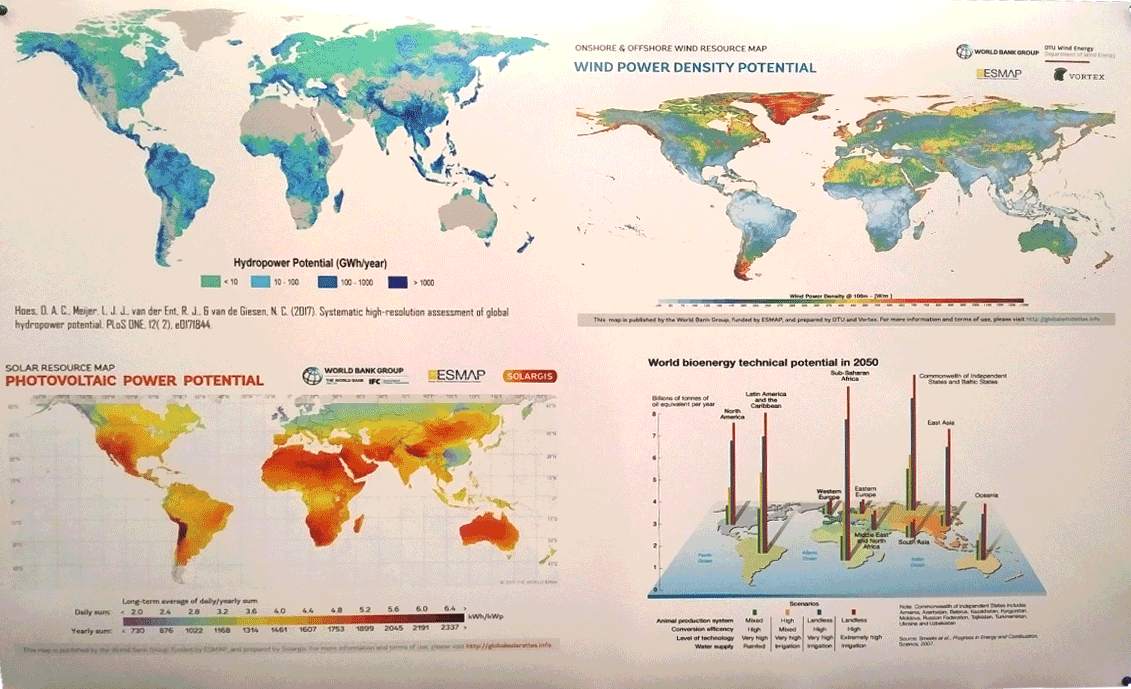

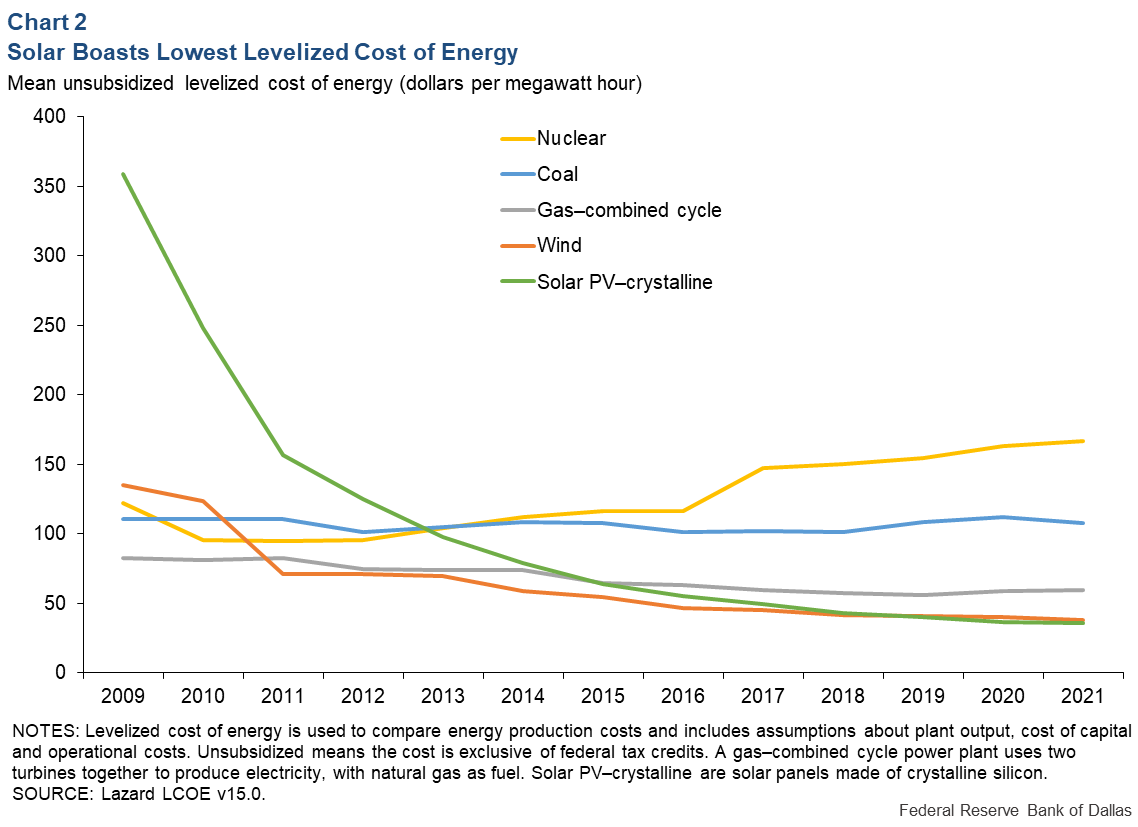
Uh...Germany's actually recarbonized by shutting down their nuclear [increasing coal and imported electricity to pick up the slack].
"The nuclear electricity production lost in Germany's phase-out was primarily replaced with coal electricity production and electricity importing. One study found that the nuclear phase-out caused $12 billion in social costs per year, primarily due to increases in mortality due to exposure to pollution from fossil fuels." --[https://en.wikipedia.org/wiki/Energy_in_Germany]
California's likely to have serious shortages [again] if they shut off the rest of theirs. Plus: "California's electricity rates are among the highest in the United States as a result of the changing energy mix within the state, including aggressive construction of new natural gas power plants." --[https://en.wikipedia.org/wiki/Energy_in_California]
I don't know enough to check the rest of the article, but this certainly gives me some doubts as to its accuracy.