If you go back to Steve Jobs' original iPhone speech, the crux of it was: revolutionary user interfaces (mouse, click wheel, multi-touch) enabled revolutionary products (Mac, iPod, iPhone).
And while we know the LG Prada shipped with a capacitive touchscreen that's a technicality: LG took the UI of a feature phone, minimally adjusted it for touch and that was it. Meanwhile Apple took their desktop OS and shrunk it to the phone.
This is to say, if Apple is working on something big, we can't predict it. To quote David Pogue's first iPhone review
> The iPhone is revolutionary; it's flawed. It's substance; it's style. It does things no phone has ever done before; it lacks features found even on the most basic phones.
Even if we had an inclination of what they are cooking, figuring it out is near impossible. And we don't.
Of course, as a person who lives with T2 diabetes, I'd love an Apple Watch with a noninvasive glucose sensor. But while I have no doubt it costs dearly to develop and most importantly, validate that, I would guess it costs like 9 figures total (which is enough for most companies not-Apple not to be able to crack it). These numbers here are 11 figures. Yearly. Not even close.
> Even if we had an inclination of what they are cooking, figuring it out is near impossible. And we don't.
This is some sort of strange myth-making. Making a touchscreen phone had been the writing on the wall and pretty obvious to many. Having a company set up and willing to do it and do it well is another matter. But it doesn't mean you can't see things coming.
> Making a touchscreen phone had been the writing on the wall and pretty obvious to many.
Really.
This reminds of this discussion https://reddit.com/r/oculus/comments/1wdp6n/what_makes_the_o... I opened a decade ago asking "What makes the Oculus different from previous VR?" and the winning answer was pointing out how much the 1994 IBM Simon Smartphone feature list resembled on the surface the iPhone feature list.
In other words, still watching the world through my own eyes, I have been a columnist of the largest computer monthly in Hungary from 1993 to 2001. Yes, the IBM Simon, the Nokia Communicator, the Palm, the Pocket PC, yes those were there
But none of that meant anyone could have foreseen the iPhone. Android history articles often mention how Google essentially needed to restart because of how revolutionary it was! https://www.theatlantic.com/technology/archive/2013/12/the-d... if there was a prophet who could foretell the iPhone their words didn't register in Mountain View, that's for sure.
If you think anyone did, the Internet does not forget, link it.
I'm not talking about columnists. Journalists are not people who build things. I'm talking about people who build things and think about what to build next.
The option of doing away with the hardware keyboard and going touchscreen-only was always there and always up for discussion, but for the longest time not easy due to the power and performance envelope at the price point. Lots of devices already worked like this outside of phones, for example a lot of touchscreen kiosk hardware (e.g. ATMs). It's just not a particularly big leap of the imagination to do this in a phone form factor. It was also present in mobile form in plenty of media and scifi, e.g. 2001's tablets.
What matters is whether you think you can pull it off, and whether you're willing to try, and whether you are able to identify the right moment to try. A lot of companies were not willing to try (e.g. out of fear of cannibalizing existing product lines or rejection by the customer). Others didn't have the tech stack necessary to do so.
What Apple did right is to have the good sense (or luck) to try it when the technology supply chain to back it was there, and not do it too early. Other phone makers wrote their tech stacks for much lower-power devices, and really struggled to scale their existing operating systems, dev community, etc. up to making a richer device, and didn't have the ambition to push for it. Apple started, as OP pointed out, by scaling down a desktop-class OS at a point where the hardware had just made it possible, and this worked out well. What made the iPhone a success wasn't just the form factor, it was also e.g. having a proper web browser (which Apple didn't even write themselves). This pattern replicates in a few other aspects of the device (supply chain for capacitive touch, batteries, etc.)
The iPhone is a fantastic success story of a good product concept, waiting for the right moment, sensible tech choices, solid tech asset management by a software company, very good industrialization, and great execution and integration. It's not a magic fairy-tale unicorn idea that no on else could think of.
It's annoying because it misrepresents and misunderstands what it takes to make a good product, and leads to internalizing the wrong lessons and values. It's one of the subtle reasons why there aren't more Apples.
The novelty in the iPhone wasn't a touchscreen, it was a capacitative multitouch screen and a UI framework that could do their app designs but still at 60fps.
Although the last one wasn't purely technical; IIRC Nokia got it, decided it was cool "because it was 60fps", tried to compete just by doing that and failed.
> having a proper web browser (which Apple didn't even write themselves)
Yeah they did. There wasn't that much KHTML in there at that point.
> The novelty in the iPhone wasn't a touchscreen, it was a capacitative multitouch screen and a UI framework that could do their app designs but still at 60fps.
I'd agree with this, but it's also not the narrative I was arguing against :-)
In other words: it was the attitude espoused by John Carmack more than Steve Jobs. New technology creates a new market IF you can make it work brilliantly well.
And, frankly, Carmack's "trick", which he does but doesn't admit to, is to rewrite everything from scratch every time he makes a release (more or less). That's how, that's why he got so incredibly good at it. Innovate once, optimize 10x (by throwing away what you got), repeat.
Companies don't do that, because it means having a department make tech demos and nothing else. Again, and again, and again, the SAME tech demo.
> I'm talking about people who build things and think about what to build next.
The market leader in smart phones, BlackBerry (RIM), with some of the best engineering talent in this space anywhere, didn’t see it coming. Their technical co-CEO didn’t believe it in the immediate aftermath of the announcement. Couldn’t imagine how the battery could manage all that. Immediately dismissed it as some sort of trickery.
None of what you say is in any way incongruent with what I said, though. It may mean BlackBerry didn't think it could be done, but it doesn't mean that no one in the company could conceive of a phone without a keyboard. They just didn't think it was a good idea or the right time, and didn't try.
The original post I replied to claims Apple is a magical place of unicorns with ideas that exist nowhere else. I'm arguing that it isn't the case, and that it's the willingness to try and execution ability that matter. It's more likely to be dismissing the idea that kept BlackBerry from doing it.
There is a lesson in there that speaks to the "we can't possibly figure out what they will do" in the original post. You very likely can. You also have to be willing to give your ideas the mileage.
I think what you’re forgetting is that a lot of people thought the iPhone would fail because it didn’t have a keyboard, and at the time smartphones were going more towards keyboard-driven devices than touchscreen-driven, and touchscreen more often than not meant touchscreen + stylus.
Apple committed to their own approach.
> having a proper web browser (which Apple didn't even write themselves).
WebKit was forked from our KHTML, even if it definitely had significantly deviated by 2007, and particularly UX-wise Mobile Safari definitely had many fantastic ideas. I didn't mean to be dismissive of it, it was more to point out that they also don't create in a vacuum, even their successes.
On the subject of WebKit, what you said is bollocks for two reasons.
1. You are conflating the rendering engine with the browser. Safari on Mac and iPhone uses WebKit as a core technology—really the preeminent core technology—but they are not WebKit and WebKit is not Safari on either platform.
2. Similarly, WebKit is not KHTML and KJS. WebCore and JavaScriptCore are forked from KHTML and KJS—and Apple did not and to my knowledge has never downplayed that nor denied it—but a fork of a project that sees significant new development work becomes a new project and takes on an identity of its own. By the time the iPhone was released, WebKit had been in development inside Apple for 6 years; and public knowledge since its announcement and Safari’s public beta for 4.5 years.
KHTML and KJS deserve and I believe actually receive their due respect, but it is wrong to say Apple did not develop their own web browsers.
> The option of doing away with the hardware keyboard and going touchscreen-only was always there and always up for discussion, but for the longest time not easy due to the power and performance envelope at the price point.
Not only the option was there, there were mobile phones with touch screens before the iPhone. Anyone remembers Windows Mobile? It resembled windows very much, including the start button. It was just ridiculous. One of the central innovations of the iPhone was making scrolling with touchpad as natural as flicking a piece of paper over a table. It seemed instantaneous. Most touchpads before the iPhone weren't capacitive. They required a lot of pressure. Using them for scrolling seemed ridiculous.
>If you go back to Steve Jobs' original iPhone speech, the crux of it was: revolutionary user interfaces (mouse, click wheel, multi-touch) enabled revolutionary products (Mac, iPod, iPhone).
This was specifically called out in the Vision Pro announcement. They are completely ditching controllers for VR/AR, and going full hand/finger tracked gesture control. It's why I think Vision will be the first device that people actually end up using in mass. The display fidelity is one thing, but interaction control is the number one reason why VR has failed. People (average normal people) really have no idea how to use game controllers if they didn't grow up as gamers. The platform will never take off until fully intuitive controller free interaction is acheived, and Apple knows this. Ambient computing is the next step, and keyboard/mouse will be a small footnote from the early history of HCI years from now.
I’m really hoping they crack that nut. I’m not diabetic, but I do wonder what would happen when someone figures it out.
All of a sudden you could basically put real time glucose monitors on a huge chunk of the population with all sorts of medical conditions or none at all.
What could we accidentally learn from that that no one was ever looking for?
The benefits to diabetics are obvious and life changing unless you already have a CGM. And if we never learn anything we didn’t already know it would still be a fantastic improvement. But what if there is more?
My understanding is that different people react differently to the same foods. For example, some people's glucose spikes after eating bananas, other people's doesn't. It would be great to know this, and other things, about one's self. I've considered doing a trial for a couple days with the foods I normally eat, just to know if any of my common foods are especially bad or good for my particular body.
Trust me my friend, even if you have a CGM the benefits would be gigantic.
I can't speak for T1 people who spend their entire lives like this and maybe it gets easier but inserting the CGM sensor, even if you use a local anesthetics is unpleasant and psychologically taxing. Then it interferes with your daily life and more importantly, it interferes with your mental health. Do you need a visual, can-be-felt reminder every second of your life you have a disability? I thought not.
I have worn one and made my own meal plans while doing so and then stopped wearing them and I am fine, I can control my own blood sugar fine with just eating well, I am now down to six month blood sugar checks just to make sure I do not relapse. Still, having a non-invasive check so you can more easily test new stuff would be more than welcome.
(T1 here) I agree that applying a CGM is nerve-wracking for a few moments, and can hurt if you accidentally hit a nerve. But I really don’t notice it (much like my spectacles or watch) in everyday life. However, I’ve been using a CGMS for years now, so it’s likely I’m “used to it” by now.
I guess as a T1 it’s much nicer to not poke your finger every few hours which is probably why I love CGMS’es, but if you’re not diabetic I totally get why a non invasive watch would be lovely. Heck, I’d very likely buy an Apple Watch if they actually do it. However I haven’t heard great things with non invasive measuring accuracy unfortunately.
I do wonder if it would be accurate enough. Maybe it would be useful to type two diabetics who have their blood sugar under decent control. I’m not expecting true CGM level accuracy.
Still whatever they could get if it was reasonable enough to be useful I’m sure insurance would much rather give people an Apple Watch for a relatively low price then pay for expensive one time use medical supplies over and over.
I mean how long would it take before just the price of test strips would add up to the cost of a fancy Apple Watch?
I don't think it's anything as sexy as some world-shattering AGI, etc.
Remember they are doing a lot of building and research on things other companies already do: cellular modems, microled, etc. This is probably where a large portion of these costs go: the refinement of production ready devices and the manufacturing processes/plant needed is incredibly expensive.
> I don't think it's anything as sexy as some world-shattering AGI, etc.
AGI is a moonshot, and Apple doesn't talk about their in-development moonshots until very late in the product development cycle. There's evidence that ChatGPT lit a fire under their butt¹ as it did the rest of the tech industry, so I'd be surprised if whatever they're working to launch this year didn't have tendrils reaching years and decades into the future.
This makes me wonder, sure there is a large investment cost in creating many of those things. But is the Maintence/upgrade cost (particularly for things like the modems) the same or less than the investment to do it in the first place?
If they are going to own as much of the internal hardware as they clearly want to, they have to be ready to continue to innovate or risk falling behind.
I ask because I legitimately don't know the answer, but its something I have been curious about.
With how much they pay for modems and licensing, I can imagine that they have done forecasts of how much they could save by DIY. Even having a slightly inferior modem product in one low price sku is a huge bargaining chip that could save them billions in the long term.
It's behind a paywall but Barron's just removed Apple, Meta and Tesla from their "magnificent seven." Microsoft, Alphabet, Amazon, NVIDIA remain.
They were bearish on Apple due to revenue declines for 4 consecutive quarters and lack of growth in sales in iPhones and Macs as well as a high PE ratio. They suggest Vision Pro won't "move the needle."
They prefer Alphabet over Meta and having both in a portfolio might be "redundant."
I think everyone is hoping that. Non-invasive glucose monitoring is a major holy-grail piece of medical technology that would help people almost immediately.
If they did develop this, they'd likely make as much money selling the IP to medical technology partners (e.g. hospital equipment) as they would adding it to the Apple Watch.
- AR Glasses would be one but they still feel like a decade away
- Whatever happened to the Apple Car?
- Apple Watch with more sophisticated medical sensors for sure must be in there.
The Apple Silicon project has to have been fantastically expensive.
They now use them in all of the watches, all of the phones, all of the macs, all of the ipads and ipad pros, all of the headphones, and the current and future AR systems (there is also a special Apple Silicon AR coprocessor in the Vision Pro, separate from
the Mx CPU/GPU/SoC).
They are designing and iterating like 4 or 5 different custom chips, with many of them incorporating industry-leading GPUs, and having them manufactured at scale (which I’m sure is not a simple handoff but involves additional engineering to support high yield manufacture).
This project alone is larger than most technology companies that have ever existed, and a lot of the staff for it must be extraordinarily compensated to retain them (as evidenced by the fact that a bunch of them recently left to start a new chip company (Nuvia) which was then acquired by Qualcomm for $1.4B).
IMO for a place like apple, where they are buying chips in such volumes they define entire production runs anyway and define target design specs for vendors there is probably already a lot of cost they are consuming where adding something like the apple silicon design project is cheaper. The marginal cost of going full apple silicon is lower as a result. Apple has also been very frustrated with their chip vendors, especially intel, in making what they want so I imagine it started as a 'last resort' project after they've exhausted their vendors.
While another smaller place that wanted to do something like apple silicon would have much higher marginal costs because they would need to spend on the things that apple was already spending on implicitly. It became an economy of scale thing.
I think AR/MR are good candidates for investment for Apple right now. They just launched sales of their Vision Pro today, shipping in two weeks. They are launching an entire new category of product which necessarily requires a broad spectrum of deep engineering investment. The current product is clearly too bulky and expensive for mainstream appeal, so they are going to need to release repeated generational improvements to both cost and size. The ten years from AR glasses is ten years of heavy product investment.
And as others said, there is a lot happening in AI too which would go well with headsets and phones alike.
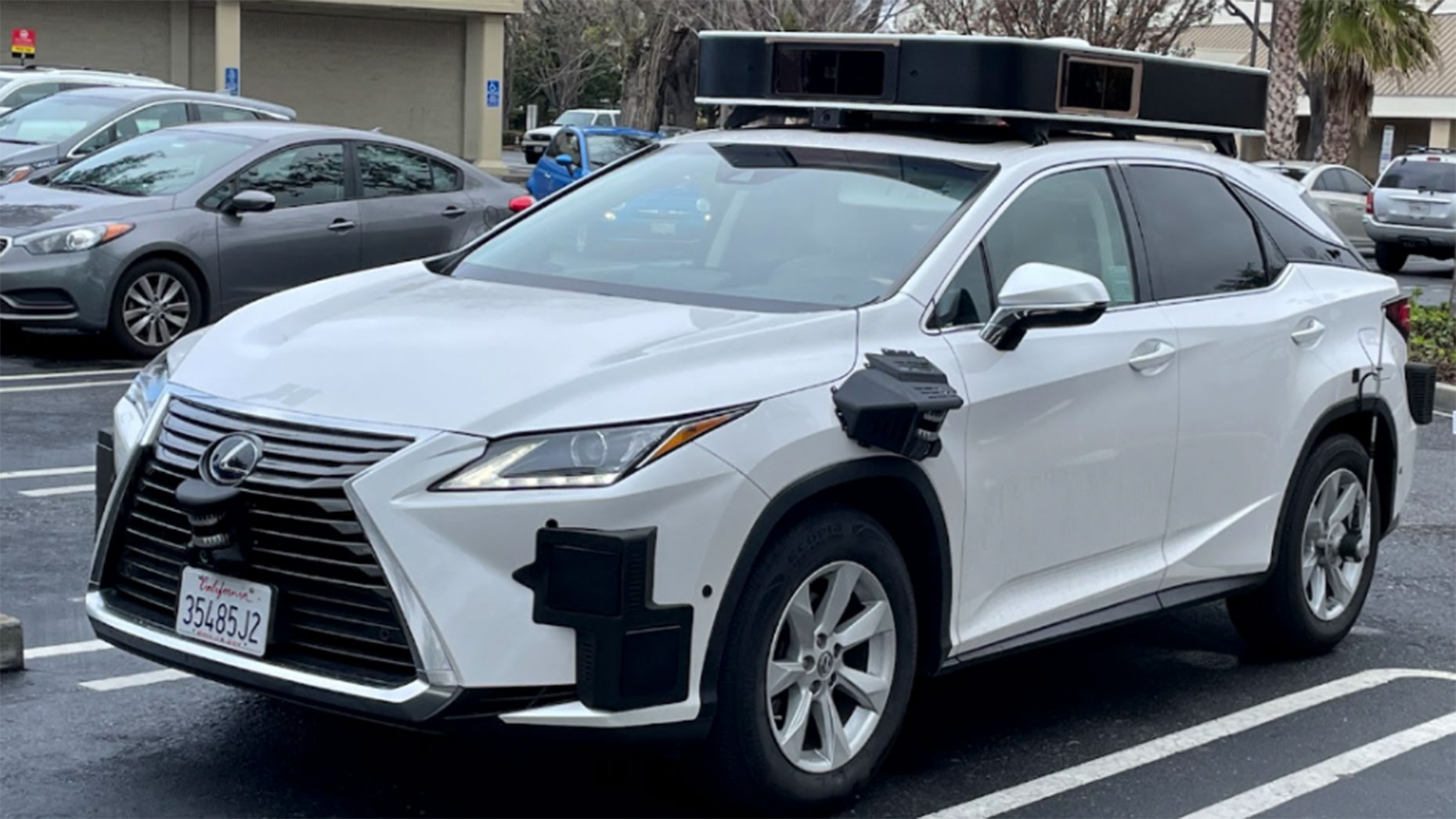
There are unlabeled, very slick looking LIDAR enabled cars driving around the Mountain View area - I've been told by a few folks on HN and IRL that 'everyone knows' they're Apple vehicles.
Unfortunately no, and I should mention a cursory search turns up known driverless startups active in Mountain View - so I think unless any other HNster has better evidence, treat me as hearsay.
I also shouldn't oversell them, the ones I've seen look 'slick' in that they are similar to other well-polished LIDAR test vehicles that aren't just a bunch of sensors bolted to a roof rack, and they're 'mysterious' in that they're unmarked.
Ghost has a weird pattern and their name on the sides of the vehicle. Nuro is uses Prius' mostly. Woven planet/Toyota tends to have slicker looking vehicles. They're the right vehicle in this picture:
I guarantee LLMs are a big piece of it. Not necessarily ChatGPT-like interfaces but instead dynamic interfaces/behavior that intuit what you want the device to do, especially on mobile where the user <> device interaction bandwidth is quite constrained.
>the company built its own large language model called Ajax and rolled out an internal chatbot dubbed “Apple GPT” to test out the functionality. The critical next step is determining if the technology is up to snuff with the competition and how Apple will actually apply it to its products.
>Giannandrea is overseeing development of the underlying technology for a new AI system, and his team is revamping Siri in a way that will deeply implement it. This smarter version of Siri could be ready as soon as next year, but there are still concerns about the technology and it may take longer for Apple’s AI features to spread across its product line.
I wonder, will they launch this as "Siri, but actually useful" or will the Siri brand be replaced altogether.
If this next-gen LLM-based Siri is built to take advantage of local documents/data with all processing happening on-device, I think it could be more useful than incumbent LLMs in some ways even if it’s technically not as smart simply because it has far more relevant context by default. It being local-first could also help assuage privacy concerns and make users less reluctant to use it.
I'd be happy if they used an LLM interpret the command so Siri could better understand what to do without specific wording or requiring multiple separate commands.
This is yet another instance of people simply not understanding what R&D spending means in the context of tech. Most employee salaries are R&D. Cloud compute is R&D. Any expense related to developing any of their existing products or services gets categorized under that bucket, and they get tax breaks on it.
AI is the greatest threat to Apple’s dominance. They might be spending billions on creating an AI-centric iOS and iPhone, and that would be money well spent. If Android phones put a personal secretary in your pocket, fully integrated throughout the device, then iPhone users would be very tempted to switch without feature parity.
I don't think he would be shocked to see this comment, though, since it is materially identical to the complaints I remember reading circa 2010 and is as willfully ignorant of the Vision Pro as those complaints were of the iPad, and later the Apple Watch and the AirPods (when 'the FBI will destroy Apple's privacy edge' was the government conflict du jour).
I don't mean to come across as standoffish here, it's just, this complaint reads to me like the "HN is becoming reddit" complaints. People have been saying it forever, so, without any new evidence, it just reads like the same old prediction that hasn't come true yet.
And if they didn’t invest in r&d the same people would say they’re stodgy dinosaurs cashing in on what they’ve got ABC heading for extinction. Like HN said about Microsoft 15 years ago.
> as willfully ignorant of the Vision Pro as those complaints were of the iPad, and later the Apple Watch and the AirPods
These are the evidence of the opposite.
Apple's hardware from the 70s and 80s, like the original Macintosh, were something special. NeXTSTEP, the Steve Jobs thing that got rebranded as Mac OS X when Apple bought them, was the first modern OS to be simultaneously good and popular. The iPhone changed what a phone is.
The iPad is an iPhone, but bigger. The watch is an iPhone, but smaller. These are not innovations of the same kind. They're the sort of thing you'd expect out of Facebook or Amazon or any other large mature bureaucratic corporation.
If the Apple II was the 70s and the Macintosh was the 80s and NeXTSTEP was the 90s and the iPhone was the 2000s, name the thing of this caliber they did in the 2010s.
> name the thing of this caliber they did in the 2010s.
Well, you had to wait for the 2020s, but Vision Pro. It's an entirely new computer, meant to be your primary device. It's similar to how the Mac came out when PCs already existed, but were just different.
The Vision Pro is hardly differentiated from the top end Meta VR model. There are a few UX enhancements, and I think they'll take the lead in the space eventually. But I wouldn't say this is a big innovation in the VR space from what I've seen.
The iPhone was hardly different from other touch screen phones at the time, except for the UX enhancements. And it turns out good UX changes the world.
Pay attention to how people talk about the experience of using Vision Pro vs other headsets. The eye tracking interface is widely praised and described by third parties (not just Apple) as feeling like magic.
I haven't used it yet, but I can imagine what using a computer would be like if I didn't have to actually point my mouse anywhere and instead it could effectively read my mind about where I want to click. IMO this is the interface revolution that will become ubiquitous over the next 5-10 years, and Apple is once again leading the charge.
> The Vision Pro is hardly differentiated from the top end Meta VR model.
I think their approach is unique. They are branding it as a replacement for your computer. The one and only device you need to be productive. And don't underestimate the value of not needing controllers.
Google glass was ahead of its time. And was creepy with its recording ability and other features it launched with. Also, it was only a display for an attached phone for the most part. It couldn't really do anything.
Why would you want a computer strapped to your head? Computers generate heat and have weight that you'd rather put in your pocket than have to support with your neck. To make it work you're stuck with a trade off between performance, weight and battery life when none of those is fun to sacrifice in this context.
Moore's law has been dead for a while now and nobody really knows how much more we can get in terms of performance per watt. But even if it continues to improve, you're implying that what they've got right now is this:
Or maybe worse than that, because the trade off never really goes away. Desktops and servers are still faster than laptops, but portability is a huge advantage, so sacrificing some performance is worth it to have something with you everywhere you go. But how much performance is it worth sacrificing to avoid having a phone in your pocket? Nowhere near as much as it is to avoid lugging a desktop computer around with you.
Or to measure it from the other side, lots of people still have a Macbook even though they also have an iPhone.
That's why I said Moore's law limping along.. it has slowed significantly, and the original transistor doubling every 18~24 months is definitely dead, but transistor processes are still improving, slowly.
The trade off is always there, but more people are using their phones over their desktop computer these days.
That said, I do have serious concerns the greater impact to society in general when transistor technology hit a hard roadblock. Probably outside the scope of this discussion though.
> That's why I said Moore's law limping along.. it has slowed significantly, and the original transistor doubling every 18~24 months is definitely dead, but transistor processes are still improving, slowly.
What they're really doing is getting more power efficient. The "feature size" (number of nm) is fiction at this point. And the tricks they're using to eek out improvements at this point are, uh, interesting. Like they can't make it better without causing errors to occur so they just do that anyway and cover it up by using more error correction. It's really not obvious how much more of this there is to be found.
> The trade off is always there, but more people are using their phones over their desktop computer these days.
That isn't exactly true. The growth in the number of people with a desktop computer has leveled off, but it hasn't really gone down, and the things people use them for are still the same things. If you're going to write a long document, you're going to want a full-sized keyboard. The GPU needed for modern AAA games isn't going to fit in a phone. Professional activity that requires a lot of computation, like compiling code or editing video (or, going forward, a lot of this AI stuff), is a lot faster on a high-power device with more CPU or GPU cores.
What actually happened is that at least the same number of people still use a desktop computer, but now everybody has a phone, including the people who traditionally had a desktop (and still do). So more people have a phone than have a desktop, but not because fewer people have a desktop.
And it would be hard for some new technology to do the same thing to phones because nearly everybody has a phone. A new device can't have 20% more users than phones do when 97% of people have a phone.
Why weren’t there tons of earbuds that looked like AirPods before the AirPods came out? Two independent things that weren’t linked with a wire that you could put in a charging case?
I seem to remember there was one other similar looking device at the time, I think from Samsung. But it wasn’t as small and got terrible battery life.
There was absolutely nothing like them at the time in the category.
> Why weren’t there tons of earbuds that looked like AirPods before the AirPods came out? Two independent things that weren’t linked with a wire that you could put in a charging case?
Because making them that way is more expensive.
> There was absolutely nothing like them at the time in the category.
iPhone: There is now a usable internet-connected general-purpose computer in your pocket.
AirPods: We got rid of the piece of wire between your earbuds.
> iPhone: There is now a usable internet-connected general-purpose computer in your pocket. AirPods: We got rid of the piece of wire between your earbuds.
Most people who have AirPods didn’t have earbuds with the wire. Those who did didn’t wear them like AirPods. The iPhone is a computer in your pocket you interact with through touch. AirPods are computers in your ears you interact with through voice. Especially with LLMs, the latter is a huge step forward.
Also, the processing power in an AirPod outclasses Apollo 11’s; if we’re going to go full tech reductionist, it’s still a feat.
> Are you really contending that this is a difference of the same magnitude as the iPhone?
Yes. Convincing a large fraction of the population to not only adopt a novel computing device, but attach it to their person in a publicly-visible way is something that happens a few times a generation at most.
AirPods are far more broadly adopted than the Apple Watch. I’d also argue against the latter having the sense of design finality the AirPods came out of the door with. Similar to the iPhone.
> AirPods got people to stop complaining that Apple took away the headphone jack. I suspect that might have even been the main reason Apple made them
Doubtful given development timeline and sourcing. It’s more that they arise from a shared vision.
They literally were the next iPhone. Apple mainstreamed the wireless earbuds product category in 2017 and then proceeded to dominate it. (Note that Apple owns Beats as well.)
Urgh AirPods are really annoying, I'm not a fan of their propagation. I would say 50% of folks I work with use them for video calls now. They have some cut in behaviour so you miss the first part of what those people say every time they start talking. They also have a much higher incidence of "sorry, it was using the laptop mic / speakers" and waiting for people fiddling about. If you're not into your audio setup get a wired headset for remote calls please...
We went from earbuds looking like one thing, to basically everyone wearing airpods-like things with great noise cancellation and usability. I'd say that's a home run.
>If the Apple II was the 70s and the Macintosh was the 80s and NeXTSTEP was the 90s and the iPhone was the 2000s, name the thing of this caliber they did in the 2010s.
Arguably, the iPod was 2000s and the iPhone was 2010s. The iPhone really didn't get started until the iPhone 3GS in middle-2009 so it started slowly but really defined the 2010s for Apple.
That's just as true of the others. NeXTSTEP was the 90s but "Mac OS X" wasn't released until 2001. But if you asked someone in 2004 or 2014 if Apple had done anything interesting recently, you'd have been able to name what it was.
> If the Apple II was the 70s and the Macintosh was the 80s and NeXTSTEP was the 90s and the iPhone was the 2000s, name the thing of this caliber they did in the 2010s.
To be fair, AirPods that aren't Max and (maybe) Pro are complete garbage. Any wireless headphones in the same price range and often cheaper is better at every category except integration with Apple ecosystem.
I don't think he'd be shocked. More like disappointed. Most innovators and future thinkers understand the entropy of large organizations left to business-types.
Apple is one of the most successful business on the planet, and has been for years. Jobs would be shocked to see how big of a money pool he could swim in.
You forgot to mention that the only reason people buy Apple products in the first place is because of marketing. If the sheeple ever wake up, Apple is doomed.
Or so I've been hearing for, what, the last decade or more?
Even despite how displeased I am with Apple right now, I can still clearly the edge it has in technology, how neatly integrate their software/hardware stack is etc.
Marketing is strong on Apple, but they do have great products. They just failed to do anything meaningful since the IPhone.
Don't come tell me about Airbuds, iPad and iWatch, they are all really obvious and soulless products. This isn't anywhere the kind of product innovation Jobs used to push.




And while we know the LG Prada shipped with a capacitive touchscreen that's a technicality: LG took the UI of a feature phone, minimally adjusted it for touch and that was it. Meanwhile Apple took their desktop OS and shrunk it to the phone.
This is to say, if Apple is working on something big, we can't predict it. To quote David Pogue's first iPhone review
> The iPhone is revolutionary; it's flawed. It's substance; it's style. It does things no phone has ever done before; it lacks features found even on the most basic phones.
Even if we had an inclination of what they are cooking, figuring it out is near impossible. And we don't.
Of course, as a person who lives with T2 diabetes, I'd love an Apple Watch with a noninvasive glucose sensor. But while I have no doubt it costs dearly to develop and most importantly, validate that, I would guess it costs like 9 figures total (which is enough for most companies not-Apple not to be able to crack it). These numbers here are 11 figures. Yearly. Not even close.