> The "you can't be 100% sure" argument is impossible to defeat, and I don't think this design will move the needle.
You can thank Greenpeace and CND and their misinformed campaigns for that.
Meanwhile fossil fuels have killed tens of millions of people, billions of animals, and changed the climate. All directly or indirectly.
Somehow, it's a version of the quote "Kill one man, and you're a murderer. Kill millions of men, and you're a conqueror", a few deaths due to Chernobyl, and people are focused on it.
But those dead miners? Or those old people with lung disease? Or those thousands of miles of bleached, dead coral?
> You can thank Greenpeace and CND and their misinformed campaigns for that.
I always think it's funny when HN thinks that Greenpeace is omnipotent. Their very first campaign in 1971 was against commercial whaling, which still hasn't stopped more than 50 years later. Greenpeace also has a decade-long campaign against oil, which has not exactly succeeded.
Why are HN readers so quick to think that Greenpeace is all powerful? Or is Greenpeace just a convenient boogeyman to trot out whenever anyone is critical of nuclear power?
Failure in one endeavour doesn't predict failure in another.
You're making the same logical error you're accusing others of. But if you'd like to know, it's because there's a frequent association between the two. But truthfully I think people use "Greenpeace" as a stand in for any environmentally focused organization because it's the one they're most familiar with. There is direct connection with the nuclear case, but as another user points out the Sierra Nevada Club has uncontestable bias given that there are records showing that they took money from natural gas companies to support their anti nuclear campaigns. (I'm unsure if there's as clear evidence for GP. Maybe someone could link. I'm aware of indirect evidence but if someone has financial statements -- like we have with SNC -- I'd appreciate that)
As for why might success in whaling be different than nuclear? For one, whaling was already a huge established industry, while nuclear was budding. I think that's a key difference you can't ignore. Not to mention that whaling doesn't have a direct connection to bombs, not to mention that biggest bombs we've ever made.... Importantly, I think you're also undermining the success of their anti whaling campaigns. Synthetic oils almost certainly had a larger impact but it wouldn't be surprising if their efforts helped accelerate the adoption. Whaling might not have "stopped" but it has as a global industry.
As for oil, well, again, harder to take down a well established large industry. Especially when so much is dependent upon it and ethics gets complicated when you get into nuance (you want to shut down hospitals?). It's also a not harder to do when you fight against alternatives because they don't pass a purity test, even if they are strictly better (and by a lot).
I think we agree on more than we don't. You're listing very reasonable reasons why Greenpeace has failed to, say, reduce our fossil fuel use to meet the Paris Accords, and why whaling hasn't been completely eradicated. (FWIW my family just got back from Norway, and there were many restaurants and stores that sold whale products for food.)
Having said that, your reasons for the campaign against nuclear power include the fact that it's related to bombs, which has nothing to do with Greenpeace. You also reasonably said that "Greenpeace" is short for "environmental groups at large". To me this means that civil society in general came out against nuclear power, which lead to nuclear power being curtailed, which is... how civil society is supposed to work?
If the underlying argument is "I wish people in the 1980s had a better understanding of the benefits of nuclear power plants and we had continued to build them, albeit with better safeguards" then I would 100% agree with you.
But every time there is a discussion of nuclear power on HN there is a top comment blaming the current lack of it on Greenpeace. It's lazy and intellectually bankrupt.
To say that civil society came out against nuclear power after two high profile disasters, due in part to mainstream environmental groups' campaigning, but also due to high construction and electricity costs, low trust in the industry, and the availability of (imperfect!) alternatives, would be much more accurate, if less exciting to upvote.
  > the fact that it's related to bombs, which has nothing to do with Greenpeace.

  >> Greenpeace got its start protesting nuclear weapons testing back in 1971.
> "Greenpeace" is short for "environmental groups at large". To me this means that civil society in general came out against nuclear power,
I think you took the meaning different than intended. I'm more saying that someone might substitute "Sierra Nevada Club" with "Green Peace". This includes when people blame.
As to the claim that there was dirty money involved, well I find that when I post sources my comments get less engagement. But here's an example (there's others that are easily searchable. Including governments because yes, weapons and energy production are related. Due to enrichment. They don't need to be, but it is an avenue to justify enrichment even if the quantities are dramatically different).
> But every time there is a discussion of nuclear power on HN there is a top comment blaming the current lack of it on Greenpeace. It's lazy and intellectually bankrupt.
I'm pro nuclear, have a physics degree, and have worked on nuclear tech; I agree with you. But I also think the same is true for the other side (I'll note that I frequently correct many pro nuclear comments. But I'm just tied today and trying to stay off HN more. If you search my history breeder reactors are a common topic).
Truth here is that these conversations are excellently complicated. Climate change is one of the, if not THE, most complicated challenges humans have ever faced. All the sub topics have a lot of nuance and complexity to them as well as a lot of misinformation. Even with strong domain backgrounds these are hard topics! (And I doubt many HN users have strong backgrounds in atomics, PV, battery production, energy transmission, various physical engineerings, and so on, let alone all at once) But I do believe a lot of people care and a lot of people are on the same side (fixing the planet and moving away from fossil fuels). And I think it'd be better if we saw that common ground and would argue as if we're on the same team instead of not. So let's bring what pieces we have to the table. Because when we argue like we aren't on the same team, oil is the winner. But I think we can all agree that be it renewable or nuclear (or honestly some combination that is best suited for a given situation and location) are leagues better than fossil fuels and gas. It's also important to recognize that neither camp offers a full solution to the problem. Luckily their solutions aren't complete overlaps. So please do still advocate your position, but we need to also recognize a common enemy who wants to split us apart. Let's save most of the arguing until they're dead. Clearly fighting each other hasn't worked.
> You're making the same logical error you're accusing others of.
His complaint is that GP stopping nuclear is BS with no evidence. Your comment can be summarized as "I don't see why it couldn't be true" without presenting any evidence that it is true.
Germany didn't quit nuclear power because of Greenpeace. They quit because Japan kept unsafely operating a nuclear power plant that was older than the one in Chernobyl until a tsunami caused a meltdown.
As someone that grew up in the UK in the 1970s and 80s with 3 TV channels that reached the majority of the UK, Greenpeace were a fixture on mainstream news. The past was somewhat different to today.
As a New Zealander born in the 70s I very much remember Greenpeace protesting against the testing of the nuclear weapons, the snap election in 1984, the 1985 bombing of the Rainbow Warrior and then becoming nuclear free in 1987. Nuclear power was never going to get of the ground in that environment. In NZ, being nuclear free is like the 2nd amendment in the US.
In the 1970s the BBC news programmes gave huge amounts of air time to Greenpeace and CND. Greenham Common and CND being given the most coverage.
When the only source of information is a daily newspaper, or nightly news programmes, a huge number of people can be influenced by whatever a channel like the BBC was broadcasting.
Unlike today where you can read wikipedia (!) or switch to one of a hundred other channels and simply just not watch the news.
TV set the agenda back then, and the course of nuclear sentiment for a few decades.
That does not address the comment you reply to, which looks at actual results. All the things the comment mentioned are from that same time period too. That shows that all that exposure and "awareness" still being chased today apparently did not help to achieve an actual result. That means that you attempting to show that awareness was achieved does not contradict the parent comment.
This still fails to address the fundamental question: Why do so many HNers think that environmental groups have infinite power to shape public policy around nuclear energy, while they have failed to succeed in any number of other campaigns, including ones that are more serious (climate change) and/or self-contained (commercial whaling)?
Because being against nuclear was and still is to some extent the core idea that unites all green parties. There's nothing else they all agree on and nothing else that defines better the green vote.
Because of that, the green parties in most countries sold their votes in exchange of policies against nuclear as a first priority.
> being against nuclear was and still is to some extent the core idea that unites all green parties
Are there green groups that support whaling? Coal-fired electrical plants? Global climate change?
There are any number of other problems that "green parties" have in common. Having said that, it's important to note that Greenpeace and Sierra Club are not green parties, but non-profit organizations.
> Greenpeace and Sierra Club are not green parties, but non-profit organizations.
The line is much blurrier than you might think. The green parties originate directly from those movements and there's significant exchange with the non-profit world.
And yes, whaling or coal plants aren't pushed as much as nuclear as a subject, that's not even close.
Not wise to generalise - I'm an HN reader and I do not think "Greenpeace is omnipotent".
I used to be a Greenpeace supporter and would donate to them, even. Then I started to get harassed by their "premium donation agents" and stopped. Over the years, I have realised that they have taken up certain good causes (anti-oil, anti-whaling) but have also been rather misguided (e.g. stop all nuclear rather than argue for realistic-safe nuclear).
> against commercial whaling, which still hasn't stopped more than 50 years later
With the exception of a few native tribes in Canada and US, and the countries of Japan, Norway, and Iceland, I am pretty sure that all commercial whaling has stopped. And, the whaling that does remain is sustainable. If what I wrote is correct (I might have missed a country or two), I would say the campaign was successful.
It’s a convenient scape goat. The incredible impracticality of nuclear power is easily reducible to its immense cost vs other sources of energy. But that goes against the nerd creed of nukes smart. The marketplace long ago abandoned nuclear in favor of things that actually work.
>Why are HN readers so quick to think that Greenpeace is all powerful?
The nuclear lobby cant exactly blame the exhorbitant cost of nuclear power for their problems. They need a more exciting scapegoat that isnt "it's 5x the cost of the competition".
Imagine if all the governments of the world came up with a mass produced, cookie cutter, plant, rather than starting all fabrication and design from scratch for each plant?
Construction costs really aren’t the issue, they are just harder to hide. If you could get someone to build you an absolutely free nuclear power plant it still wouldn’t be cheap power. Just fuel itself which is generally assumed to be ‘free’ runs nearly half the cost of solar power per kWh by the time you’re dealing with actual fuel rods you can stick in a reactor not just ore or 99.3% U235 0.7% U235 metal.
Then with that leftover margin, you need to cover everything from land costs to new equipment as thing break over 50+ years. Manned 24/7 operations take ~500 people per GW over the plants full lifetime, as are less obvious expenses like insurance and mandatory downtime for weeks at a time requires something to pick up the slack, etc.
Nuclear just ends up expensive even without any safety concerns.
> by the time you’re dealing with actual fuel rods you can stick in a reactor not just ore or 99.3% U235 0.7% U235 metal.
It's actually possible to run a reactor on natural unenriched uranium. IIRC the first man-made reactor ever, the Chicago pile, used natural uranium. Why did we stop using natural uranium in reactors?
Read up on CANDU, it ends up being slightly more expensive and produces more high level nuclear waste. Currently they’re enriching uranium even if the design doesn’t need to. https://en.wikipedia.org/wiki/CANDU_reactor
There’s a lot of different trade offs you can make with nuclear designs, but so far non of them have been demonstrated to actually be meaningfully cheaper.
Isn't that a chicken and egg problem? These small designs are supposed to be (more) automated, so they wouldn't need huge teams of people 24/7. My main response to the idea of sticking one so far underground is that you might as well just make a geothermal plant.
The physical bit of reactor where the fission happens is left alone in operation. All the pipes, steam turbines, pumps, plumbing, cooling towers, etc etc do and this wants all of that on the surface.
Theoretically stuff like EPR is supposed to be a cookie cutter design.
Actual implementation of said design has had a lot of issues, hence the escalation of costs. And it’s not easy to iron out and iterate on something that is billions of dollars a piece when a solar panel is in the thousands and a wind turbine is in the millions.
It’s just that solar panels can be imported from China without needing a skilled specialist workforce. Yey free market
But nuclear has to be built here, and we in the west suck (especially UK/US, France still holding out) at building any big infrastructure without cost overruns. ‘Free market’ doesn’t like the risks of large, hard to finance, one off projects. And our governments have decided that if central planning doesn’t work, then they don’t need to plan anything at all.
Combine that with lack of skilled staff workforce as all the people who built previous nuclear powerplants have already retired and the western firms wage war against their own skilled engineers, and you have a toxic cocktail.
TL SR: the only reason Small Module Reactors are interesting is because they could be made in China and imported by our lazy system
no, SMRs are interesting because they represent smaller units of power. Nuclear reactors are huge things generating power in one specific location, so they're a large point of failure. In addition they have the opposite coin problem of solar and wind; whereas solar and wind don't generate enough power sometimes, nuclear often generates too much power for the grid, and can't easily be turned up or down. A lot of the pumped hydro we have was not developed for solar and wind storage, but for excess nuclear storage. Most hydro in Japan is pumped hydro for nuclear plants: https://en.wikipedia.org/wiki/Hydroelectricity_in_Japan
If you are going to wind up with the same energy storage problems with nuclear or newer renewables then you may as well go with the cheaper option.
Renewables have the problem on both sides though, they overproduce and underproduce. And the variability of this overproduction and underproduction is much greater than any nuclear plant.
This was a major ordeal as long as we could not conveniently store massive amounts of electricity nor transport it far away, or quickly and frequently balance the grid (hence the need for 'baseload' generation).
Which source states that more than a few minutes will be necessary, once the adequate continental system (storage: including V2G and similar ways such as Powerwalls) will be in place?
> the efficiency is beyond terrible
... when used in transportation. Green hydrogen produced then stored nearby a turbine or fuel cell acting as backup for the grid efficiency is similar to fossil fuels' or nuclear (about .3 to .4).
> That's why no country on earth is managing with those.
> Which source states that more than a few minutes will be necessary, once the adequate continental system (storage: including V2G and similar ways such as Powerwalls) will be in place?
Ever looked at an electricity demand graph? The electricity demand isn't linear, it's not linear in a day, not linear in a week and especially not linear in months either in the northen hemisphere. And the more you decarbonize the economy, the worse it's going to get for renewables here since fossil fuels are used for highly non linear usage.
> Green hydrogen produced then stored nearby a turbine or fuel cell acting as backup for the grid efficiency is similar to fossil fuels' or nuclear (about .3 to .4).
You are mixing up two things. Nuclear, since it's a baseload technology, only needs to adapt itself to the demand, the production can mostly be planned. Renewables on the other hand need to adapt both the demand and the production.
Those efficiencies figures aren't needed for nuclear because you don't need P2G or any of that, you can just adjust the production. So you get the usual production. Nuclear doesn't drop abruptly to 5% capacity and those bandaid solutions aren't really needed.
What you are quoting is the efficiency of the production, which is a totally different subject. The efficiency of the production is more of an indication of how far you can actually go in the future.
Overproduced electricity can be stored. V2G will play a major role.
> You are mixing up two things
I doubt so. I was stating that hydrogen may become a clean backup, replacing fossil-fuel existing plants, some of them (burning methane) may be retrofitted. Water electrolysis done in centralized plants gathering electricity overproduced at continental level in order to obtain and locally temporarily store hydrogen, maybe even benefiting from co-generation, will locally burn it (gas turbine or fuel cell) in order to produce electricity when the grid needs it while renewable sources cannot provide enough.
> aren't needed for nuclear because you don't need P2G or any of that, you can just adjust the production
Nuclear can 'modulate' its output up to a certain level and frequency, which in practice are insufficient. Even over-nuclearized France never enjoyed a zero-carbon grid: each year between 6% and 12% of electricity is produced by burning fossil fuel ( https://ourworldindata.org/explorers/energy?Metric=Share+of+... ) because exploiting enough reactors to cope with the mandatory load-following and also with the peak load would be way too expensive.
There are safety-related limits (power modulation proportion, duration of a pause needed after each modulation, modulations frequency...) to nuclear load-following capacity, and the very combustible status is a major parameter. Pertinent document (French ahead!): https://www.sfen.org/rgn/expertise-nucleaire-francaise-suivi...
Proposed translation: "a reactor power output can vary from 100% to 20% in 30 minutes, then after 2 hours can go back to 100% at the same speed, and can cycle this way 2 times per day".
This is quite a good performance when it comes to load-following (French engineers are very good at this), however it is insufficient in the real world (save any ridiculously expensive over-provision of nuclear reactor, most idling) and very weak compared to gas turbines performances.
Those "bandaid" solution are needed with each and every low-carbon type of source, even nuclear. We have to consider the amount of emissions caused, in each type of system, by those solutions.
On a grid when it comes to the "production = consumption" rule there are 2 big types of challenge:
1/ short-term adjustment (under a few seconds). Nuclear, per se, just cannot cope. It is done by the sheer inertia of the turbo-alternator drive shaft. On a renewable system it can also be done this way, thanks to flywheels. It is already done.
2/ long-term adjustments. It is either done by reducing the output of production units, or storing or wasting it or (if production isn't sufficient), by a reserve of "production" units (batteries, green hydrogen turbines...).
> Those "bandaid" solution are needed with each and every low-carbon type of source, even nuclear. We have to consider the amount of emissions caused, in each type of system, by those solutions.
Well no, they simply aren't. It's true that nuclear simply cannot do the same as gas but renewables on the other hand are in a league of their own way outside of any baseload tech. That's why they are considered intermittent.
No nuclear fleet drops to 5% capacity for weeks at a time like solar or wind, that's simply not a thing.
> short-term adjustment (under a few seconds). Nuclear, per se, just cannot cope. It is done by the sheer inertia of the turbo-alternator drive shaft.
The nuclear fleet takes around 30min to adapt the production right now in France. Not only it is done but it works in real life right now, unlike large scale P2G, green hydrogen or batteries which aren't used anywhere on earth for grid management.
> Overproduced electricity can be stored. V2G will play a major role.
Unfortunately no it can't. Unless there's a new breakthrough, dams is all we have for large scale electricity storage. And we can't count on tech which doesn't exist yet.
At the end of the day, the proof is in the pudding, even Germany which built tons of supposidly green hydrogen pipes will use them for transporting ... gas.
Well no, unfortunately that doesn't work either. And the best example is winter 2022 where the whole western europe was out of wind for 3 weeks.
That's a nice idea but unfortunately it doesn't work with the real figures.
You can even check right now on electricity map, most of the EU countries have similar wind capacity production at around 20%. (Terrible figure in itself but that's another debate)
Edit : I forgot to answer that part.
> Even over-nuclearized France never enjoyed a zero-carbon grid: each year between 6% and 12% of electricity is produced by burning fossil fuel ( https://ourworldindata.org/explorers/energy?Metric=Share+of+... ) because exploiting enough reactors to cope with the mandatory load-following and also with the peak load would be way too expensive.
Unfortunately, France replaced a lot of the coal plants with gas plants to follow up renewables and is now stuck with it. France only had a single gas plant before 2010.
The consensus at the time was that those renewables would eat up the share of the gas plant and they could be removed altogether.
We now know that it doesn't work and the gas plants are there for good.
Green hydrogen is a work in progress, granted, however such "it was never done before" argument would have condemned France attempt do produce most of its electricity thanks to nuclear power.
>> Overproduced electricity can be stored. V2G will play a major role.
> Unfortunately no it can't.
What do you mean? Electricity cannot be stored?!
> Unless there's a new breakthrough
I proved (above) that stationary batteries already are a thing, quickly growing up.
> even Germany which built tons of supposidly green hydrogen pipes will use them for transporting ... gas.
Yes, due to a lack of finance and a very debatable plan (transporting hydrogen is more and more probably doomed).
> winter 2022 where the whole western europe was out of wind for 3 weeks.
> most of the EU countries have similar wind capacity production at around 20%.
20% is the usual load factor for terrestrial wind turbines. Offshore is way better (about 2x) but not as widely deployed. The goal is not to maximize a load factor but to produce enough energy to serve the needs, at minimal total long-term impacts and costs.
> France replaced a lot of the coal plants with gas plants to follow up renewables and is now stuck with it. France only had a single gas plant before 2010.
Here is a list of some fossil fuel backup plants and their building/extension dates: Brennilis (1981, 1981, 1996), Dirinon (1981), Gennevilliers (1991), Vaires-sur-Marne (2008, 2009), DK6 (2005)...
> The consensus at the time was that those renewables would eat up the share of the gas plant and they could be removed altogether.
True, however this will only be fully possible when the French fleet of renewable plants will be complete. We are far from this as France is notoriously way behind, partly because it wastes money on nuclear late-and-overbudget projects (EPR...). France was punished by the UE because it missed its own renewable objectives, there is no other case in the UE ( https://www.reuters.com/markets/commodities/eu-beats-2020-re...).
In France RTE is in charge of the grid (less the "last kilometer") and is a subsidiary of EDF (electricity producer, head of the nuclear sector. Here is what it officially and publicly declares about this: https://www.youtube.com/live/xP4jL4b_Nnk?si=g2-cryDt62TyJWuA...
Translation: "I absolutely confirm that technically every running wind turbine reduces the amount of consumed gas somewhere".
All the other existing gas plants in France were built post 2010 for renewables.
> We are far from this as France is notoriously way behind, partly because it wastes money on nuclear late-and-overbudget projects (EPR...).
France spent more than a hundred billions on new renewables alone (roughly half of the total cost of the nuclear grid). It's true that the results look even worse than the EPR though. And it's not counting these new gas plants and external costs on the nuclear grid in the total.
The renewable investments look so bad that there's people like you who think they haven't been done but they have.
There's multille reasons France is bring the nuclear program back from the dead and one of them is that the renewable investments underdelivered.
> In France RTE is in charge of the grid (less the "last kilometer") and is a subsidiary of EDF (electricity producer, head of the nuclear sector.
RTE benefits from grid investments for renewables so yeah it's not a surprise they are all for it. They are especially afraid of a merge to go back to the previous statu quo.
Remember that big hole in the production on the graph before? That's exactly the time where the president of RTE made a public speech for building renewables, when they produced closed to nothing.
You wrote that "solar and wind" can drop "to 5% capacity for weeks at a time", and I ask for the source of this, in order to check that if, contrary to all scientific studies, it is true for a mix (wind, solar...) deployed on whole continent. Guess what? It isn't! Check "How synchronous is wind energy production among European countries?" (Monforti, Gaetani, Vignati). This is also true in China (check Liu, Xiao Wang, Dai, Qi "Analysis on the hourly spatiotemporal complementarities between China's solar and wind energy resources spreading in a wide area") and America ("Is it always windy somewhere? Occurrence of low-wind-power events over large areas" (Handschy, Rose, Apt).)
> Daunkelflaute
It's "Dunkelflaute" (only one 'a')
"a single event usually lasts up to 24 hours" and "more than two days over most of Europe happen about every five years" (source: https://en.wikipedia.org/wiki/Dunkelflaute ), here is for your "weeks at a time". Moreover regions outside North of Europe are way less impacted.
> are used for very low scale grid management
And what exactly forbids to manage all local grids this way? This is more and more true, as being able to isolate a local grid is useful.
> The only large scale tech to store electricity are dams
As of 2022, the total combined energy capacity of electric vehicle (EV) batteries sold in Europe reached approximately 690 GWh, and grows very quickly.
Note: dams are a renewable source.
> The only exisitng gas plant stil used before 2010
> As of 2022, the total combined energy capacity of electric vehicle (EV) batteries sold in Europe reached approximately 690 GWh, and grows very quickly.
Lol, so for context, a single French person is using 2.5GWh/year. One single inhabitant.
France is consuming 1.2TWh of electricity per DAY in winter.
So the whole electric vehicle fleet in the whole Europe is worth half a day (being generous) of electricity just in France during the time which is the tightest in electricity. That's so low it's not even worth mentioning. And that's the whole Europe compared to a single country, that's not going to make it.
> Note: dams are a renewable source.
There's also pretty much no new place where you can build one in a developped country as it's an old technology.
> You wrote that "solar and wind" can drop "to 5% capacity for weeks at a time", and I ask for the source of this
Solar produces most of it's production during 6 months and only gives 3% of the yearly production on each month of January and February. That's the two months where the countries are using the most electricity for context and need the most production.
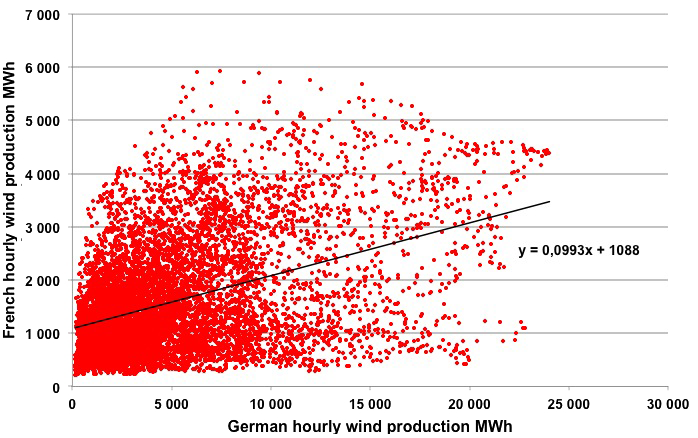
For wind, that happens regularly, even right now as we speak, Germany has a 7% capacity which isn't far.
> deployed on whole continent. Guess what?
The wind production is synchronized right now, you can check it. That's another kind of strange of being shown the reality right now and denying it.
Here is the statistics, when it blows in Germany, it blows in France and when there's no wind in France, there's wind in Germany either.
> This is highly debatable as the real total cost of the nuclear fleet is disputed. Remember: EDF's debt now surpasses 50 billion €...
No it's not disputed, there's extensive reports in France on that subject as it's a common talking point.
I don't know any study about the external costs of renewables though so 100 billion for around 10% of the production is the best scenario. And calling it a failure seems pretty fair even with the most generous figures possible.
At the end of the day, the proof is in the pudding anyway, if it had worked, the nuclear program wouldn't have been brought back from the dead. France already tried ambitious renewable investments to replace the nuclear fleet during a whole decade and it failed. What the country got instead was mediocre results for the price paid and an increased dependency on gas which proved to be a huge issue with the Russian war. Those who don't learn from the past are condemn to repeat it.
Your document (Jancovici) analyzes current production of the very incomplete fleets of neighboring nations while the pertinent studies take into account wind regimes of geographic zones where wind turbines can be deployed and which are far appart. Conclusions of adequate scientific (J.-M. Jancovici expertise isn't about wind regimes) in reviewed and published studies (J.-M. Jancovici isn't) are quite different (please find some pointers in https://news.ycombinator.com/item?id=41397343 )
The last part of your answer is mostly devoid of sources, and I don't want to write about mere opinions.
> if it had worked, the nuclear program wouldn't have been brought back from the dead
> France already tried ambitious renewable investments to replace the nuclear fleet during a whole decade and it failed
Those industrial renewables are very new tech, they evolve very quickly, France missed its own objectives on renewables (sole nation in the UE to do so), France isn't rich anymore (during its nuclearization it benefited from the '30 Glorieuses' and from an intense and expensive R&D at home and in the US)...
https://sites.google.com/view/electricitedefrance/messmer-pl...
You completely forgot that there's companies using electricity and we live in a world where individuals are on the top of that electricity chain.
Your figures are completly wrong and do not include the whole electricity chain.
France produces close to 500TWh/year.
So yeah, I confirm what I said, the whole europan fleet of battery which you thought was impressive can only last half a day of a single country.
Also assuming that nobody want to use their car in Europe of course for that particular half day.
> Not true in some parts of Europe (North, esp Scandinavia, Balkans...)
That's not going to revolutionize anything, the biggest spots in the EU are already taken.
> Conclusions of adequate scientific (J.-M. Jancovici expertise isn't about wind regimes) in reviewed and published studies (J.-M. Jancovici isn't) are quite different
That's amamazing, you are plain denying reality, I'll do it once again, right now:
There you have it. The reality is in front of your eyes, the statistics confirm that the wind patterns are matching and even the real-time data that you refuse to look also does!
Sure there's some existing differences in some regions and some outliers but not nearly enough change the fact that relying on neighbors when the wind isn't blowing is a dead idea.
> Determining which project delivers a 'mediocre result' is easy.
Yeah sure it's easy, the new renewables took half the cost of the nuclear fleet for 10% of the production.
You can't put any lipstick on that sorry, you can try to tweak it the way you want, it's so bad that France had to restart its program back from the dead.
And those figures aren't even including the adaptations to the grid and the gas plants which I think they should.
> The French nuclear program was never killed. When was it killed, according to you, by who and how?
It was killed in 2012 by president Hollande and even written officially in the law in 2015 with a maximum of 50% nuclear production. The idea was to do maintenance while renewables took over. The nuclear program only got brought back from the dead in 2023, because of the Russian war and the failure of renewables to take over.
If you basically ignore that they are all built in China. I'd say that's the most centralized mainstream technology to generate electricity by far, it's all down to a single country. We could even say it's down to a single person even, the power being so vertical in China.
> easy to scale.
Well if you don't care about how you are going to pass the winter maybe.
France also invested heavily in nuclear because they develop their own nuclear weapons. So a knowledgeable industry is key, even though the materials aren't exactly the same.
France spent around half of the cost of the nuclear grid on renewables and the result isn't even close. Renewables underdelivered by a huge margin in the past 10 years compared to what the country thought they would. That's a actually one of the reasons of the nuclear rebirth in France, along with the Russian war.
Greenpeace has become this wholly inelegant shortcut to mean the inefficient outrage-based left-leaning movement focused on problems with small impacts on our world-ending climate problems.
People are not afraid of a whale dying in the middle of the ocean. Concerned, yes (maybe), but that's it.
People are very much afraid of radiation thanks to a lot of misinformation, crappy movies, and yes, also to the fact that radiation is damn scary and dangerous.
Greenpeace and the green parties, while meaning absolutely well, have been useful idiots who helped shape the public opinion against nuclear and effectively doom an incredibly clean competitor of coal, oil and gas.
Doesn't matter - time's up. Wind and solar are now a viable alternative for generation, for a small fraction of the cost of nuclear, and if the Lithium and Sodium chemistries actually hit the implausibly low costs they are thought to be destined to, storage will also be solved before a single new nuclear plant can be built in the West. Pity, we would have a substantially less fucked planet by now.
The Soviets were pretty big on "nuclear all the things", given their expertise in it. (Chernobyl being more of an economic and operational/communication fuckup)
And also, it was a better solution to their particular set of challenges: powering remote installations far from the nearest urban center (and powerplant).
Anti-nuclear sentiment in Europe seems to have hardened as a consequence of (a) Chernobyl, (b) Germany realizing they'd be on the front lines in any war, & (c) various other nuclear incidents (US and UK).
In fact its self serving, in that reducing your own reliance on oil frees up more of your production for sale. Lets not forget that the latter Soviet Union was in large part propped up by the proceeds from its oil sales.
The Western antinuclear movement had their own agency and motivations, but because they happened to align with Soviet interests they may have received material support from the Soviets. If they did, that would make them useful idiots rather than puppets. Useful idiots mean well, they have more than enough good intentions to pave a long road with, and they are completely unwitting when it comes to whatever role they had to play in the broader geopolitical conflict.
Actually it is obviously inconsistent. (I think you meant to say, "It may seem inconsistent on the surface, but if it serves their overall agenda it can still make sense for them", or something like that). But that's not the concern here.
Which is simply: even after several iterations on this topic -- no one seems to be able to point to any actual indications of the Soviets having promoted such propaganda in the West.
What the hell are you talking about? That’s like saying it’s inconsistent for a basketball team to try and score points while also trying to prevent the opposing team from also scoring points. It’s certainly adversarial, but so was the geopolitical relationship between the Soviet Union and the West.
> I think you meant to say…
Don’t patronize me. I meant to say exactly what I said.
The basic messaging ("Nuclear power is good for me, but not for thee") is plainly and obviously inconsistent. I'm genuinely at a loss to understand why you would contest this.
The hypothesized messaging, that is. There's no evidence of such a propaganda campaign from Soviet side in those years (cover or overt), so this entire discussion is moot anyway.
There's no need to "allege" that they did. There was tons of propaganda to that effect in 1950s/1960s (just as there was in the U.S. at the time, though this has been largely forgotten). For example:
Finland was absolutely part of the West, despite its non-aligned status.
It was definitely not "third world", and you aren't even using the term correctly. As Wikipedia explains:
In the Cold War, some European democracies (Austria, Finland, Ireland, Sweden, and Switzerland) were neutral in the sense of not joining NATO, but were prosperous, never joined the Non-Aligned Movement, and seldom self-identified as part of the Third World.
> Finland was absolutely part of the West, despite its non-aligned status.
You’re making a tedious semantic argument while conceding my central point, that Finland was non-aligned. I’ve heard of respectful disagreement but you’ve managed to pull off disrespectful agreement.
The only point here is that, throughout the course of this thread - you've been consistently very sloppy both with basic geographic and historical facts, and in your core logic regarding this completely untenable theory about alleged Soviet influence that you've been holding onto.
And when people do fact-check you, you say they're making "tedious semantic arguments", or being disrespectful.
There's nothing disrespectful in their doing so, of course. They're just setting the record straight -- again, chiefly in regard to this nutty theory you've been promoting. If anything, they're doing you a favor.
Though I do agree that this discussion has gotten quite tedious.
You’re the one who’s been tediously nitpicking irrelevant points and attacking imaginary strawmen. For instance I never actually said that the Soviets supported antinuclear movements in the West by which, in the context of the Cold War, I obviously mean “the countries aligned with the United States and against the Soviet Union”, a set of countries that Finland was not, in fact, part of. It wouldn’t particularly surprise me if the Soviets backed those movements, because they backed a lot of similar movements, but I don’t have any particular evidence about the antinuclear movement in particular.
My point—which seems to be well-received since it’s up about 12 points—is that if the Soviets did, in fact, support these movements, it wouldn’t be inconsistent with their own use of nuclear power, or even their efforts to develop nuclear power in “non-aligned” countries in an attempt to curry political favor. Your attempts to claim otherwise are bizarre and incoherent, and none of your fact checks are factual or indeed even relevant to the topic at hand.
You're conveniently quoting me out of context. That comment continued:
> they may have received material support from the Soviets. If they did....
It should be obvious that it would have served the interests of the Soviet Union if their geopolitical adversaries had less abundant energy and less practical expertise in nuclear technology. I make no claims about whether or not the Soviets attempted to advance these particular interests by interfering in the domestic politics of their adversaries, even though they did interfere in other ways to advance other interests.
> Which "interests" were you referring to, other than the interest of discouraging nuclear power development in the West?
There is no “other than”. Discouraging nuclear power development in the West (by which in this context, I am reiterating because it was insufficiently clear earlier, I mean the countries aligned with the US and against the USSR during the Cold War) was the Soviet interest that would have been served by Soviet attempts to interfere in the domestic politics of Western countries (by which I mean “First World”, US-aligned countries, just so we are crystal clear on that point).
And I expanded on that point, actually:
> It should be obvious that it would have served the interests of the Soviet Union if their geopolitical adversaries had less abundant energy and less practical expertise in nuclear technology.
Why would you expect some other Soviet interest to be served? Perhaps you were confused by my use of the superficially plural term “interests”? In that case, please forgive the imprecision of my language. As I’ve explained, the Soviet interest in curbing the use of nuclear power in Western countries (by which, let me remind you, I mean countries that were Soviet adversaries) was multifaceted, but in common usage, when someone speaks of a country’s or a party’s “interests”, they are not necessarily thinking of some countable number of distinct points of interest.
Vladimir Bukovsky charged the Western disarmament movement (in particular the CND) with taking Soviet funding in the 1980s. YMMV up to your credence in him.
Noted, but to the extent the Soviets may have aided the CND -- their interest seems to have been in its pro-disarmament, rather than its anti-nuclear industry stance.
If we go by the article you provided (and I am skimming it properly) - it doesn't mention nuclear power at all.
The nuclear disarmament movement achieved nothing and just because the Soviets supported something and maybe groomed some members doesn't mean they were pulling the strings. Having read about the KGB in London makes it seem like it was a pretty amateurish organization that never recovered from Operation FOOT. There are allegations that a leader of the Labour Party was a KGB agent, and still no one would insinuate that the Labour Party was a front of the KGB.
Some of the things in the world may never be known for certain. The layman can look at the constellation of factors that lead up to an event.
The NKVD/KGB/FSB was and continues to be known to engage in kneecapping actions in enemy states. Many Northern nations were kindled into taking an anti-nuclear stance. It is taking a lot of initiative for Northern Europe to extricate itself from dependence on Russian natural gas. Russia used natural gas control as retaliation following sanctions.
Occam’s Razor would suggest these things are linked.
Given the incredibly organic nature of anti-nuclear (power) sentiment during its heyday (the 70s-80s), when everyone was freaked out over TMI and Chornobyl; and the fact that so far, there've been no "revelations" of the Soviets or their latter counterparts having funded or infiltrated any of these groups (apart from attempting to influence the disarmament issue) --
Occam's Razor would seem to cut the other way, actually.
That is inconvenient. You could change your own organization, and nobody wants that. Much better to defend each and every problem on your own side as a distraction and that acknowledging your side's issues would only help the other side, and to concentrate on pointing out what others do wrong. That way you have zero responsibility to actually change anything.
I didn't see anything in that in that wikipedia article about it. Besides, the claims of defectors are frequently exaggerated and fall apart. They have a strong tendency to try to say what they think their audience want to hear.
Doesn't need to be a big conspiracy. Find groups that are saying what you want said, help them along.
Simple test. Look for issues which aren't really green but which benefit Moscow (and these days, Beijing.) Where do the "green" groups stand? I haven't been paying attention for quite a while because I spotted too many such things long ago and figured Moscow was pulling the strings.
Last month a bus caught fire in some random village in Czech Republic and apparently that was Putin’s fault too.
This is getting to the point where I have to check if he is hiding in the closet before I leave the house
Meanwhile we have dozens of official think tanks influencing our politics and their sources of funding are not disclosed. Could be oil companies, could be China, could be the devil himself!
> You can thank Greenpeace and CND and their misinformed campaigns for that.
You can thank the USA and the war against Japan for that. It’s pointless to try to ignore that Hiroshima and Nagasaki did happen.
That’s the paradox. Nuclear fission probably would never have become viable without the massive investment in its weaponisation but the same weaponisation made it unpalatable as a source of energy.
I think there remains a deep seated association between nuclear energy, the nuclear weapon armed powers and imperialism amongst the members of most green parties, which are all historically alter-mondialist.
No you can't. Nuclear power plants werent very connected to nuclear weapons and the public didnt think of nuclear weapons when thinking of power reactors.
Only after anti-nuclear misinformation got huge starting in the 70s.
The key to understand what started in the 70s is obviously the Vietnam War.
The fact remains that nuclear opposition is rooted neither in safety concerns nor in environmental impacts. If you ignore that, you are condemned to always miss the point - which is often happening when people discuss the nuclear question to be fair.
This is not a battle of reason but a confrontation between two incompatible moral frameworks.
Renewables don't provide base load capacity, though. What do you do when it's dark and the wind isn't blowing? You either burn some carbon or split some atoms. Those are currently the options available.
Hydropower storage is geographically limited. Chemical storage is not available at the scale required. Plus most batteries produced are going to EVs. Remember, the world uses ~60 TWh of energy per day. And it's not not the day and night cycle that needs to be smoothed out, it's also seasonal fluctuations that can last for weeks.
All the other options haven't been built at scale. Hydrogen storage, giant flywheels, compressed air have all been suggested, but aren't deployed widely enough to prove viability.
It is. But the issue is that storage systems are quite expensive and not nearly as green as what feeds them.
Interestingly when you include these nuclear is much more competitive. But this depends on the studies and you should pay very close to the assumptions those studies make. Regardless, these are always in aggregate. So even with biases the case always is made that when considering the heterogenous nature of environment that some places will favor nuclear and others will favor renewables (which is again nonhomogeneous as wind and solar aren't always strongly coupled and certainly hydro isn't available everywhere). This is true for the studies that show the best results for nuclear and the studies that show the worst. A major problem with these discussions is people are operating on aggregate assumptions and acting as if it's one or the other.
One interesting part that people might not be aware of is hydrogen production. Nuclear is often argued as a base load so the question is what to do when the sun is shining and wind is strong? You can throttle nuclear but this is not cost effective. But you can in turn produce hydrogen, which can even be used to cheapen and make renewable storage more green. One of the biggest concerns here though is that hydrogen production might be so valuable that nuclear producers might favor that over providing base load.
So as everything, the reality is much more complicated than our general conversations reveal. It's even far more complicated than what can be included in a HN reply. But I hope I gave a sufficient response than can also point to more information.
Obtaining electricity thanks to industrial renewable (see Lazard's LCOE) is way (and more and more) cheaper than with nuclear.
There are many ways to alleviate unwanted impacts of 'intermittency' (PEM membranes, central plant enabling many sites exposed to different wind regimes to feed it, batteries...)
Hydrogen overproduction (from the grid perspective) isn't a challenge because various industries need huge amounts (~94 millions metric tons/an) of it.
Therefore the 'hydrogen' approach favors renewable sources.
Most of what you are talking about is theoretical and the real costs will become apparent only once someone tries actually doing it. Meanwhile, nuclear power is proven technology for decades, worldwide.
Established by make sure you know the assumptions it makes too. Don't just take data at face value, make sure you know what the data actually is telling you and importantly what it doesn't tell you.
I'm talking about nuclear power plants in general, which have been in use since the '50s. Not a specific type of reactor. If 'it was proven' then I guess France's electricity shouldn't be cheaper than Germany's? Oh wait...
The point is about total cost, and considering all public money invested the French nuclearization isn't a cheaper way. Just compare tax pressure in France and Germany, and their public fundings for the grid.
Moreover in case of any mishap (major accident, hot waste wandering around...) all bets are off.
What tax pressure are you talking about? Germany has higher income tax than France. Also, even if nuclear power is a bit more expensive–why should we race to the bottom price tag when we're trying to fight a climate crisis? Isn't preserving vast natural areas and ecologies (instead of covering them up with solar and wind farms) worth a bit more money? Isn't it worth it to reduce pressure on strip-mining huge amounts of earth to eke out some meagre amounts of minerals for batteries?
> Moreover in case of any mishap
Reactors are designed to shut down (full containment) and have been for many years now, so no 'all bets' are not off. That's just FUD.
All taxes considered (not only income tax)
"the highest shares of taxes and social contributions as a percentage of GDP being recorded in France (48.0 %), Belgium (45.6 %) and Austria (43.6 %)."
https://ec.europa.eu/eurostat/statistics-explained/index.php...
> Isn't preserving vast natural areas and ecologies (instead of covering them up with solar and wind farms) worth a bit more money?
Indeed, however the burden related to renewable sources is often way less than presented as off-shore wind turbines (globally the biggest reserve) don't use any land and offer sanctuaries to exhausted seas, while solar panels on roofs and agrivoltaics... aren't really a burden, either.
> Isn't it worth it to reduce pressure on strip-mining huge amounts of earth to eke out some meagre amounts of minerals for batteries?
These raw materials have substitutes and they are recycled.
Uranium is a fuel (disappearing gradually), has no substitute, is hardly recycled in practice and as ore grades are diminishing greenhouse-gas emission associated to its obtention will augment.
>> Moreover in case of any mishap
> Reactors are designed to shut down (full containment)
Clearly write: "a major nuclear accident in France is simply absolutely not possible" and everyone knowing about all this will immediately grasp that you don't know what you are writing about. An hydrogen / vapor explosion is possible, and it may let dangerous stuff escape in the wild, and this is true in France. The subject of debate is not this danger but the associated risk (probability and effects of such an events).
Talking about overall tax levels is a red herring. We have to look specifically at the costs of power generation (both internalized and externalized).
> the burden related to renewable sources is often way less than presented
Surely you're joking. Wind turbines are the size of football fields and they basically can't be recycled after their useful lifespan of 20 years. They have to be buried, using up huge amounts of space.
> Uranium is a fuel (disappearing gradually)
Again, I hope you're joking, because leaving aside all the existing uranium mines operating today, even leaving aide the fact that spent fuel can be recycled (and a lot of if is even today!), we know how to extract it from seawater. If you think seawater is a scarce resource, I don't know what to tell you.
> write: "a major nuclear accident in France is simply absolutely not possible" and everyone knowing about all this will immediately grasp that you don't know what you are writing about.
As opposed to writing 'as ore grades are diminishing greenhouse-gas emission associated to its obtention will augment' which is perfectly legible to everyone? Sure dude.
Also, you realize that the burden of proof lies with the person claiming something is possible, because you can't prove a negative, right? You know that's not how the scientific process works, right?
Source? The real TCO isn't. Fact: EDF gobbled during decades public money and various advantages, and is now crushing under a >50 billions € debt
> the carbon intensity of generation is 10 times lower than Germany's
In the 1960's France coal reserves were vanishing (France switched to nuclear) while Germany's were massive (in RDA it was huge). This is the root cause.
Nope. This is now illegal in most nations. Even recyclable blades now exist, and old ones are more and more burnt in cement killns.
> uranium
> spent fuel can be recycled (and a lot of if is even today!)
Nope. Source? Even France doesn't recycle (MOX) more than a few percent, and it only is recyclable once. Industrial real 'eternal' recycling (possible with renewables, as most components such as copper or aluminium are 'infinitely' recyclable at human timescale) of uranium isn't achieved anywhere. If it is, please state where and how.
> we know how to extract it from seawater
This is nothing more than an old dream. Please state (source) where it is, at industrial stage. It simply isn't, anywhere, and all attempts (since the 1970's) failed, and this is a well-know fact. Quote: "pumping the seawater to extract this uranium would need more energy than what could be produced with the recuperated uranium". Source: http://large.stanford.edu/courses/2017/ph241/jones-j2/docs/e...
The remainder being almost entirely fossil fuels including 25.6% from burning coal, largely necessary because Germany chose to phase out nuclear energy.
Electricity is not the whole story either. Renewables accounted for less than 20% of Germany's primary energy consumption in 2023.
The point is, removing the remaining 1/3rd of fossil fuel production becomes a lot harder. The issue is that renewables other than hydro and geothermal are all intermittent. Build as many solar panels as you want, you're not going to satisfy nighttime demand without massive storage facilities.
10 GWh of storage is peanuts. That's what one nuclear plant produces in about 5 hours. The USA uses 500 GWh of electricity per hour.
The first step is just to build enough renewables and enough battery to last one average day. That gets you to 95% of reducing CO2. Then you can think about if it even makes sense to replace those cloudy yet/windless days.
We just need to spend on the most economic places to save CO2.
World electricity consumption is 60,000 GWh per day. "Last one average day" is much greater than existing battery production can satisfy - it's around 40x annual battery production to achieve just 12 hours of storage. And that's ignoring the fact that electric vehicles are consuming the vast majority of battery production. Making any serious efforts towards grid-storage would set back EV adoption.
Using EV as grid storage is not feasible. One, many vehicles are used for business, utilities, and public transit. So they'll be driven during the day, and charged at night. This is going to increase load during hours of non-production, the opposite of storage. Two, no san grid operator is going to accept a situation where much of their storage capacity will just drive away for vacation, or in anticipation of a disaster. The predicted exponential rise is still an order of magnitude less than the scale required, and the vast majority of it is not going to grid storage.
Wind is subject to intermittency, too. It's not a magic bullet that eliminates storage. Unless you're overprovisioning wind by a factor of 10 (in which case it's not cheap anymore), you'll still have weeks-long stretches where there is insufficient energy.
Hydro is really the only non-intermittent carbon-free energy source besides geothermal and nuclear power. The reality is that wind and solar are only cheap in the context of a non-intermittent source that can fill in for the intermittency of renewable production. Running a minority of your grid on solar and wind, supplementing gas plants is one thing. Running a grid mostly wind and solar is totally different beast.
But you can't deny the reality that the electricity supply is rapidly changing and that the issues of non-intermittency are turn out as not so relevant than anticipated. We have the existing non-intermittent power plants and can use them if we need to. Batteries are helping us rely less on them and since cost of batteries and PV/wind is trending so strongly down, it is already happening that many markets prefer batteries over using gas/coal plants.
This will push down CO2 emittance. That all that matters really (at reasonable cost).
> We have the existing non-intermittent power plants and can use them if we need to.
Not if you want to solve climate change. Reducing emissions to 50% of present levels and then just keeping them there isn't going to prevent climate change. Overproduction during peak hours doesn't help unless you have a way to release that energy in non-peak hours.
Again, growing battery production isn't actually resulting in grid storage. Even dedicating 100% of battery production to grid storage isn't going to make significant changes in grid storage, but it will stop EV adoption.
> Sorry this just false. Battery deployment for electricity grid storage is progressing with unprecedented and accelerating speed.
And what, exactly, is that speed? The US plans to deploy "15GW" (presumably the authors mean GWh of storage, GW is not a unit of storage) of grid storage in 2024. That's less than 2 minutes of storage!
Again, global battery production is only about 6-700 GWh (be careful with figures that cite capacity, which is distinct from actual production). And very little of that is dedicated to grid storage.
Those figures are about maximum dispatchable power usually for a time of more than 1 hour (2 to 4 seems typical).
So 16 GW battery allow you to power the US similarly to 3x times the power of the largest US nuclear reactor for probably 3 hours.
If such projects are economically feasible now, the economics are just getting better and better and this means we will see exponential growth. California is seeing improved grid stability and reduction in CO2 emissions due to batteries today.
Somewhere between 4 and 8 minutes worth of storage deployed over the span of a whole year is not even remotely close to feasible. Even diurnal storage to even out solar production will require 8-12 hours worth of storage. Seasonal intermittency will require days or even weeks.
Since 2020, battery prices have gone flat. Moore's law works because computers get faster as transistors get smaller. That's not the case for batteries, or most other goods. A new car cost a million dollars in 1900, $100k in 1910, and $10K in 1920. Would it have been reasonable to assume that a new car would cost $10 by 1950? Of course not, the steel and rubber in the car is worth much more than $10. A car cannot cost less than the input materials used to build it.
I guess, fair amount of NIMBY there (if you don't like wind power next to you, you also don't like storage next to you in a lot of cases), some subsidies might also have had some effects on storage vs production built. Not everything is capital efficient in all places, too, of course.
1) Pump water uphill and let it run downhill. There is a massive amount of viable geography for this all over the world.
2) Batteries
3) Charge more money for electricity so people shift their demand.
4) Make hydrogen, store it and burn it to make the electricity.
Surprisingly, if you only did 4 (which is the most expensive) all of the time for every watt of power generated from solar and wind it would be very expensive, but would still be a bit cheaper than nuclear power. Nuclear power is just that expensive.
And the price only gets more horrendous if you try to use it as a peaker.
It can be solved at continental-level. Germany already sells part of its overproduction (wind, solar...) to Austria and Switzerland, to have it stored by their dams.
Whatever happened to the notion of local/decentralised energy?
Plus it relies on countries at both ends wanting the interconnection. Sweden and Norway are not so happy about other countries taking their hydro energy when it suits the market.
> relies on countries at both ends wanting the interconnection
Exactly as, right now, each and every country in the continental grid sometimes starts a production unit in order to help a neighbor in need. Everyone gains by playing according to this rule.
> taking their hydro energy
Because, right now, the system is far from being complete: not enough production units deployed on the continent, interconnections, lines, storage... This transition, a huge ordeal, is in progress.
> help a neighbor in need. Everyone gains by playing according to this rule.
Not so for Norway, where electrical prices have gone up as a result of all of these inter-connectors and a drought. Norwegian people and businesses have lost out. Politicians have taken note.
> The larger the interconnection the bigger the failure domain
True, however we have to consider the chances of a given proportion of the grid to fail: a more spread-out and heterogeneous (wind, solar...) fleet of production units is way more robust.
> power is political
True, however such incidents are rare (this one dates back from 2018) and their extent more and more reduced as grid-control devices and backup plants are continually enhanced.
As already shown there is no way for nearly all nations to ever hope to obtain an autonomous grid, and even those able to plan on this will obtain a less-robust and more expensive grid. Team play is becomes more and more mandatory and efficient, on all accounts, and bad players may lose the support of the biggest group.
> electrical prices have gone up
Yes, because there now are not enough ways to store, causing some over-pressure on existing ones. Storing in order to sustain the grid when production isn't sufficient only makes sense if we store overproduction, and overproduction remains rare (esp. at continental-level) because way too few renewable are producing. We reached the very first step: more and more overproduced renewable electricity, which triggers investments towards the next step: massive storage. V2G is a major contender.
You need more than that. My memory is that solar needs something like 16 hours of storage assuming perfect weather. And it gets much worse if you don't have perfect weather.
No you don't need more than that because electricity grids do not consist entirely of a single form of generation. Have you considered learning something about this topic before commenting?
Judging from their other comment I think they seem to be some kind of nuclear/anti-environmentalist zealot. In this comment they assumed wind power didn't exist. In the other comment they said that my current electricity tariff (3) would get people lynched and crater the economy rather than getting me to put my laundry, dishwasher and car charger on at a different time of day.
This kind of abject extremism is sadly par for the course on topics like this due to the kind of propaganda that the nuclear industry spews out. It generates zealots.
Yes, obviously I did because you responded to it below.
I find it amusing that when I cited a study that modeled exactly this scenario you poured scorn on it because it was modeled around a specific country. You didn't respond with actual figures demonstrating that this altered the results significantly, you just said "AUSTRALIA EASY MODE".
Seriously?
Yet the guy that presumed that the wind doesnt blow... ever? You didnt respond to that.
It's an interesting insight into the mind of a nuclear activist.
I'm certainly not anti-environment. It's just I recognize that the only path forward that is both possible and not horribly destructive is nuclear. The technology to make renewables practical simply does not exist even on the horizon. The storage problem is always handwaved away with "batteries" or "hydrogen"--the greens never do the numbers because that will expose the fact it doesn't work.
Renewables reduce oil and gas use. Period. You still need just as much generating capacity and you still release a lot of CO2.
And in that other comment what I said is that going pure renewable would get people lynched for how badly they wrecked the economy. The "green" approach is basically "pay no attention to the fact that the storage tech does not exist." In the real world we see it *increasing* emissions. (Shut down nuke, the load falls onto gas because it actually exists.) What would happen to our economy if power was dollars per kWh?? Because that's what it would take to ensure the lights always stay on in a pure renewable environment.
>With that in mind, exactly one year ago I started running a simple simulation of Australia’s main electricity grid to show that it can get very close to 100% renewable electricity with approximately five hours of storage
Worst case scenarios can be provisioned for by storing and burning hydrogen.
The roundtrip cost of electricity generated this way is expensive (it's ~50% efficient) but even then it is still cheaper than the cost of baseload nuclear power electricity.
1) Pump what water up what hill? You need vast quantities of water and terrain capable of being dammed at reasonable cost. Few sources of water can be pumped at that rate without causing considerable trouble. And places with lots of water tend to be rather sparse in suitable hills. (If the terrain isn't pretty flat the water runs fast and doesn't stick around to be vast quantities of water.)
2) Not even in the ballpark of economic.
3) You'll really crater our economy, you'll get lynched and people will go back to the old way.
4) You realize the low efficiency of the loop you are proposing and big storage headaches it causes?
And nuclear power isn't "just that expensive". Rather, US nuclear power is by regulation defined as too expensive. There is a horrible provision in the nuclear world: "as low as reasonably achievable." Sounds good, and probably is good in the medical side. But on the power side it inherently defines nuclear as too expensive because if it wasn't too expensive then additional "safety" (which I find questionable, there comes a point where additional "safety" means more to break and thus doesn't really work) would be reasonably achievable.
The Republicans keep crusading about "too much regulation" but because they're not actually interested in the best possible outcome they miss the biggie: We should define that which is say 2x as safe as the status quo is deemed safe enough. And the flip side of this, that which is 2x as dangerous as the status quo is deemed unsafe. (I'd be open to different ratios, I just need to put something down.)
Let's look at the reality.
Nuclear safety? It's about 10x as good as natural gas. (5x if you count Fukushima--but all of those deaths are from the evacuation. Staying put had an expected death toll of zero.)
Natural gas is about 10x as safe as oil.
Oil is about 10x as safe as coal.
Yes--coal is 1000x as dangerous as nuclear.
(And note that these numbers do not include any harms from climate effects and thus are actually an understatement.)
Waste? There are two basic types:
Low-level: stuff that might have been contaminated. Compare it to ambient (things which aren't hotter than ambient shouldn't be treated as nuclear waste) to see if you need to care, usually you don't.
High-level: Yeah, it's hot. Very hot. But we are handling it wrong. The problem is that in the name of preventing proliferation we made reprocessing a dirty word. Plutonium is plutonium, isn't it? No. Bombs need Pu-239 with low amounts of Pu-240. It's extremely hard to make a bomb from reactor plutonium because it's got gobs of Pu-240. Yes, they can be separated--but anybody who can separate them can also separate U-235 from U-238. Pretty much the same thing, it's just the plutonium is 3x harder to separate.
Reprocess the spent fuel. 90% of it goes back into the reactor, even more if you're using a breeder design. Of what's left there are some commercially useful isotopes. Cobalt-60 would be pretty nasty spread over the environment but it's pretty darn good at killing things you really want dead. Say, to make shelf stable meat and dairy products. Once you get done with that you have some actual waste. Which will decay to ambient in 10,000 years and note that most of that decay is in the early part. You simply don't need elaborate precautions.
Actually that's completely backwards. Hydro is the only source that has saved thousands of lives (beyond the production of electricity element) by preventing flooding and providing a secure water supply.
While that's horrifying, the dam doesn't bleed radioactive particles into the atmosphere or water which sparks conversations about global catastrophic disaster
> While that's horrifying, the dam doesn't bleed radioactive particles
Another way to put it: if the worst case happens, and a dam breaks and floods a large area, you can immediately go there and walk all over the damaged area with little more protection than a pair of sturdy boots. The worst you'd find would be things like transformer oil and some generator lubricants.
A nuclear plant that emitted like a coal plant would be shut down pronto.
And consider the Palo Verde nuclear plant. They had to get an NRC exemption on radioactivity of their discharge water. They had a little problem: their intake water didn't meet the discharge water requirements. They're using reclaimed sewage water--and getting the radioactivity that goes down the toilet from nuclear medicine patients.
I'm personally much less worried about the radioactive materials from a uranium nuclear power plant than I am from coal or bad decisions on how to dispose of radioactive waste products.
We'd likely lower our radioactive footprint by completely switching from coal power to uranium.
The parent comment is not comparing coal and nuclear. The parent comment is comparing hydroelectric dam failures with nuclear power plant failures (on normal operation, neither nuclear power plants nor hydroelectric power plants leak any significant amount of radiation into the atmosphere).
Not sure how the cultural revolution has anything to do with the number of people exposed to be killed in case of failure. In any case that's the worst one but not the only one:
List: the low amount of victims (given the amount of existing dams and electricity produced/stored) and the causes (many acts of war) seem enlightening to me.
Moreover this list is laughable: Malpasset, for example, was not a hydroelectric station.
Spot on. I think as humans we respond to acute pains (ie: natural disasters, nuclear reactor meltdown) cause we can observe extremes in real time. But the heat cranking up year over year, wildfires getting worse year over year, its gradual but far more lethal. We are numb and ineffective at responding to the slow threats I fear, government/corporations are also not incentivized to care it seems.
It's just a common glitch in human thinking and happens multiple times a day in your life. We constantly swap much lower expected value catastrophic events for much higher expected value dispersed bad events. We almost always socialize costs much larger in aggregate but much smaller individually to avoid costs much larger individually but much smaller in aggregate. You see this in traffic laws every day with lower speed limits being preferred over a slightly higher chance of someone being killed in a car accident. You see this in food and medical regulation constantly, you see it in environmental rhetoric, etc. It's just basically the way a majority of humans work. Something breaks in our mind when we try to compare high cost but extremely low probability things to anything else.
It's not just about death counts. It's about pollution as well. Chernobyl has polluted a huge area which is closed off to this day and won't be able to be used for decades more. Fukushima pollution is all over the Pacific.
And dismantling is a huge cost that is often left to the state because the operators don't bother factoring it in.
Even then, that may say more of the negative impact of human industry and urbanization on those species and their habitats, as opposed to the safety of any isotopes.
It is not about "fossil fuel or nuclear". Fossil fuel has few (and fewer and fewer) advocates. it is about "renewable or nuclear", and the trend is clear:




You can thank Greenpeace and CND and their misinformed campaigns for that.
Meanwhile fossil fuels have killed tens of millions of people, billions of animals, and changed the climate. All directly or indirectly.
Somehow, it's a version of the quote "Kill one man, and you're a murderer. Kill millions of men, and you're a conqueror", a few deaths due to Chernobyl, and people are focused on it.
But those dead miners? Or those old people with lung disease? Or those thousands of miles of bleached, dead coral?
Where's the outrage for that?